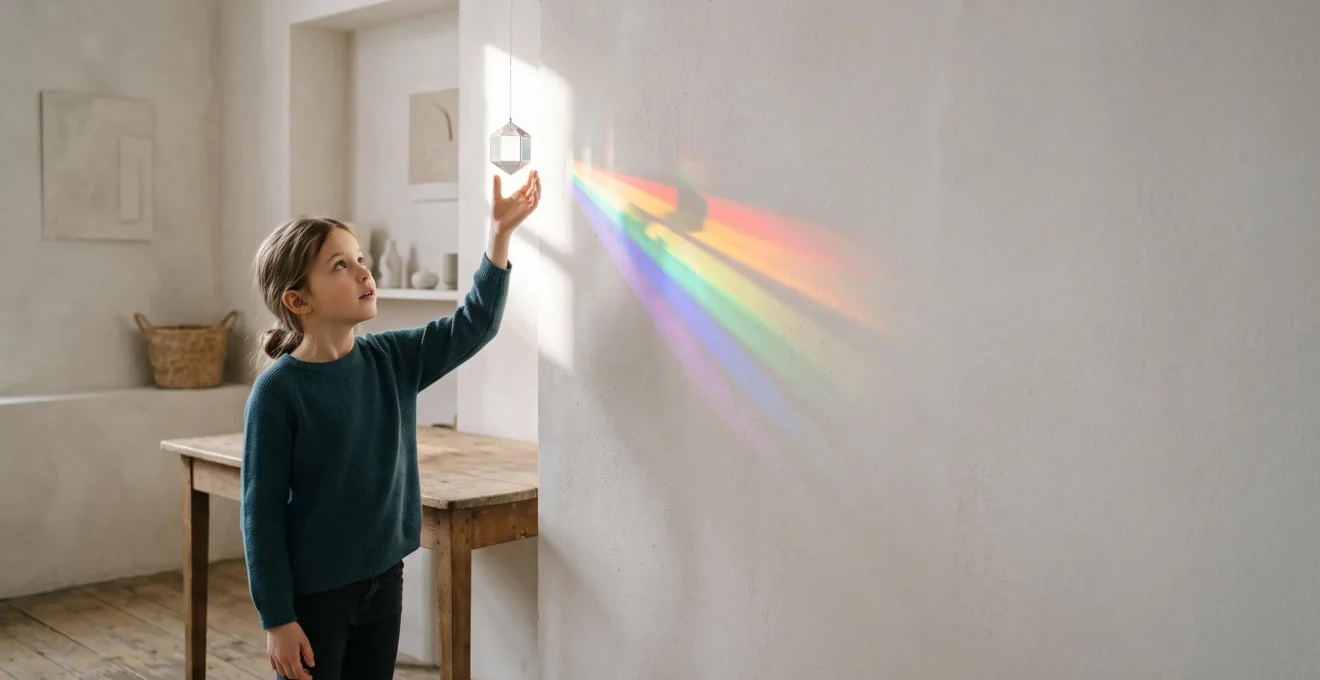
Career success is not built on high IQ scores or early specialization, but on identifying and nurturing a child’s innate ‘cognitive operating system.’
- Aptitudes like spatial reasoning are stronger predictors for success in STEM fields than traditional verbal and math scores alone.
- Observing a child in a ‘flow state’ during unstructured play is the most accurate way to reveal their true cognitive strengths and passions.
Recommendation: Shift your role from a performance coach to a ‘talent anthropologist’—an observer who focuses on nurturing the process of learning, not just the outcome.
As an ambitious parent, you are constantly navigating a world that equates future success with measurable achievements. We are conditioned to believe the path to a fulfilling career is paved with high IQ scores, top grades, and a relentless schedule of extracurriculars. We hire tutors, enroll our children in advanced programs, and meticulously track their performance, hoping we are giving them the competitive edge they need. This approach is rooted in a simple, yet profoundly limited, industrial-era model of talent: that intelligence is a single, quantifiable score.
But what if this entire framework is outdated? What if the relentless focus on academic performance is actually masking the very aptitudes that will define success in the complex, creative, and systems-driven economy of the future? The true predictors of long-term achievement are not found in report cards, but in the subtle, observable patterns of a child’s natural curiosity. They are revealed in how a child plays, how they solve problems when no one is watching, and what they gravitate towards when given complete freedom. It’s about understanding their unique cognitive operating system.
This article offers a paradigm shift. We will move beyond the metrics of IQ and explore the cognitive aptitudes that truly matter. You will learn to transition from the role of a manager, pushing for results, to that of a visionary ‘talent anthropologist’—one who can identify, understand, and cultivate the deep-seated potential within your child. We will deconstruct the myths of early specialization and talent-praise, and provide a new blueprint for fostering genuine, resilient, and process-driven success.
To guide you through this new perspective, we have structured this exploration into clear, actionable sections. The following summary outlines the journey we are about to take, from redefining intelligence to building the foundations of true grit.
Summary: A Parent’s Guide to Unlocking True Potential
- Why Is Verbal Reasoning Not the Only Measure of Intelligence?
- How to Identify Natural Talents by Watching Your Child Play?
- Skill or Aptitude: How to Distinguish Practice from Potential?
- The Specialization Mistake That Kills Curiosity in Primary School
- When Do Cognitive Interests Stabilize: The Teenage Brain Shift
- Why Does a “Smart” Label Make Kids Afraid of Difficult Tasks?
- Effort or Talent: Which Narrative Leads to Long-Term Success?
- Focusing on Process Over Outcome: How to Build True Grit?
Why Is Verbal Reasoning Not the Only Measure of Intelligence?
For decades, our education system has operated on the assumption that verbal and quantitative reasoning are the twin pillars of intelligence. While undeniably important, this narrow view overlooks a spectrum of other powerful cognitive aptitudes. One of the most critical, yet frequently ignored, is spatial ability—the capacity to visualize and manipulate complex systems, patterns, and objects in one’s mind. This is the aptitude of the architect, the engineer, the surgeon, and the systems designer.
This isn’t just theory; it’s backed by significant data. In fact, large-scale U.S. studies show high spatial ability predicts entry into and achievement within STEM fields, independent of traditional test scores. A child who spends hours building intricate block cities or can easily assemble complex models without instructions is demonstrating a powerful form of intelligence that a standard IQ test may completely miss. They possess what the National Research Council calls the “habit of mind of thinking spatially,” a key cognitive asset for innovation.
Observing these behaviors is the first step toward recognizing your child’s unique cognitive signature. It requires looking beyond the school curriculum and seeing the intellectual work happening during play. This is not about being “good with hands”; it’s about a sophisticated mental process of simulation, rotation, and systemic understanding. Recognizing this is crucial, as it allows you to provide resources—like building kits, 3D puzzles, or even coding apps—that nurture this aptitude rather than forcing them into a purely verbal-linguistic mold.
How to Identify Natural Talents by Watching Your Child Play?
The most authentic expression of a child’s innate aptitude is not found in their response to a homework assignment, but in the moments of deep, voluntary absorption during play. This state of effortless concentration and pure enjoyment is known as “flow,” a concept famously defined by psychologist Mihály Csíkszentmihályi as “being completely involved in an activity for its own sake.” When a child is in flow, they are operating at the peak of their ability, driven entirely by intrinsic motivation. This is where their true cognitive operating system reveals itself.
This isn’t an experience reserved for adults or prodigies. On the contrary, research shows that children as young as 7 can and do experience profound flow states. As a parent acting as a ‘talent anthropologist,’ your role is to become a keen observer of these moments. Notice when time seems to disappear for your child. Is it when they are drawing elaborate stories, organizing their toys into complex social systems, or taking apart an old appliance to see how it works? The activity itself points to the aptitude.
The key is to observe without directing. Don’t ask, “What are you making?” Instead, note the intensity of focus, the visible joy in the process, and their persistence in the face of minor setbacks. These are the flow state indicators that signal a deep connection between the child and the activity. This is not just a hobby; it is a direct window into the kind of problems their mind is uniquely wired to solve. Identifying these patterns is far more predictive of future engagement and expertise than any grade they receive in a mandatory school subject.
Your Observation Action Plan: Spotting Natural Aptitudes
- Identify the Arena: List the top 3-5 unstructured activities where your child loses track of time and seems most engaged and joyful.
- Document the Process: For one week, take quiet notes on *how* they engage. Do they organize, build, experiment, narrate, or strategize? Capture the verbs.
- Analyze the Challenge Level: Note when they seek a slightly harder challenge within the activity. This indicates they are stretching their skills, a hallmark of flow.
- Track the Emotion: Observe their emotional state. Is it one of focused calm, excited discovery, or determined problem-solving? This reveals their emotional connection to the work.
- Connect to Aptitudes: Map your observations to potential cognitive aptitudes. Organization points to systems thinking; building to spatial reasoning; narration to verbal-linguistic skills.
Skill or Aptitude: How to Distinguish Practice from Potential?
The popularization of the “10,000-hour rule” has led many to believe that expertise is purely a product of practice. This narrative, while motivating, is a dangerous oversimplification. It often ignores the foundational role of aptitude. The debate is not whether practice matters—it is absolutely essential. The critical distinction for a parent is understanding the relationship between aptitude and skill.
Aptitude is the innate potential or natural talent for an activity. It is the speed at which a person learns and improves in a specific domain. Skill, on the other hand, is the demonstrated expertise that results from a combination of aptitude and deliberate practice. A child with high aptitude for music will learn to play the piano faster and with more intuitive understanding than a child with low aptitude, given the same amount of quality practice. As the original research on deliberate practice by K. Anders Ericsson and his colleagues states, this framework provides “a sufficient account of the major facts about the nature and scarcity of exceptional performance,” but it doesn’t deny that initial differences exist.
So, how do you distinguish fleeting interest from true potential? Look for the rate of improvement. When your child tries something new that aligns with an innate aptitude, their learning curve will be remarkably steep. They will seem to “get it” faster than their peers. They not only learn the rules but begin to improvise and experiment with them. This rapid progress, combined with the intrinsic motivation observed in a flow state, is the clearest sign of a powerful aptitude at work. Deliberate practice is the fuel, but aptitude is the engine’s horsepower. A 2019 review revisiting the landmark 1993 study on deliberate practice confirms the ongoing debate and complexity, highlighting that practice alone may not account for all variance in expert performance.
The Specialization Mistake That Kills Curiosity in Primary School
Once a parent identifies a budding aptitude, the most common—and often most damaging—impulse is to push for early specialization. If a child shows promise in soccer, they are enrolled in elite travel teams. If they are quick with numbers, their free time is filled with math competitions. This “all-in” approach, intended to maximize potential, frequently backfires, leading to burnout, anxiety, and a tragic extinguishing of the very curiosity that sparked the interest in the first place.
The pressure to specialize early is a modern phenomenon driven by a culture of competitive parenting. However, it ignores a fundamental principle of long-term development: childhood is for exploration, not optimization. A broad range of experiences in primary school builds a more agile and creative mind. It allows children to make novel connections between different fields—the kind of interdisciplinary thinking that drives innovation. Forcing a child down a single path robs them of this crucial period of cognitive sampling. As one former elite athlete reflected on their journey, performance was always highest when driven by enjoyment, not external pressure.
The athlete describes performing best when motivated by genuine enjoyment of the activity itself, while external pressures such as scholarship expectations and coaching demands were linked to their most difficult setbacks — echoing the idea that broad, intrinsic curiosity sustains long-term engagement better than early, pressured specialization.
– A former elite athlete, Sports Medicine Update
This isn’t just anecdotal. The negative effects are well-documented. A systematic review and meta-analysis on the topic found that adolescents who specialized early reported significantly higher rates of burnout and exhaustion compared to their peers who engaged in a variety of activities. The role of the visionary parent is not to create a child prodigy at age ten, but to cultivate a resilient, curious learner at eighteen who has a rich well of experiences from which to draw. Resist the urge to specialize; instead, encourage a portfolio of interests.
When Do Cognitive Interests Stabilize: The Teenage Brain Shift
If childhood is for broad exploration, when do a person’s true, lasting interests begin to take root? The answer lies in the profound neurological transformations of adolescence. The teenage brain undergoes a massive reorganization process, often misunderstood as mere hormonal chaos. This period is defined by two key phenomena: synaptic pruning and myelination.
During childhood, the brain creates an overabundance of neural connections. It’s a jungle of possibilities. Then, during adolescence, the brain begins to “prune” away the connections that are used less frequently and strengthen those that are used most often. It’s a process of sculpting and efficiency. The interests and activities your child consistently engages in are, quite literally, wiring their brain for expertise in those domains. Myelination, the coating of nerve fibers with a fatty sheath, speeds up signal transmission, making these strengthened pathways incredibly fast and efficient.
This is why the teenage years are so critical. It’s the period when the broad, exploratory interests of childhood begin to consolidate into a more stable cognitive identity. A child who dabbled in drawing, coding, and writing might discover during their teenage years that their true passion lies at the intersection of these things: perhaps in graphic design or interactive storytelling. Their brain is shifting from “What can I do?” to “What do I want to master?” This is the natural, biologically-driven moment of specialization. It cannot be forced in primary school; it must emerge from the foundation of broad exploration built during childhood.
Your role as a parent shifts accordingly. During these years, it’s less about introducing new things and more about supporting the deepening of existing interests. Provide resources, find mentors, and encourage projects that allow for a deeper dive. This is the time to transition from a facilitator of exploration to a supporter of mastery, following your child’s lead as their cognitive signature becomes clearer and more defined.
Why Does a “Smart” Label Make Kids Afraid of Difficult Tasks?
One of the most intuitive and yet most counterproductive things a well-meaning parent can do is praise a child for being “smart.” It seems harmless, even encouraging. But groundbreaking research into what is known as “mindset” reveals that this single phrase can instill a deep-seated fear of failure and an aversion to challenges. When you praise a child for an innate quality like intelligence, you are helping them build a fixed mindset.
A fixed mindset is the belief that your abilities are static, carved in stone. If you are “smart,” then every task becomes a test of that smartness. Success confirms it, but failure or struggle puts your very identity at risk. A child praised for being smart learns to protect that label at all costs. They will begin to subconsciously avoid difficult tasks where they might fail, sticking instead to the things they know they can do well. They become performers, not learners. The moment a subject becomes difficult, they are likely to disengage, thinking, “I must not be smart at this after all.”
The alternative is to cultivate a growth mindset—the belief that abilities can be developed through dedication and hard work. This is achieved by changing what you praise. Instead of praising the trait (“You’re so smart!”), praise the process (“I love how you kept trying different strategies to solve that problem”) or the effort (“You worked so hard on that, and look how much you’ve improved!”). This teaches the child that challenges are not threats, but opportunities to grow. It reframes struggle as a normal and necessary part of learning.
By focusing your praise on effort, strategy, and perseverance, you are giving your child a powerful gift. You are building their resilience and teaching them to find satisfaction in the process of learning itself, not just in the validation of a successful outcome. This shift in narrative frees them to take on difficult tasks, knowing that even if they fail, they have not failed as a person; they have simply found a way that doesn’t work yet.
Effort or Talent: Which Narrative Leads to Long-Term Success?
Our society is obsessed with a false dichotomy: is success the result of innate talent or relentless effort? We lionize the “natural” athlete and the “prodigy” musician, yet we also celebrate the underdog who succeeds through sheer grit. As a parent, the narrative you build around this question for your child will profoundly shape their identity and their approach to life’s challenges.
The most visionary—and accurate—narrative is that talent and effort are not opposing forces, but a powerful partnership. Aptitude (talent) determines the starting line and the potential speed of learning, but effort is the engine that drives progress. A child with a great engine (high aptitude) who doesn’t put in the fuel (effort) will go nowhere. A child with a smaller engine who works relentlessly will eventually pass them. The optimal scenario, of course, is a powerful engine run with consistent, high-quality fuel.
Therefore, the narrative you should foster is one of a process-driven identity. This means teaching your child to see themselves not as “a talented artist” or “a person who is bad at math,” but as “a person who is dedicated to the process of creating art” or “a person who is working to build their math skills.” This identity is not threatened by a bad drawing or a failed test. In fact, it is strengthened by the act of engaging with the challenge. It shifts the source of self-worth from the outcome (which is often outside of our control) to the effort (which is always within our control).
This narrative recognizes and honors a child’s natural gifts without making them a fixed label. You can acknowledge an aptitude by saying, “This seems to come more naturally to you, which is great. It means your hard work in this area will pay off even more.” This frames their talent not as a final verdict, but as an advantage to be activated through effort. This synthesis of talent and effort is the foundation for long-term, resilient success.
Key Takeaways
- Intelligence is multi-faceted; aptitudes like spatial reasoning can be more predictive of future success in certain fields than a general IQ score.
- The most authentic way to identify a child’s innate talent is by observing their ‘flow states’—moments of deep, joyful absorption during unstructured play.
- Build resilience by praising effort, strategy, and process, not fixed traits like “smartness,” to cultivate a growth mindset that embraces challenges.
Focusing on Process Over Outcome: How to Build True Grit?
We have deconstructed the myths of IQ, specialization, and talent-praise. The final and most crucial piece of the puzzle is to actively build a family culture that values process over outcome. This is the practical application of all we have discussed, and it is the only sustainable way to cultivate true grit—the combination of passion and perseverance that drives long-term achievement.
Building a process-focused culture means changing the questions you ask at the end of the day. Instead of “Did you win your game?” or “What grade did you get on your test?”, try asking, “What was the most interesting challenge you faced today?” or “What did you learn from that mistake?” or “What part of the project did you enjoy the most?” These questions signal that you are more interested in their experience, their learning, and their engagement than in the final score. It celebrates the messy, iterative, and often frustrating journey of growth.
This approach also involves modeling vulnerability and a growth mindset yourself. Talk openly about your own struggles, mistakes, and the processes you use to overcome them. Let your child see you as a learner, not just an authority figure with all the answers. When you normalize struggle as an inherent part of any meaningful pursuit, you remove the shame and fear associated with it. You create a safe environment for them to take risks, to fail, and, most importantly, to get back up and try again.
Ultimately, your goal is not to engineer a “successful” child. Your goal is to raise a resilient, self-aware human who understands their own cognitive strengths, finds joy in the pursuit of mastery, and has the grit to persevere through the inevitable challenges of life. This is the true definition of success, and it is built not on a foundation of trophies and accolades, but on a deep, abiding love for the process itself.
Begin today to shift your focus from coaching for performance to observing for potential. By becoming a ‘talent anthropologist’ for your child, you are not just preparing them for a career; you are equipping them for a life of purpose, resilience, and fulfillment.