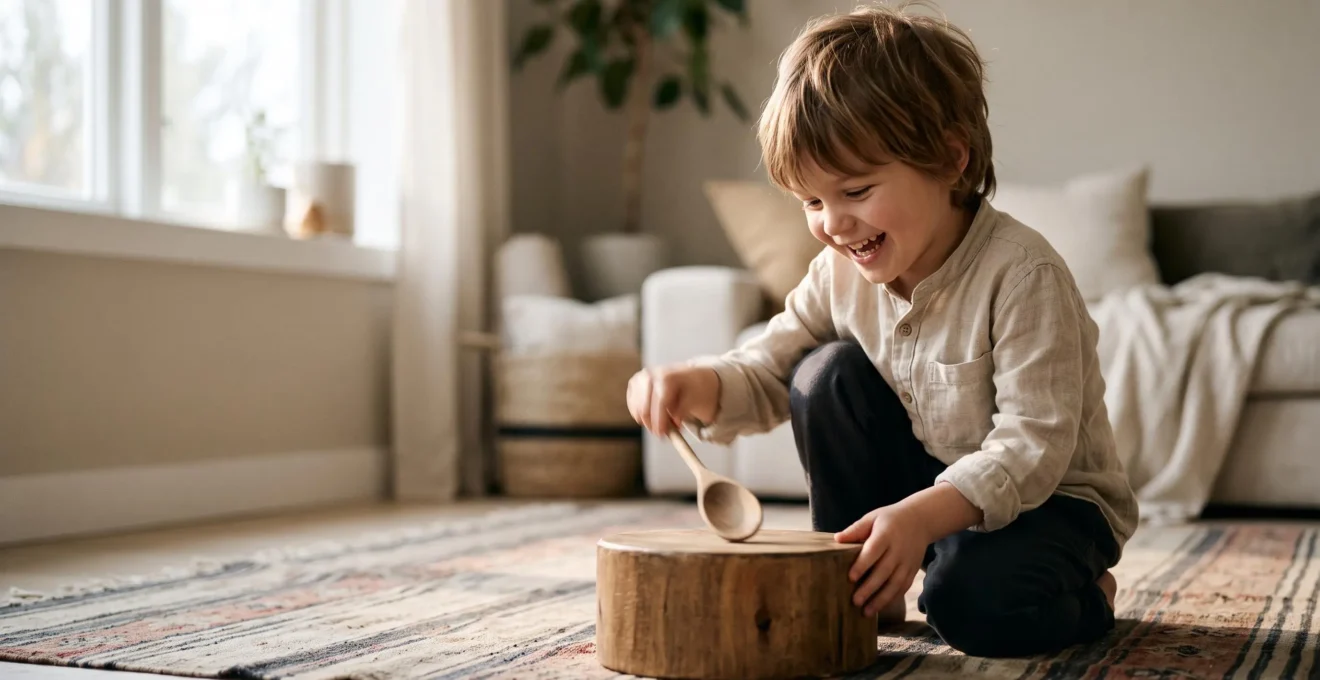
The greatest musical gift for your child isn’t a playlist of classics, but the permission to explore a world of rich sensory dialogues.
- Rhythmic play, even on kitchen pots, builds the same neural foundations used for mathematical and logical thinking.
- Multi-sensory experiences, from listening to nature to engaging in messy play, directly sculpt brain connectivity and emotional intelligence.
Recommendation: Embrace your role as a sensory guide, not just a provider of entertainment, to unlock your child’s full cognitive and creative potential.
As a parent and a music lover, you already feel it instinctively: a child’s world expands with music. We fill our homes with gentle lullabies and playful nursery rhymes, hoping to nurture a budding appreciation for melody and harmony. We often focus on what music to play *for* them, curating playlists of Mozart or folksy sing-alongs. This is a beautiful starting point, but it’s only the opening chord of a much richer composition. We see the arts as a pleasant hobby and messy play as just… a mess.
But what if the true key to unlocking your child’s cognitive potential lies not in passive listening, but in active sensory exploration? What if the chaotic drumming on a pot is actually a lesson in logic, and the squish of finger paint is a masterclass in neural development? The real magic happens when we shift our perspective from providing entertainment to facilitating a profound sensory dialogue. This is where the brain’s most intricate connections are forged, long before formal education begins. It’s about understanding that sound, texture, and color are your child’s first languages.
This article will guide you through this sensory-rich world. We will explore the deep connection between rhythm and reasoning, discover how to create music from the mundane, and learn to navigate the delicate balance between joyful noise and overwhelming sound. By the end, you will see artistic and auditory play not as simple pastimes, but as fundamental tools for sculpting a resilient, creative, and emotionally intelligent mind.
To help you navigate these interconnected ideas, this guide explores the core principles of sensory learning, from the rhythm of a drum to the texture of paint, and how each contributes to a holistic and harmonious development.
Summary: The Sensory Symphony: How Sound, Rhythm, and Art Sculpt Your Child’s Mind
- Why Does Drumming Improve Mathematical Thinking?
- How to Create a Kitchen Orchestra with Pots and Spoons?
- The Noise Tolerance Risk: How to Explore Sound Without Headaches?
- Sound or Noise: Teaching Kids Active Listening Skills
- When to Use Which Tempo: Using Music to Regulate Energy
- Why Does Messy Play Boost Brain Connections in Toddlers?
- Why Does Creative Art Increase Neural Plasticity in Children?
- Fostering Artistic Expression: Why Art Is a Cognitive Tool Not Just a Hobby?
Why Does Drumming Improve Mathematical Thinking?
The seemingly chaotic banging of a drum holds a secret language of logic. When a child strikes a surface, they aren’t just making noise; they are engaging in a foundational form of pattern recognition. This is the very essence of mathematical thinking. Rhythm is, at its core, a predictable sequence—a pattern of sound and silence. By creating and repeating these patterns, a child’s brain begins to build and strengthen the neural pathways required for understanding sequences, ratios, and fractions. It’s an embodied, intuitive form of algebra.
This connection isn’t just theoretical. The act of drumming involves counting beats, dividing time, and recognizing symmetrical structures within a musical phrase. Think of a simple “one-two-three-four” count: this is a child’s first foray into sets and periodicity. A strong internal pulse, cultivated through rhythmic play, becomes a cognitive metronome that helps organize not just music, but thoughts and logical steps. This internal clock helps a child anticipate what comes next, a skill vital for both solving a math problem and following a complex set of instructions.
The link is so significant that research consistently finds a correlation between musical training and mathematical ability. For instance, a comprehensive review of multiple studies confirmed that for 69% of students, learning an instrument improved their math skills. This is because both disciplines share a common ground: the abstract language of patterns and relationships. By encouraging your child to drum, you are not just fostering a love for music; you are giving them a playful, resonant, and powerful primer in logical reasoning.
How to Create a Kitchen Orchestra with Pots and Spoons?
You don’t need a miniature drum kit or a perfectly tuned piano to begin your child’s musical journey. One of the most vibrant and accessible orchestras is likely sitting in your kitchen cabinets right now. Transforming pots, pans, wooden spoons, and plastic containers into instruments demystifies music and places creative expression directly into your child’s hands. The goal here is not perfect pitch, but pure, uninhibited exploration of sound.
Begin by laying out a variety of “instruments.” An overturned stainless steel pot produces a bright, ringing tone, while a plastic bowl offers a dull, thudding sound. A wooden spoon creates a warmer impact than a metal one. This simple act of gathering materials becomes a lesson in timbre—the unique quality or “color” of a sound. Encourage your child to strike different surfaces and listen to the results. Ask gentle, open-ended questions: “Which one sounds like a deep giant’s footstep? Which one sounds like tiny raindrops?” This is the start of their sensory dialogue with the world of sound.
This playful jam session is more than just fun; it’s a multi-sensory learning experience. Your child develops motor skills as they coordinate their hands to strike a target, and they explore cause and effect with every tap. Most importantly, they learn that music is not something distant or formal, but something they can create, control, and share in the heart of their home. The shared laughter and rhythm create a powerful bonding experience, associating music with joy and connection from the very beginning.
As you can see, the beauty of a kitchen orchestra lies in its spontaneity and accessibility. It teaches the fundamental lesson that music is everywhere, waiting to be discovered. It’s about empowering your child to be a creator, not just a consumer, of sound, turning an ordinary afternoon into an extraordinary symphony of discovery.
The Noise Tolerance Risk: How to Explore Sound Without Headaches?
As we invite our children to explore the rich world of sound, it’s vital to attune ourselves to their unique sensory thresholds. For some children, the joyful cacophony of a kitchen orchestra can quickly become an overwhelming wave of noise. This sensitivity, known as hyperacusis, is more common than many realize. While not always indicating a deeper issue, it’s a real experience for many children; in fact, clinical reports show the prevalence of hyperacusis in children can range from 3.2% to 17.1%.
Recognizing the signs of auditory overstimulation is the first step. A child might cover their ears, become irritable or distressed, or try to leave a noisy environment. This isn’t a behavioral issue; it’s a physiological response from a nervous system that is feeling overloaded. Honoring this sensitivity is crucial for building a trusting and safe environment for exploration. Forcing a child to “tough it out” can create a negative association with sound and music, undermining our very goal.
The key is to empower your child with a sense of control over their auditory environment. This involves a delicate balance of gentle exposure and reliable retreat. Start with quieter sounds and shorter sessions. Pay close attention to their cues and be ready to dial it back. Creating a designated “quiet corner” with soft pillows and books can provide a safe harbor where their nervous system can reset. By respecting their limits and providing tools for self-regulation, we teach them that their sensory needs are valid and that they can navigate the world of sound with confidence, not fear.
Your Action Plan: Managing Auditory Overload
- Create a Calm Space: Designate a quiet, cozy area in your home, free of loud noises or other strong sensory stimulants, where your child can go to decompress.
- Use Deep Pressure: When they feel overwhelmed, offer deep pressure techniques like a firm hug, a gentle squeeze of the hands, or the comfort of a weighted blanket to help their nervous system settle.
- Plan for Noisy Environments: Before entering predictably loud places like a birthday party or a crowded store, talk about what to expect and have an exit strategy ready to reduce the risk of a sudden sensory meltdown.
- Empower with Coping Tools: Provide your child with tools like noise-reducing headphones or soft earplugs, giving them the power to self-regulate their auditory environment and feel in control.
Sound or Noise: Teaching Kids Active Listening Skills
In our bustling world, we are constantly surrounded by sound, much of which we filter out as background noise. Hearing is passive, an automatic physiological process. Listening, however, is an active, focused skill—a form of auditory attention that is foundational to learning, communication, and mindfulness. Teaching a child the difference between sound and noise is about helping them tune their inner radio to specific frequencies, transforming a wall of sound into a landscape of distinct details.
One of the most beautiful ways to cultivate this skill is through a “sound safari.” This can be done anywhere—in your backyard, at a park, or even in a quiet room of your house. The instruction is simple: close your eyes for one minute and listen. When the minute is up, share all the different sounds you heard. Your child might notice the distant hum of a refrigerator, the chirp of a single bird, the rustle of leaves, or the rhythm of their own breathing. This exercise trains the brain to isolate, identify, and categorize sounds, moving from passive hearing to active listening.
This practice has profound cognitive benefits. It strengthens auditory processing skills, which are crucial for language development—distinguishing between similar-sounding words like “cat” and “hat” relies on this very ability. It also enhances focus and concentration. By learning to anchor their attention on a specific sound, children are practicing a form of meditation, calming their minds and developing a greater awareness of the present moment.
Ultimately, teaching active listening is about giving your child a key to a richer world. It shows them that even silence is filled with music and that the most mundane environments hold a symphony for those who know how to tune in. This skill helps them find calm in chaos and discover detail in the din, a gift of awareness that will serve them for a lifetime.
When to Use Which Tempo: Using Music to Regulate Energy
Music possesses a unique power to connect with our internal rhythm—our heartbeat, our breathing, our very energy level. This principle, known as entrainment, is the basis of using music as a powerful tool for emotional and energetic regulation. As a music therapist, this is one of the most fundamental concepts we use. The tempo, or speed, of a piece of music can either elevate or soothe a child’s state, making it a wonderful ally for navigating the daily ebb and flow of energy.
The key is to first match, then lead. If your child is full of boisterous, high-level energy, putting on a slow, calming lullaby will likely create dissonance and be rejected. Instead, start with music that matches their current state: a fast-paced, rhythmic song with a strong beat that invites them to jump, dance, and release that physical energy in a structured way. Think of upbeat folk music, a lively drum circle, or even a playful pop song. This validates their feelings and gives them a healthy outlet.
Once you have matched their energy, you can then gently guide them toward a different state. After the fast song, transition to a piece with a slightly slower tempo—perhaps a mid-tempo song with a walking pace. Then, move to something slower still, like a gentle acoustic guitar piece or a soft ambient soundscape. This gradual downshift helps their nervous system to regulate, bringing their heartbeat and breathing down with the music. Conversely, this technique works for low-energy moments too. To help a groggy child wake up in the morning, start with calm music and gradually increase the tempo to gently energize them for the day. This is the art of creating cognitive resonance, harmonizing the outer world of sound with the inner world of feeling.
Why Does Messy Play Boost Brain Connections in Toddlers?
The principles of sensory learning extend far beyond the auditory. When a toddler plunges their hands into a bowl of cool, smooth finger paint or squishes mud between their fingers, their brain lights up with activity. This is “messy play,” and it is one of the most powerful forms of learning for a young child. Every new texture, temperature, and consistency provides a rich stream of sensory data that the brain must process and organize. This process is literally building the architecture of the mind.
Each sensory experience creates new neural connections. The feeling of goop, the smell of the paint, the sight of the colors mixing—this is a multi-sensory symphony that engages multiple brain regions at once. This type of integrated experience strengthens the corpus callosum, the bridge of nerve fibers connecting the left and right hemispheres of the brain. This allows for more efficient communication between the logical and creative sides of the brain, which is crucial for complex problem-solving later in life.
Furthermore, messy play is a hands-on lesson in science and physics. A child learns about viscosity as they pour water into sand. They explore cause and effect as they see how their handprint leaves a mark. There are no right or wrong answers, which frees them from the fear of failure and encourages experimentation and curiosity. It’s a fundamental form of inquiry-based learning. The value of these tactile experiences in cognitive development is well-documented.
Case Study: The Power of Sensory Stimulation
To understand the impact of these activities, consider the findings from a broad systematic literature review. After synthesizing 34 different peer-reviewed publications, researchers found overwhelming evidence that tactile experiences and movement-based sensory activities consistently strengthen a wide range of abilities in young children. The review highlighted significant improvements in cognitive functioning, emotional stability, imagination, and motor coordination, confirming that sensory play is a key catalyst for holistic brain development.
Why Does Creative Art Increase Neural Plasticity in Children?
When a child draws, paints, or sculpts, they are doing much more than creating a pretty picture. They are engaging in a complex cognitive workout that enhances the brain’s ability to adapt and rewire itself—a process known as neural plasticity. Art is not a static product; it is a dynamic process of problem-solving, decision-making, and translating a three-dimensional world onto a two-dimensional surface. This act of translation is a powerful exercise for the brain.
Consider the act of drawing a family portrait. The child must recall features from memory (working memory), decide on the placement and scale of each person (spatial reasoning), choose colors that feel right (emotional expression and decision-making), and coordinate their hand movements to execute their vision (fine motor skills). Each step engages and strengthens different neural networks. If they make a “mistake,” they must creatively problem-solve: do they erase it, or incorporate it into a new idea? This builds cognitive flexibility and resilience.
This rich engagement has measurable effects on cognitive skills. For instance, a systematic review synthesizing 11 eligible studies found that sustained engagement in visual arts strengthens critical cognitive functions. The review specifically noted improvements in spatial reasoning, working memory, and creative problem-solving skills among children who participated in art activities. By providing materials and encouragement for creative art, we are giving our children a toolbox for building a more flexible, adaptive, and resourceful mind.
Key Takeaways
- Rhythm is a form of pattern recognition that directly builds the neural pathways for mathematical and logical thinking.
- Everyday objects can become a child’s first orchestra, teaching them about sound, timbre, and the joy of creation.
- Sensory exploration must be balanced with respect for a child’s noise tolerance to build a safe and trusting relationship with sound.
Fostering Artistic Expression: Why Art Is a Cognitive Tool Not Just a Hobby?
We have journeyed through the worlds of rhythm, sound, and texture, and a clear harmony emerges: sensory and artistic expression are not optional extras in childhood. They are fundamental cognitive tools. Framing art as “just a hobby” or music as “just for fun” misses the profound work that is happening beneath the surface. These activities are the very language the brain uses to grow, to organize information, and to make sense of the world and one’s place within it.
The true power of the arts lies in their ability to integrate multiple cognitive processes simultaneously. As research reviews consistently show, activities like painting or playing music engage perception, attention, memory, and emotional processing all at once. This holistic engagement builds a more interconnected and efficient brain. When your child mixes blue and yellow to make green, they are not just learning about color; they are conducting a scientific experiment, making a prediction, and observing a result. This is the scientific method in its most playful form.
Fostering this expression, therefore, is about creating an environment rich in possibilities, not products. It’s about valuing the process over the finished piece. The scribbled drawing, the out-of-tune song, the lopsided clay pot—these are not failed attempts at adult perfection. They are the beautiful, essential artifacts of a mind at work. They are evidence of neural sculpting in progress. By celebrating this process, we teach our children that their ideas have value, that experimentation is welcome, and that creativity is a way of thinking, not just a talent one is born with.
Your role as a parent is that of a gentle conductor in this sensory symphony. By providing the materials, the space, and the encouragement for this deep, playful exploration, you are nurturing not just a future musician or artist, but a curious, resilient, and intelligent human being, fluent in the many languages of thought and feeling.