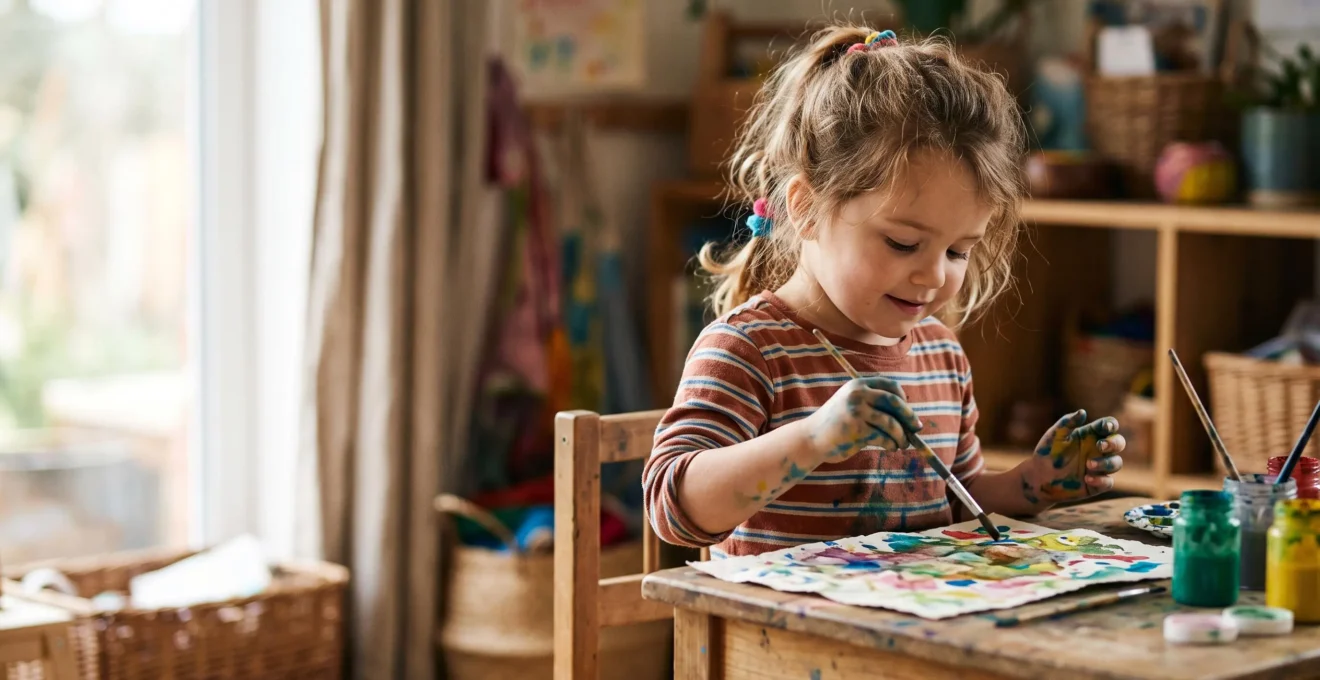
While many parents prioritize extra math or science over art for a cognitive edge, neuroscience shows the opposite is more effective: process-based art is a critical workout that builds the brain’s executive functions—like adaptability and problem-solving—essential for high-level thinking in STEM fields.
- Artistic creation is not passive; it actively forges new neural connections (plasticity), enhancing cognitive skills like inhibitory control and spatial reasoning.
- Focusing on the *process* of creating (Process Art) over a finished product (crafts) develops superior divergent thinking and risk-assessment abilities.
Recommendation: Reframe art from a recreational activity to a foundational learning tool by creating an ‘invitation to create’ space at home with open-ended materials.
In a world obsessed with standardized tests and measurable academic outcomes, it’s a common dilemma for parents. The pressure to give children a competitive edge often leads to a calculated choice: cutting “soft” subjects like art in favor of more time for math, coding, or science. The conventional wisdom suggests that art is a pleasant hobby, a fun break from the ‘real’ work of cognitive development. It’s seen as a way to improve fine motor skills or provide an emotional outlet, but rarely as a critical component of intellectual growth.
But what if this perspective is fundamentally flawed? What if, from a neuroscientific standpoint, art isn’t a break from learning, but one of its most potent and necessary forms? This is not about feeling good; it’s about building a better brain. The act of creating art is a complex cognitive workout that directly stimulates the very executive functions we want our children to master. It develops the neural architecture required for innovation, adaptability, and complex problem-solving in any field, including the STEM subjects it’s so often sacrificed for.
This article will dismantle the myth of art as mere recreation. We will explore the hard science behind how creative expression drives neural plasticity, differentiate between activities that build compliance and those that build genuine problem-solving skills, and offer concrete strategies for transforming your home into a cognitive powerhouse. It’s time to see art for what it truly is: an indispensable tool for building the minds of tomorrow.
To help you navigate this essential topic, we’ve structured this guide to build from the foundational science to practical, everyday applications. Explore the sections below to understand how to truly harness the cognitive power of art for your child.
Table of Contents: Unpacking How Art Rewires the Brain for Learning
- Why Does Creative Art Increase Neural Plasticity in Children?
- How to Set Up an “Invitation to Create” Station at Home?
- The Critique Mistake: Why Saying “What Is It?” Kills Creativity?
- Process Art or Crafts: Which Builds Better Problem Solving Skills?
- How to Curate a Kids’ Art Gallery Without Cluttering the Fridge?
- Why Does Messy Play Boost Brain Connections in Toddlers?
- STEM or STEAM: Why Adding Art Improves Engineering Skills?
- Using STEM Exploration Kits: Turning the Garden into a Laboratory?
Why Does Creative Art Increase Neural Plasticity in Children?
Creative art directly stimulates neural plasticity—the brain’s fundamental ability to reorganize itself by forming new connections in response to experience. Far from being a passive activity, engaging with art is an intense cognitive process that forces different brain networks to communicate. It’s not just about what the hands are doing; it’s about the complex symphony of observation, planning, problem-solving, and execution happening in the brain. This active engagement serves as a powerful catalyst for building a more flexible and resilient cognitive architecture.
Neuroimaging research provides compelling evidence for this phenomenon. A detailed review published in Nature confirmed that visual arts education drives significant brain changes. Studies show that artists have enhanced connectivity in networks related to inhibitory control (the ability to focus and ignore distractions), spatial imagination, and mental rotation. When a child decides which color to use next, how to balance a structure made of clay, or how to represent a 3D object on a 2D page, they are actively training these essential cognitive circuits.
As the neuroscience outreach group NW Noggin aptly puts it, “Novelty, motivation, self-directed engagement – and art – all serve to make our brains easier to change and adapt.” Art uniquely combines all these elements. It presents a child with a novel problem (a blank page), is driven by internal motivation, and requires self-directed engagement to reach a solution that is entirely their own. This process makes the brain more adaptable and primed for learning in all other areas of life.
How to Set Up an “Invitation to Create” Station at Home?
An “Invitation to Create” is a thoughtfully arranged space with a small selection of materials designed to spark curiosity without prescribing an outcome. Unlike a craft box with a pre-determined project, its purpose is to encourage divergent thinking and deep exploration. The philosophy is simple: reduce cognitive load to maximize creativity. When faced with too many choices, a child’s brain can become overwhelmed, leading to superficial engagement. By offering a curated selection, you invite them to explore the properties of the materials in depth.
Setting one up is straightforward and requires a shift in mindset from product to process. Follow these core principles:
- Offer Open-Ended Materials: Prioritize “loose parts” like sticks, stones, fabric scraps, buttons, clay, and paint over single-purpose kits. These materials can be anything the child imagines, forcing them to invent their own approach rather than follow instructions.
- Rotate and Limit Materials: Present only 3-4 complementary materials at a time. For example, you might offer black paper, white paint, and chalk. This limited palette encourages the child to discover all the possibilities within those constraints, fostering a deeper level of creative problem-solving.
- Make it Accessible: Arrange the materials in an appealing, easy-to-reach way on a low table or a specific mat on the floor. The visual appeal of the “invitation” is part of what draws the child in to engage independently.
The final, crucial component is your interaction. Instead of evaluating what the child has made, use “observational talk.” Describe what you see them doing: “I see you are mixing the blue and yellow together,” or “You are making very long, straight lines.” This validates their process without imposing a need for the creation to *be* something, fostering a sense of psychological safety and encouraging further experimentation.
The Critique Mistake: Why Saying “What Is It?” Kills Creativity?
Asking a child, “What is it?” may seem like a natural, encouraging question, but from a neuro-pedagogical perspective, it can be one of the most detrimental things you can say. This simple question instantly shifts the child’s brain out of a state of open-ended, process-driven exploration and into a mode of justification and evaluation. The focus moves from the rich sensory and cognitive experience of *doing* to the pressure of producing a recognizable *product*. This pressure can stifle the very risk-taking and experimentation that builds creative confidence.
When a child is engrossed in their art, they are navigating a complex internal world of choices, feelings, and discoveries. The final product may be abstract or entirely unintelligible to an adult because its purpose was the process, not the outcome. The question “What is it?” implies that the work is only valid if it can be named and understood by an outsider, devaluing the internal journey. As one expert notes, this kind of external pressure can be damaging.
Asking children to complete patterned artwork or to copy adult models of art undermines children’s sense of psychological safety.
– Robert Schirrmacher, Product vs. Process Art
The alternative is a powerful technique known as observational talk. Instead of asking what it is, describe what you see: “You’ve used a lot of red in this corner,” or “I noticed you’re pressing the crayon down very hard here.” This approach validates the child’s choices and actions without judgment. It opens a dialogue about their process, boosts their vocabulary, and, most importantly, supports the development of self-regulation by allowing them to be the sole authority on their own work.
Process Art or Crafts: Which Builds Better Problem Solving Skills?
The distinction between process art and crafts is critical for parents who want to foster genuine cognitive skills. While both can be enjoyable, they train the brain in fundamentally different ways. A craft kit, focused on a final product, primarily develops the ability to follow multi-step directions and achieve a pre-determined outcome. Process art, in contrast, is an open-ended exploration with no defined end goal, which is where true problem-solving skills are forged.
An academic analysis highlights that open-ended activities focused on the process provide children with authentic methods of exploration. This fosters a willingness to engage in what they term an “aesthetic problem-solving process.” When a child is given cardboard, tape, and paint with no instructions, they must invent, assess risks (“Will this structure stand?”), adapt when it fails, and regulate their frustration—all core components of high-level problem-solving. This is backed by strong data; one study found a strong positive correlation (r = 0.81) between art activities and creative thinking abilities in young children.
This table clarifies the different cognitive skills developed by each approach:
| Approach | Core Cognitive Skill Developed | Example Activity |
|---|---|---|
| Craft Kits (Product-Focused) | Following multi-step directions, fine motor precision | Building a pre-designed birdhouse from a kit |
| Process Art (Process-Focused) | Divergent thinking, risk assessment, adaptability, emotional regulation | Inventing a new creature from leftover materials |
While following instructions is a useful life skill, it develops convergent thinking (finding the single correct answer). The complex challenges of the future will demand divergent thinking (generating multiple unique solutions to a problem). Process art is a direct training ground for this essential 21st-century skill, making it a far more valuable cognitive tool than a pre-packaged craft.
How to Curate a Kids’ Art Gallery Without Cluttering the Fridge?
Celebrating a child’s artwork is important, but the default “fridge gallery” can quickly become cluttered and devalue the individual pieces. Transforming the act of displaying art into a “curation” process turns it into another powerful cognitive exercise. By creating a dedicated and rotating gallery space, you teach your child metacognition (thinking about their own work), categorization, and articulation skills, all while keeping your home organized.
Instead of a chaotic collage, dedicate a single, high-quality frame or a string-and-clothespin line in a prominent location as the official “gallery.” This elevates the status of the art and makes the selection process meaningful. The key is to involve the child in the curation, making them the director of their own exhibition. This turns passive display into an active learning experience.
Your Action Plan: Create a Dynamic Home Gallery
- Choose One ‘Exhibition’ Piece Weekly: Sit down with your child once a week and look through their recent creations. Ask them to choose just one piece for the main display frame.
- Ask “Why This One?”: Prompt them to explain their choice. They might say, “I like the colors,” or “It was hard to make the lines straight.” This builds their ability to reflect on and articulate their own creative process.
- Digitally Archive and Document: Take a photo of the chosen piece. You can add a one-line note from the child about their process. This creates a running digital archive that preserves the work and the learning behind it.
- Physically Archive Older Pieces: Once a piece is rotated out of the main display, store it in a designated portfolio box or folder. This respects the work while preventing physical clutter.
- Create Themed Mini-Exhibitions: Periodically, go through the archive box with your child. Group pieces into themes (“The Blue Period,” “Circle Art,” “Creations with Sticks”) to create mini-exhibitions, building their categorization and organizational skills.
This approach transforms a mountain of paper into a structured, engaging, and educational practice. The home gallery becomes less about decoration and more about a living portfolio that documents and celebrates a child’s cognitive and creative journey.
Why Does Messy Play Boost Brain Connections in Toddlers?
Messy play—engaging with materials like sand, water, clay, and paint—is the genesis of sensory learning, and it is profoundly important for brain development in toddlers. This type of play boosts brain connections because it provides rich, multi-sensory input that the brain must work to process and organize. Every texture, temperature, and smell is a piece of data that helps form and strengthen neural pathways, a process known as sensory integration. The effectiveness of this is well-supported; a Korean meta-analysis of 24 studies confirmed the significant benefits of sensory integration interventions in children.
When a toddler plunges their hands into wet sand or gooey paint, their brain is firing on all cylinders. It’s processing tactile information (gritty, smooth, cold), proprioceptive feedback (how much pressure to apply), and visual input. This complex sensory data is the raw material for building a sophisticated understanding of the physical world. It lays the groundwork for more complex cognitive tasks later on.
The benefits extend beyond basic sensory processing. A quasi-experimental study published in Education Sciences employed a pretest-posttest design with children aged 4 to 6. The findings were clear: children who participated in sensory-rich messy play demonstrated greater gains in both expressive and receptive language compared to a control group. This occurs because as children engage in this play, they are often motivated to describe their experience, ask questions, and learn new vocabulary (“sticky,” “gritty,” “slimy”), directly linking physical action to language development.
STEM or STEAM: Why Adding Art Improves Engineering Skills?
The push to add “A” (Art) to STEM, creating STEAM, is not a superficial attempt to make science more fun. It is a strategic move rooted in the understanding that art develops cognitive skills that are crucial for high-level engineering and scientific innovation. While STEM fields excel at teaching analytical and quantitative reasoning (convergent thinking), art excels at fostering creativity, ambiguity tolerance, and divergent thinking—the very skills needed to solve novel, complex problems that don’t have a textbook answer.
Engineers and scientists are not just technicians; they are innovators. Their job is to devise solutions that have never existed before. This requires the ability to visualize, to experiment, to fail and adapt, and to approach a problem from multiple angles. These are precisely the skills honed through artistic practice. An artist staring at a blank canvas and an engineer facing an unprecedented design challenge are engaging in a similar creative problem-solving process. They must both imagine possibilities, prototype ideas, and refine their approach based on feedback.
This isn’t just theory; it’s being proven in practice. A 2023 study focused on engineering students participating in STEAM project-based learning. The results showed that integrating art-based projects led to significant improvements in their problem-solving and creative thinking skills. As stated by researchers in a systematic review, “The need to equip students with creative and innovative skills has fuelled the growth of STEAM Education worldwide.” Art provides the framework for developing the mental flexibility and innovative mindset that turns a competent technician into a groundbreaking leader in their field.
Key takeaways
- Art is not a “soft” hobby; it’s a powerful cognitive workout that directly stimulates neural plasticity and builds a more flexible, resilient brain.
- To foster genuine problem-solving skills, prioritize Process Art (open-ended exploration) over Product Art (craft kits), as it develops essential divergent thinking and risk-assessment abilities.
- Integrating Art into STEM education (STEAM) is critical, as it cultivates the creative, innovative, and adaptive mindset required for high-level engineering and scientific challenges.
Using STEM Exploration Kits: Turning the Garden into a Laboratory?
The modern marketplace is filled with STEM exploration kits, promising to turn any environment, like the backyard garden, into a laboratory. While these kits can be valuable, their effectiveness is exponentially increased when approached with an artistic, process-oriented mindset. Viewing the garden as a laboratory is not just about identifying plant species or measuring growth; it’s about fostering a deep sense of observation, curiosity, and wonder—skills that are the bedrock of both scientific inquiry and artistic expression.
When a child is encouraged not just to collect leaves, but to sketch their different shapes, textures, and vein patterns, they are engaging in a STEAM activity. The act of drawing forces a level of detailed observation that simply identifying and labeling cannot match. A 2022 study confirmed this, showing that STEAM-based drawing activities are highly effective. The research highlights that the role of fine arts in interdisciplinary education is to guide children in acquiring scientific knowledge in arts-themed activities. Sketching requires them to learn engineering knowledge (how do branches support weight?) and prepare materials for their creation, blending disciplines seamlessly.
Therefore, the most effective “kit” is not one you buy, but a mindset you cultivate. Encourage your child to be both a scientist and an artist in the garden. Ask questions that blend both worlds: “What patterns do you see on this snail’s shell?” “How could you draw the way this vine is climbing the fence?” “What colors do you notice in the soil?” This approach transforms a simple walk in the garden into a rich, interdisciplinary experience. It demonstrates that science is a way of seeing, and art is a way of understanding what is seen. They are not opposing forces, but partners in the quest for knowledge.
By shifting your perspective to see art as a foundational cognitive tool, you provide your child with the mental flexibility and innovative mindset essential for success in any field. The next step is to stop treating art and science as a zero-sum game and start creating an environment where they can thrive together.