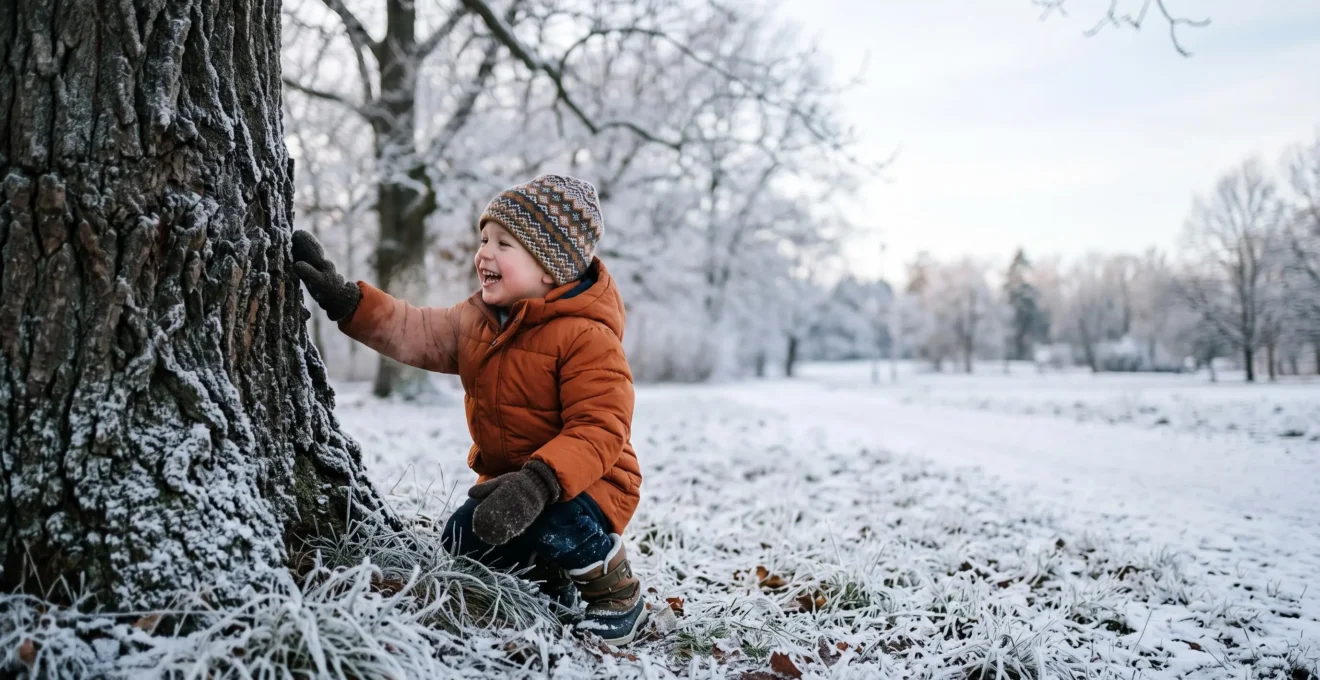
The secret to a successful winter scavenger hunt isn’t what kids find, but how the act of searching itself calms their nervous system.
- Purposeful movement, like searching for textures and shapes, provides crucial “heavy work” that helps with sensory regulation.
- The 3-layer clothing system is non-negotiable for keeping children warm and happy for at least an hour of outdoor play.
Recommendation: Focus on guiding your child to notice textures, sounds, and patterns—not just collecting items—to unlock the full calming and cognitive benefits of the activity.
The winter months can feel long. The walls of the house seem to close in, and children, full of boundless energy, can start bouncing off them. The easy advice is to “get them outside,” but a standard walk around the block often loses its appeal by the second corner. Many parents turn to a scavenger hunt, armed with a printable list of things to find. It’s a good start, but it often misses the profound opportunity hidden within the activity.
We tend to focus on the ‘what’—finding a pinecone, a red leaf, a funny-shaped stone. But what if the real magic wasn’t in the finding, but in the *searching*? What if a well-designed scavenger hunt could be a powerful tool for sensory regulation, helping a hyperactive or overwhelmed child feel more grounded and calm? This isn’t just about fun; it’s about applied developmental science you can use on any patch of green space.
The key is shifting our perspective from a treasure hunt to a sensory exploration. By focusing on textures, sounds, weights, and shapes, we engage a child’s entire sensory system in a way that is deeply organising for the brain. This guide moves beyond simple checklists to explore the ‘why’ behind the hunt. We will delve into how to create an engaging list for any environment, ensure kids stay warm enough to enjoy it, and transform their findings into deeper learning back home. It’s time to embrace the cold and discover the calm that nature offers, even in the heart of winter.
This article will guide you through creating a scavenger hunt that does more than just pass the time; it builds mindfulness, enhances motor skills, and fosters a genuine connection to the natural world. Here’s a look at the path we’ll explore together.
Summary: Designing a Winter Scavenger Hunt That Keeps Kids Moving
- Why Does Searching for Textures Calm a Hyperactive Mind?
- How to Create a Scavenger List That Works in a City Park?
- Thermals or Snowsuits: What Gear Keeps Kids Warm for 1 Hour Outside?
- The Picking Mistake: Teaching Kids to Observe Without Destroying Nature
- How to Use the Hunt Findings for an Art Project at Home?
- How to Build an Obstacle Course in a Small Living Room?
- Why Does Knowing Local Bugs Help Fight Climate Anxiety?
- Creating a Biodiversity Lab: How to Teach Ecology in Your Backyard?
Why Does Searching for Textures Calm a Hyperactive Mind?
When a child is running, jumping, and seemingly unable to settle, our first instinct might be to tell them to calm down. But what their body is often seeking is a specific kind of sensory feedback. The physical act of a scavenger hunt—crouching to inspect a leaf, reaching up to touch bark, carrying a heavy stone—provides something called proprioceptive input. This is the information our muscles and joints send to our brain, telling us where our body is in space. This type of activity, known in occupational therapy as “heavy work,” is incredibly grounding.
Instead of being a chaotic release of energy, the focused movement of a hunt channels it. The search for a “bumpy” texture or a “smooth” surface requires concentration and physical effort, which helps to organise the nervous system. As Laura Petix, a Pediatric Occupational Therapist, explains it, this is a fundamental need for regulation.
Aside from having a good sense of your body, proprioceptive input provides calming, organizing and regulating input to your nervous system.
– Laura Petix, Pediatric Occupational Therapist, The OT Butterfly
This isn’t just theory; the benefits are well-documented. Research into sensory integration therapies has consistently shown their positive effects. A major systematic review confirmed that these approaches lead to statistically significant improvements in motor skills and daily functioning in children. So, when your child is searching, they are not just looking for objects; they are actively regulating their mind and body, turning a simple game into a powerful therapeutic activity.
How to Create a Scavenger List That Works in a City Park?
One of the biggest barriers to nature play can be the belief that you need a sprawling forest. The truth is, nature is everywhere, and a fantastic scavenger hunt can happen in the most urban of parks or even on a walk around your neighbourhood. The key is to create a list that focuses on sensory attributes rather than specific, hard-to-find items. This makes the hunt adaptable and ensures success no matter where you are.
Instead of “find an oak leaf,” try “find a leaf with pointy edges.” Instead of “find a robin,” try “find something that flies.” This shift opens up a world of possibilities. You are no longer just identifying items but comparing them, categorising them, and truly observing your surroundings. The goal is to mix easily found natural elements with features of the urban landscape to create a rich tapestry of textures and shapes. This versatility is crucial for city dwellers.
Our scavenger hunt contains a mix of natural items (butterfly, spider web, pinecones) with a number of “neighborhood” items (stop sign, truck, bricks), which makes it versatile for a variety of areas.
– Run Wild My Child, Neighborhood Scavenger Hunt
A great starting list for a city park could include prompts that engage all the senses. Here is a simple but effective 12-item sensory checklist to get you started:
- Something green
- Something red
- Something smooth
- Something rough
- Something fuzzy
- Something round
- Something straight
- Something that rattles or makes a sound
- Two different kinds of leaves
- A pinecone (or seed pod)
- A flower (even a winter-blooming one or a hardy weed!)
- A rock with an interesting pattern
And a brilliant tip for young collectors? Bring along an empty egg carton. It provides perfect little compartments for their treasures and makes them feel like real scientists on an expedition.
Thermals or Snowsuits: What Gear Keeps Kids Warm for 1 Hour Outside?
There’s no such thing as bad weather, only unsuitable clothing. This old adage is the absolute truth when it comes to winter adventures with children. Their enjoyment is directly proportional to their warmth and comfort. The goal is to keep them warm enough to play for a solid hour without overheating once they start running around. The secret isn’t one big, bulky snowsuit, but a clever system of layers.
The three-layer system is the gold standard for outdoor enthusiasts of all ages. Each layer has a specific job, and together they create a micro-climate that keeps a child dry, warm, and protected from the elements. Understanding their function is key to getting it right.
The beauty of this system is its adaptability. As your child warms up from running, you can easily remove the mid-layer to prevent sweating. A sweaty base layer is the fastest way to get cold when they stop moving. As a general guideline, the American Pediatrics Society recommends dressing a child in one more layer than you are comfortably wearing for the same activity.
This comparative analysis from PatPat’s guide breaks down how each layer functions to create the perfect defence against the cold.
| Layer | Function | Material Example |
|---|---|---|
| Base Layer | Wicks moisture away from skin | Thermal / merino wool |
| Mid Layer | Traps warm air for insulation | Fleece or down |
| Outer Shell | Blocks wind and water | Insulated waterproof coat |
Don’t forget the extremities! Warm, waterproof boots, thick socks (wool is best), a hat that covers the ears, and waterproof gloves or mittens are non-negotiable. With the right gear, the cold becomes an exhilarating part of the adventure, not a reason to stay inside.
The Picking Mistake: Teaching Kids to Observe Without Destroying Nature
A child’s first instinct when they find something beautiful in nature—a perfect flower, a colourful mushroom, a delicate feather—is to pick it up and claim it. While this impulse comes from a place of wonder, it’s a critical teaching moment. The goal of a nature scavenger hunt isn’t to accumulate a pile of loot, but to cultivate a sense of mindful observation and respect for the environment. We want to nurture nature lovers, not nature takers.
This is where the ‘leave no trace’ philosophy comes in. We can teach children that some things are for our eyes only. A flower is food for a bee, a mushroom is part of a complex underground network, and a fallen log is a home for countless insects. By leaving them in place, we are respecting the intricate web of life. The challenge, and the joy, is in learning to appreciate things without possessing them. It shifts the focus from acquisition to appreciation.
As any birder or hunter knows, when you look with a purpose, you see a lot more.
– Cool Green Science, The Nature Conservancy blog
So, how do we redirect that desire to collect? By offering compelling alternatives that still honour their discoveries. Instead of picking, we can practice non-destructive observation techniques:
- Become a photographer: Use a phone or a kid-friendly camera to “collect” photos of their finds. This creates a digital trophy they can look back on.
- Start a nature journal: Bring a small notebook and pencils. Encourage them to draw what they see, noting its colours, shapes, and where they found it.
- Use a magnifying glass: This simple tool transforms their perspective, allowing them to see the incredible details on a leaf or the texture of bark without removing it.
- Practice texture rubbing: Place a piece of paper over a leaf or bark and rub a crayon over it to capture its pattern.
For items that are already detached and abundant (fallen leaves, sticks, stones), you can create a “nature box” at home. This designated space to display their finds gives them a sense of ownership and importance without harming living things.
How to Use the Hunt Findings for an Art Project at Home?
The adventure doesn’t have to end when you walk back through the front door. The small, ethically collected treasures from your scavenger hunt—fallen leaves, interesting twigs, smooth stones, seed pods—are the perfect materials for a creative session back home. This extends the experience and gives the items a second life, reinforcing the memories and observations made outside.
One of the simplest and most satisfying activities is creating nature paintings. As one parent shared, “We love bringing home sticks, leaves, and other goodies to use for nature paintings!” Instead of using traditional paintbrushes, let the found objects become the tools. A pinecone dipped in paint makes a wonderful, textured pattern. A sturdy leaf can be used to print its own shape and veins. A small twig is perfect for drawing fine lines. This connects the physical texture they felt outside with a visual, artistic expression.
Another fantastic project is a nature collage or “sun-catcher.” On a piece of card or clear contact paper, arrange the leaves, thin bits of bark, and pressed flowers into a beautiful mosaic. This helps children think about composition, colour, and shape. If using contact paper, a second sheet can be placed over the top to seal the creation, which can then be hung in a window to let the light shine through.
For older children, the findings can become characters in a story. A gnarled twig could be a wizard’s staff, a smooth stone could be a dragon’s egg, and a feathery seed pod could be a fairy’s wing. Creating a small diorama in a shoebox with these elements encourages imaginative play and storytelling, blending the natural world with their inner creativity.
How to Build an Obstacle Course in a Small Living Room?
Sometimes, despite the best intentions and the right gear, the weather is just too fierce to venture out. On those days, the need for movement and sensory input doesn’t disappear. In fact, being cooped up can intensify it. The good news is that you can replicate the benefits of a scavenger hunt’s “heavy work” indoors with a DIY obstacle course, even in a small living room.
The goal is the same: to provide purposeful movement that engages the muscles and joints. The guiding principle of a scavenger hunt is that it “requires movements; this promotes gross motor development.” An indoor obstacle course is simply a more concentrated version of this. It’s not about having fancy equipment; it’s about using everyday household items to encourage crawling, climbing, balancing, and pushing.
Here’s how to build a simple, effective course in minutes:
- Crawl Under: Line up a few dining chairs to create a tunnel to crawl through.
- Balance Across: Lay a line of tape or a blanket rolled up long-ways on the floor to serve as a balance beam.
- Jump Over: Place a row of pillows or cushions on the floor that they must jump over.
- Push and Pull: Incorporate a “heavy work” station. Have them push a laundry basket full of soft toys from one side of the room to the other.
- Climb On: If you have sturdy furniture like a sofa or footstool, make it a designated climbing station.
The key is to create a clear path from one station to the next. You can even combine it with an indoor scavenger hunt, hiding puzzle pieces or small toys at each station of the course. This brings back the element of searching and purpose, providing both the physical regulation and cognitive engagement they need to feel settled and calm, no matter the weather outside.
Why Does Knowing Local Bugs Help Fight Climate Anxiety?
The concept of climate change can be overwhelming and abstract for adults, let alone for children. The sheer scale of the problem can lead to feelings of helplessness and anxiety. One of the most powerful antidotes to this is not to look further away at global problems, but to look closer, at the tiny, intricate world right at our feet. Fostering a connection to the local micro-ecology—the bugs, the weeds, the worms in your backyard or city park—can be a profound tool for empowerment.
When a child learns to identify a ladybug, a woodlouse, or the type of bee buzzing on a flower, the abstract concept of “biodiversity” becomes real and personal. They are no longer just “bugs”; they are specific creatures with names, habits, and a role to play. This knowledge fosters a sense of stewardship. That patch of garden or park becomes *their* ecosystem to protect. This shift from a passive worrier to an active caretaker is incredibly powerful for a child’s mental well-being.
This focused attention on the small wonders of nature is a form of mindfulness. It pulls us out of our anxious thoughts about the future and grounds us firmly in the present moment. The wonder and curiosity sparked by watching an ant carry a crumb or a spider spin a web replace fear with fascination.
Nothing inspires wonder, cultivates mindfulness, and relieves stress as effectively and enjoyably as time spent in nature.
– Doing Good Together, Nature Scavenger Hunt for Kids
By encouraging your child to become an expert on their local bugs, you are giving them a tangible connection to the natural world. They learn that even small actions, like leaving a patch of weeds for pollinators, have a positive impact. This sense of agency and wonder is the most effective shield against the paralysing weight of climate anxiety.
Key Takeaways
- The primary goal of a scavenger hunt is sensory regulation through “heavy work,” not just collecting items.
- A three-layer clothing system (base, mid, shell) is essential for keeping kids warm and comfortable for extended outdoor play.
- Teach mindful observation over collection, using tools like cameras and nature journals to foster respect for the environment.
Creating a Biodiversity Lab: How to Teach Ecology in Your Backyard?
Your winter scavenger hunt has yielded a small collection of natural treasures and a wealth of observations. Now it’s time to put on your scientist hats! Transforming your kitchen table into a temporary “Biodiversity Lab” is the perfect way to extend the learning and teach the fundamentals of ecology in a hands-on, engaging way. This final step brings all the elements of the day together, from sensory exploration to scientific inquiry.
The lab doesn’t need to be complex. A simple tray to contain the mess, a magnifying glass, and the finds from your walk are the only essential tools. This is where you can take a closer look at the patterns, textures, and structures you discovered. Compare the veins on two different leaves. Examine the intricate architecture of a pinecone. Look at the different colours and crystals within a stone. This is where real discovery happens, sparking questions like “Why is this leaf different from that one?”
This is also a chance to discuss ecological concepts in a simple way. Looking at an evergreen needle from your hunt, you can explain how some trees have special adaptations. For instance, evergreen trees have unique, waxy ‘leaves’ that are designed not to freeze in the cold, which is why they stay green all winter. Suddenly, it’s not just a tree; it’s a marvel of natural engineering. Your backyard or park becomes a living classroom for understanding how nature works.
Your Action Plan: Build a Tabletop Nature Investigation Lab
- Gather Your Tools: Before heading out, prepare your “lab kit.” You’ll need an empty egg carton for collecting small finds, a tray (like a baking sheet) to define the workspace, and a magnifying glass.
- Ethical Collection: During your scavenger hunt, fill your egg carton with interesting finds that are already on the ground—fallen leaves, twigs, seeds, and small stones.
- Set Up the Lab: Back home, lay everything out on the tray. This creates a focused area for investigation and makes cleanup easy.
- Observe and Compare: Use the magnifying glass to get a closer look. Guide your child to compare the textures, patterns, and shapes of the different items side-by-side.
- Ask “I Wonder” Questions: Encourage curiosity by asking open-ended questions. “I wonder why this bark is so rough?” or “I wonder what made these tiny holes in the leaf?” There’s no need to have all the answers; the goal is to spark inquiry.
By transforming a simple walk into a sensory mission and a scientific investigation, you give your children more than just an activity; you give them tools for regulation, a mindset of curiosity, and a deep, meaningful connection to the world around them. Start planning your biodiversity lab today and watch their love for nature grow.