In summary:
- Transform your garden into a hands-on lab to teach children genuine ecological principles, moving beyond simple nature walks.
- Empower children against climate anxiety by giving them agency and a role in local environmental stewardship.
- Use structured activities like building effective bug hotels, running a worm farm, and logging data for real science projects.
- Teach the crucial difference between passive observation and active care, fostering a deep respect for local micro-habitats.
There’s a quiet disconnect growing between our children and the natural world, right outside our own back doors. Many parents feel it, encouraging kids to “go play outside” or pointing out a colourful bird, hoping a love for nature will magically take root. We know that connecting with the environment is vital, especially in an age of mounting ecological concerns. The common advice often stops at appreciating nature from a distance—visiting parks or identifying a few common flowers. These are wonderful starting points, but they often lack the depth to build a true, lasting understanding.
What if the key wasn’t just to look at nature, but to actively participate in it? The real solution lies in transforming the most accessible patch of green we have—our own garden—into a living, breathing biodiversity laboratory. It’s about shifting the focus from passive observation to hands-on stewardship. This approach moves beyond simply identifying a ladybird; it involves understanding its role, creating a habitat for it, and observing its life cycle. It’s about building a framework for ecological thinking that empowers children, giving them a sense of agency and purpose.
This guide provides a blueprint for doing just that. We’ll explore how to build micro-habitats that actually work, reframe the “eww” factor around insects into a lesson on empathy, and even contribute to real scientific research from your lawn. By fostering this deep, practical connection, you’re not just teaching ecology; you’re raising a generation of thoughtful environmental stewards who understand their place within the intricate web of life.
This article will guide you through practical strategies to foster this deep connection. Explore the sections below to build your own backyard biodiversity lab from the ground up.
Summary: Your Backyard Biodiversity Lab: A Hands-On Guide to Teaching Ecology at Home
- Why Does Knowing Local Bugs Help Fight Climate Anxiety?
- How to Build a Bug Hotel That Actually Attracts Residents?
- The “Eww” Factor: How to Handle Fear of Dirt and Insects?
- Gardening or Rewilding: What Is the Difference for a Child?
- How to Use Apps to Log Wildlife for Real Scientific Studies?
- The Picking Mistake: Teaching Kids to Observe Without Destroying Nature
- How to Teach Decomposition with a Worm Farm?
- Raising Young Ecologists: How to Foster Environmental Stewardship?
Why Does Knowing Local Bugs Help Fight Climate Anxiety?
The rising tide of climate anxiety among young people is a deeply felt concern for parents. It is an abstract, overwhelming fear of a vast and complex problem. In fact, a major global survey on climate anxiety found that 62% of young people feel anxious and 67% feel afraid about climate change. This feeling of powerlessness can be paralyzing. The antidote, however, is not to ignore the problem but to cultivate a sense of agency and connection. This is where the humble woodlouse in your garden becomes a powerful tool.
Focusing on the micro-world of local insects shifts a child’s perspective from a global, unsolvable crisis to a tangible, manageable ecosystem. When a child learns to identify a Buff-tailed bumblebee, understands its role as a pollinator, and helps create a habitat for it, they are no longer a passive bystander. They become an active steward of their immediate environment. This hands-on involvement demonstrates a fundamental ecological principle: that small, local actions have real, observable impacts.
This process of learning, caring for, and observing the tiny creatures in their own backyard replaces abstract fear with concrete knowledge and purpose. It teaches children that they have the power to make a positive difference, even on a small scale. As Elizabeth Haase, a founding member of the Climate Psychiatry Alliance, noted, this anxiety can be seen in children as young as three. By empowering them with knowledge about their local bugs, we give them a foothold of control and a narrative of hope, proving that they can be part of the solution, one bug hotel at a time.
How to Build a Bug Hotel That Actually Attracts Residents?
The idea of a “bug hotel” is popular, but many end up as little more than decorative garden art, remaining stubbornly vacant. The secret to a bustling micro-habitat is understanding what your local UK insects are actually looking for: a safe, dry, and stable place to nest and hibernate. Success lies in using the right materials to create a variety of nooks and crannies that cater to different “guests,” from solitary bees to lacewings and ladybirds.
A truly effective bug hotel is less about a single large structure and more about a collection of ideal nesting materials. Hollow stems are crucial for many solitary bees, so bamboo canes, hollowed-out raspberry canes, or drilled logs are essential. Tightly packed dead wood and bark will attract woodlice and centipedes, which are vital for decomposition. Bundles of twigs and dry leaves offer shelter for ladybirds, and corrugated cardboard rolled up inside a waterproof cylinder can become a haven for lacewings.
As this detailed view shows, the variety and texture of the materials are what create a successful habitat. Notice how the different shapes and sizes of the openings provide options for a wide range of insects. To get started with your child, you don’t need a complex blueprint. A simple project using recycled materials can be incredibly effective, especially when placed in a sheltered, sunny spot. A teacher-led project showed that even simple hotels made from bamboo canes and recycled bottles quickly became home to dozens of different insect species, proving that a quick project can become a thriving micro-habitat with the right placement and materials.
The “Eww” Factor: How to Handle Fear of Dirt and Insects?
For many children (and adults!), the initial reaction to a wriggling worm or a scuttling beetle is “Eww!” This instinctual aversion to dirt and bugs can be a major barrier to exploring the natural world. However, framing this encounter correctly can transform fear into fascination and, eventually, empathy. The goal is not to force interaction but to create a safe and curious environment where the child feels in control.
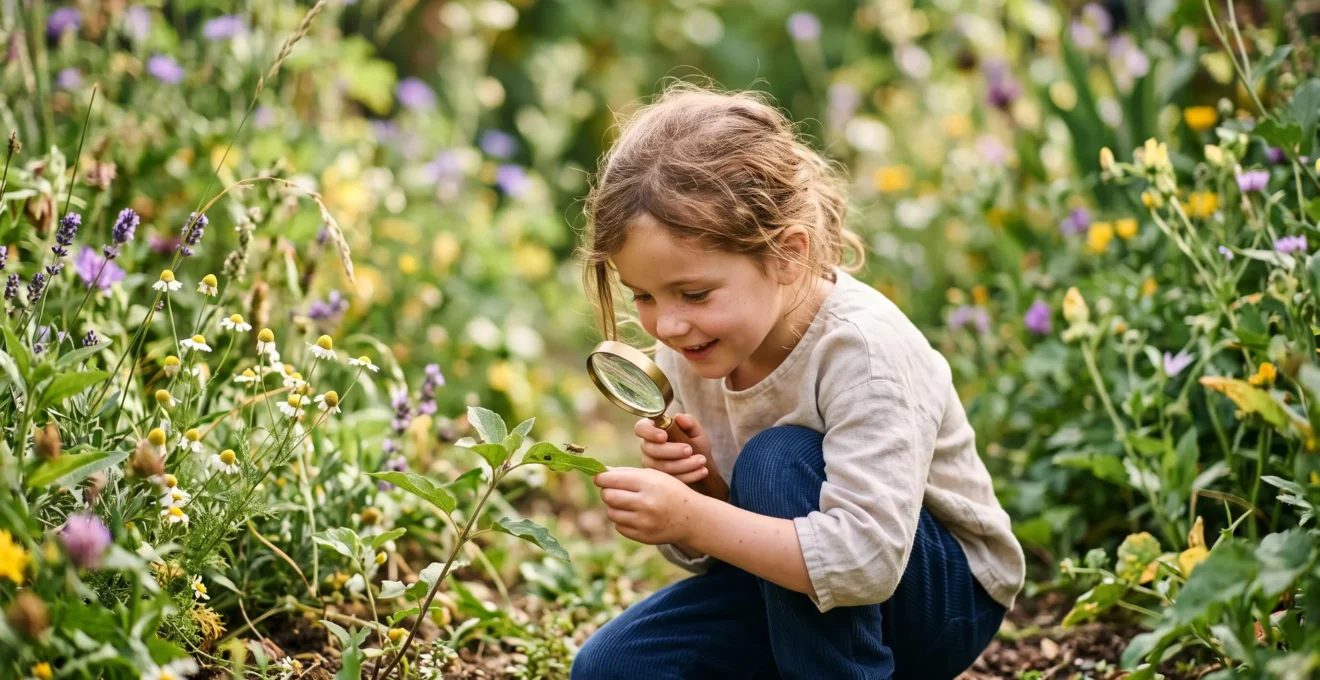
The first step is to model curiosity, not fear. Instead of saying “Don’t be scared,” try “Wow, look at all those legs! I wonder where it’s going?” Use tools like magnifying glasses or clear bug pots to allow for close observation from a comfortable distance. This creates a buffer, allowing the child to study the creature’s movements and features without the pressure of direct contact. It’s also vital to establish a core rule: we observe with kindness. We never harm the creatures we find, and we always return them to their homes after a brief look.
This approach reframes the interaction from a scary encounter to a scientific investigation. An educator who built bug hotels with children discovered a powerful side effect: the structures provided a compassionate solution for dealing with “pests.” Instead of squashing a slug they found in the vegetable patch, the children had a designated place to relocate it. This simple act turned fear into a hands-on lesson in care and coexistence, teaching them that every creature, even the “creepy” ones, has a role to play in the ecosystem. By providing a positive action, you replace the “eww” with a sense of responsibility.
Gardening or Rewilding: What Is the Difference for a Child?
For a child, the garden is a world of its own. But the way we manage that world teaches two very different lessons. Traditional gardening often teaches control: we plant in neat rows, we pull weeds, we decide what lives and what dies. It’s a valuable skill, but it positions humans as managers of nature. Rewilding, on the other hand, teaches a lesson of collaboration and observation. It’s about intentionally letting a small patch of your garden “go wild” to see what happens.
For a child, the difference is profound. A tidy flowerbed is a project with a clear, adult-defined outcome. A rewilded corner is a mystery unfolding. It’s where the “weeds” are allowed to flower, attracting different pollinators. It’s where a small log pile becomes a five-star hotel for beetles and a hunting ground for spiders. This patch of wilderness becomes a dynamic, self-directed classroom. It doesn’t require planting or weeding; it only asks for quiet observation. What has moved in this week? What new flowers have appeared? Who is eating whom?
This contrast between the cultivated and the wild teaches a powerful lesson in biodiversity. A child can directly compare the few species in the flowerbed to the teeming life in the wild patch. They learn that a “messy” garden is often a healthier, more vibrant ecosystem. To explore this, you can try activities like a “Backyard Beings” catalogue or a sensory map, noticing the different smells, sounds, and textures in each zone. This simple act of leaving a corner to nature provides endless opportunities for discovery and teaches a deeper respect for natural processes.
How to Use Apps to Log Wildlife for Real Scientific Studies?
In the digital age, a smartphone can be one of the most powerful tools in your backyard ecology kit. Far from being a distraction, it can serve as a bridge connecting your child’s observations to a global community of scientists and naturalists. Apps like iNaturalist or its more kid-friendly counterpart, Seek, use photo recognition technology to help identify plants, insects, and animals from a single snapshot. This instantly gratifies a child’s curiosity, turning “What’s that bug?” into a moment of discovery.
But the real magic happens next. When you upload an observation to a platform like iNaturalist, you are contributing to a massive, crowd-sourced database used by scientists to track biodiversity, monitor species distribution, and study the effects of climate change. This transforms your backyard exploration into genuine citizen science. Your child isn’t just taking a picture of a moth; they are documenting its presence at a specific time and place, creating a data point that could be part of a real scientific paper.
The scale of this collaborative effort is staggering. For instance, as of late 2024, the iNaturalist platform reported over 200 million observations from millions of observers worldwide. A year-long project at a Canadian university demonstrated the power of this approach, where community members submitted thousands of observations, ultimately documenting over 100 species that were new to the region. This proves that everyday logging can generate genuinely new scientific data. Telling your child that their photo of a garden spider could help a real scientist makes them feel like a valued and important part of a much larger mission.
The Picking Mistake: Teaching Kids to Observe Without Destroying Nature
A child’s natural impulse upon seeing a beautiful flower or a fascinating leaf is to grab it. This desire to possess is a normal part of exploration, but it presents a crucial teaching moment. The “picking mistake” is the act of loving something to the point of destroying it. Our role as educators is to gently guide this impulse from “I want to have it” to “I want to understand it,” fostering a mindset of observation over possession.
Instead of a blanket “don’t touch,” which can shut down curiosity, we can offer alternative, non-destructive ways to engage. Encourage sketching the flower in a nature journal, taking a close-up photograph, or simply sitting quietly and describing its colours, shape, and any insects visiting it. These actions satisfy the desire to interact while preserving the object of their fascination for others (including wildlife) to enjoy. This teaches a fundamental lesson in conservation: that nature is a shared resource, not a personal collection.
A structured activity can be a powerful way to channel this observational energy. Creating a simple “biodiversity index” for a small patch of your garden turns the focus from individual items to the health of the whole system. By counting not just the number of species but also the number of individuals, children learn to see their backyard as a community, not a shop. This simple, data-driven approach shifts their goal from collecting things to collecting information.
Your Backyard Biodiversity Audit: A 5-Step Plan
- Define Your Plot: Mark out a small, one-metre-square area in your garden with string or sticks. This is your official survey plot.
- Count the Species: With a worksheet and pencil, carefully list and count the different *types* of plants and creatures you see within the plot (e.g., dandelions, grass, woodlouse, ant).
- Count the Individuals: Next to each species, tally the *number* of individuals you can find (e.g., 5 dandelions, 3 woodlice). If an exact count is hard, make an estimate.
- Describe the Unknown: If you can’t identify something, don’t worry! Describe it simply in your notes (e.g., “tiny black beetle,” “spiky-leafed plant”) and take a photo to identify later.
- Calculate and Compare: Add up your total species and total individuals. This is your plot’s biodiversity index. Repeat the audit in a different part of the garden (e.g., under a bush vs. on the lawn) to compare results.
How to Teach Decomposition with a Worm Farm?
The concept of decomposition—of things rotting and breaking down—can be a bit grim or abstract for a child. A worm farm, or vermicomposter, transforms this idea into a fascinating, hands-on process of recycling. It provides a living, visible demonstration of one of nature’s most fundamental cycles: how organic matter is broken down by living organisms and returned to the soil as nutrient-rich food for new life. It’s nature’s ultimate recycling programme, happening in a box.
Setting up a worm bin is a fantastic family project. It becomes a dedicated home for your kitchen scraps, like vegetable peels and coffee grounds. The children’s task is simple: feed the worms and observe. Over weeks, they will witness the “yucky” food scraps disappear, transformed by the worms into dark, crumbly, and incredibly rich compost, often called “black gold.” This tangible transformation is a powerful lesson. It shows that waste is not an endpoint, but part of a continuous loop.
The impact of this simple educational tool is widely recognised; worm bins are now found in thousands of classrooms across North America, from kindergarten to high school. To make the lesson even clearer, you can create a parallel “worm-free” decomposition bag with the same scraps. The slow, mouldy decay in the bag, compared to the rapid, clean transformation in the worm bin, provides undeniable proof of the worms’ vital role as nature’s clean-up crew. When you finally use the finished compost on your garden plants, the cycle is complete, connecting waste directly to new growth.
Key Takeaways
- Foster Agency, Not Anxiety: Combat climate fears by empowering children with hands-on, local tasks where they can see their positive impact.
- Observe, Don’t Possess: Teach the core conservation principle of appreciating nature without destroying it through activities like sketching, photography, and data collection.
- Stewardship is Active Care: Move beyond passive appreciation by creating and managing micro-habitats, turning your garden into a living laboratory that requires active participation.
Raising Young Ecologists: How to Foster Environmental Stewardship?
The journey from simply looking at bugs to understanding an ecosystem is the journey toward environmental stewardship. It’s the culmination of all the small lessons: the empathy learned by relocating a snail, the patience learned while waiting for a bee to visit the bug hotel, and the sense of wonder at seeing food scraps turn into soil. Fostering stewardship is about weaving these individual experiences into a coherent worldview where a child understands that they are not just living *on* the planet, but are an integral *part* of its systems.
This long-term perspective is built through routine and seasonal observation. It’s about moving from one-off activities to a continuous backyard ecology curriculum. Encourage your child to become the official scientist of your garden, using simple tools to monitor its health. They can investigate soil pH with household items, track pollinator visits over a summer, and use basic data collection methods like quadrats (survey squares) to see how the rewilded patch changes from spring to autumn. This consistent engagement connects their small-scale findings to broader conservation concepts like seasonal change and species interdependence.
Ultimately, our goal as parents and educators is to ignite a lifelong curiosity and a sense of responsibility. It’s about nurturing a mindset that sees the value in every creature and every natural process. As Shannon Trimboli, host of the Backyard Ecology project, beautifully puts it:
I invite you to join us as we ignite our curiosity and natural wonder, explore our yards and communities, and improve our local pollinator and wildlife habitat.
– Shannon Trimboli, Backyard Ecology
To put these ideas into practice, the next logical step is to choose one project, like the biodiversity audit or the worm farm, and begin your family’s journey into backyard ecology today.