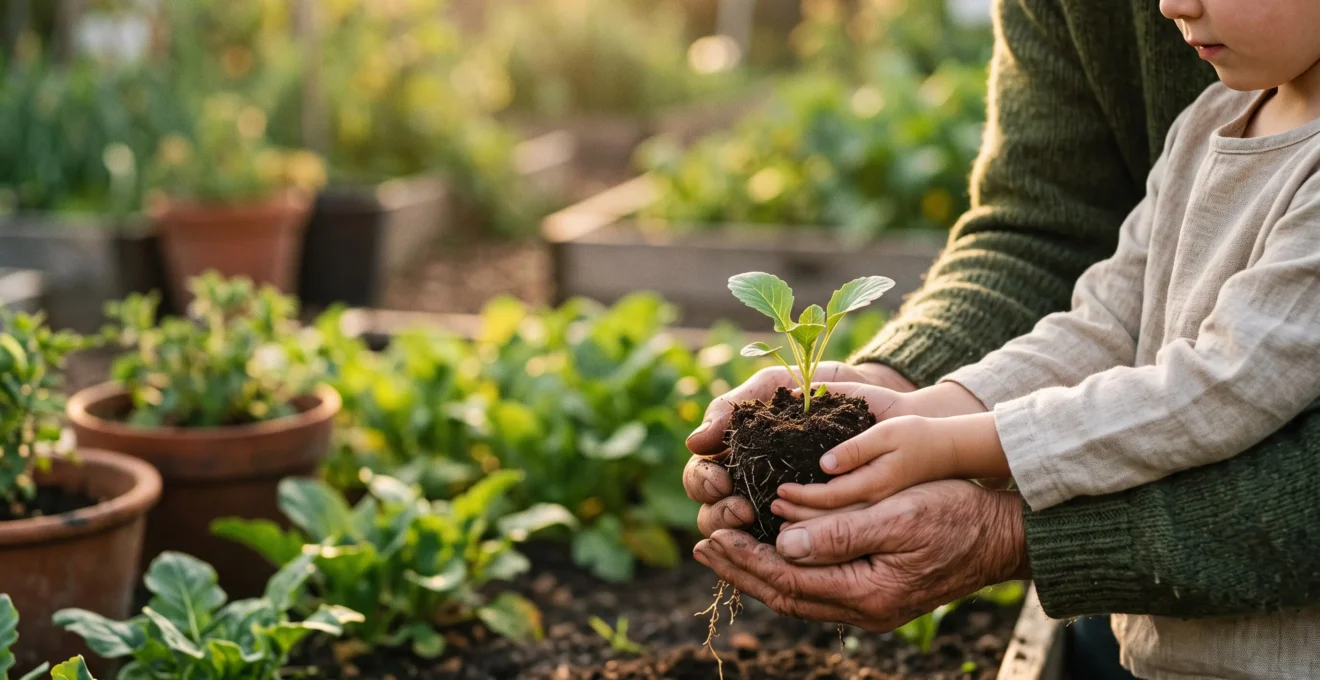
Many eco-conscious parents struggle with teaching their children about environmental issues without causing fear and anxiety. The solution isn’t to shield them from reality, but to shift the focus from overwhelming global problems to empowering, tangible actions. This guide demonstrates that fostering a sense of personal agency through hands-on, local, and creative projects is the most effective way to cultivate a resilient and positive ecological identity in children.
As a parent, you want to raise a child who cares for our planet. You compost, you recycle, you talk about the importance of nature. But a quiet fear underlies these efforts: how do you discuss the reality of climate change without burdening your child with eco-anxiety? The news is filled with stories of melting ice caps and endangered species, and the sheer scale of the problem feels paralyzing for adults, let alone for a child. The common advice—to teach the “3 R’s” or read books about the environment—often feels inadequate, a passive gesture against an overwhelming tide.
These approaches can inadvertently frame environmentalism as a series of chores or a source of distant, scary news. They focus on the problems without providing the tools to feel like part of the solution. But what if the key wasn’t to talk more about the global crisis, but to act more on the local level? What if the most powerful antidote to a child’s feeling of helplessness is the tangible proof of their own capability?
This is the core of raising a true young ecologist: shifting the focus from fear to agency. It’s about empowering children to see themselves not as passive observers of a crisis, but as active creators, builders, and stewards of their immediate world. It’s a philosophy that transforms environmental education from a lecture into an adventure.
This article will guide you through this positive, action-based approach. We will explore the psychology of why hands-on projects combat anxiety, provide practical ways to engage with ecosystems at home, and show how creativity can turn the concept of “waste” into an opportunity for innovation. It’s time to move beyond the narrative of doom and start building a story of constructive hope with your children.
To navigate this journey, we’ve structured this guide to build from foundational principles to practical, creative applications. Explore the sections below to discover how to cultivate a positive and resilient environmental mindset in your family.
Summary: Raising Young Ecologists: A Guide to Positive Action
- Why Is Action the Best Antidote to Eco-Anxiety in Kids?
- How to Teach Decomposition with a Worm Farm?
- The Doomism Risk: Why Only Talking About Disaster Paralyzes Kids?
- Local Cleanup or Global Charity: Where Should Kids Start?
- When to Celebrate Earth Day: Making It a Yearly Tradition
- Why Does Knowing Local Bugs Help Fight Climate Anxiety?
- Why Does Reusing Trash Teach Better Design Skills Than New Materials?
- Upcycled Art Projects: Teaching Sustainability Through Creativity?
Why Is Action the Best Antidote to Eco-Anxiety in Kids?
Eco-anxiety is a rational response to a real threat, and children are particularly vulnerable. When confronted with large-scale problems they cannot influence, feelings of helplessness can take root. A primary-school study found that nearly 50% of children worry about global warming. However, the study also revealed a crucial insight: worry was directly correlated with taking action. The children who felt most empowered were those who were actively involved in solutions.
This highlights a fundamental psychological principle: agency is the antidote to anxiety. Agency is the belief that your actions matter and can produce a desired effect. While a child cannot stop an ice cap from melting, they can build a bug hotel that gives a solitary bee a home. They can turn food scraps into rich soil. These small, tangible victories build a powerful internal narrative of competence and hope. The focus shifts from “The world has a problem” to “I am a problem-solver in my world.”
This isn’t about ignoring the larger issues, but about building the emotional and psychological resilience to face them. A systematic review of studies on youth eco-anxiety confirms this, identifying that active participation is a key factor in how young people cope with climate distress. When children participate, they are no longer just spectators to a crisis; they become protagonists in a story of change. Their backyard, their community, and their school become laboratories for positive action.
By framing environmentalism around what a child *can do*, you give them the most critical tool for a sustainable future: the unwavering belief in their own power to make a difference. This creates a foundation of what experts call “constructive hope”—a hope that is earned through effort, not one based on blind optimism.
How to Teach Decomposition with a Worm Farm?
Abstract concepts like “decomposition” or “nutrient cycles” can be difficult for a child to grasp. A worm farm, or vermicomposter, transforms these ideas into a tangible, living micro-ecosystem that they can observe and manage. It’s a hands-on science lesson that smells like earthy soil, not a stuffy classroom, turning food “waste” into a valuable resource: nutrient-rich fertilizer for plants.
As you can see in the rich texture of compost, this is a world teeming with life. Setting up a simple indoor bin with red wiggler worms gives children a direct window into one of nature’s most fundamental processes. They learn firsthand what worms will eat (fruit and vegetable scraps, paper) and what they won’t (meat, dairy). This simple act of sorting kitchen scraps becomes a daily lesson in biology and responsibility. The finished product, “black gold” compost, provides a powerful and satisfying conclusion to the cycle when used to grow a plant on the windowsill.
This isn’t just a fun activity; it’s a proven educational tool. A study highlighted in 2021 found that children involved in composting and gardening showed measurable gains in environmental awareness and even mathematical reasoning. By observing, recording, and problem-solving, kids develop a deep, intuitive understanding of ecological principles. Here is how you can turn a worm bin into a structured learning experience:
- Set up the bin as an “ecosystem”: Introduce the worms, the bedding, and the food as parts of a living system, not just a compost pile.
- Map the food web: Create a simple drawing that shows the sun helping plants grow, the family eating the plants, and the worms decomposing the scraps to help new plants grow.
- Become a scientist: Encourage kids to observe and record what’s happening. How do worms react to light? Which foods disappear fastest? This builds scientific observation skills.
- Harvest the compost: The moment you harvest the finished vermicompost is a celebration. It’s the tangible reward for their stewardship.
- Close the loop: Use the compost to pot a new plant or enrich a garden bed. This visually and experientially demonstrates the concept of a closed-loop, sustainable system.
The Doomism Risk: Why Only Talking About Disaster Paralyzes Kids?
While honesty is important, an exclusive focus on worst-case scenarios is counterproductive. This narrative, often called “doomism,” presents environmental problems as so vast and inevitable that individual action feels futile. For a child, this message can be emotionally crushing, leading to apathy or despair rather than engagement. The data paints a stark picture: a 2023 survey revealed that a staggering 61% of young adults in the U.S. endorsed the statement that “humanity is doomed.”
This sense of hopelessness is not an accident; it is often fueled by the very media meant to inform us. A systematic review of studies on youth eco-anxiety specifically identified media exposure as a key social factor shaping how children emotionally process climate information. Constant exposure to catastrophic imagery and language, without a balancing narrative of solutions and progress, creates a feeling of powerlessness.
So, at what age should you talk about climate change? The answer is less about *when* and more about *how*. The conversation should always be anchored in agency and scale. Before discussing melting polar ice caps (a global, abstract problem), talk about the bees in your local park (a local, tangible reality). Before showing them a documentary about deforestation, help them plant a tree. The goal is to build a strong foundation of positive, personal connection to nature first.
When they are older and begin asking about the larger issues, you can frame the conversation around problem-solvers. Talk about the scientists developing renewable energy, the communities restoring wetlands, and the engineers creating sustainable materials. This approach acknowledges the problem’s severity while highlighting the human capacity for innovation and resilience. It shifts the story from “We are doomed” to “This is a huge challenge, and here is how people like us are working to solve it.”
Local Cleanup or Global Charity: Where Should Kids Start?
The impulse to “do good” can pull families in two directions: addressing the visible, local problem (litter in the park) or contributing to the abstract, global one (donating to a rainforest fund). For a child, the choice is clear. The path to building lifelong environmental stewardship begins at their own feet. Starting local is not just easier; it is psychologically essential for developing a sense of agency.
A child who spends an hour picking up trash at a local playground can see the direct result of their labor. The space is cleaner. They made it happen. This tangible cause-and-effect is a powerful lesson that no donation to a distant charity can replicate. It builds what psychologists call an “internal locus of control”—the belief that one can influence events and their outcomes. This feeling of competence is the bedrock upon which a child’s ecological identity is built.
How do you explain global warming to a 7-year-old? You don’t. You take them to a local creek and help them pull out a plastic bag. You explain that this bag can hurt the fish that live right *here*. The lesson is immediate, personal, and emotionally resonant. As they grow, this concrete understanding of local ecosystems and human impact provides the necessary framework for comprehending larger, more complex global issues. A child who has cared for a local creek is better equipped to understand the importance of the world’s oceans.
To help your family identify the most meaningful place to start, it can be useful to conduct a small, personal audit of your own environmental impact and opportunities.
Your 5-Step Audit for a Meaningful Family Eco-Action Plan
- Identify Points of Contact: List the daily areas where your family interacts with the environment. Think about food (where does it come from?), waste (what do we throw away?), energy (lights, heat), transport (how do we get around?), and play (where do we connect with nature?).
- Collect Data on Habits: For one week, take an inventory of your current habits. How many bags of trash do you produce? What’s inside? How often do you walk or bike versus drive? This isn’t about judgment; it’s about observation.
- Check for Coherence: Compare your habits to your family’s values. If you value nature, are there simple changes you can make that better reflect this? Identify one or two gaps between your values and your actions.
- Find the Emotional Connection: From your list of potential actions, pinpoint one or two that feel exciting and tangible for your kids. Building a bird feeder often has more emotional resonance than a lecture on turning off lights. Choose action over abstract rules.
- Create an Integration Plan: Choose one key project to start with (e.g., starting a compost bin, organizing one neighborhood cleanup). Define the very first small step and put it on the calendar to make it real.
When to Celebrate Earth Day: Making It a Yearly Tradition
For many, Earth Day is a single, fleeting event—a day to post a nice photo of a tree or participate in a one-off school activity. But to truly foster a deep sense of environmental stewardship, Earth Day should be transformed from a passive observance into an active family ritual. It shouldn’t be the *start* of your environmental efforts, but a yearly celebration of the progress you’ve made.
Think of it as an ecological “harvest festival.” It’s the day your family comes together to acknowledge and honor the actions you’ve taken throughout the year. Did you maintain your worm farm? Did you grow tomatoes on the balcony? Did you successfully build a bug hotel? Earth Day becomes the moment to reflect on these successes, reinforcing the cycle of positive action and building a family culture of stewardship.
Creating a tradition around this day solidifies your family’s ecological identity. It sends a powerful message that your commitment to the planet is not a temporary fad but a core part of who you are. The ritual can be simple but meaningful:
- A “State of the Garden” review: Walk through your garden or look at your houseplants and talk about what thrived, what didn’t, and what you learned.
- Project Showcase: Display the art you’ve made from upcycled materials. Retell the story of its creation.
- Planning the year ahead: Use the energy of the day to decide on your family’s next eco-project. Will you try to reduce plastic use in lunch boxes? Plant a native flower to attract pollinators?
By making Earth Day a yearly milestone, you are not just celebrating the Earth; you are celebrating your family’s active, positive relationship with it. It becomes a day to honor your collective agency and impact. This reframes the entire concept from a day of worry about the planet’s health to a day of pride in your family’s contribution to its well-being, turning a global event into a personal and empowering tradition.
Why Does Knowing Local Bugs Help Fight Climate Anxiety?
In a world of globalized media, it’s easy for a child’s concept of “nature” to be dominated by polar bears and pandas—magnificent, but impossibly distant. This abstraction can feed into eco-anxiety by reinforcing the idea that nature is something “out there” and in peril. The antidote is to anchor a child’s relationship with the natural world in their own backyard, and there is no better ambassador for this than the humble bug.
Focusing on local insects—the ladybug on a rose, the rolly-polly under a rock, the dragonfly by a pond—grounds a child in their immediate ecosystem. It teaches them that nature isn’t just in faraway documentaries; it’s a complex, fascinating world right under their feet. This fosters a sense of intimacy and stewardship over a domain they can actually see and protect. The biologist E.O. Wilson powerfully articulated the danger of losing this connection:
Children who remain out of touch with the natural world are like cattle in a feedlot. They may appear content, but are they children — or cattle — in the fullest sense?
– E.O. Wilson, A Conversation With E.O. Wilson, NOVA, PBS
This idea is central to Wilson’s “biophilia hypothesis,” which posits that humans have an innate need to connect with nature. Fulfilling this need is crucial for mental well-being. By equipping a child with a magnifying glass and a simple identification guide, you are not just teaching them entomology; you are giving them a tool for mindfulness and wonder. The act of patiently watching an ant carry a leaf is a meditative practice that builds focus and appreciation for the complexity of life.
This personal relationship changes everything. A child who knows the name of the local pollinators and understands their role is more likely to feel a sense of responsibility for them. The threat to “biodiversity” is no longer an abstract concept but a direct threat to the bees they see every day. This connection transforms anxiety about a global crisis into a protective, caring impulse for their local environment.
Why Does Reusing Trash Teach Better Design Skills Than New Materials?
Give a child a box of perfect, brand-new craft supplies, and they will follow the instructions. Give a child a pile of “trash”—a cardboard box, some plastic bottles, and bottle caps—and they will invent a spaceship. This is the magic of what educators call constraint-based creativity. Working with found materials is not a second-best option; it is a superior method for teaching genuine design thinking and problem-solving skills.
Unlike a pre-packaged kit, a yogurt cup or a toilet paper roll has no predetermined purpose. The child must ask: What could this be? How can I connect it to this other piece? This process forces them to engage in flexible, divergent thinking. They must analyze the material’s properties—its strength, its shape, its texture—and envision new possibilities. They are not just assembling; they are engineering. They are learning to see potential where others see waste.
This educational philosophy has a rich history. As far back as 1968, the Alvarado School Arts Workshop, co-founded by sculptor Ruth Asawa, began using recycled materials to foster creative expression in children. This legacy continues today in organizations that provide found materials to educators, proving that these humble items are powerful tools for learning. It teaches kids a fundamental principle of sustainable design: the most innovative solutions often come from cleverly using what you already have.
Furthermore, this practice instills a deep appreciation for the lifecycle of objects. When a child transforms a plastic bottle into a beautiful bird feeder, they are rewriting its story. It’s no longer a disposable item destined for a landfill. It has become a valued creation, imbued with their time, ingenuity, and care. This experience provides a far more profound lesson in sustainability than any lecture on recycling ever could.
Key Takeaways
- Eco-anxiety in children is best addressed by fostering a sense of agency, not by shielding them from reality.
- Hands-on, local projects (like worm farms or bug hunts) are more effective than discussing abstract global issues.
- Upcycling and using “trash” for art teaches superior problem-solving and design skills through creative constraints.
Upcycled Art Projects: Teaching Sustainability Through Creativity?
The ultimate goal of environmental education is not just to teach facts, but to cultivate a mindset. Upcycled art projects are the perfect synthesis of this philosophy, merging creativity, problem-solving, and the principles of sustainability into a single, joyful activity. They are the tangible expression of an optimistic and resourceful worldview, showing children that “waste” is simply a failure of imagination.
These projects empower children to become creators and innovators. By taking everyday household disposables, they learn to see value and potential everywhere. A collection of bottle caps becomes a colorful mosaic, a stack of old magazines turns into a vibrant collage, and a large cardboard box is transformed into a magnificent castle. These simple acts teach a profound lesson: with creativity, we can transform the unwanted into the beautiful and functional.
The process itself builds crucial skills. Children must design, plan, and execute their vision using materials with inherent limitations, fostering resilience and ingenuity. Moreover, these activities can become powerful community-building rituals. Organizing a neighborhood “recycled art day” brings families together, creating a shared experience centered on creativity and sustainability. These events turn a solitary household habit into a vibrant, collective celebration of what can be achieved together.
Ultimately, upcycled art gives a child a powerful sense of purpose. Their creation is not just a fun craft; it is a statement. It says, “I can solve problems. I can create value. I can make my world a little more beautiful and a little less wasteful.” This is the very essence of environmental stewardship, taught not through fear or obligation, but through the pure, empowering joy of making something wonderful out of nothing.
By focusing on these positive, hands-on activities, you are not just distracting your child from the world’s problems. You are equipping them with the skills, mindset, and unwavering sense of agency they will need to face those problems with courage and creativity. Begin today by choosing one small project and embarking on this empowering journey together.