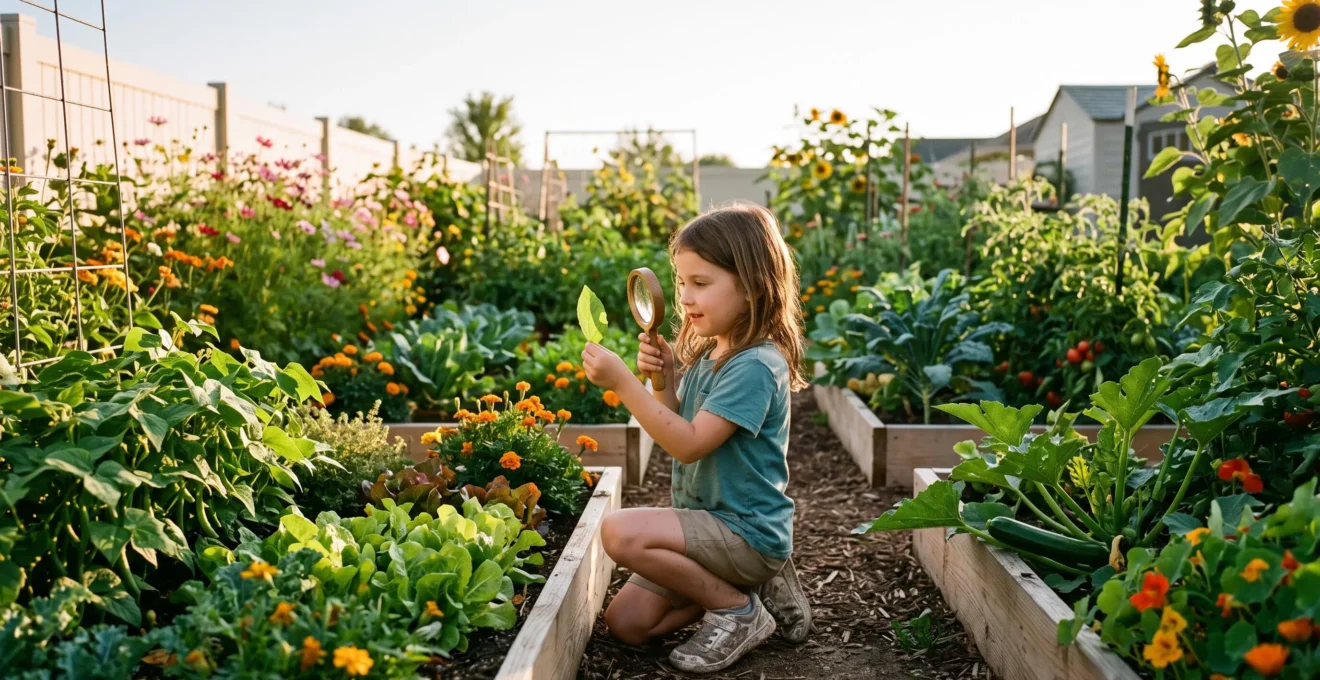
That shiny new STEM kit isn’t the magic bullet for a summer of science; it’s just the beginning. Real, lasting curiosity is built not from following instructions, but from the freedom to get them wrong.
- True learning is sparked by ‘productive struggle’, where mistakes are treated as valuable data, not failures.
- Your role isn’t ‘teacher’, but ‘senior research partner’—guiding, questioning, and exploring together.
Recommendation: Shift your goal from ‘completing the experiment’ to ‘having a scientific conversation’ about what you observe in your own backyard.
The summer holidays stretch out, a golden opportunity for learning and fun. In a bid to combine both, many well-intentioned parents invest in STEM exploration kits, picturing their children as budding scientists, diligently discovering the wonders of nature. Yet, too often, the initial excitement fizzles out. The kit is completed in an afternoon, or worse, abandoned after a frustrating step, and the child is back to declaring “I’m bored.” We’ve been told that hands-on activities are the key, but we rarely discuss what makes them truly stick.
The common approach is to see the kit as a self-contained lesson, a box of instructions to be followed for a predetermined outcome. But what if the kit isn’t the lesson at all? What if it’s merely the catalyst? The real secret to unlocking a child’s inner scientist lies not in the equipment, but in the mindset we, as parents, bring to the garden table. It’s about shifting from the role of instructor to that of a collaborative co-investigator. This is a journey into inquiry-based learning, where questions are more valuable than answers and a “failed” experiment is celebrated as a fascinating new piece of data.
This article will guide you through this transformative mindset. We will explore the neuroscience behind why asking “why?” is more powerful than following a manual, why letting your child fail is a crucial step towards success, and how even the simplest toys like building blocks lay the groundwork for complex mathematical thinking. Prepare to see your garden not just as a patch of grass, but as a sprawling, living laboratory, ripe for discovery.
To navigate this exploration, we’ve structured this guide to build from foundational principles to practical applications. The following sections will equip you with the perspective and tools needed to transform any afternoon into a genuine scientific adventure.
Summary: Using STEM Exploration Kits: Turning the Garden into a Laboratory?
- Why Does Inquiry-Based Learning Stick Better Than Textbooks?
- Homemade Microscope or Store-Bought: Which Is Better for Beginners?
- The Instruction Trap: Why You Should Let Them Fail at the Experiment?
- STEM or STEAM: Why Adding Art Improves Engineering Skills?
- When to Use Which Kit: Matching Science to the Seasons
- Why Does Block Play Predict Better Maths Scores at GCSE?
- How to Use Apps to Log Wildlife for Real Scientific Studies?
- Creating a Biodiversity Lab: How to Teach Ecology in Your Backyard?
Why Does Inquiry-Based Learning Stick Better Than Textbooks?
Have you ever noticed how a child can remember every intricate rule of a complex video game, but forgets a history date read from a textbook? The secret isn’t just “fun”; it’s a matter of brain chemistry. When a child is passively receiving information, their brain is in a low-power state. But when they are actively engaged in solving a problem or investigating a question—the core of inquiry-based learning—their brain lights up. In fact, neuroscience research shows that brain activity is significantly higher during active learning tasks.
This isn’t just a theory; it’s a proven educational strategy. Inquiry-based learning reframes the dynamic from “Here is a fact” to “Let’s find out why.” Instead of telling a child that plants need sunlight, you ask, “What do you think will happen if we put this seed in a dark cupboard?” This process forces their brain to form a hypothesis, observe, and then reconcile their prediction with the outcome. This mental wrestling is what forges strong, lasting neural connections. The learning becomes an experience they own, not a fact they’ve borrowed.
As educator David Sousa highlights, the link between brain science and teaching is powerful. He notes that “When teachers link neuroscience research with classroom practice, they can see how experience shapes the brain.” As a parent, you are your child’s first and most important teacher. Adopting an inquiry-based approach in the garden means you are actively shaping their brain for curiosity and critical thinking.
Case Study: Scaffolding Inquiry Skills
The power of this method was demonstrated in a series of studies by Kuhn and colleagues. They found that with explicit training and scaffolding, children from grades four to eight could significantly enhance their mental models and apply more sophisticated inquiry strategies. A follow-up longitudinal study confirmed that children who received this kind of guided inquiry support consistently outperformed control groups on complex tasks. This shows that the skill of inquiry isn’t just innate; it can be taught and nurtured, with you as the guide.
So, the goal isn’t just to get to the “right answer” in the instruction manual. It’s to ask delightful questions, make excitingly wrong predictions, and discover the answer together. This is the path to knowledge that sticks.
Homemade Microscope or Store-Bought: Which Is Better for Beginners?
The moment you decide to explore the microscopic world, a question arises: do you invest in a polished, store-bought microscope or try crafting a simple one at home? The conventional wisdom might lean towards the “proper” equipment. But from an inquiry-based perspective, the answer is less about the tool and more about the process of discovery it enables.
A store-bought microscope offers immediate, high-magnification results. It’s reliable and designed for clarity, allowing a child to quickly see the intricate patterns on a fly’s wing or the cells in an onion skin. This can produce a powerful “wow” moment. However, it can also position science as something that requires expensive, specialized equipment—something that happens in a lab, separate from everyday life.
A homemade microscope, on the other hand, is an experiment in itself. The classic water-droplet lens, created with a simple loop of wire, turns the focus from the object being viewed to the very physics of light and magnification. The “wow” moment isn’t just “look at that tiny thing,” but “wow, we *made* a lens!” It demonstrates a fundamental scientific principle: that with ingenuity, we can build tools to extend our senses. This approach naturally encourages learner choice and social interaction, which researcher Mary Helen Immordino-Yang found to have a “strong effect on how neural networks learn.”
As you can see, even a simple drop of water can reveal a hidden world. The choice between DIY and store-bought isn’t a binary one. The best approach? Do both. Start with the homemade version to explore the principle of optics. Then, introduce the store-bought microscope to take that exploration to the next level. This teaches another vital scientific lesson: we start with simple tools and develop more sophisticated ones as our questions become more complex.
Ultimately, the “better” microscope is the one that sparks the most questions. Is it the one that provides a perfect image, or the one that makes your child ask, “Why does a drop of water do that?”
The Instruction Trap: Why You Should Let Them Fail at the Experiment?
Picture this: you and your child are building a circuit from a STEM kit. The lightbulb is supposed to turn on, but it doesn’t. What’s your first instinct? For many parents, it’s to jump in, check the instructions, and fix the “mistake.” This is what I call the “Instruction Trap.” It stems from a desire to avoid frustration, but in doing so, we rob our children of the single most important part of the scientific process: failure.
As the team at Tinkrworks aptly puts it, “One of the single most important things you can instill in your students is how to fail well.” An experiment that doesn’t work as expected is not a failure; it’s the collection of unexpected data. The moment the bulb doesn’t light up is the moment the real experiment begins. Now you have a puzzle. Is the battery in backwards? Is the connection loose? Is the bulb broken? Each of these questions is a hypothesis, and testing them is the essence of scientific inquiry.
This concept has a name in education: “productive struggle.” It’s the sweet spot where a task is challenging enough to require effort and critical thinking, but not so difficult that it leads to giving up. Fostering an optimistic mindset during these moments teaches children to persevere and see challenges as opportunities. It’s so critical that organizations like Engineering is Elementary have built entire frameworks around it, establishing “Engineering Habits of Mind” that are rooted in this principle of productive struggle.
Your role as a scientific mentor is not to provide the answers, but to model curiosity in the face of a problem. Instead of saying, “Let’s see what we did wrong,” try, “How fascinating! It didn’t light up. What do you think is happening here?” This simple shift in language transforms a moment of potential frustration into an exciting investigation. It reframes you from the expert with the answer key to a co-detective, solving a fun mystery side-by-side.
By letting them “fail,” you are teaching them resilience, problem-solving, and the foundational truth of all innovation: discovery rarely follows a straight line.
STEM or STEAM: Why Adding Art Improves Engineering Skills?
For years, the focus has been on STEM: Science, Technology, Engineering, and Maths. But a new letter has been gaining traction, transforming the acronym into STEAM. That ‘A’ stands for Art, and its inclusion is far from being a “soft” or decorative addition. In fact, integrating art is a powerful way to enhance core engineering skills and foster more creative, holistic problem-solvers.
The connection might not seem obvious at first, but as The Institute for Arts Integration and STEAM points out, these fields are deeply intertwined: “there’s math within art and that science and technology impact engineering and design.” When a child builds a model bridge, that’s engineering. When they first sketch out ideas for what that bridge should look like, considering aesthetics and form alongside function, that’s art. This initial design process is fundamental to all real-world engineering.
Artistic practices teach skills that are directly transferable to technical fields. Observational drawing, for instance, trains the eye to see detail, proportion, and spatial relationships—all critical for an engineer reading a blueprint or a biologist identifying a species. Sculpting with clay or building with different materials develops an intuitive understanding of 3D spatial reasoning and structural integrity. It’s a hands-on physics lesson without a single formula.
Case Study: Drawing and Interdisciplinary Knowledge
A study published in the National Center for Biotechnology Information explored the role of fine arts in STEAM education. It found that activities requiring children to sketch their creations before building them were highly effective. In this process, children learned to use drawing techniques to design features and apply interdisciplinary knowledge to represent spatial characteristics in their drawings. The act of drawing wasn’t just a creative outlet; it was a crucial planning and problem-solving phase that directly supported the engineering task.
In your backyard lab, this means encouraging your child to draw the bug they see under the microscope before they look it up. It means asking them to design a fantastical birdhouse before they start hammering wood. This practice of visualization and planning bridges the gap between imagination and execution, making them not just better scientists, but more innovative engineers.
The ‘A’ in STEAM is the reminder that the greatest scientific breakthroughs often come not just from logical deduction, but from a leap of creative imagination.
When to Use Which Kit: Matching Science to the Seasons
A common pitfall with STEM kits is treating them as one-off activities, disconnected from the world around them. The true power of a backyard lab comes from seeing it as a dynamic environment that changes with the seasons. By matching your scientific explorations to the natural cycles of the year, you create a curriculum that is always relevant, timely, and exciting.
In the spring, as new life emerges, the garden is a perfect laboratory for germination and botany. This is the ideal time for a germination kit, but also for simple experiments like seeing if a bean can sprout in a wet paper towel inside a jar. In summer, the garden is buzzing with life. It’s the season for entomology and pollination. A pollinator observation kit with nets and identification cards becomes invaluable. Autumn brings decay and transformation, the perfect backdrop for exploring decomposition with a soil testing kit or by creating a simple decomposition column in a clear bottle with leaves and soil.
Even winter, when the garden seems dormant, offers unique opportunities. It’s a fantastic time for physics and chemistry, like experimenting with how salt affects the melting point of ice on the porch, or for anatomy, using a seed dissection kit to discover the dormant life waiting for spring. This seasonal approach teaches a profound ecological lesson: that science is not a collection of isolated facts, but the study of interconnected systems.
The following table gives a few ideas for aligning activities, whether you’re using a pre-made kit or embracing a kit-free alternative with household items. As a comparative analysis from The Institute for Arts Integration and STEAM shows, both approaches have immense value.
| Season | Kit-Based Exploration | Kit-Free Alternative |
|---|---|---|
| Spring | Germination kit with seed trays and pH strips | Bean-in-a-jar observation using a damp paper towel |
| Summer | Pollinator observation kit with nets and ID cards | Bubble-blower comparison using household objects |
| Autumn | Soil testing kit to measure pH changes | Clear-bottle decomposition column with leaves and worms |
| Winter | Seed dissection kit with magnifiers | Ice and salt melting experiment on the porch |
Action Plan: Auditing Your Garden for Seasonal Science
- Spring Germination Audit: Identify different zones in your garden (full sun, shade, damp soil). Plan to plant the same type of seed in each to compare growth rates. This is a real-world experiment in variables.
- Summer Pollinator Census: Mark off a one-meter square of lawn or flowerbed. During a sunny hour, count how many different types of insects visit. Log your findings and repeat weekly to track changes.
- Autumn Decomposition Study: Start a simple compost pile or a “decomposition jar.” Layer green materials (grass clippings) and brown materials (dry leaves) and observe how they transform over the months.
- Winter Weather Station: Create a simple rain gauge from a jar and a ruler. Make a wind vane. Log daily temperature, rainfall, and wind direction to become a family of meteorologists.
- Year-Round Phenology Journal: Choose one specific tree or plant. Once a week, take a photo of it and write down observations. When did the first leaves appear? The first flower? When did the leaves change color? This long-term project teaches the rhythm of nature.
By syncing your science with the seasons, you’re not just doing experiments; you’re participating in the grand, ongoing experiment of nature itself.
Why Does Block Play Predict Better Maths Scores at GCSE?
It might seem like a huge leap from a toddler stacking wooden blocks to a teenager solving complex equations. Yet, a growing body of research shows a direct and powerful link between early block play and later mathematical achievement. This connection reveals a crucial truth: the foundations of scientific and mathematical thinking are built not with fancy kits, but through the simplest forms of play.
When children play with blocks, they are not just having fun; they are running a constant series of physics and engineering simulations. They are intuitively learning about gravity, stability, and geometry. They are developing spatial reasoning skills—the ability to mentally manipulate objects in two and three dimensions. This skill is not only fundamental to fields like architecture and engineering but is also a cornerstone of higher-level mathematics, from geometry to calculus.
The evidence is compelling. In fact, a Purdue University study found that a semi-structured block play program improved preschoolers’ math skills, including numeracy, shape recognition, and mathematical language. Sara Schmitt, a researcher on the study, is so convinced of its power that she says, “What I find myself saying a lot, among other things, is block play.” It’s a simple, accessible tool with profound cognitive benefits.
Case Study: The 16-Year Study
The most powerful evidence comes from a long-term study that followed children from 1982 to 1998. Researchers evaluated the complexity of block constructions built by four-year-olds and then compared these findings with their math test scores in high school. The results were clear: a child’s ability to create complex structures with blocks at age four was a significant predictor of their mathematical ability and test scores as a teenager. The play was not just play; it was foundational training for the brain.
This doesn’t mean you should throw out your STEM kits. It means you should recognize that the same cognitive muscles are being built in different ways. The problem-solving a child uses to figure out why their block tower keeps falling is the same mode of thinking they will later use to debug a line of code or solve an algebraic problem. It’s all about understanding relationships, patterns, and systems.
So, the next time you see a child deeply engrossed in building with blocks, know that you’re not just watching them play. You’re watching a future mathematician, engineer, or scientist at work.
How to Use Apps to Log Wildlife for Real Scientific Studies?
The science you do in your backyard doesn’t have to stay there. Thanks to modern technology, your family’s curious observations can contribute to genuine, global scientific research. This is the exciting world of citizen science, where ordinary people, armed with smartphones, become the eyes and ears for professional scientists around the world. As one researcher noted, “Professional scientists simply can’t be everywhere at once.”
So how does it work? It’s surprisingly simple. Apps like iNaturalist allow you to take a photo of a plant, insect, or animal, upload it, and get help with identification from a community of experts and enthusiasts. But it does more than just answer the question, “What is this bug?” Every verified observation becomes a data point with a timestamp and a GPS coordinate. This data is then used by scientists to track biodiversity, monitor species migration, and study the effects of climate change. Your backyard beetle could become part of a major scientific paper.
The scale of this collaboration is staggering. The iNaturalist platform, for example, is a testament to the power of collective effort. As of September 2024, the platform has grown to include over 200 million unique observations from 3.3 million observers worldwide. This gives scientists a dataset of a scale that would be impossible to gather through traditional means alone. It’s a real, living library of our planet’s biodiversity.
Case Study: Are Kids’ Observations Actually Useful?
A common question is whether observations made by young people are accurate enough to be scientifically valuable. A study focusing on the contributions of 249 youths to iNaturalist provided a resounding “yes.” It found that nearly all their observations were “verifiable,” and more than half achieved “Research Grade” status, meaning they were confirmed by the community and useful for biodiversity research. The study also noted that sustained participation led to even higher quality data, showing that kids get better at it over time.
This transforms a simple nature walk into a mission with real-world purpose. It teaches children that their observations matter and that they can be active participants in the scientific community. It’s a powerful motivator that elevates their interest from a hobby to a meaningful contribution. All it takes is a curious eye and a smartphone.
By participating in citizen science, you are teaching your child perhaps the most important lesson of all: that science is not something you just learn about, but something you *do*.
Key Takeaways
- Inquiry-based learning, where kids ask and investigate their own questions, builds stronger, more lasting knowledge than passive memorization.
- Embrace “productive struggle.” Letting a child fail at an experiment and then figure out why is more valuable than getting it right the first time.
- Science is creative. Integrating art (the ‘A’ in STEAM) through sketching and design improves engineering and problem-solving skills.
Creating a Biodiversity Lab: How to Teach Ecology in Your Backyard?
We’ve explored the mindset, the tools, and the connection to global science. Now it’s time to bring it all together. The ultimate goal is to stop seeing your backyard as just a place to play, and to start seeing it as a living, breathing biodiversity laboratory. This is where you move from single experiments to teaching ecology—the study of how all the living and non-living parts of an environment interact.
You don’t need a huge space or fancy equipment. An ecologist’s most basic tool is the quadrat—a simple square frame used to sample a small, representative area. You can make one with four sticks and some string. Place this square on a patch of lawn. Inside that one square meter, how many different types of plants can you find? How many insects? This simple act of focused observation is the foundation of ecological fieldwork.
This approach was successfully used in the Basaula project, an educational initiative where 122 students were trained to record plant species in an outdoor activity. Using simple tools and collaborative recording, they identified 32 different species, creating their own virtual herbarium. The students rated the experience highly, finding it a powerful way to understand and document biodiversity. Your family can do the same, creating a “backyard herbarium” of pressed leaves or a photo-log of all the different birds that visit a feeder.
The role of the parent-mentor becomes paramount here. As research by Herodotou and colleagues has shown, “communicating with more knowledgeable others was shown to relate to a desire to become a scientist.” You don’t need to be an expert ecologist. You just need to be the “more knowledgeable other” who models curiosity, asking questions like, “I wonder why we only see dandelions in the sunny part of the lawn?” or “What kind of bird do you think prefers this type of seed?” Your enthusiasm and willingness to investigate together are what will ignite their desire to learn more.
When you transform your garden into a lab, you give your child a priceless gift: the ability to see the intricate web of life all around them, and the curiosity to spend a lifetime exploring it.