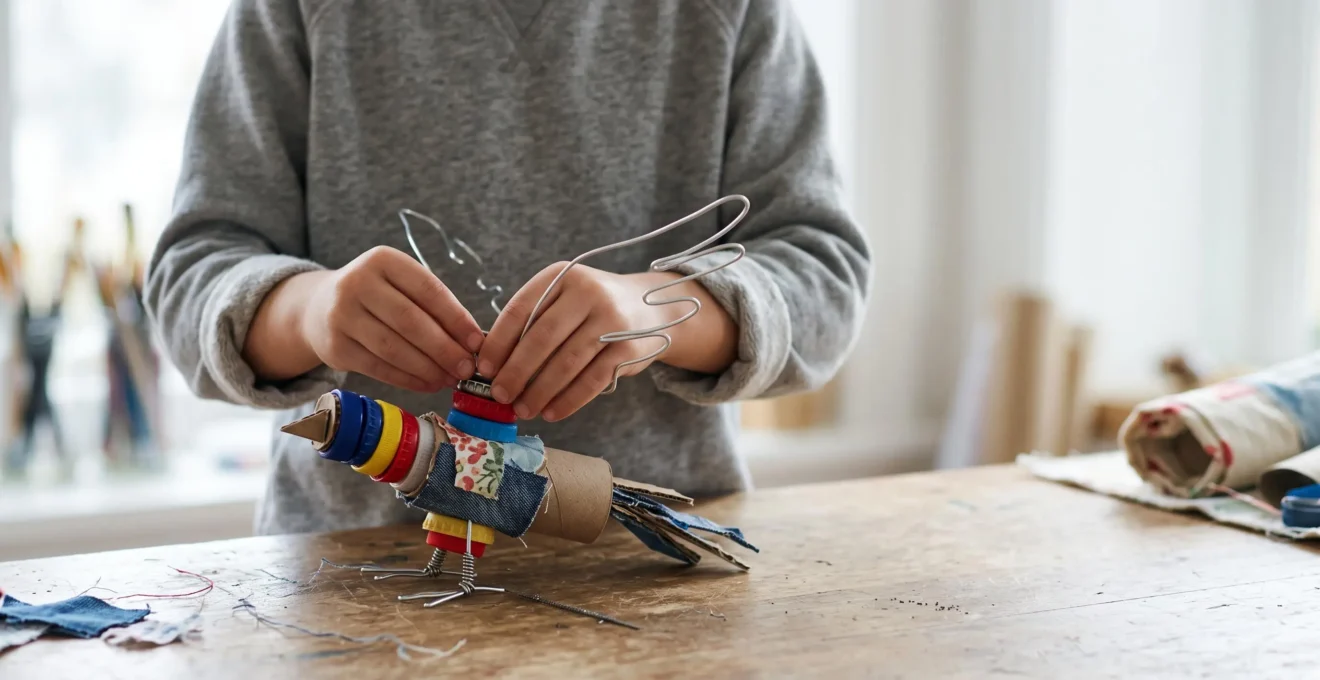
Upcycling isn’t just about eco-crafts; it’s a powerful method for training your child’s brain in design, engineering, and innovation.
- Working with limited, imperfect materials forces a level of creative problem-solving that new craft kits can’t replicate.
- This process builds a “maker mindset”—a resilient and curious approach that is foundational for future learning.
Recommendation: Start by creating a small, dedicated “maker-space” at home with safely sourced recycled materials to foster this hands-on exploration.
The recycling bin is overflowing again. It’s a familiar sight for many parents: a collection of cardboard tubes, plastic jugs, and colorful containers that seem too useful to simply toss out. A quiet voice whispers, “We could make something with that.” This impulse is often driven by noble goals—a desire to teach children about recycling, to find frugal alternatives to expensive craft supplies, or simply to fill a rainy afternoon with a hands-on activity.
These are all valid reasons, but they only scratch the surface of what’s possible. The common approach focuses on the end product: a cute robot from a box or a pencil holder from a can. But what if the true, lasting value of using these materials isn’t just about being thrifty or green? What if the very limitations of “trash”—its odd shapes, its unexpected weaknesses, its finite supply—are a secret ingredient for developing a child’s creativity, problem-solving abilities, and even their inner engineer? The real magic isn’t in what they make, but in *how* they learn to think when faced with constraints.
This guide moves beyond simple craft ideas to explore the powerful cognitive benefits of upcycling. We will examine why working with found objects can teach superior design skills, how to safely source and manage your material library without it taking over the house, and ultimately, how to cultivate a “maker mindset” that will serve your child for a lifetime. It’s time to see that pile of recycling not as clutter, but as a curriculum for innovation.
Summary: Creative Learning with Upcycled Materials
- Why Does Reusing Trash Teach Better Design Skills Than New Materials?
- How to Source Clean “Trash” for Art Projects Safely?
- The Hoarding Risk: How to Save Materials Without Cluttering the House?
- Upcycling or Recycling: Teaching Kids the Distinction Through Art
- How to Build a Bridge from Cardboard Tubes: An Engineering Challenge
- Process Art or Crafts: Which Builds Better Problem Solving Skills?
- Maker Mindset or Follow Instructions: Which Builds Innovation?
- Building a Home Maker-Space: Fostering Engineering Skills at Home?
Why Does Reusing Trash Teach Better Design Skills Than New Materials?
There’s a common belief that creativity thrives on absolute freedom—an endless supply of every color of paper, a brand-new set of paints, and perfect, uniform materials. The assumption is that constraints inhibit the creative spirit. However, when the goal is to develop design skills and a problem-solving mindset, the opposite is often true. Using pre-selected “trash” for art isn’t a handicap; it’s a cognitive workout that builds mental muscles a pristine craft kit can’t.
A new piece of construction paper has no opinion. It can be anything. A yogurt cup, however, has a distinct shape, a specific flexibility, and a defined size. It presents an inherent problem to be solved. A child can’t just wish it were a different shape; they must adapt their idea to the material’s properties. This is the essence of design thinking. They have to ask: What can this *become*? How can its curve be an advantage? Can I connect it to this cardboard tube? This process of material tinkering—exploring, testing, and understanding the physical properties of an object—is far more educational than simply following a prescribed set of instructions.
This is where constraint-based innovation comes into play. When a child runs out of blue bottle caps, they don’t just go buy more. They are forced to reconsider their design. Maybe green caps will work. Or maybe they can paint the caps they have. Or perhaps they can abandon caps altogether and find a new material to create the texture they envisioned. This builds cognitive flexibility and resilience, teaching them that there is almost always more than one solution to a problem. A blank canvas is easy; a pile of “junk” is a puzzle that demands a truly creative solution.
How to Source Clean “Trash” for Art Projects Safely?
The idea of a “trash art” project can conjure images of sticky, smelly, or even hazardous materials. The key to successful and enjoyable upcycling is establishing a system for sourcing clean, safe, and inspiring “trash.” This isn’t about rummaging through the garbage can moments before starting a project; it’s about mindfully collecting a library of potential materials. Your kitchen and mail deliveries are the best places to start.
The cardinal rule is clean and dry. Any container that held food, like yogurt cups, milk jugs, or plastic bottles, must be thoroughly washed with soap and water and allowed to dry completely before being stored. This prevents mold, mildew, and unpleasant odors. For dry goods like cereal boxes, egg cartons, and cardboard tubes, simply ensure they are free of food residue. Safety is paramount: avoid anything with sharp edges, like the lids of tin cans, and steer clear of containers that held harsh chemicals, such as bleach or cleaning solvents.
Once clean, sorting materials by type makes creation much easier. Here are some excellent items to start collecting for your home material library:
- Collect toilet paper and paper towel rolls for tube-based sculptures and creatures.
- Save egg cartons and cereal boxes for textured collage and construction projects.
- Rinse and dry milk cartons and plastic bottles before storing them for building projects.
- Set aside paper bags and clean plastic bags for weaving or costume-making activities.
- Sort each material type into its own labeled container so projects are ready to grab and go.
By curating your collection, you transform “trash” into a palette of creative possibilities, ready for the next flash of inspiration.
The Hoarding Risk: How to Save Materials Without Cluttering the House?
For many parents, the biggest barrier to embracing upcycled art is the fear of clutter. The line between a curated “material library” and a pile of junk can feel perilously thin. One cardboard box is potential; twenty can feel like a hoard. The secret to managing your collection lies in establishing clear systems and boundaries from the very beginning. Without a plan, your well-intentioned effort to foster creativity can quickly overwhelm your living space.
The first rule is to define the container. Designate a specific storage area—a single large bin, a set of stackable drawers, or a particular shelf—as the official home for all upcycling materials. When this container is full, it’s full. This physical limit forces you and your child to make conscious decisions about what is truly valuable. It introduces the concept of resource management. Before adding a new item, you must ask: Is this more useful than something already in the bin? This “one-in, one-out” policy prevents endless accumulation.
Another effective strategy is to collect for a purpose. Instead of saving everything “just in case,” try focusing your collection around a potential project. For example, you might decide to collect cardboard tubes for a month to build a castle, or plastic bottles for a vertical garden project. This project-based approach gives the collection a clear goal and a natural endpoint. Once the project is complete, you can purge the excess and start fresh. This keeps the inventory dynamic and prevents materials from sitting unused for years, gathering dust and inducing guilt.
Upcycling or Recycling: Teaching Kids the Distinction Through Art
In everyday conversation, “recycling” and “upcycling” are often used interchangeably. However, they represent two fundamentally different processes, and art is the perfect medium to teach this crucial distinction. Understanding the difference elevates a child’s environmental literacy from a simple “put it in the blue bin” mentality to a deeper appreciation for material value and creative reuse.
Recycling is a process of breaking a product down into its raw material components to manufacture a new, often lower-quality, item. This is also known as “downcycling.” For example, a plastic water bottle might be shredded and turned into fiber for a carpet or fleece jacket. While better than sending it to a landfill, this process still consumes significant energy, and the material quality degrades. In fact, research found that only about 2% of plastic packaging waste is ever “upcycled” into a product of equal or higher value.
Upcycling, on the other hand, is the art of transformation. It takes an object and, through creativity and ingenuity, turns it into something of *higher* value or utility without first breaking it down. A wine bottle becomes a lamp, a collection of old t-shirts becomes a quilt, and a stack of magazines becomes a piece of sculptural art. Upcycling preserves the integrity of the original material and adds value through design. A hands-on activity is one of the best ways to solidify this concept. A quasi-experimental program with students demonstrated that combining a talk with a hands-on upcycling project significantly improved their knowledge, attitudes, and practices, proving that doing is the best way of learning.
How to Build a Bridge from Cardboard Tubes: An Engineering Challenge
One of the best ways to see the power of constraint-based learning in action is to set a specific engineering challenge. The task: build a bridge that can span a gap between two chairs and support the weight of a small toy car. The only materials allowed: cardboard tubes, tape, and scissors. This simple prompt moves beyond a simple craft and becomes a hands-on lesson in structural engineering.
The first attempt will likely be simple: a few tubes laid flat across the gap. When the toy car is placed on it, the bridge will probably bend and collapse. This moment of “failure” is the most important part of the learning process. It’s not a mistake; it’s data. Why did it fail? The tubes bent in the middle. How can we make them stronger? This question is the start of real engineering. The process of analyzing and improving a design is something that key factors that help or hinder a child’s development as a maker.
This is where children begin to discover fundamental engineering principles on their own. They might try bundling tubes together to increase strength. They might experiment with stacking them or using tape to reinforce weak points. With a little guidance or inspiration, they may even discover the power of triangles—the strongest geometric shape—and begin creating trusses to distribute the weight. They are no longer just playing with trash; they are grappling with concepts of load, tension, and structural integrity. As noted by experts in the maker movement, this is exactly the kind of hands-on work that cultivates a can-do attitude.
a maker mindset can be cultivated using found and donated materials such as cardboard, duct tape, fabric
– Invent Together / The Lemelson Foundation, How to Cultivate a Maker Mindset in Your Makerspace (White Paper)
Process Art or Crafts: Which Builds Better Problem Solving Skills?
In the world of children’s activities, a subtle but critical distinction exists between “crafts” and “process art.” While both can be fun, they build very different skills. Understanding this difference is key to unlocking the full problem-solving potential of your upcycled material library. A typical craft focuses on the destination, while process art celebrates the journey.
A craft is product-oriented. It usually comes with a set of instructions and a clear picture of the desired outcome. The goal is for every child to produce a nearly identical result—a paper plate ladybug or a cotton ball snowman. Success is measured by how closely the final product matches the example. While this can be good for practicing fine motor skills and following directions, it leaves little room for creativity, experimentation, or problem-solving. If a child makes a “mistake,” it’s seen as a deviation from the plan.
Process art, conversely, is all about the experience of creating. There are no instructions and no single correct outcome. The focus is on exploring the materials and tools. What happens when you mix these two paints? How does glue feel? What sounds does this crinkly plastic make? Success is measured by engagement, curiosity, and discovery. Upcycled materials are a natural medium for process art because they are inherently open-ended. A study on early-childhood makerspaces found that this kind of open-ended, exploratory making is crucial for fostering creativity and giving children the confidence to test their own unique solutions. When a child is given a box, some bottles, and tape with no instructions, they are free to solve problems you never could have predicted.
Maker Mindset or Follow Instructions: Which Builds Innovation?
The ultimate goal of all this making, tinkering, and creating is to cultivate a “maker mindset.” This isn’t just about being “crafty”; it’s a powerful and resilient approach to life and learning. It’s the belief that you can solve problems, create what you need, and learn from your mistakes. This mindset is the engine of innovation, and it’s built through hands-on practice, not by passively following a list of instructions.
Following instructions, like assembling a pre-packaged kit, teaches compliance. It’s a linear process with one right answer and a predictable outcome. While useful in some contexts, it does not build the skills needed to face novel, unstructured problems. Innovation rarely comes from a manual. It comes from curiosity, experimentation, and the willingness to try something that might not work. Research synthesizing maker education studies finds the maker mindset is built on curiosity, resilience, autonomy, and an openness to error—all values that are consolidated through hands-on learning, not by following rigid steps.
A maker mindset is a powerful combination of attitude and ability. It’s about seeing a broken toy not as trash, but as a puzzle to be solved. It’s having the confidence to try fixing it, even if you don’t know how. It’s about viewing challenges as opportunities. Experts describe it as a particular way of seeing the world.
a framework of thinking, a can-do attitude, resiliency
– Clapp et al., cited in maker-mindset classroom research
Upcycled art projects are a perfect training ground for this mindset. Every mismatched piece and every unexpected material failure is an opportunity to practice resilience and creative thinking. This is how we teach children to become innovators, not just assemblers.
Key Takeaways
- Constraints are a catalyst for creativity and problem-solving, not a barrier. Imperfect materials build flexible thinking.
- Focus on “process art”—the act of exploration and discovery—over “crafts” with a predetermined outcome.
- The ultimate goal is to foster a “maker mindset” rooted in resilience, curiosity, and the confidence to solve novel problems.
Building a Home Maker-Space: Fostering Engineering Skills at Home?
Fostering a maker mindset and engineering skills doesn’t require a high-tech lab or expensive equipment. It begins with creating an environment at home that invites curiosity, exploration, and hands-on tinkering. Building a “maker-space” is less about the specific tools you have and more about the accessibility of materials and the freedom to experiment. This space becomes the physical heart of your family’s creative and problem-solving journey.
The most effective home maker-spaces are born from simplicity. You can start with a small, dedicated corner, a rolling cart, or a few bins on a shelf. The key is to make materials visible and accessible, signaling that it’s okay to make a mess and try things out. This space should contain your curated library of upcycled materials alongside some basic tools: scissors, various types of tape, glue, string, and perhaps some simple connectors like paper clips or brads. Research on the maker movement confirms that this kind of tinkering-based practice helps students face future uncertainty and become confident, self-directed learners.
Creating this space is the final, practical step in turning the philosophy of upcycling into a daily reality. It provides the structure needed to support unstructured play and learning. Below is a simple checklist to get you started on building a low-cost, high-impact maker-space in your own home.
Action Plan: Your Low-Cost Home Maker-Space
- Start with found and donated materials like cardboard, duct tape, fabric, and plastic bottles instead of expensive equipment.
- Prioritize the creative process and exploration over having the latest tools to build transferable lifelong skills.
- Organize materials in clear, accessible bins to invite independent use and make cleanup easier.
- Designate a specific work surface (a small table or even a floor mat) where it’s okay to be messy.
- Encourage connection by making the space a place where children can share ideas and collaborate on projects with others.
The journey begins not with a big budget or a fancy workshop, but with a single cardboard box and an open mind. Embrace the process, encourage experimentation, and watch as your child’s creativity, resilience, and problem-solving skills flourish in ways you never thought possible.