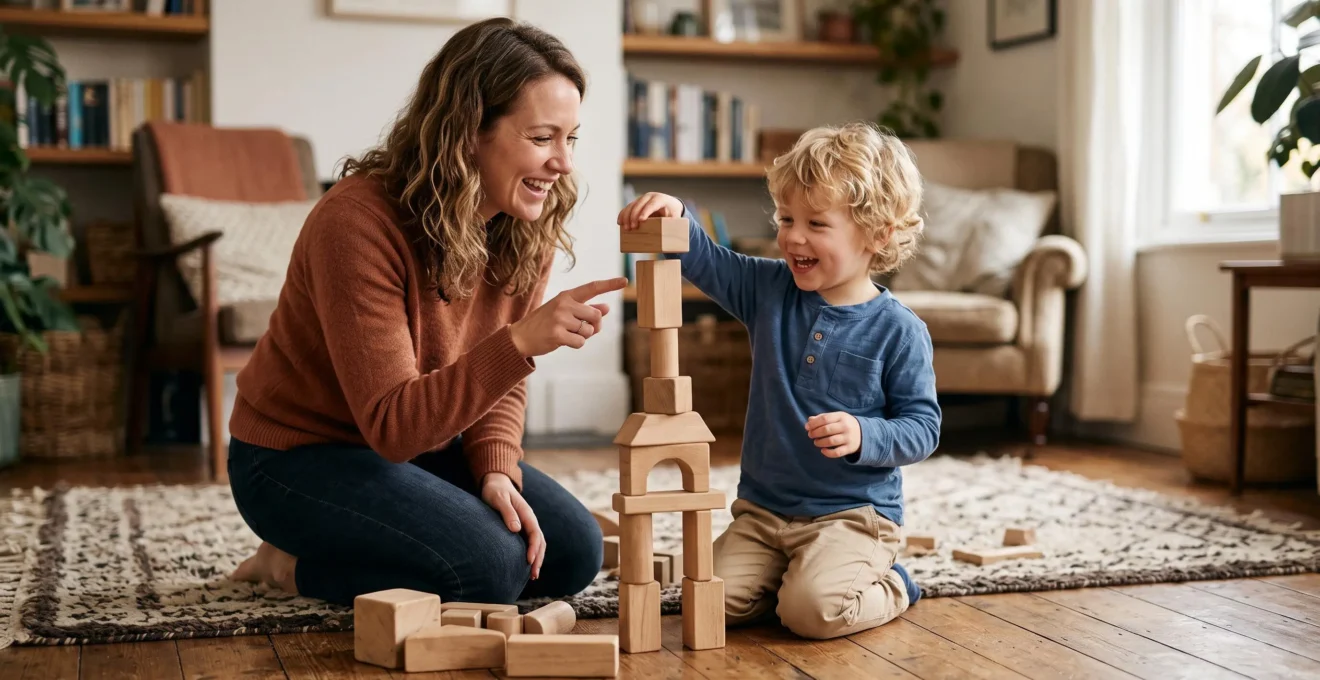
The key to unlocking your child’s future STEM potential isn’t found in educational apps, but in the physical, three-dimensional world.
- True spatial intelligence is built through hands-on interaction, where tactile feedback and proprioception create a cognitive blueprint that screens cannot replicate.
- Activities like block play, puzzle solving, and even baking are not just pastimes; they are systematic training for essential skills like mental rotation and spatial visualization.
Recommendation: Shift your focus from finding the ‘best’ educational toy to engineering a home environment where everyday activities become powerful opportunities for spatial learning.
As a parent invested in your child’s future, you’re likely aware of the growing emphasis on STEM skills. The natural instinct is often to reach for educational apps and digital games that promise to give your preschooler a head start. Yet, a nagging feeling persists: is this the right path? While many guides focus on the importance of spatial language or general play, they often miss the fundamental engineering principle at work. The debate over screen time often overshadows a more critical question: what cognitive architecture are we actually trying to build?
The development of spatial reasoning isn’t about memorizing shapes or completing digital puzzles. It’s about building a robust internal model of a three-dimensional world. This involves skills like mental rotation (imagining an object turning in space), spatial visualization (understanding relationships between objects), and the ability to translate 3D reality into a 2D representation, like a map. These aren’t just abstract concepts; they are the foundational pillars upon which advanced mathematical and engineering abilities are constructed. The common advice to simply “play with blocks” or “do puzzles” is correct, but it lacks the deeper “why.”
But what if we approached this not as a checklist of activities, but as a deliberate engineering project? The true key to fostering profound spatial intelligence lies in understanding how specific physical, hands-on experiences forge neural pathways that screens, by their very nature, cannot. This isn’t an argument against technology, but a focused strategy for building a superior cognitive foundation during the most critical developmental window. It’s about recognizing that the tactile feedback from a wooden block and the proprioceptive experience of navigating a physical space are irreplaceable data points for a young, developing brain.
This guide deconstructs the “how.” We will move beyond a simple list of toys and delve into the specific mechanisms that make certain screen-free activities so powerful. We will explore why block play is a long-term predictor of maths success, how a simple walk can become a lesson in cartography, and why the tangible world of baking can teach fractions more effectively than any app. It’s time to stop looking for the magic toy and start engineering a rich, spatially aware environment.
Contents: How to Engineer a Spatially Rich Environment
- Why Does Block Play Predict Better Maths Scores at GCSE?
- How to Teach Map Reading Skills During a Weekend Walk?
- Jigsaw Puzzles or Building Blocks: Which Develops Better Mental Rotation?
- The 2D Risk: Why Screen Apps Fail to Teach True Spatial Depth
- When to Introduce 100-Piece Puzzles: Following Your Child’s Pace
- Why Is Baking the Best Way to Teach Fractions and Weights?
- STEM or STEAM: Why Adding Art Improves Engineering Skills?
- Playful Learning at Home: Integrating Maths into Daily Chores?
Why Does Block Play Predict Better Maths Scores at GCSE?
The humble set of wooden blocks may be the most powerful piece of educational technology in your home. Its value goes far beyond simple entertainment; it is a foundational tool for building the cognitive architecture required for higher-level mathematics. The connection isn’t just theoretical. A remarkable longitudinal study tracked preschoolers and later reviewed their high school academic records. The findings were clear: there was a positive correlation between early block performance and high school math outcomes, including grades and enrollment in advanced courses. This suggests that the skills honed in early childhood create a lasting advantage.
So, what is the underlying mechanism? When a child builds with blocks, they are engaged in a constant, hands-on process of spatial problem-solving. They must mentally rotate shapes, visualize how pieces will fit together, and understand concepts of balance, symmetry, and stability. This isn’t passive learning; it’s an active construction of a mental blueprint. According to research on the subject, this type of structured play literally changes how the brain works. It develops the parietal regions of the brain, which are crucial for spatial reasoning and numerical processing.
This process of physical manipulation provides a constant tactile feedback loop. The child feels the weight, texture, and geometry of the blocks. They learn from failure—when a tower collapses, they receive immediate, undeniable physical feedback about the limits of their design. This rich, multi-sensory experience is what forges the strong neural connections between spatial awareness and logical thinking. You are not just watching your child play; you are watching them build the very framework they will one day use to understand algebra and geometry.
How to Teach Map Reading Skills During a Weekend Walk?
Translating the three-dimensional world into a two-dimensional representation is a sophisticated cognitive leap and a cornerstone of spatial intelligence. This skill, essential for everything from navigating a city to reading an engineering schematic, has a critical developmental window. In fact, research from NAEYC shows that spatial-thinking skills grow tremendously between the ages of 3 and 5. A simple weekend walk offers a perfect, screen-free laboratory to cultivate this ability.
The first step is to build a rich spatial vocabulary. As you walk, consciously narrate the journey using relational words. Instead of “Let’s go to the park,” try “The park is across the street, next to the big oak tree, and we have to walk past the post office to get there.” This constant stream of spatial language helps your child build a mental model of their environment. You’re connecting words to physical, lived experiences, which is far more powerful than learning them from a screen.
Next, introduce the map itself. Start with something simple: a hand-drawn sketch of your block or the path through the park. Before you leave, point out your house (the start) and a destination (the playground). During the walk, stop periodically to consult the map. “We are here now,” you can say, pointing to a spot on the paper. “What do we pass next?” This exercise in 3D-to-2D translation teaches them that abstract symbols on a page correspond to real-world objects. A classroom activity in Australia demonstrated this effectively, where children on a nature walk sketched a map of the trail, marking landmarks. This act of creation reinforces spatial memory and solidifies the concept of symbolic representation.
Jigsaw Puzzles or Building Blocks: Which Develops Better Mental Rotation?
While both jigsaw puzzles and building blocks are champions of screen-free spatial learning, they are not interchangeable. From an engineering perspective, they are specialized tools that train different, albeit related, aspects of a child’s cognitive machinery. Understanding their unique strengths allows you to deploy them more effectively. The core difference lies in how they engage a child’s ability to manipulate objects, both physically and mentally.
Building blocks are the undisputed champions for developing an understanding of three-dimensional space and construction. When a child builds a tower, they are working in the X, Y, and Z axes. They are solving problems of gravity, stability, and structure from the ground up. This has a direct neurological impact. An Indiana University fMRI study found increased activation only in the building blocks group in brain regions associated with spatial processing when compared to other forms of play. This suggests that the act of constructing something from individual parts provides a unique cognitive workout.
Jigsaw puzzles, on the other hand, are masters of 2D mental rotation and pattern recognition. A child doing a puzzle is not building a new structure but reassembling a pre-existing whole. The primary task is to look at a piece, mentally rotate it to see if it could fit, and then test that hypothesis. They learn to identify clues from shape, color, and pattern. A study on elementary-aged children confirmed this, finding that puzzle performance was strongly correlated with skills like mental rotation and spatial visualization. Essentially, blocks teach a child to think like an architect, while puzzles teach them to think like a decoder.
Therefore, the question is not “which is better?” but “what skill am I targeting?” For building a foundational understanding of 3D relationships and structural logic, blocks are superior. For honing the ability to mentally manipulate 2D shapes and recognize patterns, puzzles are the ideal tool. A truly robust cognitive architecture requires training in both.
The 2D Risk: Why Screen Apps Fail to Teach True Spatial Depth
Many well-intentioned educational apps attempt to replicate the experience of block play or puzzle solving. They feature digital blocks that snap into place and colorful puzzle pieces that rotate with a swipe. However, these apps miss the most crucial ingredients for developing robust spatial intelligence: the tactile feedback loop and the proprioceptive experience. The flat, frictionless surface of a screen simply cannot simulate the data-rich environment of the physical world.
Case Study: The Digital Block Illusion
A study of children’s play with a touchscreen block-building app (Toca Blocks) revealed a critical limitation. Even when apps use clever graphics to simulate three dimensions, children are still manipulating objects on a two-dimensional plane with a single finger. The app lacks the realistic depth cues, the feel of an object’s weight, and the fine motor challenge of physically placing one block atop another. The conclusion was that digital blocks may fail to create the tactile and spatial cues necessary for genuine spatial development.
This limitation has measurable consequences. A recent 2024 study of preschoolers found that children with higher screen time had lower visual-spatial scores than their peers with limited use. The reason is fundamental. When a child picks up a real wooden block, their brain processes a flood of information: its weight, its texture, the subtle adjustments their muscles must make to keep it balanced. This is the proprioceptive experience—the body’s innate sense of its position and movement in space. This physical data is essential for building an accurate internal model of the world.
The child who builds virtually is doing something cognitively interesting but is missing the fine motor development, the proprioceptive experience of physical materials, and the spatial understanding that comes from interacting with three-dimensional physical objects.
– Parenting Assist editorial team, The Screen vs. Play Debate: What Science Says About Digital Learning
A screen provides none of this. A swipe of a finger replaces the complex, multi-sensory act of physical interaction. While the child may be solving a visual problem on the screen, they are being starved of the very physical data their brain needs to understand concepts like depth, volume, and friction. They are learning a simplified, 2D version of a 3D world.
When to Introduce 100-Piece Puzzles: Following Your Child’s Pace
Introducing puzzles is not a race; it’s a process of scaffolding, where each new level of complexity builds upon previously mastered skills. Rushing a child to a 100-piece puzzle before they are ready can lead to frustration and disengagement. The goal is to keep them in the “zone of proximal development”—a state where the task is challenging enough to be interesting but not so difficult that it becomes overwhelming. The long-term benefits of this gradual approach are significant, as research from the University of Chicago found that the amount and quality of puzzle play in children aged 2 to 4 predicted their spatial transformation skills at the start of kindergarten.
Following a logical progression is key to building both skills and confidence. You wouldn’t ask an engineering student to design a bridge before they’ve mastered basic physics; similarly, you shouldn’t hand a complex jigsaw to a toddler who is still figuring out how to fit a circle into a circular hole. The journey from a simple shape sorter to a complex jigsaw puzzle is a carefully calibrated educational path.
Observing your child is the best way to know when to level up. Are they completing their current puzzles with ease and speed? Are they starting to lose interest out of boredom? These are signs they are ready for the next challenge. Conversely, if a new puzzle results in consistent frustration, tantrums, or immediate abandonment, it’s likely too advanced. It’s perfectly fine to put it away for a few weeks and try again later. The key is to nurture a positive, resilient attitude toward problem-solving, where puzzles are seen as an enjoyable challenge, not an impossible task.
Your Action Plan: A Puzzle Progression Roadmap
- Around 18 months: Begin with the basics. Introduce simple shape-sorting toys and puzzles with large, chunky knobs where each piece fits into its own dedicated slot. The focus is on basic shape recognition and hand-eye coordination.
- Ages 2-3: Level up to peg puzzles with 4-6 pieces that form a single, coherent picture. This introduces the concept that individual parts combine to create a meaningful whole.
- Ages 3-4: Transition to simple jigsaw puzzles. Start with 12-24 large, interlocking pieces. This is where true mental rotation skills begin to be honed as they learn to identify “edge” versus “middle” pieces.
- Ages 4-5+: As their skills and patience grow, you can gradually increase the piece count to 48, 60, and eventually 100 pieces. There is no upper age limit; puzzles remain a valuable cognitive tool throughout childhood and beyond.
- Audit and Adapt: Continuously observe your child’s engagement. The right puzzle is one they can complete with some effort and a sense of accomplishment. Adjust the complexity up or down based on their individual pace.
Why Is Baking the Best Way to Teach Fractions and Weights?
The kitchen is one of the most effective and underutilized STEM labs available to a child. Baking, in particular, offers a multi-sensory, deeply engaging way to transform abstract mathematical concepts like fractions, measurement, and volume into tangible, delicious results. While an app might show a child that two halves make a whole, baking allows them to *experience* it. It provides a real-world context that a worksheet or screen simply cannot match.
Consider the act of measuring flour. When your child scoops a half-cup and then another half-cup to fill the one-cup measure, they are performing a physical experiment in fractions. They feel the weight of the cup change, they see the volume increase, and they understand that “1/2 + 1/2 = 1” not because a rule says so, but because they made it happen. This is embodied cognition—the idea that our physical interactions with the world shape our thinking. The concept of a “quarter” becomes concrete when they cut a stick of butter into four equal pieces.
This paragraph introduces the concept of baking as a learning tool. The illustration below captures the tactile, hands-on nature of this process, where learning is a physical experience.
As you can see in this image, the learning is in the doing. The process also involves sequencing (first we mix dry ingredients, then we add the wet ones), temperature changes, and chemical reactions. It’s a holistic scientific experiment from start to finish. When you ask your child, “The recipe calls for one cup of sugar, but we only have a 1/3 cup measure. How many scoops do we need?” you are not giving them a math problem; you are presenting an engineering challenge with a clear, motivating goal: cookies.
STEM or STEAM: Why Adding Art Improves Engineering Skills?
In the push for STEM, the “A” for Arts is often seen as a soft, non-essential addition. From an engineering standpoint, however, this is a significant oversight. Art is not merely about decoration or self-expression; it is a rigorous discipline of spatial problem-solving. The skills developed through drawing, sculpting, and painting are directly transferable to engineering and design, fostering a more creative and versatile innovator.
Drawing, for instance, is a profound exercise in spatial visualization and 3D-to-2D translation. When a child attempts to draw a house or a car, they must analyze its three-dimensional form and figure out how to represent it on a flat piece of paper. They grapple with perspective, proportion, and how lines can create the illusion of depth. This is the same fundamental skill an architect uses when creating a blueprint or a mechanical engineer uses when designing a part in CAD software. They are building a mental library of how forms and shapes relate to one another.
Sculpting with clay or building imaginative structures from recycled materials is essentially a form of free-form block play. It requires the same understanding of balance, structure, and three-dimensional relationships, but without the rigid constraints of uniform blocks. This encourages divergent thinking—the ability to generate multiple solutions to a single problem. An engineer who has spent time thinking like an artist is better equipped to approach a technical challenge from unconventional angles, leading to more innovative solutions. The arts train the brain to see not just what is, but what *could be*.
By integrating art, we are not diluting the STEM curriculum; we are strengthening it. We are nurturing the ability to visualize complex systems, to think flexibly, and to bridge the gap between abstract ideas and physical reality. STEAM recognizes that the best engineers are not just technicians; they are creative visionaries who can imagine a new world and then build it.
Key takeaways
- Spatial reasoning is a foundational skill for STEM, built most effectively through hands-on, physical interaction, not screens.
- Activities like block play, puzzles, and map-making are not interchangeable; they train distinct but complementary spatial skills like mental rotation and visualization.
- Integrating learning into everyday chores like baking or sorting laundry transforms your home into a powerful, screen-free STEM lab.
Playful Learning at Home: Integrating Maths into Daily Chores?
Building a solid foundation for mathematical and spatial thinking doesn’t require a dedicated curriculum or expensive educational toys. The most effective approach is to engineer your home environment so that learning becomes a natural and integrated part of daily life. By reframing everyday chores as opportunities for playful problem-solving, you create a constant stream of learning experiences that are both meaningful and screen-free.
The key is to shift your perspective and see the hidden mathematical principles in routine tasks. Setting the table, for example, is a perfect lesson in one-to-one correspondence, a fundamental pre-math skill. “Each person needs one plate, one fork, and one cup.” Sorting laundry becomes a hands-on exercise in classification and data sorting—by color, by size, or by owner. Putting away groceries is a lesson in spatial awareness and optimization: “Can we fit all these boxes onto this shelf? Which shape is the most efficient?”
These activities work because they are contextual and purposeful. The child isn’t sorting abstract shapes; they are helping the family function. This intrinsic motivation makes the learning “stick” in a way that decontextualized drills often don’t. You are not adding another task to your day; you are enriching the tasks you are already doing. The goal is to cultivate a “mathematical gaze” in your child, where they begin to see the world through a lens of patterns, shapes, and relationships.
Ultimately, by weaving these micro-lessons into the fabric of your day, you build a robust and resilient cognitive architecture. You demonstrate that math and logic are not just subjects in school but are useful, powerful tools for understanding and interacting with the world. You are transforming your home from a simple living space into a dynamic learning laboratory, laying the groundwork for a lifetime of curiosity and STEM success.
Start today. Look at your daily routine not as a list of tasks, but as a series of opportunities. By consciously embedding these small moments of spatial and mathematical thinking into your family’s life, you are doing more than just teaching—you are building the mind of a future problem-solver, engineer, and innovator.