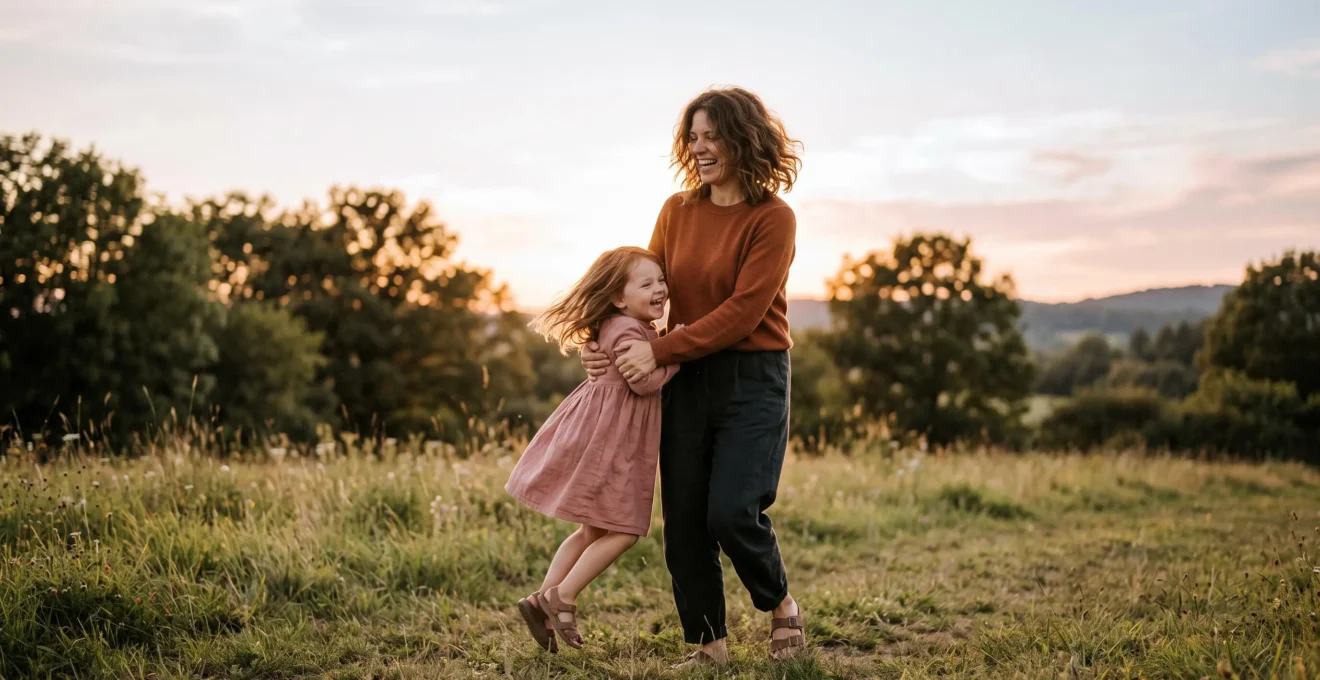
True core memories aren’t about grand vacations or perfect photos; they are designed through small, emotionally-charged moments of pure, undistracted presence.
- Strong emotions “tag” memories as important in the brain, a process that is weakened when we’re focused on filming rather than feeling.
- Simple, predictable rituals and moments of spontaneous joy (like a “Yes Day”) are more powerful architects of memory than elaborate, staged events.
Recommendation: Put the phone down and intentionally design moments of connection, however small, to build your child’s lifelong emotional blueprint.
As parents, we are the unofficial archivists of our children’s lives. We ache with a beautiful nostalgia for moments that have just passed, driven by a deep desire to bottle up the magic of their childhood. This often leads us down a familiar path: planning the perfect holiday, staging elaborate birthday parties, and keeping a phone at the ready to capture every smile. We operate under the assumption that the more we document, the more they will remember. We try to manufacture memories through grand gestures and digital records.
But what if the very act of trying to capture the moment is what prevents it from becoming a memory in the first place? What if the true key to a cherished past isn’t found in a camera roll, but in the quiet, undocumented spaces in between? The science of memory tells a surprising story. It suggests that a child’s most formative memories—their “core memories”—are forged not by scale, but by emotional significance. They are less about what you do and more about how you make them feel.
This is where we shift our role from memory-makers to experience designers. Instead of chasing the perfect shot, we can learn to engineer the conditions for authentic connection and emotional resonance. It’s a quieter, more intentional approach that values presence over performance. It’s about understanding the subtle mechanics of a child’s mind and heart to help them build an internal archive of joy, safety, and love that will last a lifetime.
This guide will walk you through the art and science of designing these lasting moments. We will explore what truly makes a memory stick, how to create spontaneous joy, why our obsession with capturing everything can backfire, and how to establish rituals and traditions that become the bedrock of a happy childhood, even through the teenage years.
Summary: A Parent’s Guide to Designing Unforgettable Childhood Moments
- What Actually Qualifies as a “Core Memory” for a Child?
- How to Use “Yes Days” to Create Spontaneous Joy?
- The Instagram Trap: Why Filming the Moment Ruins the Memory?
- Capture or Experience: Which Builds a Stronger Neural Pathway?
- When Do Kids Start Remembering: The “Childhood Amnesia” Barrier
- Why Do Cooperative Games Reduce Sibling Fighting After Play?
- Why Do Predictable Rituals Reduce Anxiety in Children?
- How to Establish Weekend Traditions That Teens Actually Want to Join?
What Actually Qualifies as a “Core Memory” for a Child?
A “core memory” is more than just a vivid recollection; it’s an event that becomes part of a child’s identity and emotional blueprint. These are the moments that surface years later, steeped in feeling. Contrary to popular belief, they are rarely tied to the most expensive or elaborate events. Instead, neuroscience shows us that the defining ingredient is strong emotion. When an experience is emotionally charged—whether with intense joy, surprise, or even profound comfort—the brain releases neurotransmitters that essentially “tag” the event as important and worthy of long-term storage.
This process of emotional tagging is why a child might forget a theme park visit but remember for decades the feeling of baking cookies with a grandparent on a rainy afternoon. The smell of the kitchen, the texture of the dough, and the feeling of warmth and safety created a powerful emotional cocktail. Brain imaging studies confirm this, revealing increased activity in the amygdala and hippocampus—the brain’s emotion and memory centers—when people recall these significant events. The story becomes encoded with feeling.
Furthermore, these memories are not static. They are strengthened and refined through storytelling. Every time a child recounts the memory or hears you tell the story of that day, the neural pathways are reinforced. As leading researchers in the journal *Nature* have noted, this is a powerful feedback loop.
Emotional learning selectively and retroactively strengthens memories for related events.
– J. E. Dunsmoor et al., Nature Reviews Neuroscience
Therefore, a core memory isn’t just a snapshot of an event; it’s a living piece of a child’s personal narrative, marked by intense emotion and reinforced by the shared act of remembering. As designers of experience, our goal is to create more opportunities for this emotional tagging to occur.
How to Use “Yes Days” to Create Spontaneous Joy?
In our quest to create memorable childhoods, we often over-schedule and over-plan, leaving little room for the magic of spontaneity. A “Yes Day” is a powerful antidote. It’s a simple concept: for a designated period, you agree to say “yes” to your child’s requests (within pre-agreed boundaries of safety, health, and budget). It’s not about extravagant spending or abandoning all rules; it’s about ceding control and embracing your child’s impulses. As Dr. Rachael Sharman, a psychology lecturer, notes, a “Yes Day” can be a wonderful tool to “help broaden horizons” and explore new experiences together.
The true power of this idea lies in the small things. It’s saying yes to building a fort in the living room, eating dessert for breakfast, or spending an entire afternoon at the park doing nothing but watching the clouds. These moments feel so special to a child precisely because they break the routine. They communicate a profound message: your joy is my priority right now. This feeling of being seen, heard, and prioritized is a potent catalyst for emotional tagging, turning a simple Tuesday into a core memory.
The goal isn’t a performative, movie-style “Yes Day,” but rather cultivating a “yes” mindset in everyday life. It’s about recognizing the small bids for connection your child makes and, whenever possible, meeting them with openness instead of a reflexive “no.”
Your Action Plan: Building a Low-Key, High-Impact “Yes” Mindset
- Set an Intention: Decide to be open to your child’s small, spontaneous requests within reasonable safety, time, and financial limits.
- Embrace Simple Asks: Say yes to everyday things kids love but are often declined for convenience, like a snack on the porch, a walk to the park, or baking cookies together.
- Let Them Lead: Allow your child to fully lead the activity, like handling every (messy) step of a recipe, to deepen their sense of ownership and competence.
- Make Emotional Deposits: Treat these small “yeses” as deposits into a shared emotional bank account. This builds a buffer of goodwill that can help navigate future conflicts and meltdowns.
- Be Fully Present: Put your phone away during these moments. The goal is to be a full participant, not a documentarian, to make the connection authentic.
The Instagram Trap: Why Filming the Moment Ruins the Memory?
In the digital age, we’ve developed a powerful instinct: when something beautiful happens, we reach for our phones. We are driven by the fear of losing the moment, so we attempt to preserve it in a digital amber. But a growing body of research suggests this very act of capturing can sabotage the memory we’re trying to save. When we view an experience through a screen, we shift from being a participant to an observer. We engage our minds in the technicalities of framing, focus, and recording, rather than immersing our senses in the experience itself.
This is a form of cognitive offloading. We are outsourcing the job of remembering to our device. A revealing study involving 120 participants in a simulated tour found that those who simply observed had significantly better memory recall than those who took photos or, even worse, recorded videos. The researchers concluded that filming, in particular, requires sustained attention and increases cognitive load, which weakens the internal encoding of the memory. You remember filming, but you don’t remember the moment.
The image above illustrates this divide perfectly: the separation between the observer in the shadow and the participant in the light. When you’re behind the lens, you’re not in the scene. You miss the fleeting expression on your child’s face, the specific way the light hit the trees, the sound of their laughter—the very sensory details that make a memory rich and lasting. As one psychology professor puts it, we’re asking technology to do our remembering for us.
When people rely on technology to remember something for them, they’re essentially outsourcing their memory.
– Linda Henkel, Professor of Psychology, NPR
This doesn’t mean you should never take another photo. It means being fiercely intentional about when you do. Choose to put the camera down during the peak of the experience and simply live it. The most precious memories are the ones you keep with your heart, not your hard drive.
Capture or Experience: Which Builds a Stronger Neural Pathway?
The tension between capturing a moment and living it is at the heart of modern parenting. While the previous section highlighted the dangers of cognitive offloading, the story is more nuanced. Not all photo-taking is detrimental to memory. The key distinction lies in our intention. Are we taking a photo to offload the memory, or are we taking it to enhance our future ability to recall it?
When our focus shifts entirely to getting the perfect shot, we disengage from the present. As memory researcher Fabian Hutmacher states, this dual task of experiencing and recording “reduces your enjoyment of the situation, as well as the memory you have of it.” Our brain cannot fully encode the sensory details of the moment because its resources are diverted to the task of photography. The neural pathway being built is for the act of capturing, not for the event itself. The result is a shallow memory, lacking the emotional and sensory depth that defines a core memory.
However, a landmark study in *Psychological Science* found that when people choose to take photos with the specific goal of remembering, the photos can serve as a powerful retrieval cue to enhance memory. In this context, the photo isn’t a replacement for the memory but a key that unlocks it later. Think of it like a bookmark. The photo itself isn’t the story, but it reminds you exactly where to find it in your mind. The danger comes when we create the bookmark but forget to read the book.
The most effective strategy is a hybrid approach. Be fully present first. Immerse yourself in the moment, soak in the sights, sounds, and feelings. Then, if you choose, take a quick, intentional photo not as proof of the moment, but as a future reminder of the feeling. This way, you are building a strong neural pathway from the experience itself, with the photograph acting as a simple trigger for recall, not as the memory itself.
When Do Kids Start Remembering: The “Childhood Amnesia” Barrier
Many parents pour immense effort into creating beautiful memories for their toddlers, only to wonder if any of it will stick. The reality is, most of us have very few, if any, narrative memories from before the ages of three or four. This phenomenon is known as childhood amnesia. It’s not that memories aren’t being formed; rather, the brain’s filing system is still under construction. The hippocampus, crucial for forming long-term episodic memories, is not yet fully mature.
A landmark Emory University study was the first to empirically document this process in action. Researchers followed children from age three, asking them to recall past events. The study found that while young children could remember recent events, there was a significant drop-off over time. The findings showed that around age seven, these earliest memories tend to fade into oblivion for most children. This doesn’t mean your efforts are wasted; it simply means we need to think about early “memories” differently.
Before narrative memory comes online, children are building a vast library of sensory imprints. These are pre-verbal, non-narrative memories tied to the senses: the specific smell of your perfume, the texture of a favorite blanket, the sound of a lullaby, the feeling of being held securely. These imprints form the bedrock of a child’s emotional world. They are the building blocks of feeling safe, loved, and secure.
While the story of their third birthday party may fade, the feeling of the sun on their skin and the taste of the cake might remain as a vague, warm feeling of happiness. These sensory memories are profoundly powerful because they are stored in deeper, more primal parts of the brain. So, for young children, the goal is not to create a story they will recount, but to fill their world with positive sensory input that builds a foundation of love and security.
Why Do Cooperative Games Reduce Sibling Fighting After Play?
Sibling rivalry can feel like a constant, draining battle. One of the most effective and counter-intuitive strategies for fostering harmony is to replace competitive games with cooperative ones. The reason this works lies in a fundamental shift in mindset. Competitive games, by nature, create a zero-sum dynamic: for me to win, you must lose. This inherently pits siblings against each other, reinforcing a mindset of opposition and often leading to gloating, resentment, and post-game conflict.
Cooperative games, on the other hand, establish a positive-sum dynamic. The players are not opponents; they are a team working towards a shared objective against the game itself. This simple change has profound psychological effects. Instead of plotting against each other, siblings must communicate, strategize, and support one another. A failure is a shared setback to be overcome together, while a victory is a collective achievement that strengthens their bond.
Imagine a game where the goal is to get all the farm animals into the barn before the wolf reaches the door. If one sibling makes a mistake, the other is incentivized to help them correct it, because their own success depends on it. This creates a low-stakes training ground for crucial life skills: negotiation, empathy, and collaborative problem-solving. They are literally practicing being on the same team. This shared experience of “we did it!” builds a sense of team identity that can carry over long after the game is put away, reducing the likelihood of subsequent fights because they’ve just spent an hour reinforcing their connection, not their opposition.
Why Do Predictable Rituals Reduce Anxiety in Children?
A child’s world can often feel chaotic and unpredictable. In this context, rituals and traditions act as powerful memory anchors—stable, reliable points in the sea of daily life. From a simple bedtime story every night to a special pancake breakfast every Saturday, these predictable routines provide an profound sense of security. The power of rituals lies in their ability to answer the unspoken question in a child’s mind: “What’s next?” By making parts of their world predictable, we reduce their cognitive load.
When a child doesn’t have to spend mental energy worrying about or trying to figure out the immediate future, their nervous system can relax. This lowers levels of the stress hormone, cortisol, and creates a state of calm. The brain isn’t on high alert; it knows what to expect. This frees up mental resources for learning, playing, and connecting. A consistent bedtime ritual, for example, doesn’t just signal that it’s time to sleep; it signals safety, love, and the comforting continuity of their world.
These rituals become what we might call “islands of calm.” They are sacred, protected spaces in time where a child knows the rules, feels competent, and can count on a positive connection with their caregivers. It’s in these quiet, repeated moments—not in the grand, one-off events—that a child’s deep-seated sense of safety is forged. The memory isn’t just of the pancakes; it’s of the feeling of reliability and belonging that the Saturday morning ritual represents. These moments accumulate over time, building a resilient foundation of well-being and becoming some of the most cherished, emotion-filled core memories.
Key Takeaways
- Focus on Emotion, Not Scale: The intensity of the emotion, not the grandeur of the event, is what creates a core memory.
- Experience Over Evidence: Being fully present in a moment strengthens memory encoding far more than documenting it for a camera.
- Rituals Build Safety: Predictable, simple traditions act as emotional anchors that reduce anxiety and build lasting bonds of connection and belonging.
How to Establish Weekend Traditions That Teens Actually Want to Join?
The cozy family rituals that worked wonders for young children can often be met with eye-rolls and resistance from teenagers. As they grow, their primary developmental drive shifts towards autonomy and peer connection. The key to maintaining traditions during these years is not to force participation, but to adapt the rituals to honor their need for independence. If you try to impose the same old “family fun night,” you’re setting yourself up for a battle. But if you invite them to co-create the experience, you might be surprised by their willingness to engage.
The first step is to shift from prescription to collaboration. Instead of dictating the plan, offer them a stake in it. This could be as simple as changing “family movie night” to a “movie draft,” where each family member gets a turn to pick the film for that week, no questions asked. This small transfer of autonomy and ownership can make all the difference. You’re no longer telling them what to do; you’re creating a structure within which they have a choice.
Another successful approach is to build traditions around their interests. If your teen is into gaming, a weekend tradition could be a family video game tournament. If they love a particular type of food, “takeout Saturday” where they get to choose the restaurant can become a cherished ritual. The activity itself is less important than the message it sends: your interests are valued here. It’s also wise to keep traditions low-pressure and flexible. A standing “Sunday brunch” that they can join when they wake up, without a strict start time, feels more like an invitation and less like an obligation. By evolving your traditions to be more flexible, collaborative, and respectful of their growing independence, you transform them from a chore into a comforting anchor they may actually look forward to.
Ultimately, designing a life rich with core memories is not a frantic race to do more, see more, or capture more. It is the gentle, consistent art of being present. It’s in the quiet rituals that anchor their days and the spontaneous moments of joy that punctuate them. By understanding that a child’s heart remembers feelings more than facts, we can shift our focus from manufacturing perfect moments to cultivating authentic connection. This is the greatest experience we can design for them, creating an inner landscape of love and security that they will carry with them for the rest of their lives.