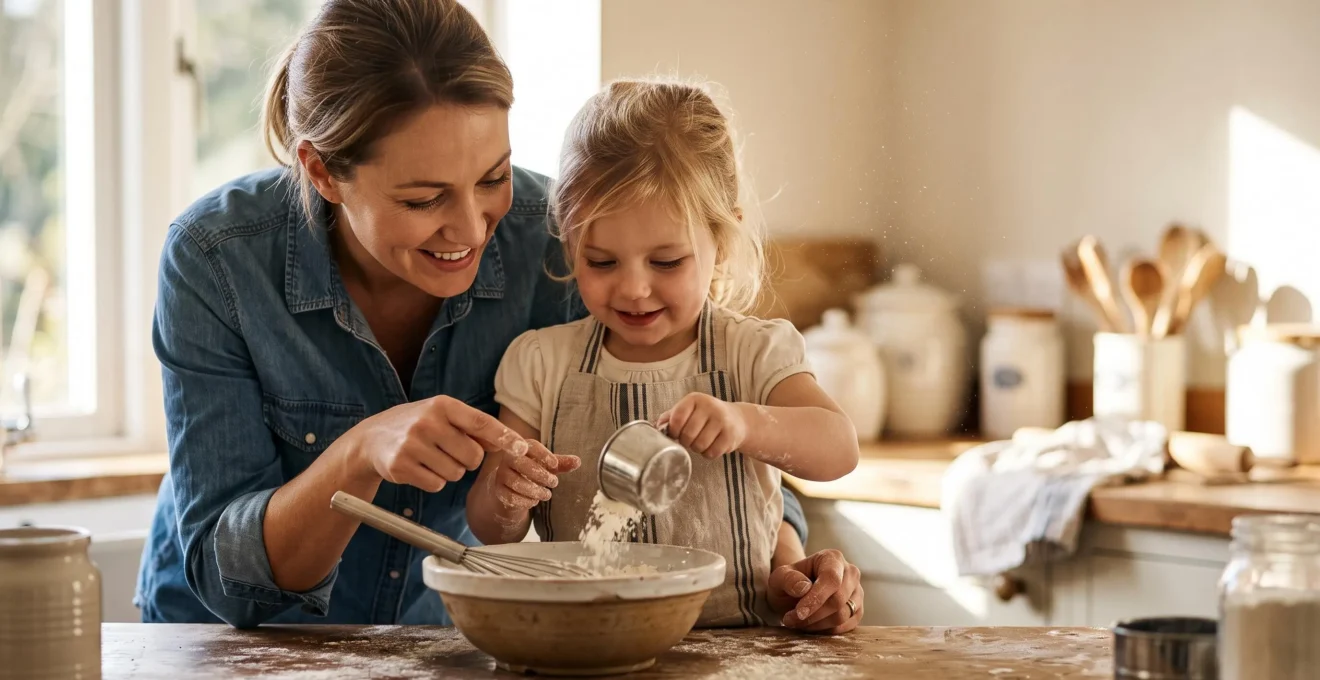
The myth is that “teaching” math at home means sneaking lessons into chores. The reality is that true mathematical thinking is sparked by shared discovery, not secret schooling.
- Genuine learning happens when you reveal the maths already present in everyday tasks, rather than forcing artificial problems.
- Activities like baking, shopping, and block play are naturally rich with concepts like ratios, estimation, and spatial reasoning.
Recommendation: Shift your role from ‘teacher’ to ‘curious co-discoverer’. Your goal is not to test your child, but to wonder alongside them.
There’s a quiet pressure on modern parents, a feeling that we should always be doing more to support our children’s education. This often translates into trying to turn our homes into extensions of the classroom. We hear the advice to “make learning fun” and dutifully try to inject educational content into every moment. We count stairs, quiz multiplication facts in the car, and download the latest “educational” app, hoping some of it sticks. We turn the kitchen table into a battlefield of worksheets and flashcards, often meeting resistance and frustration from both sides.
But what if this entire approach is based on a flawed premise? What if the goal isn’t to constantly *add* math lessons to our day, but to simply *reveal* the elegant, complex, and genuinely useful mathematics that are already woven into the fabric of our lives? The real magic isn’t in turning play into a lesson; it’s in recognizing that authentic play and meaningful work are already profound learning experiences. This is not about being a teacher in disguise, but about becoming a partner in discovery.
This guide is about making that mental shift. It’s about letting go of the “lesson trap” and embracing a more natural, curiosity-driven approach. We will explore how everyday routines—from baking a cake to doing the weekly shop—are packed with opportunities not for drills, but for genuine mathematical thinking. You’ll learn to spot these moments, foster your child’s innate curiosity, and build a family culture where maths is not a dreaded subject, but a fascinating tool for understanding the world.
To help you navigate this shift in perspective, we’ve broken down the core ideas into practical, real-world contexts. The following sections will guide you through the why and how of integrating maths naturally into your home life.
Table of Contents: A Guide to Noticing Maths Everywhere
- Why Is Baking the Best Way to Teach Fractions and Weights?
- How to Turn the Weekly Shop into a Budgeting Lesson?
- Worksheets or Real Life: Which Stick Better in Memory?
- The “Lesson” Trap: Why Turning Play into Work Kills Motivation
- How to Teach Concepts in 5-Minute Bursts?
- Why Does Block Play Predict Better Maths Scores at GCSE?
- STEM or STEAM: Why Adding Art Improves Engineering Skills?
- How to Improve Spatial Reasoning in Preschoolers Without Screens?
Why Is Baking the Best Way to Teach Fractions and Weights?
Baking is the ultimate sensory maths lab. It’s a place where abstract concepts like fractions, ratios, and measurements become tangible, edible realities. Forget the divided circles on a worksheet; here, a half-cup of flour is a real, physical thing you can hold, feel, and see. It has weight and volume. When a child has to measure three-quarters of a cup of sugar, they are not just reading a symbol; they are performing a practical task with a delicious outcome. The motivation is intrinsic to the activity itself.
This is what we call conceptual play. The learning isn’t the goal; it’s a byproduct of a meaningful project. Doubling a cookie recipe to bring to a friend’s house isn’t a multiplication drill—it’s a problem that needs solving. “We need twice as many cookies, so what do we do with the 1/3 cup of butter?” This question sparks a conversation about ratios and proportions that is directly relevant and immediately applicable. The kitchen becomes a space for experimentation, where mistakes (like confusing a tablespoon with a teaspoon) have clear, and often funny, consequences that are remembered far longer than a red ‘X’ on a page.
Case Study: The Scone Ratio Experiment
Mathematician Eugenia Cheng took this concept to a new level when she explored the ideal ratio of jam and cream to scone size. By baking an array of scones in 25 different sizes, she turned a simple baking exercise into a hands-on lesson in proportional reasoning and scaling. It demonstrates that even at a high level, the principles of maths can be explored through tangible, everyday activities, making the concepts intuitive and memorable.
The beauty of baking is that it seamlessly integrates different mathematical concepts. You’re using a timer (time), preheating an oven (temperature and numbers), weighing ingredients (mass), and measuring liquids (volume). It’s a holistic experience that shows maths isn’t a set of isolated skills but an interconnected system for describing the physical world.
How to Turn the Weekly Shop into a Budgeting Lesson?
The supermarket is a symphony of numbers, a real-world spreadsheet just waiting to be explored. For a child, it can be an overwhelming blur of colours and sounds, but with a little guidance, it becomes a brilliant training ground for estimation, budgeting, and unit price comparison. The key, as always, is to avoid the “lesson trap” and frame it as a collaborative challenge. You aren’t quizzing them; you’re asking for their help. “I have £10 for all our fruit and veg this week, can you help me keep track?”
This simple request transforms the child from a passive passenger in the trolley to an active participant in the family’s finances. Suddenly, the price of apples versus bananas matters. They can be in charge of the calculator, adding items up as you go. You can introduce the concept of value by comparing two different-sized boxes of their favourite cereal. “This one is bigger, but this one costs less per gram. Which one is the better deal?” This isn’t an abstract word problem; it’s a real choice with a real impact on the final bill.
The produce section is particularly rich for “math noticing.” The act of weighing vegetables connects a physical feeling—the heft of a bag of potatoes—to a specific number on a scale. It makes the abstract concept of a kilogram concrete.
A parent describes turning the produce section into a hands-on lesson: asking their child to find exactly one pound of apples by feel first, then checking the result on the scale, connecting the physical sense of weight to a concrete number.
– Parent, Math for Life
By involving them in these small decisions, you’re not just teaching them to calculate; you’re teaching them financial literacy and critical thinking. You are showing them that maths is a tool for making informed choices in the real world, a skill far more valuable than simply arriving at the right answer on a test.
Worksheets or Real Life: Which Stick Better in Memory?
Let’s be honest: when was the last time you, as an adult, solved a problem by filling in a worksheet? The skills we use daily—budgeting for a project, estimating travel time, adapting a recipe—are learned through practice, context, and necessity. This is the principle of real-world stickiness. A concept sticks in our memory when it’s attached to a sensory experience, an emotion, and a purpose. A worksheet, by its very nature, is divorced from all three.
Learning in the real world gives a child agency. When they help you navigate using a map or figure out how much change you should get, they are solving a real problem. They own the process and the outcome. This sense of control is a powerful motivator. As mathematician Eugenia Cheng notes, when you understand the principles behind a process, “you will be much more in control of the situation.” This is the opposite of the worksheet experience, where the child’s only role is to follow a prescribed path to a predetermined answer.
Furthermore, real-world maths embraces error as part of the learning process. If you miscalculate the amount of paint needed for a wall, you have to go back to the store. It’s an inconvenient but memorable lesson in area and estimation. On a worksheet, a wrong answer is just a red mark. It carries no weight, no story, and thus, very little long-term learning.
A parent reflects that the true goal of everyday math practice is not teaching a child to perform calculations perfectly, but to show them that math is genuinely useful in daily life, reframing errors during real-world practice as valuable moments rather than failures.
– Parent, Math for Life
The goal isn’t perfection; it’s familiarity and confidence. It’s about showing children that maths is not a performance but a practical tool. When the stakes are low and the context is real, they are free to explore, make mistakes, and build a resilient, intuitive understanding that will serve them far better than a sheet of memorised facts.
The “Lesson” Trap: Why Turning Play into Work Kills Motivation
Every parent has done it. Your child is happily stacking blocks, and you see a “teachable moment.” “How many blocks do you have there? What shape is that? If you add two more, how many will you have?” In an instant, the joyful, open-ended exploration of balance and structure is transformed into a pop quiz. The child’s focus shifts from their creation to your expectation. This is the “lesson trap,” and it is the fastest way to kill intrinsic motivation.
Play, by definition, is an activity done for its own sake. When we layer it with external goals and performance metrics, it ceases to be play and becomes work. The child is no longer exploring for the joy of discovery; they are trying to produce the “right” answer to please you. This introduces a subtle anxiety into the interaction. They may become hesitant to take risks or try new things for fear of getting it wrong. For a child, “I don’t know” can feel like a failure, especially when they just want to build a cool tower.
This pressure is often a reflection of our own insecurities. Many adults carry a degree of “math anxiety,” and we inadvertently pass it on. A study confirmed that when parents who are anxious about math frequently “help” with homework, their children’s skills can actually decline. Our well-intentioned interventions, when loaded with pressure, can do more harm than good. In fact, research involving 130 children and their parents found that higher parental math anxiety was directly linked to lower quantitative skills in their children, showing how easily this pressure is transferred.
The antidote is to shift from instructor to interested observer. Instead of asking “How many?” try a wondering comment: “I wonder if that tall tower will stay up,” or “I notice you’re using all the blue blocks first.” This validates their play without hijacking it. It communicates curiosity, not judgment. It keeps the focus on their process and empowers them to be the expert in their own play, which is where the deepest learning happens.
How to Teach Concepts in 5-Minute Bursts?
Meaningful learning doesn’t require hour-long, dedicated sessions. The most effective “unschooling” approach to maths happens in micro-moments—short, spontaneous bursts of mathematical thinking woven into the day. These are not planned lessons but opportunities seized in the moment. It’s about cultivating a habit of “math noticing” during the in-between times: waiting in a queue, sitting in traffic, or tidying up toys.
A car journey, for instance, is full of these moments. Instead of defaulting to a screen, you can tap into the data all around you. “The GPS says we’ll be there at 3:15, and it’s 2:50 now. How many minutes is that?” This is a quick, real-world subtraction problem. You could talk about speed and distance, estimating how long it will take to reach a visible landmark. These are not quizzes; they are shared puzzles that make the journey more engaging.
The power of these micro-moments is that they are low-stakes and context-rich. They show that maths isn’t something you only do at a desk, but a language you use to describe the world. When a LEGO tower falls over, a quick “I wonder why that happened?” can lead to an impromptu exploration of balance, foundation size (area), and structural integrity—all without ever using the word “lesson.”
Case Study: Embedding “Math Moments”
A family engagement program successfully demonstrated this by embedding brief, targeted math prompts into routines parents already do. For example, a prompt might suggest counting fingers and toes during a diaper change, or sorting laundry by colour and size. This approach, called “stacking” a new habit onto an existing one, shows how easily micro math moments can be integrated into daily family life without adding any extra time or stress to a parent’s schedule.
The key is to keep it light and quick. The goal is to spark a thought, not to conduct a full-blown seminar. These five-minute bursts, accumulated over time, build a powerful and positive foundation for mathematical thinking, making it a natural and effortless part of your child’s worldview.
Why Does Block Play Predict Better Maths Scores at GCSE?
It sounds almost too good to be true: the simple act of a preschooler stacking wooden blocks can have a measurable impact on their high school maths achievement. Yet, this is precisely what research has found. The connection isn’t magic; it’s a testament to the profound power of spatial reasoning. When a child plays with blocks, they are not just having fun; they are engaging in a complex, three-dimensional problem-solving exercise.
Every decision in block play is a mathematical one. Will this structure be stable? How many small blocks are equivalent to this one long block? They are intuitively exploring concepts of geometry, balance, symmetry, and proportion. They are mentally rotating shapes, planning structures, and learning from the physical feedback of a collapsing tower. This hands-on, trial-and-error process builds a strong mental model of how objects relate to each other in space—a skill that is foundational to higher-level mathematics like geometry and engineering.
This isn’t just a theory; it’s backed by significant long-term data. In a study that followed children over many years, researchers found a direct correlation between the complexity of a child’s block play at preschool age and their maths scores in adolescence. In fact, a landmark longitudinal study found that a child’s ability to build complex structures with blocks was a better predictor of later maths achievement than their early counting skills.
This finding is revolutionary for parents. It suggests that providing open-ended, screen-free toys like a simple set of wooden blocks can be one of the most effective “educational” investments we can make. It frees us from the pressure of flashcards and drills, and encourages us to value and protect our children’s unstructured playtime. It’s a powerful reminder that sometimes the most profound learning looks a lot like simple, classic fun.
STEM or STEAM: Why Adding Art Improves Engineering Skills?
For years, the focus in education has been on STEM: Science, Technology, Engineering, and Math. But a growing movement advocates for adding an “A” to make STEAM, and that “A” stands for Art. This isn’t just about making science projects look pretty; it’s about recognizing that creativity and design thinking are essential components of good engineering. Art and design encourage a different way of thinking that complements the rigid logic of traditional STEM.
When a child approaches a project with a STEAM mindset, they are concerned not only with *if* it works, but *how* it works, *why* it works, and how it feels to the user. Art introduces the human element. It forces them to think about aesthetics, user experience, and communication. A well-designed bridge isn’t just strong; it’s also elegant. A well-designed app isn’t just functional; it’s also intuitive and enjoyable to use. This holistic approach fosters innovation because it encourages students to draw connections between disparate fields.
Integrating art has been shown to have measurable benefits. Students engaged in STEAM projects often show higher levels of creativity, problem-solving, and self-confidence.
Case Study: STEAM and Student Self-Efficacy
This is more than just a theory. A formal study by Conradty and Bogner demonstrated that course instruction that integrated art with traditional STEM subjects (STEAM) measurably improved students’ creativity and self-efficacy levels when compared to students who received STEM-only instruction. The art component encouraged students to take risks and express unique ideas, building their confidence to tackle complex problems.
For parents at home, this means encouraging projects that blend technical skill with creative expression. Building a go-kart? Great! Let’s also design a cool logo for it. Creating a marble run? Fantastic! Let’s see if we can make it play a simple tune as the marble descends. These activities show that engineering isn’t just about cold calculation; it’s a deeply creative and human endeavor.
Your STEAM Project Audit: 5 Points to Check for Real Learning
- Technical Confidence: Does the project involve hands-on experimentation with tools and materials, even simple ones?
- Design Thinking: Did we start by identifying a real problem or goal before brainstorming and testing solutions?
- Systematic Approach: Are we encouraging a methodical process for tackling structural or technical challenges, rather than just random trial and error?
- Testing & Revision: Is there a built-in opportunity to evaluate the result and make improvements to the design?
- Documentation: Can we find a simple, fun way to record the steps and results, like taking photos or drawing diagrams?
Key Takeaways
- Shift your role from a teacher who tests to a curious co-discoverer who wonders.
- Real-world context is the glue that makes mathematical concepts stick in a child’s mind.
- The most profound learning often happens during unstructured play, free from adult agendas.
How to Improve Spatial Reasoning in Preschoolers Without Screens?
In our screen-saturated world, it’s easy to assume that digital apps are the best way to teach spatial skills. But the most powerful tools for developing a child’s spatial reasoning are often the most traditional and tangible. Spatial reasoning is the ability to think about and manipulate objects in three dimensions. It’s what allows a surgeon to navigate the human body, an architect to design a building, and a child to figure out how to fit all their toys back into a box.
The good news is that developing these skills can be incredibly fun and requires zero screen time. One of the best activities is building a simple obstacle course in your living room. “Can you crawl under the table, climb over the cushion mountain, and then slither like a snake to the sofa?” This isn’t just physical play; it’s a complex spatial puzzle. The child has to plan their route, orient their body in space, and navigate around, under, and over objects.
Other fantastic screen-free activities include jigsaw puzzles, which require mentally rotating pieces to find their fit, and playing with tangrams or other shape-based toys. Even simple tasks like setting the table involve spatial planning. The fork goes on the left, the knife on the right. This teaches spatial relationships and sequencing. The most important thing is to give them the freedom to move and interact with their physical environment.
“spatial skills are an integral predictor of young children’s later science and mathematics achievement”
– Uttal & Cohen, cited in Early Education and Development
As experts confirm, these skills are not trivial; they are a cornerstone of future academic success. By encouraging physical, interactive play, you are giving your child a fundamental advantage, building a strong foundation in their brain that will support them long after the obstacle course is tidied away.
To truly integrate this approach, the next step is to choose one routine—baking, shopping, or tidying up—and commit to simply noticing the maths with your child this week, with no agenda other than shared curiosity.