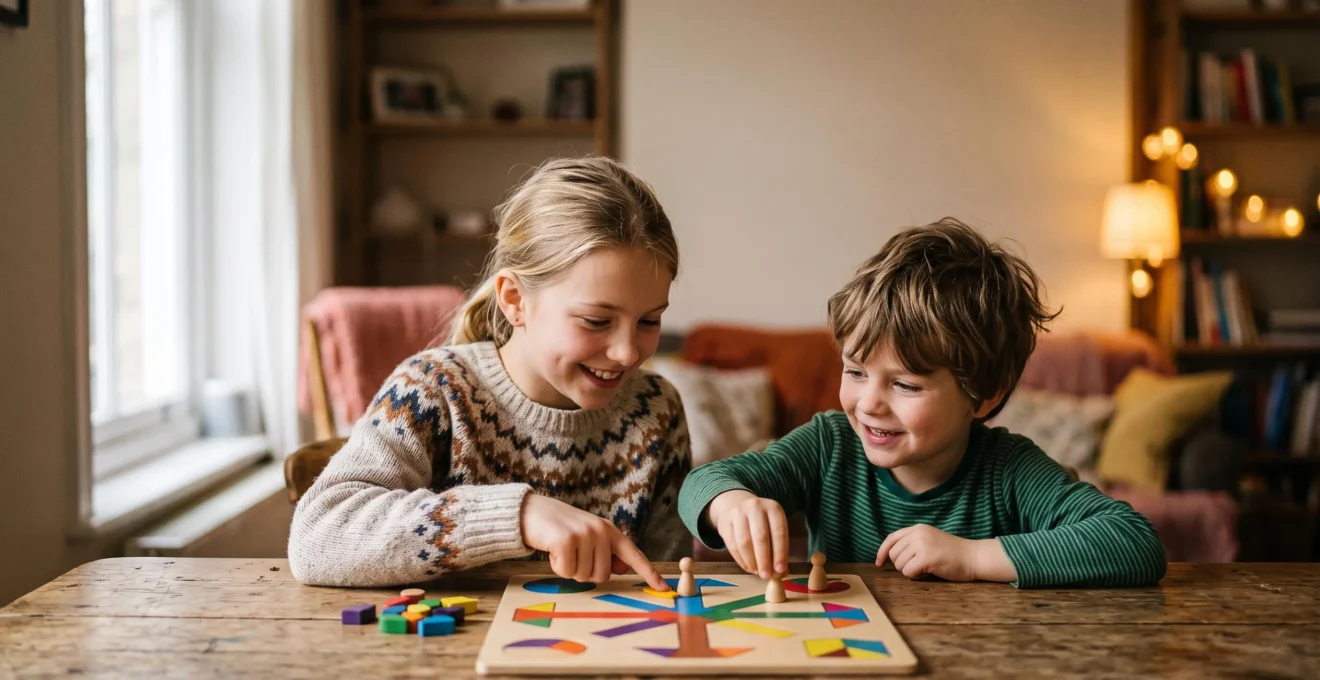
Cooperative games are not just about “playing nice”; they are engineered systems that transform sibling rivalry into a powerful alliance against a shared challenge.
- They replace zero-sum competition with a unified goal, making teamwork the only path to victory.
- Losing as a team builds resilience and strategic thinking, unlike the shame of individual defeat.
Recommendation: Stop refereeing fights and start curating experiences. Select games that scale in complexity and have clear, shared objectives.
The familiar scene unfolds: the Monopoly board is flipped, accusations of cheating fly across a game of Risk, and a promising family game night dissolves into tears and slammed doors. For parents weary of these zero-sum conflicts, the search for peace often leads to a well-intentioned but simplistic solution: “Let’s just play something where we all have to work together.” This instinct is correct, but it only scratches the surface of a profound parenting tool.
The real value of cooperative board games isn’t merely the absence of direct competition. Many parents try them, only to find the older sibling dominates the strategy or the younger one loses interest. The common advice—to encourage sharing or to just have fun—misses the point. The magic isn’t in the sentiment; it’s in the system. The best cooperative games are carefully engineered experiences designed to dismantle sibling rivalry from the ground up.
This guide moves beyond the platitudes. Forget simply “playing nice.” We will deconstruct *how* these games function as powerful tools for alliance building. We will analyze the mechanics that turn a common enemy—the game board itself—into a catalyst for unity. This is not about finding a temporary ceasefire for your living room; it’s about using the power of a shared narrative challenge to fundamentally reshape how your children see each other, transforming them from rivals into a team.
By understanding the design principles that foster genuine teamwork, you can move from being a referee of endless squabbles to a curator of character-building experiences. This article will explore the psychology behind cooperative play, provide a framework for selecting the right game for different ages, and offer strategies to turn both wins and losses into valuable life lessons.
Summary: A Critic’s Guide to Co-op Games That Build a Sibling Alliance
- Why Do Cooperative Games Reduce Sibling Fighting After Play?
- How to Select a Co-op Game That Neither Bores the Eldest nor Frustrates the Youngest?
- Winning Together or Beating Others: Which Builds Better Character?
- The “Pandemic” Effect: How Losing as a Team Builds Resilience
- When to Schedule Family Game Night for Maximum Engagement?
- How to Use “Sportscasting” to Describe Conflicts Without Judging?
- Why Is Losing a Board Game Good for Your Child’s Character?
- How to Mediate Sibling Fights Without Taking Sides?
Why Do Cooperative Games Reduce Sibling Fighting After Play?
The peace that settles over a household after a successful cooperative game isn’t a fluke; it’s a direct result of psychological recalibration. Competitive games, by their very nature, are zero-sum. For one sibling to win, the other must lose. This structure inherently breeds rivalry, activating the same parts of the brain that manage threat and social hierarchy. Cooperative games fundamentally change this dynamic by introducing a shared narrative challenge. Suddenly, the “enemy” is not the person across the table but the volcano about to erupt, the diseases spreading across the globe, or the ghosts haunting the manor.
This shift from interpersonal conflict to external problem-solving is powerful. It forces siblings to pool their cognitive resources, communicate strategies, and celebrate shared victories. A real-time interaction study on sibling pairs confirmed this, finding that the structure of a cooperative task dramatically changes behavior compared to a competitive one. The goal is no longer to outwit a sibling but to work with them to outsmart the game’s system. This fosters a sense of alliance and shared identity, with research noting a 25% reduction in negative social interactions after cooperative play sessions.
By creating a common foe, these games provide a safe, structured environment for siblings to practice the art of alliance building. They learn that their brother’s special ability or their sister’s keen observation is not a threat, but an asset to the team’s survival. This experience of mutual dependency and shared success creates a positive feedback loop that can extend well beyond the game board, laying a foundation for more collaborative and less combative real-world interactions.
How to Select a Co-op Game That Neither Bores the Eldest nor Frustrates the Youngest?
The biggest challenge in a multi-age family is the “engagement gap.” A game simple enough for a six-year-old is often mind-numbingly dull for a twelve-year-old, while a game that captivates the elder can be a source of immense frustration for the younger. The key is not to find a game that targets the “middle,” but one that allows for asymmetrical contribution. The best mixed-age co-op games give every player a clear, valuable role, regardless of their strategic depth.
Look for games with unique character roles or abilities. In many cooperative games, one player might be the “Medic” who is great at healing, while another is the “Explorer” who excels at moving quickly. This allows the younger child to have a simple, powerful, and easy-to-understand job (“Your mission is to put out fires!”), while the older child can engage with the more complex, overarching strategy. The goal is to ensure each player feels essential to the team’s success. The table below highlights games known for their ability to bridge this age and skill gap, offering a good starting point for your search.
| Game | Recommended Age | Why It Works for Mixed Ages |
|---|---|---|
| Forbidden Island | 8+ | Straightforward rules taught in under ten minutes, ideal beginner co-op |
| Pandemic | 10+ | Rules simple enough for an eight-year-old to follow, yet strategic depth keeps older players engaged |
| 5-Minute Dungeon | 8+ | Fast pace suits younger attention spans |
| Horrified | 10+ | Approachable complexity for slightly older children |
The data in this table is a helpful starting point, drawing from sources like a comparative analysis of popular cooperative games. However, beyond the box’s recommendation, your own judgment is paramount. You need a system to evaluate if a game will truly work for *your* family’s unique dynamic.
Your Game Selection Audit: 5 Points to Check Before You Buy
- Role Differentiation: Does the game offer unique player roles or abilities? A game where everyone does the same thing is more likely to lead to the oldest player “quarterbacking” the whole team.
- Scalable Difficulty: Can you make the game easier or harder? Look for options like adding or removing challenge cards, changing the starting setup, or adjusting the number of “lives” the team has.
- Shared Information: Is all information open and on the table? “Hidden information” games can frustrate younger players and encourage older ones to take over. Open information promotes discussion and team strategy.
- Clear, Shared Threat: Is the “enemy” obvious and easy for everyone to understand? A visible, advancing threat (like rising water levels or spreading fires) keeps everyone focused on the common goal.
- Playtime vs. Attention Span: Does the estimated playtime match the attention span of your youngest player? A great 45-minute game is a terrible choice if your child zones out after 20 minutes.
Winning Together or Beating Others: Which Builds Better Character?
The classic defense of competitive sports and games is that they “build character” by teaching children how to win graciously and lose with dignity. While there’s truth to this, it often overlooks a crucial detail: for many children, especially in a sibling context, the primary emotional takeaway from competition is not character-building, but a stark feeling of superiority or inferiority. The joy of winning is often eclipsed by the joy of seeing a sibling lose. This is a fragile and transactional basis for family connection.
Cooperative games offer a different path to character development. By removing the sibling-versus-sibling dynamic, they focus on virtues like communication, collective problem-solving, and shared responsibility. The satisfaction comes not from individual triumph, but from contributing to a group success. This distinction is more than just philosophical. An open-access child development study on board games found a statistically significant difference in behavior after cooperative versus competitive play, with cooperation fostering more positive social interactions.
Case Study: The Preschooler Enjoyment Factor
The argument for cooperation is not just about abstract virtues; it’s also about fun. A study published in the Scandinavian Journal of Psychology looked at preschoolers’ enjoyment levels and found that children reported significantly greater enjoyment during cooperative board games than during competitive ones. For young children, the goal is often the shared activity itself. The high-stakes pressure of a one-on-one competition can detract from the simple pleasure of playing together. This suggests that when the goal is to create a positive, bonding experience, cooperative formats may be inherently more effective, especially for younger kids.
This doesn’t mean competitive games have no place. They are excellent for teaching rule-following and managing personal disappointment. However, when the specific goal is to strengthen the sibling bond and reduce conflict, cooperative play is the superior tool. It shifts the focus from “me versus you” to “us versus the problem,” building a foundation of partnership that is far more resilient and valuable than any single victory.
The “Pandemic” Effect: How Losing as a Team Builds Resilience
In most competitive games, losing is a solitary and often shameful experience. It’s a direct reflection of your own failed strategy or bad luck. This is why a loss can trigger meltdowns: the defeat feels personal. Cooperative games, particularly well-designed hard ones like *Pandemic*, introduce a revolutionary concept: productive failure. The game is designed so that you will, and should, lose often. This completely reframes the experience of defeat.
Losing is no longer an individual failing but a shared team outcome. The post-game conversation shifts from “You made me lose!” to “What could *we* have done differently?” This “us against the world” mentality is precisely what makes games like *Pandemic* a powerful training ground for resilience. A guide on using the game for education notes that teams should plan on losing more than they win. When failure is normalized and expected, it loses its sting. It becomes just another data point for the team to analyze, turning a loss into a “debrief” for the next attempt.
This process of losing together, analyzing the failure, and re-strategizing is an incredible life lesson. It teaches children to detach their self-worth from the outcome of a single event. It models a growth mindset in a low-stakes environment. Instead of a “sore loser,” you cultivate a “resilient strategist.” The key for parents is to facilitate this debriefing process, turning the disappointment of a loss into a productive, forward-looking conversation.
- Normalize the Loss: Before you even start, say, “This game is tough! We probably won’t win the first time, and that’s part of the fun. This is a practice run.”
- Isolate the Tipping Point: After a loss, ask, “Where did it get tricky? Was there one turn where we realized we were in trouble?” This turns blame into analysis.
- Focus on One Change: Instead of a full post-mortem, ask, “What’s one thing we could try differently next time?” This makes the next game a new experiment, not a dreaded rematch.
- Embrace the Challenge: Frame the game’s difficulty as the central appeal. “Wow, this game is smart! It almost got us. I bet we can outsmart it next time.”
When to Schedule Family Game Night for Maximum Engagement?
In the rush of modern life, family game night can feel like just another to-do item on a packed schedule. But its power lies in its potential to become a cherished ritual, a predictable island of connection in a sea of chaos. The specific day of the week is less important than the consistency. Whether it’s “Fun Friday” or “Sunday Game Day,” what matters is creating a sense of anticipation and protected time. This is not just a nice idea; it reflects a deep-seated human need for connection. A recent Pew Research Center survey found that 73% of adults value spending quality time with their family above almost all else.
To maximize engagement, treat it like the special event it is. Banish distractions—phones go in a basket, the TV goes off. Elevate the experience with small traditions: a special snack, a “game night” playlist, or letting the winner of the last game choose the next one. These small acts signal that this time is different, sacred, and worthy of everyone’s full attention. This isn’t just about playing a game; it’s about building a shared history and a library of in-jokes and memories.
The psychological benefits of this dedicated time are significant. As the staff of the News and Sentinel note when summarizing expert opinions, the positive impact is well-documented. They write that, according to psychologists, “these sessions strengthen family bonds, enhance social skills and foster emotional well-being.” By scheduling and protecting this time, you are sending a clear message to your children: “Our connection is a priority.” You are moving beyond simply managing their behavior and are actively curating an environment where positive relationships can flourish.
How to Use “Sportscasting” to Describe Conflicts Without Judging?
Even with the best cooperative game, disagreements can happen. A bossy older sibling might try to “quarterback” every move, or a younger one might get frustrated. When this happens, a parent’s instinct is to jump in and solve the problem: “Be nice,” “Let your sister have a turn,” “Stop telling everyone what to do.” This approach, while well-intentioned, often backfires. It casts you as the judge and jury, creating a new dynamic where kids compete for your favor. A more powerful technique is “sportscasting.”
Sportscasting means narrating the conflict neutrally, like a sports commentator describing a play. You state the facts of the situation without blame, judgment, or providing solutions. The author of the Peaceful Parents Confident Kids blog, a proponent of the technique, puts it succinctly: “Sportscasting really is the ultimate tool for coping with sibling rivalry between young children.” Instead of “You’re not letting her play,” you say, “I see Sarah wants to move this piece, and you think it should go here.” This simple shift has three powerful effects: it helps children feel seen and understood, it de-escalates the emotion by labeling it, and it puts the responsibility for finding a solution back on them.
Case Study: The Perils of Biased Sportscasting
A parent blogger documented her own journey with this technique, admitting her early attempts were failures. She found she was projecting her own biases onto the conflict (“You’re frustrated because he always takes that piece”) and rushing to a conclusion (“Why don’t you just let her have it?”). This only made things worse. She learned that the most vital part of sportscasting is to remain truly neutral and descriptive, like a camera recording the scene. The goal isn’t to guide them to your preferred solution, but to give them the space and language to find their own.
Mastering this skill takes practice. Your role is not to be a referee who blows the whistle, but a commentator who clarifies the state of play. You might say, “Hmm, two players have different ideas about the next best move. This is a tough decision for the team.” This language validates both children’s perspectives and frames the disagreement as a shared team problem, not an interpersonal fight. It empowers them to negotiate a solution, a skill far more valuable than simply obeying a parental command.
Why Is Losing a Board Game Good for Your Child’s Character?
The cultural narrative around gaming is overwhelmingly focused on winning. We celebrate victory and pathologize “sore losers.” But what if this framework is fundamentally flawed, especially for kids? In the context of a family game night, losing—when handled correctly—can be a more potent character-building experience than winning. Every time a die roll goes wrong, a plan is thwarted, or a turn is wasted, it’s a micro-dose of adversity. It’s an opportunity to practice one of life’s most critical skills: frustration tolerance.
A board game is a safe, contained environment to experience and manage disappointment. Unlike a bad grade at school or a social rejection, a game loss has no real-world consequences. This low-stakes environment is the perfect training ground for emotional regulation. The simple act of waiting your turn, seeing another player take a spot you wanted, or drawing a bad card are all small lessons in patience and adapting to circumstances beyond your control. As one child development resource notes, playing board games is a direct way to enhance a child’s ability to delay gratification and manage frustration.
The parent’s role in this process is crucial. When a child is upset about a loss, the instinct is to dismiss the feeling (“It’s just a game”) or immediately offer a win (“We’ll play again and I’ll let you win”). A better approach is to validate the emotion while reframing the experience. You can say, “It’s frustrating when you don’t get the card you need, I understand. That was a tough break.” This acknowledges their feeling without changing the outcome. You are teaching them that disappointment is a survivable emotion and that the value of the game was in the playing, not just the result.
Key Takeaways
- Shift your game library’s focus from competitive (zero-sum) to cooperative (shared goal) games to fundamentally change sibling dynamics.
- Select games that offer different player roles and scalable difficulty to keep both older and younger children engaged and feeling valuable.
- Embrace losing as a team as “productive failure”—a crucial, low-stakes opportunity to teach resilience, analysis, and strategic thinking.
How to Mediate Sibling Fights Without Taking Sides?
You’ve chosen the perfect cooperative game, set the stage for a great family night, and coached your kids on the value of losing. Yet, a fight erupts. At this moment, your intervention is critical. The goal is not to declare a winner or punish a loser, but to guide your children toward their own resolution. This requires you to step out of the “judge” role and become a neutral mediator. The classic book *Siblings Without Rivalry* by Adele Faber and Elaine Mazlish provides a time-tested framework for this exact situation.
The core principle is to show respect for the conflict itself. Instead of shutting it down, you give it air, but in a structured way. You express confidence in your children’s ability to solve their own problems, which is a powerful message that builds their competence and self-esteem. By refusing to take sides, you remove the incentive for them to “tattle” or try to win your approval, forcing them to engage with the actual person they’re in conflict with: their sibling. This process is more work in the short term than simply laying down the law, but it pays massive dividends in the long run by teaching them lifelong conflict resolution skills.
Here is a simplified version of the Faber and Mazlish method, adapted for a mid-game dispute:
- Acknowledge the Conflict & Ensure Safety: Calmly state what you see: “Looks like we have a problem here. Things seem to be getting heated.” If there is any physical or verbal aggression, state clearly, “We don’t hurt each other,” and give them space to cool down before proceeding.
- Listen to Each Side Neutrally: Give each child a chance to state their case without interruption. Reflect back what you hear: “So, you’re feeling frustrated because you think that move will make us lose,” and to the other, “And you feel it’s the only move that can save us.”
- Express Confidence & State the Problem: Show faith in their abilities. “This is a tough spot. We have two smart players with two different ideas. The problem is, the team can only make one move.”
- Leave the Room: This is the most crucial—and hardest—step. Tell them, “I have confidence that you two can work this out and find a solution that’s fair to the team,” and then walk away. By removing yourself as the audience and arbiter, you empower them to negotiate directly.
Your goal is not just to survive another game night, but to transform it into your family’s most powerful tool for connection and character-building. Start by re-evaluating your game shelf not as a collection of toys, but as a toolkit. Choose one cooperative game to try this week, and commit to playing the role of a neutral facilitator, not a referee. Your family’s next favorite memory awaits.