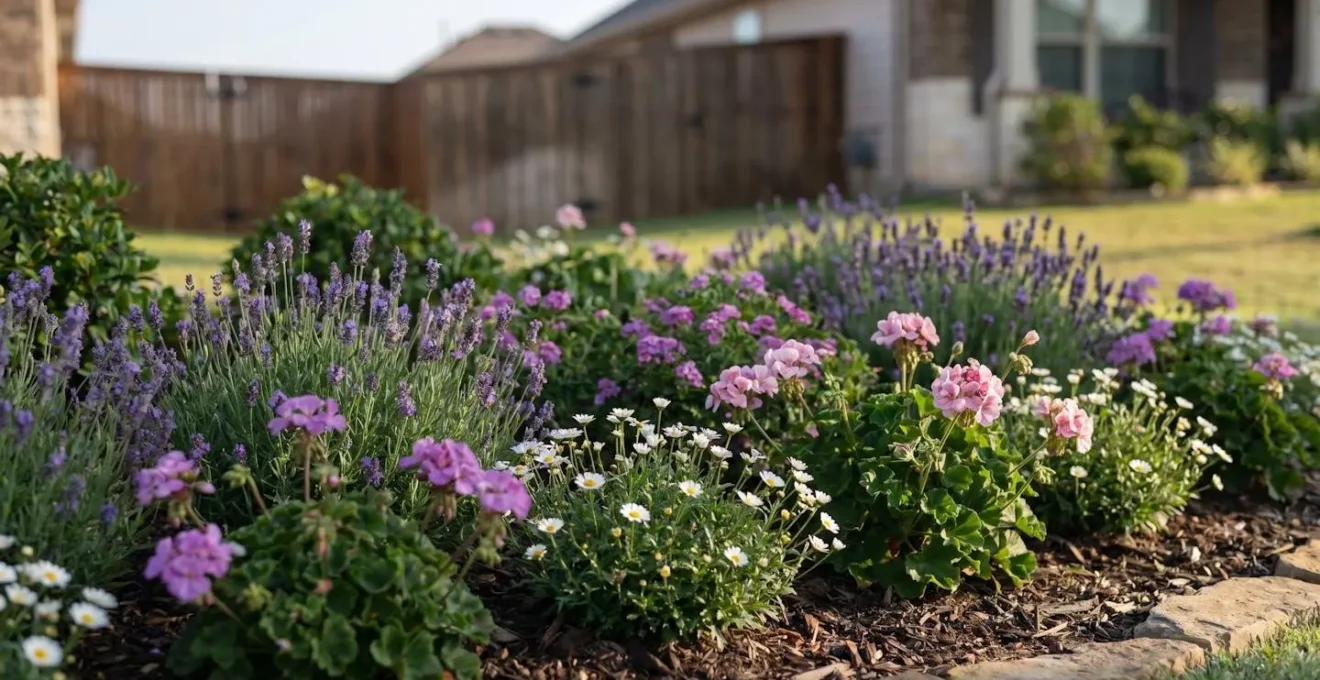
The secret to a garden that blooms for months isn’t a magic plant list; it’s understanding the horticultural trade-offs that create true performance.
- Labels like the RHS AGM are a starting point, not a guarantee. Real-world resilience and safety are equally crucial.
- A plant’s energy is finite. Sterile cultivars bloom longer because they don’t waste energy producing seed.
Recommendation: Prioritise cultivars bred for sterility and genetic stability, and always assess a plant’s structure, not just its flower.
For owners of small UK courtyards, every square inch of soil is prime real estate. The pressure is on for every plant to justify its place with a long, spectacular performance. Many articles will offer a simple list of so-called ‘long-blooming’ perennials, often headlined by the ubiquitous Geranium ‘Rozanne’. But a true plant hunter knows that a list is a tool, not the answer. The real art lies in learning to read the signs, to understand the ‘why’ behind a plant’s performance, and to spot the hidden gems and potential pitfalls before you even reach the checkout.
The common advice to “deadhead regularly” and “feed your plants” is sound, but it treats a symptom, not the cause. It puts the burden of performance entirely on the gardener. What if the secret was to choose plants that are genetically programmed for a longer display? What if understanding a little botany could save you hours of work and deliver a far more rewarding garden? This guide moves beyond the generic advice. We will not just list plants; we will deconstruct what makes a cultivar a high-performance investment for your small space.
We’ll start by questioning the industry’s gold standard, then dive into the fascinating science of plant energy. We will explore why some prized plants fail and how to make strategic choices about structure, timing, and size. This is the plant hunter’s mindset: a curated, selective approach that transforms your garden from a collection of plants into a dynamic, season-spanning ecosystem.
This guide will equip you with the critical eye needed to analyse plant potential. Below is a summary of the key areas we will explore to help you curate a garden that truly works hard for its space, delivering colour and interest for six months or more.
Summary: A Plant Hunter’s Guide to High-Performance Cultivars
- RHS AGM: Does the Logo Really Guarantee Better Performance?
- Why Sterile Cultivars Bloom Longer Than Fertile Ones?
- Variegated Reversion: Why Your Cultivar is Turning Green Again?
- Patio Clematis vs Climbers: Which Cultivar Actually Flowers at Eye Level?
- When to Buy: Getting the Best Cultivars Before Nurseries Sell Out?
- Sequencing Your Planting: How to Hide Dying Foliage With New Growth
- Pot Size Matters: When to Buy Mature Specimens for Instant Softening?
- Herbaceous Species or Shrubs: Which Offers Better Value for Small Borders?
RHS AGM: Does the Logo Really Guarantee Better Performance?
The Royal Horticultural Society’s Award of Garden Merit (AGM) is the industry’s most trusted seal of approval. It signifies that a plant has been trialled and judged for its excellent performance, availability, and stability. For the discerning gardener, it’s a powerful shortcut to quality. However, a plant hunter knows it’s a starting point, not the final word. The AGM is a brilliant filter, but it doesn’t test for every attribute that matters in a small, family-oriented garden. Critically, it does not assess for toxicity to children or pets, nor does it factor in physical hazards like thorns or irritant sap.
The AGM is an exclusive club; research highlights that only 10% of plants in the RHS Plant Finder hold AGM status, representing a carefully curated elite selection. While this guarantees a certain level of garden-worthiness, it doesn’t guarantee suitability for *your* specific context. A plant that performs magnificently in a large, open trial field might behave differently in the unique microclimate of a walled city courtyard. A plant hunter uses the AGM as a first-pass filter for reliability but always applies a second layer of personal scrutiny based on their own garden’s needs.
This is where the ‘plant hunter’s eye’ becomes crucial. It involves looking beyond the label and assessing the plant for its holistic fit. Will it withstand a stray football? Does it offer sensory engagement for children? The AGM confirms the plant won’t disappoint in terms of basic health and vigour, but it’s your job to confirm it will thrive in the life of your garden.
Your Plant Hunter’s Checklist: Looking Beyond the AGM Label
- Safety First: Check if the plant is toxic to children and pets using reliable poison databases, as the AGM does not test for this.
- Tactile Hazards: Inspect for thorns, sharp leaf edges, or irritant sap that could harm curious toddlers during play.
- Durability Assessment: Can it withstand a stray ball or the occasional rough handling that comes with family life?
- Sensory Appeal: Does it have interesting textures, scents, or seed heads that will engage a child’s curiosity beyond just the flower?
- AGM Baseline: Verify it meets the core AGM criteria for hardiness, performance, and stability as your foundation for reliability.
Why Sterile Cultivars Bloom Longer Than Fertile Ones?
This is perhaps the most valuable secret in a plant hunter’s arsenal. The single biggest factor determining the length of a plant’s flowering season is its reproductive strategy. A fertile plant’s biological imperative is to produce seeds. Once its flowers are pollinated, it diverts a massive amount of energy away from producing more blooms and into developing seeds and fruit. A sterile plant, on the other hand, cannot produce seed. It is in a state of beautiful frustration, continually pushing out new flowers in a vain attempt to reproduce. This is the mechanism behind many of the longest-blooming champions in the plant world.
This isn’t just theory; it’s a fundamental principle of energy allocation in botany. As pollinator researcher Dr. Annie White explains, the effect is direct and significant. In research on native plant cultivars, she notes:
Breeding for sterility can inhibit flowers from setting seed, hence resulting in longer bloom duration.
– Dr. Annie White, Piedmont Master Gardeners Research on Native Plant Cultivars
This is a critical horticultural trade-off. While sterile cultivars may offer less value to pollinators seeking pollen or nectar, their extended floral display provides immense ornamental value, especially in a small garden where every bloom counts.
As you can see, the plant expends all its resources on creating a continuous succession of flowers, with no energy diverted to seed pod formation. This visual evidence is what a plant hunter looks for. When you see a plant in the garden centre in late summer still covered in pristine blooms with no sign of fading or seed heads, you may be looking at a sterile cultivar—a true marathon performer.
Case Study: The Madagascar Periwinkle
The power of sterility is perfectly demonstrated by the Madagascar periwinkle (Catharanthus roseus). A comparative study found a stark difference in bloom longevity. The flowers on fertile varieties began to wither just 7 days after blooming as the plant channelled its energy into seed production. In contrast, the sterile, fringe-flowered cultivars held their blooms beautifully, with flowers still looking fresh around day 12. This 5-day extension per flower, multiplied across the whole plant, results in a significantly longer and more impressive overall display.
Variegated Reversion: Why Your Cultivar is Turning Green Again?
Variegated plants, with their stunning patterns of cream, white, or yellow on their leaves, are prized for bringing light and texture to shady corners of a small garden. However, many gardeners have experienced the disappointment of a beautifully patterned plant gradually, or sometimes suddenly, ‘reverting’ to plain green. This isn’t a sign of failure on the gardener’s part; it’s a powerful demonstration of plant genetics and survival of the fittest at a cellular level. The all-green sections of a plant are genetically more stable and vigorous.
The science is straightforward: the green parts of a leaf contain more chlorophyll, the engine of photosynthesis. As botanical research shows, green cells have superior photosynthetic efficiency, dividing and growing faster than the paler, variegated tissue. This gives the green growth a significant competitive advantage. If left unchecked, these more vigorous green shoots, known as ‘reversions’, will quickly dominate and shade out the more delicate variegated portions, eventually taking over the entire plant. A plant hunter knows to watch for this and act decisively.
The key is vigilance and swift action. Reversion is most common on woody plants like Euonymus, Holly, or variegated Pittosporum, but can also happen on herbaceous perennials. The only solution is to prune out the offending all-green shoot as soon as it appears. You must trace it back to its origin point on the stem or branch and cut it off completely. This removes the competitive advantage and allows the less vigorous, but more beautiful, variegated growth to thrive.
You can even turn this into an educational activity for children. Framing it as a “plant detective” game, where they have to spot the “imposter” green branches, is a wonderful way to teach them about plant biology and the importance of observation in the garden. It’s a living lesson in genetics and a practical task that gives them ownership over the garden’s health.
Patio Clematis vs Climbers: Which Cultivar Actually Flowers at Eye Level?
Clematis are the quintessential climbers for English gardens, but in a small courtyard, the traditional, vigorous varieties can quickly become a tangled mess, with all their flowers appearing 10 feet up, far above the eyeline. For families, and especially for children, a plant that flowers where you can see and appreciate it is far more valuable. This is where the plant hunter’s focus on *specific cultivars* pays dividends. The distinction between a “climbing clematis” and a “patio clematis” is critical.
Patio clematis, often from groups like the Evison/Poulsen Boulevard® collection, have been specifically bred for a compact habit. They are designed to produce a profusion of flowers from the base of the plant upwards, ensuring a floral display at a manageable height of 1-1.5 metres. This makes them perfect for pots, small obelisks, and containers on a balcony or patio, where their beauty can be enjoyed up close by everyone, including toddlers. Traditional climbers, like the popular ‘Ernest Markham’ or the rampant Clematis montana, are bred for vigour to cover large walls or pergolas, a scale that is often overwhelming in a confined space.
The table below breaks down the key horticultural trade-offs between these two types, making it clear why a compact cultivar offers superior value for a small, family-oriented garden.
| Feature | Patio/Compact Clematis | Traditional Climbing Clematis |
|---|---|---|
| Mature Height | 50cm – 1.5m (child eye level) | 3m – 6m+ (adult eye level only) |
| Bloom Location | Low on the vine, visible to toddlers | Higher up, requiring looking up |
| Container Suitability | Excellent for balconies/patios | Needs large containers, very vigorous |
| Safety for Families | Manageable, presents no climbing hazard | Can create entanglement risk for play |
| Example Cultivars | ‘Bijou’ (50cm), ‘Bees Jubilee’ (1m) | ‘Ernest Markham’ (3.5m), montana (6m+) |
| Root Ball Size | Smaller, easier for container growth | Larger, needs in-ground planting or huge pots |
Success Story: Clematis ‘Olympia’ for Small Spaces
A prime example of a perfect patio performer is Clematis ‘Olympia’. Reaching a modest height of only 3-4 feet, it’s ideal for a small obelisk in a border or a generous patio pot. As highlighted by clematis specialists at Taylors Clematis, it is an excellent choice for families with limited space. Its compact nature means the stunning purple blooms are produced at a height where young children can observe and appreciate them, all while remaining manageable and non-invasive, a perfect fit for a small UK courtyard.
When to Buy: Getting the Best Cultivars Before Nurseries Sell Out?
The hunt for the best plants isn’t just about knowing *what* to buy, but *when* to buy it. The horticultural retail calendar has distinct seasons, and the savvy plant hunter knows how to play them to their advantage to secure the most sought-after, high-performance cultivars before they sell out. Leaving your plant shopping until a sunny weekend in May is a recipe for disappointment, facing picked-over stock and higher prices.
The best time to secure popular, long-blooming perennials is often in the depths of winter. From December to February, many specialist online nurseries offer bare-root plants for pre-order. This is your chance to reserve titans like Geranium ‘Rozanne’ or Salvia ‘Caradonna’ before the spring rush even begins. Bare-root plants may look like unpromising twigs, but they establish incredibly quickly and are often more cost-effective.
Early spring (March-April) is prime time for visiting physical nurseries. The first deliveries of young plants and plugs arrive, offering the widest selection. The plants are fresh, full of potential, and have the entire growing season ahead to establish. By late spring (May), the story changes. The most popular cultivars are often sold out, and the remaining stock can be leggy or pot-bound. Your strategy must then shift to seeking out lesser-known alternatives that offer similar performance. This is where having a “Plan B” list of cultivars is invaluable. For every superstar, a plant hunter has two or three alternative candidates researched and ready.
This strategic approach to buying ensures you get the best plants at the best time, turning a potentially stressful rush into a planned, successful acquisition. It’s the final piece of the puzzle in curating a truly exceptional small garden.
Sequencing Your Planting: How to Hide Dying Foliage With New Growth
A truly high-performance garden isn’t just about individual plants; it’s about the choreography between them. One of the classic challenges in a small garden is the “messy phase” of spring bulbs. After their glorious display, the foliage of daffodils, tulips, and alliums must be left to die back naturally to feed the bulb for next year’s show. In a small courtyard, this slowly yellowing, collapsing foliage can be a major eyesore. The plant hunter’s solution is succession planting: cleverly positioning later-emerging plants to hide the decline of the early stars.
This is a magic trick of timing and placement. The goal is to plant summer-blooming perennials directly in front of or among your spring bulbs. As the bulb foliage begins to fade, the fresh, new growth of the perennials emerges, rising up to gracefully conceal the untidy leaves. It creates a seamless transition and ensures the garden border always looks fresh and full. Think of it as a botanical changing of the guard.
Choosing the right partners is key. You need a “foliage hider” with dense growth that emerges at the right time. Hostas are masters of this, their large leaves unfurling like architectural scrolls just as daffodils are looking their worst. The feathery foliage of Coreopsis or the spreading, soft leaves of Catmint (Nepeta) are also excellent choices. This layered approach adds depth, complexity, and a sense of thoughtful design to even the smallest border.
The table below provides some classic, family-safe pairings to create this continuous display. The ‘Family-Safe Rating’ considers both toxicity and general robustness, ensuring your beautiful sequence is also a worry-free one.
| Early Star (Spring Bloom) | Foliage Hider (Summer Emergence) | Family-Safe Rating |
|---|---|---|
| Alliums (fun globe flowers) | Hosta (large unfurling leaves) | ★★★★★ Non-toxic, engaging |
| Daffodils (bright, cheerful) | Salvia (continuous bloom May-Nov) | ★★★★☆ Salvia safe, Daffodil bulbs toxic if ingested |
| Early tulips | Coreopsis (ferny foliage, long bloom) | ★★★★★ Both non-toxic |
| Crocus (tiny, first bloomers) | Catmint (spreading, fragrant) | ★★★★★ Deer resistant, child-safe |
Pot Size Matters: When to Buy Mature Specimens for Instant Softening?
Patience is a gardener’s virtue, but sometimes, you just need instant impact. When softening the hard edges of a new patio or creating an immediate screen in a courtyard, waiting three years for a small plant to mature isn’t always an option. This is when a plant hunter considers the strategic acquisition of a mature, larger-potted specimen. It’s a significant investment, so the decision must be calculated, weighing the immediate ‘wow factor’ against the higher cost and greater transplant shock risk.
Buying mature is a trade-off. You are paying a premium for the time the nursery has invested in growing the plant on. This is most effective for structural plants—compact shrubs, ornamental grasses, or large herbaceous perennials that will immediately define a space. For instance, according to horticultural research, compact varieties of long-blooming perennials like coneflowers bloom from early summer through fall, and buying a large, multi-stemmed specimen can provide an instant block of colour for 4-5 months. This can be invaluable for a special event or for a gardener who wants a finished look by the first summer.
However, the risk is higher. A large plant in a 5-litre or 10-litre pot has a much larger root system and is more susceptible to stress during transport and planting. It’s crucial to inspect these specimens carefully before buying. Avoid plants with roots circling densely at the bottom of the pot (root-bound) or those showing signs of stress like yellowing leaves. A healthy mature plant should feel heavy for its size, indicating a well-watered root ball. When you get it home, plant it immediately and water it deeply to help it settle in. Using a good layer of mulch will help protect your investment by retaining moisture and regulating soil temperature.
Checklist for Buying Mature Plants: Protecting Your Investment
- Root Inspection: Gently tip the pot to check the roots. They should be visible but not a dense, circling mass growing out of the drainage holes.
- Stress Signal Scan: Avoid any plant with yellowing leaves, wilting, or broken stems. These are signs of stress that will hinder establishment.
- The Weight Test: A healthy mature plant feels substantial. An overly light pot indicates it’s dangerously dry; an overly heavy one might be waterlogged.
- Transport Plan: Be prepared. Large plants are fragile. Bring tarps or blankets to protect them in your car, especially on a hot or windy day.
- Immediate Planting Protocol: Plant it as soon as you get home. Dig a hole twice the width of the root ball, gently tease out the roots, water thoroughly, and mulch well.
Key Takeaways
- True performance goes beyond labels; assess plants for your specific garden’s needs, including safety and durability.
- Prioritise sterile cultivars for the longest bloom times, as they don’t waste energy on seed production.
- Mastering the art of succession planting creates a continuous, dynamic display and hides unattractive dying foliage.
Herbaceous Species or Shrubs: Which Offers Better Value for Small Borders?
The final strategic decision for a small border is the balance between herbaceous perennials and shrubs. Both have a place, but they offer very different types of value. A plant hunter understands this fundamental trade-off: the ephemeral, explosive magic of perennials versus the steadfast, year-round structure of shrubs. In a small courtyard, where the garden is visible 365 days a year, this choice has a huge impact on its overall success.
Herbaceous perennials are the stars of the summer border. They die back to the ground in winter and re-emerge each spring, offering a sense of renewal and surprise. Many, as we’ve discussed, can bloom for an incredible 3-6 months, providing a massive ‘wow factor’. Their soft, pliable stems generally make them very child-friendly, and the annual ‘now you see it, now you don’t’ cycle can be a source of wonder for kids. However, their major drawback is the winter void they leave behind, offering little to no structural interest.
Compact shrubs, on the other hand, are the backbone of the garden. They provide a permanent framework and form. Evergreen options like Hebe, Choisya, or compact Mahonia offer colour and texture even in the depths of January. As the Proven Winners horticultural team states, while they can be more costly upfront, “shrubs and perennials are usually a bit more costly than annuals, but they also tend to be some of the most durable plants in our gardens.” Their woody structure makes them far more resistant to rough play, and they provide valuable perching spots for birds. Their bloom period is often shorter than the best perennials, but their contribution to the garden’s year-round appearance is immense.
For the ultimate small garden, the solution is not to choose one over the other, but to blend them. Use a few carefully chosen compact evergreen shrubs to create the winter skeleton, then weave the long-blooming herbaceous perennials through them for the summer spectacle. This layered approach delivers the best of both worlds: durable structure and dynamic colour.
The following scorecard compares the two on criteria essential for a small, family garden, helping you decide on the right mix for your space.
| Criteria | Herbaceous Perennials | Compact Shrubs |
|---|---|---|
| Winter Interest | ★★☆☆☆ Die back, minimal structure | ★★★★★ Evergreen options, year-round form |
| Kid-Friendliness (Safety) | ★★★★☆ Soft stems, few thorns, check toxicity | ★★★☆☆ Woody = more durable but some have thorns |
| Maintenance Effort | ★★★☆☆ Annual cutting back, dividing every 3-5 years | ★★★★☆ Minimal pruning, stable structure |
| Wow Factor (Bloom Duration) | ★★★★★ Many bloom 3-6 months continuously | ★★★☆☆ Shorter bloom, but consistent foliage |
| Durability (Play Resistance) | ★★☆☆☆ Soft growth, vulnerable to footballs | ★★★★★ Woody stems withstand rough play |
| Play-Value for Kids | ★★★★★ ‘Now you see it, now you don’t’ magic | ★★★☆☆ Birds perch, consistent presence |
By adopting this plant hunter’s mindset—looking beyond labels, understanding the science, and making strategic choices about structure and timing—you can curate a small garden that delivers an outsized return of beauty and joy for months on end. Begin applying these principles on your next visit to the nursery to transform your selection process.