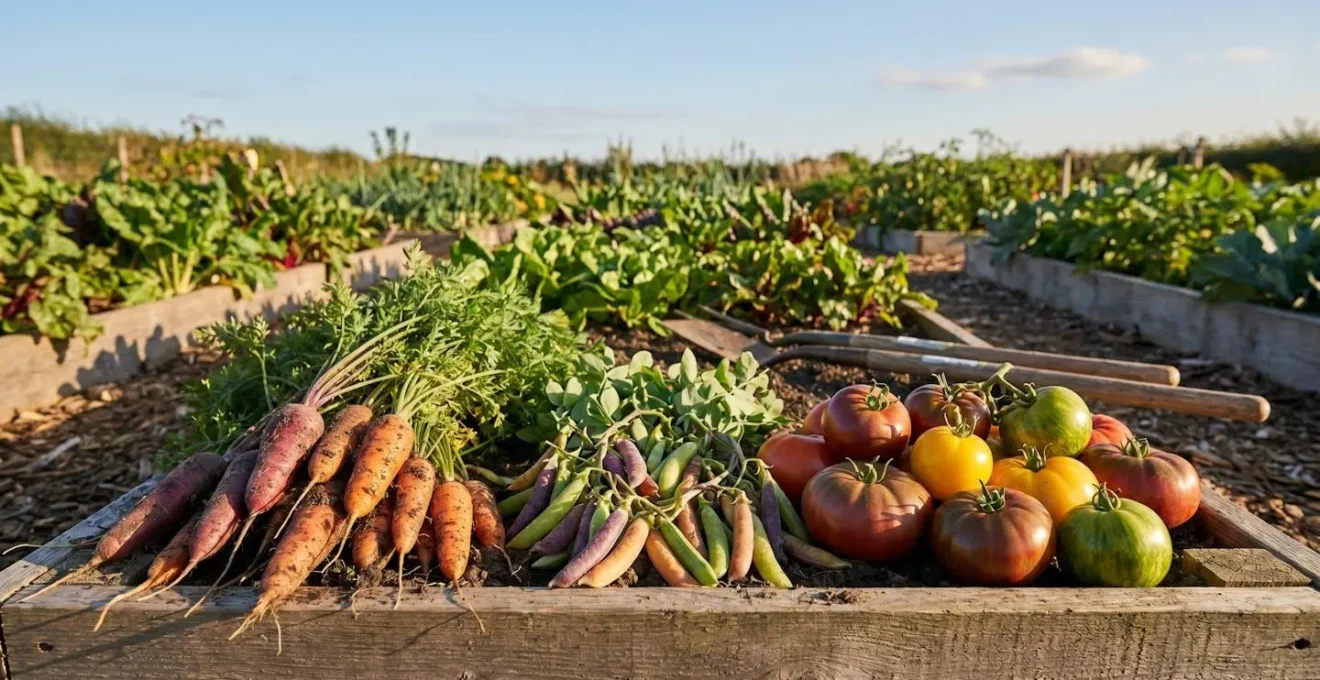
The choice between heirloom and hybrid vegetables isn’t about yield; it’s about choosing between commercial efficiency and a richer culinary narrative.
- Heirlooms offer superior flavour complexity and staggered harvests perfectly suited to the home kitchen’s rhythm.
- Their genetic diversity provides natural resilience and unique adaptations to challenging garden soils.
Recommendation: Grow for flavour, not just for weight, by selecting heritage varieties that tell a story on the plate.
For any chef or passionate home cook, the journey to exceptional flavour begins long before the kitchen, right in the soil of the garden. You select seeds not just for what they will grow into, but for the promise they hold. The modern seed catalogue presents a fundamental choice: the reliable, uniform F1 hybrid or the enigmatic, story-rich heirloom. Commercial growers have long favoured hybrids for their predictable yields and shipping durability, a logic that has seeped into the common gardening consciousness. We’re often told to prioritize disease resistance codes and high productivity above all else.
But this perspective overlooks the very reason we choose to grow our own food: an unparalleled sensory experience. What if the perceived “disadvantages” of heirlooms—their irregular shapes, lower yields, and varied ripening times—are, in fact, their greatest culinary strengths? This isn’t just about nostalgia; it’s about understanding the deep-seated genetic memory that prioritizes taste, texture, and aroma over the bland requirements of a supermarket supply chain. It’s about a plant’s ability to tell the story of its lineage through its flavour.
This guide moves beyond the surface-level debate. We will explore the genetic heart of why you can only save seeds from one type of plant, examine how historical resilience translates to modern garden success, and reframe the yield trade-off from a cook’s perspective. By understanding the unique needs and rewards of heritage varieties, from carrots that conquer clay soil to peas with a fleeting window of perfect sweetness, you will learn to cultivate not just vegetables, but a more profound and delicious connection to your food.
Summary: A Cook’s Guide to the Superior Flavour of Heirloom Vegetables
- Heirloom vs Hybrid: Why You Can Only Save Seeds from One?
- Why 19th Century Varieties Survive UK Blight Better?
- The Yield Trade-Off: Are Heirlooms Worth the Lower Harvest?
- Carrots for Clay: Which Heritage Varieties Handle Heavy Soil?
- When to Pick: The Narrow Window for Heritage Pea Sweetness?
- Sun and Shade: How a Spiral Creates Different Zones for Basil and Parsley?
- Why Some Seeds Need a ‘Winter Chill’ in the Fridge Before Sowing?
- Seed Propagation Mistakes That Waste 50% of Your Germination Potential
Heirloom vs Hybrid: Why You Can Only Save Seeds from One?
The fundamental difference between an heirloom and an F1 hybrid lies in its genetic stability, a concept that directly impacts your ability to create a self-sustaining garden. Heirlooms are open-pollinated varieties, meaning they are pollinated by natural means like insects, wind, or self-pollination. For generations, they have passed down their traits consistently. When you save the seed from a ‘Brandywine’ tomato, you can be confident you will grow another ‘Brandywine’ tomato next year, complete with its characteristic flavour and form. This is the essence of seed saving: preserving a genetic story. This stability is what allows families and communities to become stewards of flavour, passing down seeds that are perfectly adapted to their local climate and soil.
Case Study: The Power of Community Seed Saving
The impact of this practice is tangible. In a report on their 2024 activities, the Seed Savers Exchange documented that over 50,000 individuals ordered seeds from them, connecting through the shared act of growing, saving, and sharing hundreds of open-pollinated varieties. This demonstrates how family seed-saving projects are not just a nostalgic hobby but a powerful method for preserving biodiversity and culinary heritage, a stark contrast to the startling fact that an estimated 94% of seed varieties available in 1900 have been lost.
F1 hybrids, on the other hand, are the result of a deliberate, controlled cross-pollination of two different, genetically distinct parent plants. The “F1” stands for “first filial generation.” This first generation exhibits what is known as “hybrid vigour,” often resulting in higher yields, greater uniformity, and specific disease resistances. However, this perfection is fleeting. If you save seeds from an F1 hybrid, the resulting second generation (F2) will be a genetic lottery. The plants will not be true-to-type and will instead display a wide, unpredictable mix of traits from the original parent and grandparent plants, losing the desired characteristics you paid for. This genetic instability makes F1 hybrids a dead end for seed savers, requiring you to purchase new seeds every single year.
Why 19th Century Varieties Survive UK Blight Better?
The resilience of certain heirloom varieties isn’t an accident; it’s a testament to a brutal but effective form of natural selection. For crops like potatoes, late blight has been a devastating force for centuries. While modern hybrids are bred with specific resistance genes (often denoted by codes like VFNT on a seed packet), this can create a monoculture vulnerable to new strains of a disease. Heirlooms, particularly those pre-dating modern chemical agriculture, survived because they possessed a broad, inherent genetic diversity. A field planted with a single hybrid variety is like a team of specialists; if they encounter a problem outside their expertise, the entire team fails. A field of heirlooms is a team of generalists, with a wide range of natural defences.
This genetic variation means that within a single crop of a 19th-century potato variety, some plants might be more susceptible to blight, but others will have the natural fortitude to survive and produce a harvest. Over generations of seed saving, gardeners instinctively selected tubers from the healthiest plants, constantly reinforcing this natural resilience. This is a living, evolving defence mechanism, quite different from the static, targeted resistance of a hybrid. This is the genetic memory of a plant that has learned to endure.
Case Study: Real-World Blight Resistance in Heritage Potatoes
A collaborative field lab in the UK put this theory to the test. In trials conducted by Innovative Farmers, growers discovered the tangible benefits of this approach. The project tested up to 11 heritage potato varieties against blight, with the Sarpo family of varieties demonstrating outstanding resistance in real-world conditions. Interestingly, growers noted that while the earliest Sarpo varieties were prized for toughness over taste, each new generation selected by breeders has improved in flavour while maintaining that exceptional disease resistance, showcasing how heirlooms can evolve to be both tough and tasty.
For the kitchen gardener, this means that an old variety isn’t just a novelty; it can be a pragmatic choice for a low-intervention, resilient garden. It’s a partnership with a plant that has a proven history of survival, a quality that is often more valuable than a specific, but potentially fragile, resistance gene.
The Yield Trade-Off: Are Heirlooms Worth the Lower Harvest?
The most common argument against heirlooms is their lower yield. It’s true that on a pound-for-pound basis, many hybrids are more productive. Research comparing tomato varieties confirms that hybrid varieties typically yield 30-45% more fruit per plant under identical conditions. For a commercial farmer, this math is simple: more weight equals more profit. But for a chef or home cook, this calculation is misleading. We don’t grow for sheer tonnage; we grow for kitchen utility and, most importantly, for flavour. The “yield trade-off” is better understood as the yield-for-flavour exchange.
Heirlooms were not bred to ripen all at once for a single mechanical harvest. They were selected for a staggered, extended harvest that provides a steady supply of fresh produce for the family table over many weeks. This is a feature, not a bug. It means you get to enjoy peak-freshness tomatoes in August, September, and even into October, rather than facing a glut of 50 pounds of fruit in a single week. Furthermore, the very thing that makes heirlooms taste better—their higher concentration of sugars, acids, and aromatic compounds—is often at odds with the traits that produce massive yields. The plant invests its energy into creating complex flavours rather than just water and pulp.
This table highlights the different value propositions. While the “Pounds Per Plant” column favours hybrids, every other culinary and experiential metric points to the superior value of heirlooms for the home grower.
| Factor | Heirloom Varieties | F1 Hybrid Varieties |
|---|---|---|
| Flavor & Texture | Superior flavor, complex taste profiles with 20-40% more sugar and acid compounds | Good but often less complex; bred for shipping/storage over flavor |
| Nutritional Density | Higher vitamin, mineral, and antioxidant content in many varieties | Standard nutritional profile |
| Harvest Window | Staggered, extended harvest suits family kitchen needs | Uniform, all-at-once harvest (commercial advantage) |
| Experiential Value | High: diverse colors, shapes, stories, seed-saving activities | Lower: uniformity prioritized |
| Pounds Per Plant | Lower overall yield (one-third or less than hybrids in some cases) | 30-45% higher yield under identical conditions |
| Disease Resistance | Variable; some have natural resilience from generations of selection | Bred for specific disease resistance (VFNT codes) |
Ultimately, the proof is on the palate. In the same analysis, blind taste testing revealed that 72% of participants preferred the taste of heirloom varieties. For a cook, that single statistic makes the entire trade-off worthwhile.
Carrots for Clay: Which Heritage Varieties Handle Heavy Soil?
One of the most profound expressions of an heirloom’s genetic memory is its physical adaptation to challenging environments. Nowhere is this clearer than with carrots grown in heavy, clay-like soil. A long, slender modern carrot variety will struggle, fork, and become stunted in dense soil because it was bred for the idealized conditions of loose, loamy commercial fields. Heritage varieties, however, often hail from a time when gardeners had to work with the land they had, and their shapes reflect this beautiful pragmatism. Instead of fighting your soil, you can choose a carrot whose very structure is designed to thrive in it.
These carrots weren’t designed in a lab; they were perfected in real-world gardens by generations of growers. Their shapes are a masterclass in plant engineering, using leverage and force distribution to navigate obstacles underground. Choosing the right shape transforms a difficult growing situation into an opportunity to cultivate a piece of living history that is uniquely suited to your garden’s ‘terroir’.
Consider these functional shapes, each a solution to the problem of heavy soil:
- Short & Round (e.g., Paris Market): This golf ball-shaped carrot, only an inch or two in diameter, doesn’t need to delve deep. It’s the perfect choice for the most compacted or shallowest of soils.
- Blocky & Broad-Shouldered (e.g., Chantenay Red Core): Introduced from France in the 1800s, this 5-inch conical carrot with a blunt tip acts like a natural drill, using its broad shoulders to push through dense clay.
- Stout & Heart-Shaped (e.g., Oxheart/Guerande): Developed in the 1880s specifically for heavy soils, this wide, 5-6 inch long carrot uses its leveraged, heart-shaped design to push aside compacted layers.
- Half-Long & Tapered (e.g., Danvers 126): The workhorse for less-than-ideal soil since 1947, this 6-8 inch carrot has the strength and taper to bore through moderately heavy soil, with strong tops that prevent breakage during harvest.
This is the essence of gardening with heirlooms: it’s not about forcing a plant to fit your garden, but about finding the plant whose story already belongs there.
When to Pick: The Narrow Window for Heritage Pea Sweetness?
The flavour of a vegetable is not a static quality; it is a dynamic process, a fleeting moment of perfection. With heritage peas, this truth is deliciously apparent. The difference between a sublime, sugar-sweet pea eaten straight from the pod and a disappointingly starchy one can be a matter of hours. This is because the moment a pea is picked—or left on the vine too long—its biological imperative shifts from storing sugars for taste to converting those sugars into starches for seed development. Hybrids are often bred to slow this conversion, extending shelf life. Heirlooms, bred for immediate consumption, offer a more intense but narrower window of peak flavour.
Understanding this biological process transforms harvesting from a chore into a treasure hunt. You begin to read the subtle cues of the plant: the vibrant green of the pod, the perfect plumpness of the peas within, the satisfying snap as it comes away from the vine. This is what you can’t buy in a store. The ‘garden snack bar’ experience—eating a sun-warmed pea within minutes of picking—is the ultimate reward. That burst of pure, green sweetness is the flavour of life itself, before it begins the slow work of preparing for the next generation.
This process is not just a lesson in biology but a sensory education. You can train your palate and connect with the plant’s life cycle through a simple, three-stage taste test:
- Stage 1 – Slightly Young: Pick a few pods when they’re just starting to fill out. Taste them immediately and note the delicate, grassy sweetness.
- Stage 2 – Perfect Peak: Harvest when pods are full and a brilliant, vibrant green. The peas should be plump. This is the moment of maximum sugar content and crisp, explosive texture.
- Stage 3 – Slightly Over: Wait a few extra days until the pods begin to lighten in colour or feel slightly leathery. Taste these peas and observe the dramatic shift as the flavour profile moves from sweet to starchy and mealy.
Once you experience this spectrum, you will never look at a bag of frozen peas the same way again. You will understand that true flavour is a moment in time, and growing heirlooms gives you a front-row seat.
Sun and Shade: How a Spiral Creates Different Zones for Basil and Parsley?
The philosophy of growing for flavour extends beyond variety selection to garden design itself. An herb spiral is a perfect example of this principle in action. It’s a simple, raised spiral of stones or bricks that creates a three-dimensional growing space. This elegant design is more than just beautiful; it’s a highly efficient way to create multiple microclimates in a small footprint, allowing you to cater to the specific needs of different culinary herbs. The very structure manipulates sun exposure, water drainage, and heat retention.
Heirloom seeds are grown for taste, not for shipping or shelf life. Expect rich, bold, and distinctive flavors.
– Old Farmer’s Almanac Editorial Team, Favorite Heirloom Vegetables and Fruits vs. Hybrids: Why Gardeners Love Them
At the top of the spiral, the soil is driest and receives the most sun. This is the perfect spot for Mediterranean herbs like rosemary, thyme, and oregano, which thrive in hot, dry conditions that concentrate their essential oils and intensify their flavour. As the spiral descends, the soil becomes progressively moister and more shaded. The middle section is ideal for sun-lovers like basil and sage that appreciate a bit more moisture. The base of the spiral, the coolest and dampest part, is a haven for delicate herbs like parsley and chives, which can be scorched by intense midday sun. By giving each plant its ideal conditions, you are not just helping it survive; you are enabling it to produce the most complex and potent flavour possible.
Why Some Seeds Need a ‘Winter Chill’ in the Fridge Before Sowing?
Some heirloom seeds carry a deeper, more ancient memory: the memory of winter. These seeds require a period of cold, damp conditions before they will germinate, a process known as cold stratification. This is not a flaw; it is a sophisticated survival mechanism encoded in their DNA. For plants native to colder climates, this requirement is essential. It prevents the seed from being tricked into sprouting during a false spring or a warm spell in autumn, only to be killed by the inevitable return of frost. The seed must ‘experience’ a winter to know that spring has truly arrived.
This mechanism is a direct link to the plant’s heritage. Perennial herbs like lavender, echinacea, and many native wildflowers have this built-in safety switch. By mimicking this winter chill, you are participating in the plant’s natural life cycle. For the kitchen gardener, this becomes a meaningful autumn ritual. Preparing seeds for their “winter sleep” in a bag of damp sand or paper towels in the refrigerator builds a quiet anticipation for the spring planting season. It connects you and your family to the deep, slow rhythms of the seasons.
Understanding this need demystifies why some of your most coveted seeds might fail to sprout if planted directly into warm soil. It’s not that the seeds are bad; they are simply waiting for the right signal, a signal you can provide. It’s a reminder that gardening is a dialogue with nature, and sometimes, you need to speak the language of winter to get a response in the spring.
Key Takeaways
- The true value of heirlooms is not just taste, but a ‘flavour narrative’ told through genetics, staggered harvests, and historical resilience.
- Heirloom ‘disadvantages’ like lower yield and irregularity are often culinary advantages for the home cook, providing extended harvests and greater complexity.
- Choosing the right heirloom variety means matching the plant’s inherited physical traits (like carrot shape) to your garden’s specific conditions (like clay soil).
Seed Propagation Mistakes That Waste 50% of Your Germination Potential
After carefully selecting your precious heirloom seeds, the final hurdle is successful germination. It can be heartbreaking to see your efforts wasted when seeds fail to sprout. Often, the cause is not a faulty seed but a simple mistake in its environment. Most propagation failures can be traced back to a few key factors: moisture, temperature, and planting depth. Before you blame the seed, become a detective and investigate the conditions. For a vast majority of vegetable seeds, the single most important principle is consistent moisture without waterlogging. The ideal soil should feel like a well-wrung-out sponge: damp to the touch, but not dripping when squeezed.
An old seed is not necessarily a dead seed. While viability decreases over time, many common vegetable seeds can remain viable for several years if stored correctly in a cool, dark, and dry place. A simple viability test can save you weeks of waiting and wondering. Just place ten seeds on a damp paper towel inside a sealed plastic bag or container. Keep it in a warm spot and check for sprouts after the typical germination period. If seven or more sprout, your seeds have excellent viability. If fewer than five sprout, your germination rates will be low, and you should sow them much more thickly to compensate.
Your Seedling Detective’s Action Plan: Investigating Germination Failures
- Examine the Scene: Check the seed’s environment. Is the soil surface cracked and dry, or is it dark and waterlogged? Gently dig up a non-sprouted seed. A mushy seed means too much water; a hard, dry seed means not enough.
- Gather Evidence: Inventory the conditions. Use a soil thermometer to check that the temperature matches the seed packet’s requirements. Test the viability of old seeds with the paper towel method described above.
- Check for Inconsistencies: Confront the evidence with the seed’s known requirements. Did you plant tiny lettuce seeds an inch deep when they needed light to germinate? Was the soil too cold for your heat-loving peppers?
- Identify the Core Principle: In most cases, the culprit is inconsistent moisture. Remember the ‘wrung-out sponge’ rule—it is the single most memorable and effective principle for achieving high germination rates.
- Implement a Corrective Plan: Adjust your practices. Water more gently and frequently, use a heat mat to raise soil temperature, or re-sow seeds at the correct depth based on your findings.
Mastering these basic principles of seed starting ensures that the genetic promise held within each heirloom seed has the best possible chance to come to life, filling your garden and your kitchen with unparalleled flavour.
To truly bring these flavours to your table, the next logical step is to start your own seed-saving journey, transforming your garden into a living library of taste.