Contrary to popular belief, you cannot permanently “fix” soil pH with quick-fix additives. The real key is understanding that pH controls nutrient availability, a phenomenon called nutrient lockout. This guide debunks common myths about pine needles, explains the science behind soil chemistry, and provides a long-term strategy for building a healthy, living soil ecosystem that regulates its own balance without synthetic chemicals.
For the dedicated organic gardener, few things are more frustrating than watching a prized plant struggle. You provide water, sunlight, and rich compost, yet the leaves turn yellow and growth stalls. The common advice is often to add more fertilizer or a specific amendment, but this approach frequently fails. The problem isn’t necessarily a lack of nutrients in your soil; it’s that your plants can’t access them.
The unseen force governing this garden drama is soil pH. This simple measure of acidity or alkalinity dictates a complex world of chemical reactions beneath the surface. When the pH is wrong for a specific plant, essential minerals become chemically “locked up,” unavailable for uptake by the roots, no matter how much manure or feed you apply. Fighting this fundamental chemistry is a losing battle.
But what if the goal wasn’t to fight the soil, but to work with it? This guide moves beyond the simplistic advice of “add this to fix that.” We will delve into the living soil system, exploring why you can’t permanently change chalky soil and debunking myths about common garden materials. We’ll look at the science of nutrient availability and diagnose plant problems by simply looking at their leaves. Ultimately, this article provides a blueprint for creating a resilient, self-sufficient soil that thrives on organic principles, not chemical intervention.
This comprehensive guide will walk you through the essential principles of managing your soil’s pH naturally. We will cover everything from understanding your soil’s inherent limitations to a practical long-term plan for building a truly self-sufficient garden.
Summary: Correcting Soil pH Acidity Without Synthetic Chemicals?
- Fighting Nature: Why You Can’t Grow Rhododendrons on Chalk Permanently?
- Pine Needles and Oak Leaves: Do They Really Acidify Soil?
- The Sulphur Overdose: Signs Your Soil is Too Acidic for Vegetables?
- Sulphur Chips or Peat-Free Ericaceous Compost: Which Works Faster?
- The Sweet Spot: Why pH 6.5 Unlocks the Most Nutrients?
- The pH Lock-Out: Why Adding More Manure Won’t Fix Yellow Leaves?
- Veins or Margins: What Chlorosis Patterns Tell You About Nutrients?
- Managing Organic Soil Nutrients: The 3-Year Plan for Self-Sufficiency
Fighting Nature: Why You Can’t Grow Rhododendrons on Chalk Permanently?
The dream of growing vibrant, acid-loving rhododendrons, azaleas, or blueberries can quickly become a nightmare for gardeners on alkaline soil. The fundamental issue lies in the soil’s inherent chemistry, particularly in chalky or limestone-based soils. These soils are rich in calcium carbonate, which acts as a powerful buffer. This means any attempt to add acidic materials is quickly neutralized. It’s like trying to add a drop of lemon juice to a glass of milk and expecting it to become acidic; the calcium in the milk immediately counteracts the effect.
This is not a matter of opinion, but of chemistry. As the Royal Horticultural Society explains, chalky soil with free calcium carbonate continuously buffers against acidification and cannot realistically be acidified for long-term cultivation of acid-loving plants. You can create a temporary pocket of acidic soil by digging a large hole and filling it with ericaceous compost, but the surrounding alkaline soil and even the tap water used for irrigation will relentlessly work to raise the pH back to its natural state. This is a constant, expensive, and ultimately futile battle against the fundamental nature of your garden’s geology.
A more sustainable and rewarding approach is to embrace the soil you have. Instead of fighting a chemical war, a savvy organic gardener learns to work in partnership with their environment. By selecting plants that are naturally adapted to alkaline conditions, you create a thriving, low-maintenance garden where plants flourish because they are in their preferred habitat. This strategy shifts the focus from “fixing” the soil to celebrating its unique character. It’s about choosing the right plant for the right place, ensuring a garden that is both beautiful and in harmony with its surroundings.
Rather than battling your soil’s nature, embracing it opens up a world of beautiful and resilient plants that will thrive with minimal intervention. This is the first principle of creating a truly organic, self-sufficient garden.
Pine Needles and Oak Leaves: Do They Really Acidify Soil?
It’s one of the most persistent myths in gardening: mulching with pine needles or oak leaves will make your soil acidic. The logic seems sound—pine needles themselves are acidic, so adding them to the soil must lower the pH. However, this belief crumbles under scientific scrutiny. The reality is that the soil’s complex biological system, the “Soil Food Web,” is far more powerful than the initial chemistry of the mulch. When organic materials like leaves and needles are added to the soil, they become food for a vast community of microbes.
During the decomposition process, these bacteria and fungi consume the organic matter, and their activity effectively neutralizes the initial acidity. What’s left is a stable, pH-neutral humus that improves soil structure and fertility. Extensive research has confirmed this. A six-year study documented by Nikolai, Rieke, and McVay found no change in soil pH after continuous mulching with oak leaves. Similarly, research from the Connecticut Agricultural Experiment Station showed no significant pH difference in vegetable plots amended with uncomposted leaves. University extension services are united in confirming that the acidifying effect of pine needles is a myth.
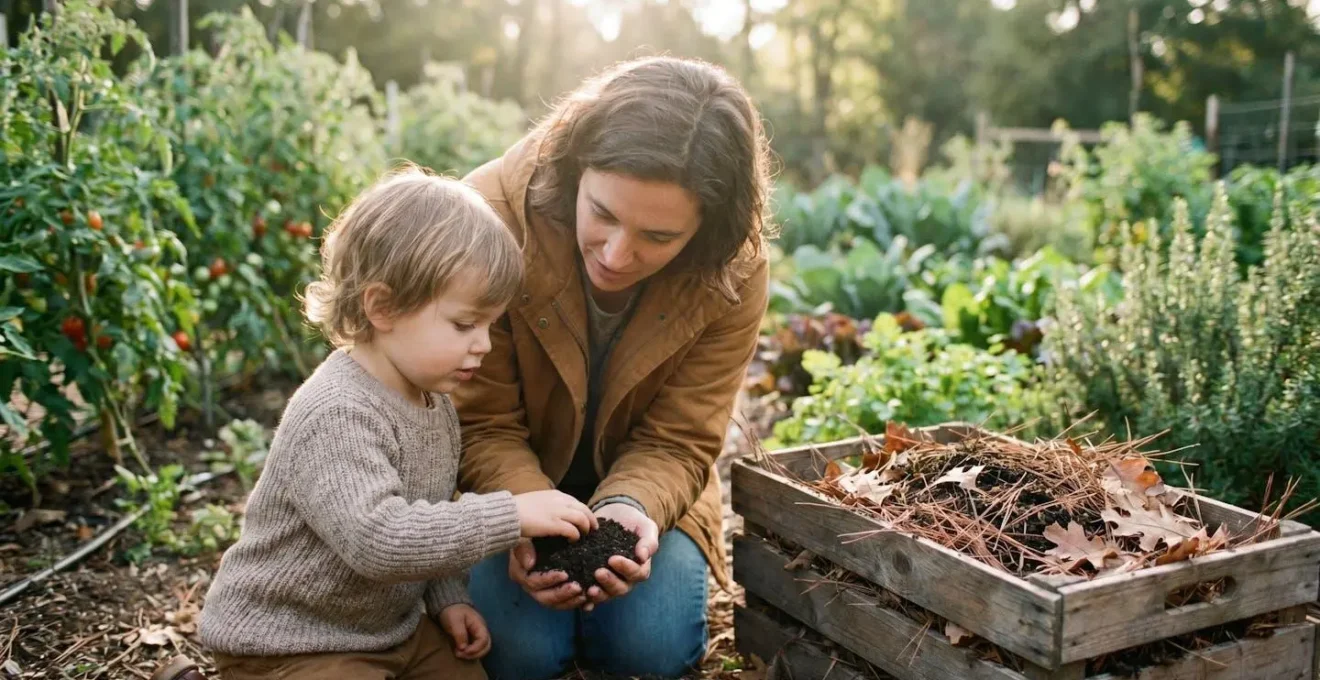
As you can see in the decomposing matter, this is not an inert layer but a bustling ecosystem. These materials are invaluable for organic gardeners, but not for the reason many believe. They are excellent for suppressing weeds, retaining soil moisture, and, most importantly, building healthy soil structure as they break down into humus. They feed the earthworms and microbes that are the true architects of a fertile garden. So, feel free to use them generously, but don’t expect them to be a quick fix for lowering your soil’s pH.
The key takeaway is to trust the biological process. The soil ecosystem is resilient and will process these organic inputs into valuable humus, without any drastic or long-term impact on your soil’s pH.
The Sulphur Overdose: Signs Your Soil is Too Acidic for Vegetables?
While many gardeners struggle with alkaline soil, it is possible to go too far in the other direction. Applying acidifying agents like elemental sulphur without careful measurement can push the soil pH into a range that is toxic for most common vegetables. A soil that is too acidic creates a hostile environment for plant roots and beneficial microbes, leading to a different set of problems than high pH. The primary danger in overly acidic soil is not the acidity itself, but its effect on soil minerals.
As soil pH drops, certain elements that are normally stable and solid become soluble in water. The most dangerous of these is aluminium. When soil pH drops near or below 5.0, aluminium becomes soluble and is readily absorbed by plant roots, where it acts as a potent toxin, severely inhibiting root growth and function, as documented by Michigan State University Extension. This leads to stunted plants that are unable to take up water and other essential nutrients, even if they are abundant in the soil.
Nature often provides its own clues to soil conditions. Certain weeds thrive in specific pH ranges, acting as natural indicators. Observing which weeds are dominating your garden can give you a good, if imprecise, idea of your soil’s acidity. The proliferation of plants like Sheep Sorrel (Rumex acetosella), Bracken fern, or even moss in lawn areas are strong signals of acidic conditions. Learning to “read” these indicator weeds can be a valuable skill for the organic gardener, providing an early warning before more serious symptoms appear in your cultivated plants. If these acid-loving bandits are taking over, it’s a clear sign that a soil test is needed before adding any more acidifying amendments.
Ultimately, moderation and monitoring are key. The goal is not to force the pH to a specific number, but to create a balanced environment where a wide range of plants can thrive, and avoiding the toxic consequences of an overzealous hand.
Sulphur Chips or Peat-Free Ericaceous Compost: Which Works Faster?
When faced with the need to lower soil pH for acid-loving plants, gardeners have two main organic approaches: a direct chemical intervention with sulphur or a slower, ecosystem-building method with ericaceous compost. The choice between them comes down to a trade-off between speed, longevity, and overall soil health. Sulphur works by providing a food source for specific soil bacteria (Thiobacillus), which convert it into sulphuric acid, directly lowering the pH. It’s a targeted chemical reaction, but one that relies on biological activity.
Peat-free ericaceous compost, on the other hand, works by gradually incorporating acidic organic matter into the soil. It builds soil structure, improves water retention, and inoculates the soil with a community of beneficial microbes that thrive in acidic conditions. It’s a holistic approach that treats the soil as a living system, rather than just a chemical medium. While sulphur might offer a quicker “fix,” the compost builds long-term resilience and health. The environmental consideration is also significant; choosing peat-free compost helps protect vital peat bog ecosystems, which are massive carbon stores and biodiversity hotspots.
This table, based on guidelines from the Royal Horticultural Society, compares the methods. It clearly shows that while sulphur offers a faster result, it primarily treats a symptom. Peat-free ericaceous compost is the more sustainable, long-term choice for building a healthy, living soil ecosystem.
| Method | Speed of Action | Duration | Soil Health Impact | Environmental Consideration |
|---|---|---|---|---|
| Sulphur Chips | Weeks to months (slower in cold soil) | Requires bacterial conversion to sulphuric acid | Chemical intervention; treats pH symptom only | Least expensive; low environmental impact if used sparingly |
| Sulphur Dust (finely ground) | Faster than chips (bacteria convert it quicker) | Effect visible within weeks | More expensive; still treats symptom not cause | Quick fix but doesn’t build soil ecosystem |
| Peat-Free Ericaceous Compost | Gradual over months to years | Long-term soil building | Inoculates beneficial acid-loving microbes; builds soil food web resilience | Sustainable choice (peat bogs store massive carbon); supports biodiversity |
For the truly organic gardener focused on soil self-sufficiency, building the soil with appropriate organic matter is always the superior long-term strategy, creating a resilient system that supports plant health from the ground up.
The Sweet Spot: Why pH 6.5 Unlocks the Most Nutrients?
For the vast majority of garden plants, from vegetables to perennials, the ideal soil pH hovers around 6.5. This slightly acidic condition is not an arbitrary number; it represents the chemical “sweet spot” where the widest range of essential nutrients are most available to plant roots. Think of it as a master key that unlocks a pantry full of food. When the pH is too high (alkaline) or too low (acidic), many of these nutrients become chemically locked up, rendered insoluble and inaccessible to plants, even if they are physically present in the soil.
At this optimal pH, the delicate balance is just right. According to the Royal Horticultural Society, a slightly acidic soil of pH 6.5 is the best general-purpose pH for gardens, allowing a wide range of plants to grow. It is at this level that the “big three” macronutrients—Nitrogen (N), Phosphorus (P), and Potassium (K)—are freely available. Simultaneously, crucial micronutrients like iron, manganese, and zinc are also soluble enough for plant uptake without reaching the toxic levels seen in highly acidic soils.
This concept of nutrient availability is central to successful organic gardening. It explains why simply adding more compost or fertilizer doesn’t always work. If the pH is wrong, you’re essentially stocking a pantry but keeping the door locked. By managing the soil to maintain a pH near this 6.5 sweet spot, you are ensuring that the nutrients provided by your compost, manure, and other organic amendments can actually be used by your plants. At this neutral sweet spot pH, essential elements like nitrogen, phosphorus, and potassium dissolve easily for rapid plant uptake, ensuring your plants have access to a balanced diet for healthy, vigorous growth.
Therefore, the primary goal of pH management is not to achieve an abstract number, but to create the optimal chemical environment that allows your living soil system to nourish your plants effectively.
The pH Lock-Out: Why Adding More Manure Won’t Fix Yellow Leaves?
It’s a classic gardener’s dilemma: your plant’s leaves are turning a sickly yellow, a tell-tale sign of nutrient deficiency. Your instinct is to feed it, so you generously apply rich manure or a high-quality organic fertilizer. Yet, weeks later, the leaves are still yellow. The frustrating reason for this is often pH lock-out. This phenomenon occurs when the soil pH is too high (alkaline), causing essential micronutrients to become chemically insoluble and unavailable to plant roots, no matter how abundant they are in the soil.
The most common culprits in alkaline soil lock-out are iron and manganese. These elements are vital for chlorophyll production, the green pigment that powers photosynthesis. In alkaline conditions (typically a pH above 7.0), iron and other minerals form chemical bonds with other elements in the soil, effectively precipitating out of the soil solution. The plant’s roots simply cannot absorb these solid-form minerals. You can pour on liquid seaweed and pile on manure, but if the pH isn’t corrected, the plant will continue to starve for these specific micronutrients.
This is a critical concept for organic gardeners to grasp. The health of your plants is not just about what you add to the soil, but about the chemical environment you create. Experts confirm that in alkaline soils, phosphorous, iron, and zinc become bound up and less available to plants. Throwing more fertilizer at a plant suffering from pH lock-out is like offering a feast to someone whose mouth is taped shut. The solution is not more food, but removing the tape—in this case, by gradually lowering the soil pH to the optimal range where these nutrients become soluble and accessible once again.
Before reaching for the fertilizer bag, a smart gardener reaches for a soil test kit. Understanding and addressing the root cause—the soil’s pH—is the only sustainable way to solve the problem and restore your plants to vibrant health.
Veins or Margins: What Chlorosis Patterns Tell You About Nutrients?
The leaves of your plants are like a diagnostic dashboard, offering visual clues to the health of the entire system. When a plant suffers from a nutrient deficiency, it often displays a specific pattern of yellowing, known as chlorosis. Learning to “read” these patterns can help you pinpoint the exact nutrient that is lacking, or more accurately, being locked out by incorrect pH. This is a far more precise method than simply guessing, allowing you to address the root cause of the problem.
The key to diagnosis is observing two things: the pattern of the yellowing (is it between the veins, on the edges, or the whole leaf?) and its location on the plant (is it on the older, lower leaves or the new, upper growth?). This location is determined by whether the nutrient is “mobile” or “immobile” within the plant. Mobile nutrients, like nitrogen and magnesium, can be moved by the plant from old leaves to new growth. Therefore, a deficiency will show up on old leaves first. Immobile nutrients, like iron and calcium, are locked in place once they are used. A deficiency of an immobile nutrient will always appear on the new leaves first, as the plant cannot relocate its existing stores.
For example, interveinal chlorosis—yellowing between green veins—on new leaves is the classic sign of iron deficiency, common in alkaline soils. The exact same pattern appearing on old leaves, however, points to a magnesium deficiency, which is more common in overly acidic soils. This Plant Detective Clue Sheet breaks down the most common patterns.
| Symptom Pattern | Leaf Location | Nutrient Culprit | Mobility Type | pH Connection |
|---|---|---|---|---|
| Yellowing between veins (veins stay green) | OLD leaves first | Magnesium deficiency | Mobile (plant moves it from old to new growth) | Common in acidic soils; magnesium less available |
| Yellowing between veins (veins stay green) | NEW leaves first | Iron deficiency | Immobile (stuck in place) | Locked out in alkaline soils above pH 7.0 |
| Entire leaf yellows uniformly | OLD leaves first | Nitrogen deficiency | Mobile | Not pH-related; general fertility issue |
| Yellow margins and tips; brown edges | NEW and OLD leaves | Calcium deficiency or Aluminum toxicity | Immobile (Calcium); Toxicity (Aluminum) | Calcium locked in alkaline; Aluminum toxic in very acidic soil (below pH 5.0) |
This skill transforms you from a simple gardener into a soil detective, using the plant’s own language to understand the complex world beneath the surface and make precise, effective adjustments.
Key takeaways
- You cannot permanently acidify chalky soil; it’s better to choose plants adapted to alkaline conditions.
- The myth that pine needles or oak leaves acidify soil is false; microbes neutralize their acidity during decomposition.
- The primary goal of pH management is to reach the “sweet spot” around pH 6.5, where the maximum amount of nutrients are naturally available to plants.
Managing Organic Soil Nutrients: The 3-Year Plan for Self-Sufficiency
Achieving a truly self-sufficient organic garden is not a one-time fix but a long-term journey of building a living, resilient soil ecosystem. It requires a shift in mindset from “feeding the plants” to “nurturing the soil.” A healthy, well-structured soil, rich in organic matter and teeming with microbial life, will naturally buffer itself and provide a steady stream of nutrients to your plants. This three-year plan provides a practical roadmap for creating this self-sustaining system, turning your garden into a closed-loop model of fertility.
This process is about more than just adding compost; it’s about systematically building the soil’s capacity to manage its own health. It involves creating high-quality amendments on-site, using living plants to protect and enrich the soil, and consistently adding diverse organic matter. According to the experts at Gardeningfine.blog, the overarching goal should always be to cultivate long-term soil health through consistent, natural methods. This is not a quick fix, but a deeply rewarding process that creates a garden that is less dependent on external inputs and more resilient to pests and diseases.
Patience is the most crucial ingredient. Adjusting pH and building deep organic soil takes months and years, not weeks. This plan is designed as a family journey, turning soil science into a living classroom and celebrating the gradual, powerful transformation of your garden from a patch of dirt into a thriving ecosystem.
Your Action Plan: The 3-Year Soil Building Journey
- Year 1 Foundation: Build an ‘ultimate compost bin’ as a family project; start a worm farm for continuous vermicompost production; conduct a red cabbage pH experiment to map the garden’s baseline pH; commit to adding 3-4 inches of quality organic matter to all beds annually.
- Year 2 Living Soil: Introduce cover crops like clover, vetch, or phacelia as ‘green blankets’ for winter to prevent erosion and add organic matter; set a family goal to count earthworms in one square foot of soil by year-end to measure biological activity; focus on feeding soil microbes with diverse inputs, not just plants.
- Year 3 Self-Sufficient Harvest: Create a ‘Closed-Loop Salad’ challenge where every ingredient (lettuce, tomatoes, herbs) and the soil fertility required to grow them comes entirely from your own garden and compost system.
- Ongoing Practice: Test soil pH annually to track progress; embrace patience as organic pH adjustment is a slow process; practice companion planting to encourage beneficial insects and soil microbes; harvest rainwater for irrigation to avoid the alkalinizing effect of tap water.
- Family Science Lab: Document the soil’s improvement with photos, regular worm counts, and annual pH tests; celebrate the garden as a living laboratory and a source of deep connection to the natural world.
By consistently following these principles, you will create a garden that not only produces abundant, healthy food but also functions as a self-regulating, regenerative ecosystem for years to come.