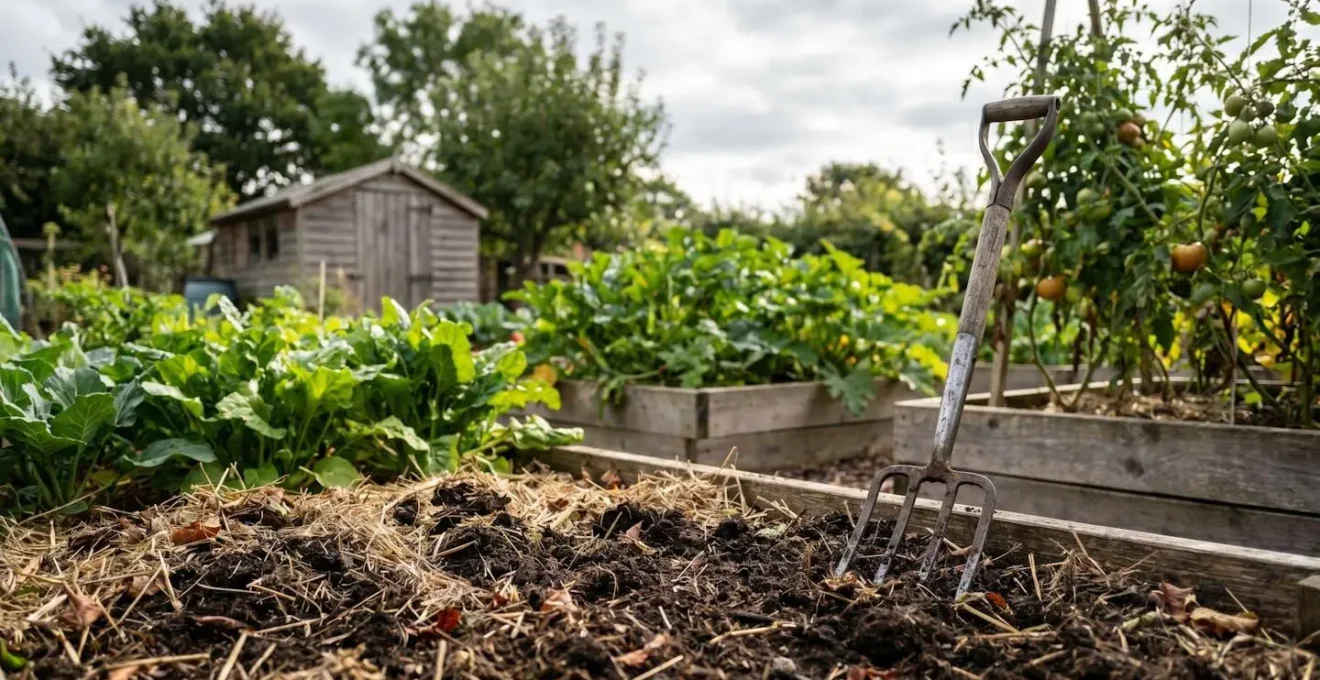
Achieving soil self-sufficiency is not about perpetually adding inputs, but about architecting a living ecosystem that manages its own fertility.
- The key is to shift from ‘feeding plants’ with bagged products to ‘feeding the soil’s workforce’ (microbes, fungi, worms) who unlock and cycle nutrients for you.
- Different organic amendments (manures, teas, minerals) have strategic roles and timings; misusing them can be ineffective or even harmful.
Recommendation: Follow the three-year plan outlined in this guide to systematically build your soil’s capacity, weaning your allotment off external inputs and creating a truly closed-loop system.
For many allotment holders, the annual ritual of buying bags of compost and bottles of fertilizer feels like an inescapable part of gardening. We feed our hungry plants, harvest our crops, and the next season, the soil is hungry again. This cycle of dependency is not only costly but also masks a deeper truth: a healthy garden shouldn’t need constant life support. The common advice is to “add compost” or “use manure,” but these are tactics, not a strategy. They treat the soil like an empty container to be refilled, rather than the living, breathing ecosystem it is.
But what if the goal wasn’t just to add more *stuff*, but to build a system that no longer requires it? What if we could shift our role from being a ‘nutrient importer’ to becoming a ‘soil ecosystem manager’? The key to breaking the cycle of dependency lies in a strategic, long-term approach. It’s about understanding the principles of nutrient cycling, the roles of the unseen workforce in the soil food web, and how to create a self-sustaining, closed-loop system over time. This isn’t a quick fix; it’s a fundamental change in perspective.
This article lays out a three-year blueprint to achieve precisely that. We will move beyond the platitudes and dive into the mechanics of soil fertility. We’ll explore which amendments work best and, crucially, *when* and *why*. By the end of this guide, you will have a clear, actionable plan to build a resilient, productive, and truly self-sufficient allotment soil.
To guide you on this journey from soil feeder to ecosystem architect, we’ve structured this plan into a series of strategic deep dives. Each section addresses a critical component of building long-term fertility, helping you make informed decisions at every stage.
Summary: The 3-Year Plan for Soil Self-Sufficiency
- Mustard or Phacelia: Which Green Manure Fixes More Nitrogen?
- How to Brew Comfrey Tea That Rivals Commercial Potash Feeds?
- The pH Lock-Out: Why Adding More Manure Won’t Fix Yellow Leaves?
- Chicken vs Horse Manure: Which is Too ‘Hot’ for Fresh Application?
- Slow vs Fast Release: When to Apply Bone Meal for Maximum Uptake?
- Carbon to Nitrogen Ratio: The Secret to Fast In-Situ Composting?
- Why Biochar Lasts 100 Years in Soil Compared to Compost?
- Creating Self-Sustaining Ecosystems: How to Stop Buying Compost and Fertilizer?
Mustard or Phacelia: Which Green Manure Fixes More Nitrogen?
The question itself contains a common misconception. While some green manures are nitrogen-fixing powerhouses, neither mustard nor phacelia are. Nitrogen fixation is the unique domain of legumes (like clover, vetch, or field beans), which partner with rhizobia bacteria to pull nitrogen from the air. In fact, research shows that leguminous green manures can fix up to 90 kg of nitrogen per hectare. Mustard and phacelia, however, are nutrient *scavengers*. Their job is to mop up any available nutrients in the soil, holding them in their biomass and preventing them from leaching away over winter. When you chop them down, these nutrients are released back into the soil for the next crop.
So, the real strategic question is not about nitrogen fixation, but about your primary objective for that specific bed. Your choice depends on the problem you’re trying to solve. Are you fighting soil-borne pests or trying to improve soil structure? This is where the distinct advantages of each plant come into play. Mustard is a brassica and acts as a biofumigant, releasing compounds that can suppress certain pests and diseases. Phacelia, on the other hand, is a champion of soil conditioning, with its fine, deep root system creating excellent tilth and aggregation.
The following comparison table clarifies their distinct strategic roles in your 3-year plan.
| Characteristic | Mustard | Phacelia |
|---|---|---|
| Growing Speed | 4-6 weeks to dense stand (fastest) | 6-8 weeks to dense coverage |
| Nitrogen Fixation | No (non-legume) | No (non-legume) |
| Primary Benefit | Biofumigant properties for pest control | Superior soil tilth and aggregation |
| Pollinator Value | Low | Excellent nectar source for bees |
| Winter Hardiness | Moderate | Killed by first hard frost |
| Rotation Concerns | Brassica family (avoid before/after cabbage crops) | Neutral (no rotation conflicts) |
For a long-term strategy, Phacelia is often the more versatile choice due to its lack of rotation concerns and its superb value to pollinators, a key part of a healthy ecosystem. However, mustard is an invaluable tool if you have a known issue with soil pests or need a very fast-growing cover on a recently cleared bed.
How to Brew Comfrey Tea That Rivals Commercial Potash Feeds?
One of the cornerstones of fertilizer self-sufficiency is creating your own high-potassium feed, essential for flowering and fruiting. Commercial potash feeds are effective but represent an ongoing expense and an external input. The organic gardener’s answer is comfrey tea, a potent, homemade liquid fertilizer that is famously rich in potassium. In fact, properly brewed comfrey tea is documented to contain higher levels of potassium than most farmyard manures or finished composts, making it a perfect replacement for store-bought tomato feed.
The main barrier for many gardeners is the notoriously foul smell of the traditional brewing method (stuffing leaves in a bucket of water). However, a more controlled fermentation process can dramatically reduce the odor while cultivating beneficial microbes. This method involves a two-stage process: a short aerobic phase followed by a longer anaerobic phase. This isn’t just about making a nutrient soup; it’s about actively culturing a living liquid that will feed both your plants and your soil biology. This is a core principle of regenerative gardening: every action should support the entire soil food web.
By investing in a patch of ‘Bocking 14’ comfrey (a sterile, non-spreading variety) in Year 1 of your plan, you establish a perennial source of potent fertilizer for years 2 and 3. This transforms a patch of your allotment into a nutrient factory, a key step in creating a closed-loop system.
Your Action Plan: Low-Odor Comfrey Tea Brewing
- Harvest comfrey leaves, including stems, and chop them into smaller pieces for faster breakdown.
- Place the chopped material in a blender with a small amount of water and blend to create a slurry. This drastically increases the surface area for microbial action.
- Transfer the slurry into a large bucket or container with a lid (an airlock is ideal) to reduce odor during the main fermentation.
- Stir the mixture daily for the first 3 days. This is the aerobic phase, helping beneficial microbes to multiply.
- Seal the container and allow it to ferment anaerobically for 2-4 weeks. This is when the deep nutrient extraction occurs.
The resulting concentrate is a dark, nutrient-dense liquid. Dilute it to a ratio of 1 part tea to 15 parts water before applying as a soil drench to heavy-feeding crops like tomatoes, peppers, and courgettes during their fruiting stage. You have now closed a major nutrient loop on your allotment.
The pH Lock-Out: Why Adding More Manure Won’t Fix Yellow Leaves?
It’s a frustrating scenario for any dedicated gardener: you’ve added barrows of well-rotted manure and piles of compost, yet your plants’ leaves are turning yellow, showing classic signs of nutrient deficiency. Your instinct is to add even more fertilizer, but the problem persists. This is often not a case of insufficient nutrients in the soil, but a classic case of pH lock-out. Soil pH is the master key that unlocks nutrient availability for plants. If the pH is too high (alkaline) or too low (acidic), specific nutrients become chemically bound to soil particles, making them unavailable to plant roots, even if they are present in abundance.
Think of your soil as a well-stocked pantry, and pH as the only key that can open it. If you have the wrong key, it doesn’t matter how much food is inside; the plants will starve. For most vegetables and fruits in organic soil, the sweet spot for nutrient availability is a slightly acidic to neutral environment. Indeed, experts recommend maintaining a 5.5 to 7.0 pH range for organic soil-grown plants. Outside this range, essential minerals like iron, manganese, and phosphorus become locked up and inaccessible.
This is why blindly adding more manure or compost (which can sometimes be alkaline) can make the problem worse. In Year 1 of your self-sufficiency plan, a simple and inexpensive pH test is the most important diagnostic tool you can use. It moves you from guessing to knowing, from being a blind applicator of “stuff” to a strategic soil manager. Adjusting pH is a slow, deliberate process, often involving the careful application of sulphur to lower it or lime to raise it over a season. It’s a foundational step that must be addressed before you can expect other amendments to work effectively.
Chicken vs Horse Manure: Which is Too ‘Hot’ for Fresh Application?
Manure is a cornerstone of organic gardening, but the adage “manure is manure” couldn’t be further from the truth. The source of the manure dictates its nutrient content, its risk of burning plants, and its role in your long-term soil-building strategy. The most common question revolves around chicken and horse manure, and the key difference is nitrogen content. Chicken manure is a highly concentrated, fast-acting fertilizer, while horse manure is a cooler, slower-acting soil conditioner.
Chicken manure is considered “hot” because of its high nitrogen levels. A comparative analysis reveals that chicken manure contains approximately 1.1% Nitrogen, significantly higher than horse manure. Applying fresh chicken manure directly to your garden beds will almost certainly “burn” the roots of your plants, causing severe damage or death. It absolutely must be composted at high temperatures first, not only to mellow the nitrogen but also to address a higher risk of pathogens. As the University of Nevada Reno Extension warns:
Chicken manure and litter may harbor pathogens, such as E. coli, Salmonella, Cryptosporidium and others.
– University of Nevada Reno Extension, Using Chicken Manure Safely in Home Gardens and Landscapes
Horse manure is “cooler” but still benefits from aging or composting to kill the notoriously high number of weed seeds it contains. Its lower nitrogen and higher carbon content make it an excellent bulk material for improving soil structure and organic matter content. In the context of our 3-year plan, they have distinct roles.
| Factor | Chicken Manure | Horse Manure |
|---|---|---|
| Nitrogen Content | High (1.1%) – Fast acting | Low-Moderate (0.7%) – Slow release |
| Weed Seed Content | Low (chickens digest seeds) | High (horses don’t fully digest seeds) |
| Pathogen Risk | Higher (requires proper composting at 140-160°F) | Moderate (still requires composting) |
| Volume Needed | Small amounts (concentrated) | Large volume (bulk soil amendment) |
| Composting Time | Faster (low C:N ratio) | Slower (high C:N ratio) |
| Burn Risk if Fresh | Very High – Never use fresh | Moderate – Still requires aging |
| Best Use in 3-Year Plan | Years 2-3: Targeted top-dressing for heavy feeders | Year 1: Building base of new beds with bulk organic matter |
Think of horse manure as the foundational material for Year 1, building the body and sponge of your soil. Composted chicken manure is the targeted, high-performance fuel for hungry crops in Years 2 and 3, once the soil structure is established.
Slow vs Fast Release: When to Apply Bone Meal for Maximum Uptake?
Bone meal is a classic organic amendment, prized for its high phosphorus content, which is vital for root development and flowering. However, simply tossing it onto the soil is an incredibly inefficient strategy. The phosphorus in bone meal is in a slow-release form, and its availability is entirely dependent on the health of your soil biology, specifically the presence of mycorrhizal fungi. This is a perfect example of where a gardener must shift from being an ‘applicator’ to a ‘facilitator’.
You are not feeding the plant with bone meal; you are feeding the soil ecosystem, which in turn feeds the plant. This is the central lesson from the following case study.
Case Study: The Mycorrhizal Fungi Partnership
University of Minnesota Extension research demonstrates that specialized mycorrhizal fungi form symbiotic relationships with plant roots, bringing hard-to-reach nutrients like phosphorus directly to plant roots in exchange for carbohydrates from the plant. This biological partnership is essential for unlocking the phosphorus bound in bone meal, transforming gardeners from simple applicators into ‘fungi farmers’ who must first cultivate the soil life that will make slow-release amendments like bone meal effective.
This insight completely changes our application strategy. Applying bone meal to biologically poor, heavily tilled soil in Year 1 is a waste of time and money, as the microbial bridge to transport the phosphorus to the plant roots doesn’t exist. The phosphorus will remain locked up. The 3-year plan, therefore, prioritizes building this fungal network first. This involves minimizing tillage, adding organic matter, and planting diverse cover crops. Only once this living infrastructure is in place does applying bone meal become a sensible and effective strategy.
Your Action Plan: Strategic Bone Meal Application in a 3-Year Plan
- Year 1 (Foundation): Do NOT apply bone meal. Focus on adding compost and planting cover crops to build the soil’s biological workforce, especially mycorrhizal fungi. Avoid tillage which shreds these delicate fungal networks.
- Year 2 (Activation): The soil life is now established. Apply bone meal in the spring at planting time, working it into the top 6 inches of soil near the root zones of phosphorus-demanding crops like tomatoes, peppers, and root vegetables.
- Synergy: When you apply bone meal, mix it with a calcium source like crushed eggshells. Phosphorus and calcium work together in building strong plant cell walls.
- Pre-Application Check: Before applying, test your soil’s pH. If your soil is highly alkaline (a simple vinegar test on a soil sample will show no fizzing), phosphorus will be locked up regardless of soil life. Address the pH issue first.
- Targeted Use: Reserve bone meal as a targeted amendment for specific crops during their establishment phase, not as a general broadcast fertilizer.
By following this sequence, you ensure that the amendment you apply can actually be used, maximizing its effect and moving one step closer to a truly efficient, self-sustaining system.
Carbon to Nitrogen Ratio: The Secret to Fast In-Situ Composting?
The heart of any self-sufficient garden is the compost pile. It is the engine of nutrient recycling, turning kitchen scraps and yard waste into “black gold.” But a slow, smelly, or stagnant compost pile is a common frustration. The secret to a fast, hot, and efficient compost system is not a magic ingredient, but a simple principle of chemistry and biology: the Carbon to Nitrogen (C:N) ratio.
Microbes that break down organic matter need two things for energy and growth: carbon (for energy) and nitrogen (for building proteins). Get the ratio right, and you create the perfect environment for them to thrive, multiply, and work at peak efficiency. Get it wrong, and the process stalls. Too much carbon (browns like cardboard, dry leaves, woodchips) and the pile is slow and cold. Too much nitrogen (greens like grass clippings, kitchen scraps, manure) and the pile becomes a slimy, smelly, anaerobic mess. Composting science has identified an ideal starting point for this process. For rapid decomposition, composting science demonstrates that a ratio of roughly 30 parts Carbon to 1 part Nitrogen (30:1) by weight creates the perfect diet for your microbial workforce.
This principle is beautifully applied in “lasagna composting” or “in-situ sheet mulching,” where you build your compost pile directly on the garden bed. By alternating thin layers of “greens” (nitrogen) with thicker layers of “browns” (carbon), you are essentially pre-building a perfectly balanced compost pile that will break down in place, creating a rich, fertile bed ready for planting. This method eliminates the need for turning a pile and moves the nutrient factory directly to where it’s needed, a key efficiency in a closed-loop system.
In Year 1 of the plan, mastering this layering technique is a fundamental skill. It allows you to build new garden beds from scratch, improve existing ones, and see the C:N ratio in action.
Why Biochar Lasts 100 Years in Soil Compared to Compost?
While compost provides a fantastic source of nutrients and organic matter, it is biologically active and designed to be consumed by the soil food web, typically breaking down within one to three years. Biochar, on the other hand, is a different class of soil amendment altogether. It is not a fertilizer; it is a permanent infrastructure investment. Biochar is wood or other organic material burned in a low-oxygen environment (pyrolysis), creating a highly porous, stable form of carbon that can persist in the soil for hundreds, even thousands of years.
The power of biochar lies in its incredible structure. Its vast internal surface area, riddled with microscopic pores, acts like a luxury condominium for beneficial microbes. It provides a safe haven, protecting them from predators and drought, and holding onto water and nutrients, preventing them from leaching out of the root zone. This is why it’s often referred to as a ‘microbe hotel’. As the experts at Permaculture Apprentice eloquently put it:
Biochar is the ‘Microbe Hotel’, providing a permanent, safe structure with millions of tiny rooms for beneficial microbes to live in, safe from predators and drought.
– Permaculture Apprentice, Soil Building – How to Make Deep Rich Soils by Imitating Nature
Before being added to soil, biochar must be “charged” or inoculated by soaking it in compost tea or mixing it with finished compost for a few weeks. This fills all those microscopic pores with the nutrients and microbes that will kickstart the soil-building process. An uncharged piece of biochar will temporarily suck nutrients from the surrounding soil to fill its empty structure.
In the 3-year plan, biochar is a Year 2 or 3 consideration. It’s a strategic addition once you have a good system of compost and nutrient tea production in place to charge it effectively. It represents a long-term investment in your soil’s water-holding capacity, nutrient retention, and biological resilience. Unlike compost, which is a recurring deposit, biochar is a one-time addition that pays dividends for a lifetime.
Key Takeaways
- True soil fertility comes from managing a living ecosystem, not from adding synthetic inputs.
- Each organic amendment has a specific strategic purpose and timing; success depends on using the right tool for the right job at the right time.
- A three-year phased approach, starting with building soil biology and structure, is the most effective path to complete fertilizer self-sufficiency.
Creating Self-Sustaining Ecosystems: How to Stop Buying Compost and Fertilizer?
We have now explored the individual components of a self-sustaining system: scavenging nutrients with green manures, manufacturing potassium with comfrey, unlocking minerals with pH management, and building long-term structure with compost and biochar. The final step in the 3-year plan is to integrate these elements into a single, cohesive, closed-loop ecosystem. This is the moment you transition from following recipes to becoming an intuitive partner with your land, able to read its signals and respond accordingly.
The goal is to create a virtuous cycle where the outputs of one system become the inputs for another. The kitchen scraps feed the compost pile. The compost enriches the soil. The enriched soil grows comfrey. The comfrey creates a liquid feed for the tomatoes. The tomato plant remains are returned to the compost pile. In this model, nothing is wasted, and the fertility of the entire system increases year on year, powered by your management and the tireless work of the soil food web.
This journey is not just a technical process; it can be a deeply rewarding family project. It teaches resilience, observation, and a profound connection to the cycles of nature. The ultimate celebration is not just a bigger harvest, but the knowledge that you created the very conditions for that abundance from within your own system. As the legendary organic farmer Eliot Coleman states, “Green manures are sort of the great ignored miracle.” This plan helps you embrace not just that miracle, but the entire interconnected web of miracles that create living soil.
Your Action Plan: The 3-Year Self-Sufficiency Project
- Year 1 (The Foundation Year): Focus on building the system’s infrastructure. Start your main compost pile, mastering the C:N ratio. Build one “lasagna” garden bed to learn in-situ composting. Plant your first green manures to see how plants can feed soil. The goal is to learn the cycles of decomposition and nutrient creation.
- Year 2 (The Production Year): Begin manufacturing your own inputs. Brew your first batch of comfrey tea. Apply the first finished compost from your Year 1 pile. Start using aged manure from local sources. Observe and journal the increase in earthworms and pollinators—your workforce is growing.
- Year 3 (The Celebration of the Loop): This is the year of integration and observation. Harvest and prepare a complete meal where every ingredient was grown in the self-sustaining soil you built, using zero purchased inputs. Your most important skill now is observation—reading the signs of health from your plants, insects, and the soil itself.
This plan moves beyond simple tips and provides a robust framework for developing a resilient, productive, and truly self-sufficient allotment that will thrive for years to come.
Begin today by choosing one action from the Year 1 plan. Start a compost pile, source cardboard for a lasagna bed, or order your first packet of phacelia seeds. The journey to soil self-sufficiency begins with a single, strategic step.