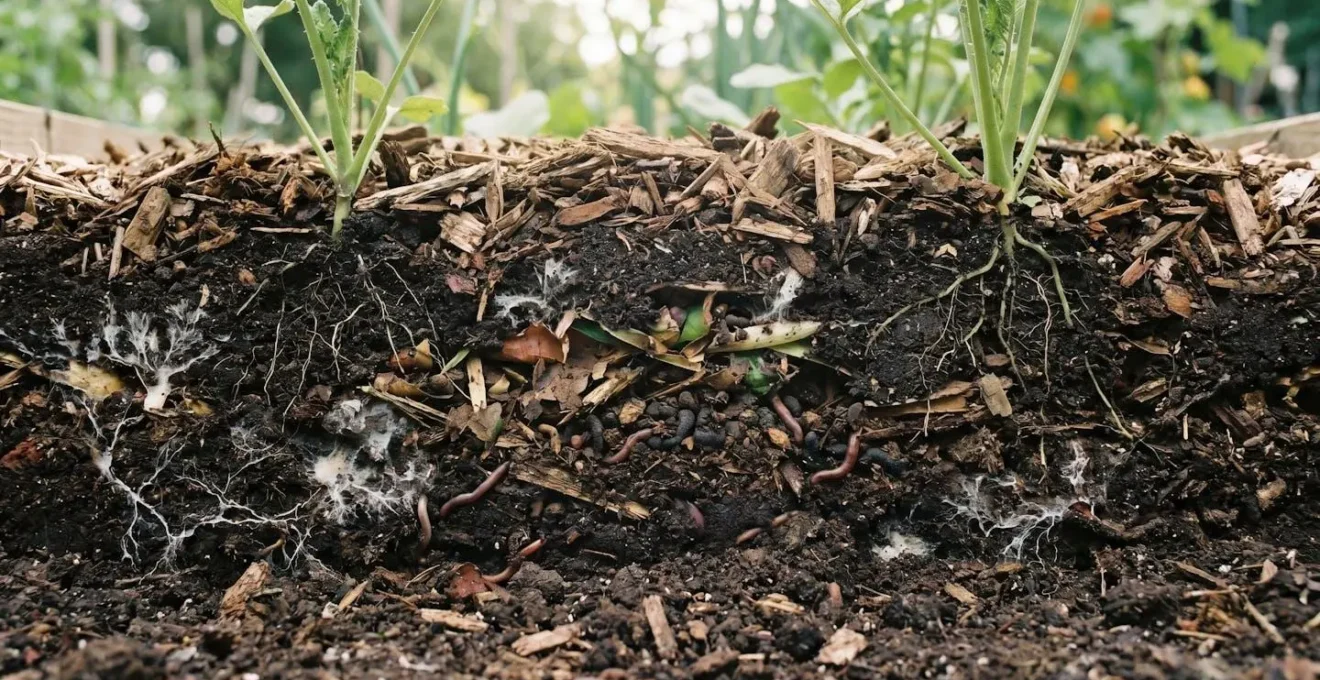
For many dedicated gardeners, it’s a frustratingly familiar story. You do everything by the book—you prune, you water correctly, you watch over your prize tomatoes and roses. Yet, every year, like clockwork, the tell-tale signs of blight or black spot appear, turning a season of promise into a battle for survival. This recurring defeat isn’t a reflection of your gardening skill, but of a fundamental misunderstanding of the enemy. The fight isn’t just on the leaves; the real war is being lost in the soil beneath your feet.
The common advice—remove infected leaves, improve air circulation, practice crop rotation—is not wrong, but it is dangerously incomplete. It’s like treating the symptoms of a persistent illness without addressing the underlying source of infection. These fungal diseases are not annual invaders that arrive on the wind; they are residents, overwintering in a vast and resilient spore reservoir within your garden soil and compost heap. They are simply waiting for the right conditions to launch their attack, year after year.
But what if you could stop treating the symptoms and start curing the disease at its source? This guide moves beyond the platitudes. We will adopt the mindset of a plant epidemiologist to understand the lifecycle of these persistent pathogens. The key isn’t a more powerful fungicide, but a more intelligent strategy. It’s about understanding the precise conditions that kill spores, the mathematical logic of crop rotation, and the critical hygiene gaps that are inadvertently keeping this cycle of infection alive.
By treating your soil not as inert dirt but as a dynamic ecosystem that can be managed and sanitised, you can break the chain of reinfection. We will explore how long spores truly survive, whether heat can be harnessed in the damp UK climate, why your compost might be your worst enemy, and how to implement a level of garden hygiene that finally tips the balance in your favour.
Contents: A Strategic Approach to Fungal Spore Management
- How Long Do Blight Spores Survive in UK Soil?
- Soil Solarization: Can Plastic Sheets Kill Fungi in the UK Climate?
- The Compost Loophole: Why Your Heap is Re-Infecting Your Garden?
- Resistance Breeding: The Only Real Cure for Clubroot?
- 3 Years or 5 Years: How Long is a Safe Rotation Gap?
- Black Spot or Blight
- The ‘Leave it All’ Mistake That Harbours Black Spot Spores
- How to Prevent Foliar Diseases in Damp UK Gardens Without Fungicides?
How Long Do Blight Spores Survive in UK Soil?
The first step in breaking the disease cycle is to understand the true persistence of the enemy. A common misconception is that once the infected plant is gone, the threat is gone. This is dangerously optimistic. Fungal spores are marvels of endurance, designed to wait. While some pathogens have a shorter lifespan, early tomato blight spores can sometimes live dormant in the soil for up to ten years, waiting for a suitable host.
This isn’t just a theoretical threat. The cool, damp conditions typical of a UK climate can paradoxically enhance their survival. While we might associate decay with warmth, many fungal oospores (a type of thick-walled resting spore) are perfectly adapted to overwintering in low-temperature, low-microbial-activity soil. Your garden bed becomes an unintentional, long-term spore reservoir. Every time you dig, you may be bringing last year’s (or the year before’s) pathogens to the surface.
Understanding this long-term viability changes the entire strategic calculus. It explains why a simple one- or two-year rotation might fail. It underscores that “tidying up” at the end of the season is only scratching the surface of the problem. The soil itself is contaminated, and any strategy that doesn’t address this deep-seated inoculum pressure is doomed to be a temporary fix, not a permanent solution. The goal must be to either physically remove, kill, or out-wait this resilient underground army.
This long-term contamination forces us to consider more aggressive, proactive measures to cleanse the soil itself before planting.
Soil Solarization: Can Plastic Sheets Kill Fungi in the UK Climate?
The concept of soil solarization—using the sun’s heat trapped under plastic to kill pathogens—is appealingly simple. However, in the often-overcast UK climate, achieving the sustained high temperatures (above 42°C) required for traditional solarization is a significant challenge. But a more advanced, and arguably more effective, technique is perfectly suited to our conditions: Anaerobic Soil Disinfestation (ASD). This method doesn’t rely solely on heat, but on creating a toxic, oxygen-deprived environment that is lethal to soil-borne pathogens.
ASD works by adding a readily available carbon source (like grass clippings or molasses) to the soil, saturating it with water, and then covering it with clear plastic. The water fills all the air gaps, and the soil microbes rapidly consume the carbon and all available oxygen. This creates anaerobic conditions where a different set of microbes thrives, producing organic acids and volatile compounds that are toxic to fungal spores, pathogenic nematodes, and weed seeds. The clear plastic helps to raise the temperature slightly, accelerating the process, but it’s the chemical warfare at the microbial level that does the heavy lifting.
This method effectively turns the soil’s own biology against the pathogens. Instead of just heating them, you are actively suffocating and poisoning them. It is a more robust and reliable technique for the UK, offering a powerful, non-chemical way to “reset” a contaminated bed and drastically reduce the initial inoculum pressure before you even plant a seed.
Your Action Plan: Implementing Anaerobic Soil Disinfestation (ASD)
- Amend soil with a readily available carbon source such as molasses, grass clippings, or wheat bran, working it into the soil 6-8 inches deep.
- Irrigate the soil until completely saturated to the same 6-8 inch depth to fill all soil pores with water.
- Cover the saturated soil immediately with clear plastic sheeting (4 mil thickness), sealing all edges completely by burying them with soil to prevent oxygen entry.
- Leave the plastic in place for 3-5 weeks. A strong sour or swampy odour when lifting a corner indicates successful anaerobic conditions.
- Remove the plastic sheeting and allow the soil to aerate for at least one week before planting to restore oxygen levels for plant roots.
While this cleanses the garden bed, another major source of reinfection often lies just a few feet away: the compost heap.
The Compost Loophole: Why Your Heap is Re-Infecting Your Garden?
The gardener’s mantra, “feed the soil,” often leads us to the compost heap—that magical source of black gold. But this well-intentioned recycling can become a devastating loophole in your garden hygiene, a Trojan horse that reintroduces the very diseases you’re trying to eliminate. The common advice to “never compost diseased material” is sound, but few understand the precise science of why, leading to critical failures in practice.
The key is the Thermal Kill Point. To reliably destroy most fungal pathogens, including blight and black spot spores, the compost pile must reach and maintain specific temperatures. For instance, effective pathogen elimination requires reaching 60-70°C (140-158°F) for at least 30 minutes. This is the realm of hot composting, a process that requires a critical mass (at least one cubic metre), the right balance of “green” and “brown” materials, adequate moisture, and regular turning to ensure all parts of the pile reach this sterilising heat.
The reality of most domestic compost bins is very different. They are often too small, too dry, too wet, or not turned frequently enough. Consequently, they operate as cool or “warm” composting systems. While they break down organic matter, they rarely reach the thermal kill point, especially at the cooler edges. Instead of a steriliser, your compost bin becomes an incubator—a perfect, sheltered environment for spores to survive the winter, ready to be spread back into your garden with a generous helping of “homemade” compost the following spring. You are, in effect, actively cultivating and redistributing the spore reservoir.
Do not compost infected material, as the pathogens can survive the composting process and spread the disease.
– Institute for Environmental Research and Education, How to Get Rid of Blight in Soil guidance article
Unless you are a master of hot composting with a verified system, the only safe policy is ruthless exclusion: no diseased plant material ever enters the compost. It must be binned or burned.
Resistance Breeding: The Only Real Cure for Clubroot?
Sometimes, the most effective way to break a disease cycle is to remove the host’s susceptibility. This is the principle behind resistance breeding, a cornerstone of modern plant pathology. For gardeners plagued by specific, highly persistent soil-borne diseases like clubroot in brassicas, planting resistant varieties is less a “cure” and more a strategic bypass of the problem. Instead of trying to eliminate every last spore from the soil, you plant something that simply isn’t affected by them.
Clubroot (Plasmodiophora brassicae) is a notorious problem, with resting spores that can survive in the soil for up to 20 years, making rotation almost impractical. For gardeners in affected areas, attempting to grow traditional brassicas is an exercise in futility. However, plant breeders have developed numerous F1 hybrid varieties with strong genetic resistance. These varieties can produce healthy crops even in heavily infested soil, offering a reliable and chemical-free solution where there was previously none.
It is crucial, however, to view this as part of an integrated strategy, not a silver bullet. Resistance is not always immunity. Some small galls may still form, and overuse of the same resistant variety can put selective pressure on the pathogen population to evolve new strains that overcome the resistance. Therefore, combining resistant varieties with other good hygiene practices, such as managing soil pH (clubroot thrives in acidic soil) and extending rotation gaps, is the most robust long-term strategy.
Here is a list of some well-regarded clubroot resistant varieties available in the UK:
- Brussels Sprouts: ‘Cryptus F1’ and ‘Crispus F1’ – reliable resistance with good crop quality.
- Cabbage: ‘Kilaton F1’, ‘Kilaxy F1’, and ‘Cordesa F1’ (a savoy type).
- Cauliflower: ‘Clapton F1’ and ‘Clarify F1’ – produce large, solid white heads.
- Calabrese (Broccoli): ‘Komodo F1’ and ‘Monclano F1’ – good disease resistance.
- Swede: ‘Gowrie’ and ‘Marian’ – essential for this highly susceptible crop.
This genetic strategy pairs perfectly with the most traditional, yet often misunderstood, pillar of soil hygiene: crop rotation.
3 Years or 5 Years: How Long is a Safe Rotation Gap?
“Practice crop rotation” is perhaps the most frequently offered, yet least explained, piece of gardening advice. The common “three-year rule” is a gross oversimplification that ignores the fundamental principle behind the practice. A safe rotation gap isn’t a magic number; it’s a strategic calculation based on the lifespan of specific pathogens and the botanical families of your plants. Getting this Rotation Calculus right is critical, as proper rotation can lead to an up to 90% reduction in soil-borne diseases.
The core concept is simple: pathogens are often host-specific or, more accurately, family-specific. Blight that affects tomatoes (Solanaceae family) will also happily infect potatoes and aubergines. Clubroot that devastates cabbage (Brassicaceae family) will also attack kale, radishes, and rocket. Planting the same family in the same spot year after year is like laying out a continuous feast for its specialist pests and diseases, allowing their populations in the soil to build to epidemic levels.
The “safe gap” is therefore determined by the longest-surviving pathogen that affects a particular plant family. For most common vegetable diseases, a 3-4 year gap is sufficient for the spore population to decline to manageable levels. However, for exceptionally persistent diseases like clubroot (Brassicaceae) or onion white rot (Allium), much longer rotations of 5, 7, or even more years are necessary for a non-resistant crop to have a fighting chance. Simply rotating from tomatoes to potatoes does nothing to break the blight cycle. The key is to rotate between different botanical families.
The following table, based on information from agricultural extension services, provides a clear framework for planning a strategic rotation:
| Plant Family | Common Crops | Major Shared Diseases | Minimum Rotation Gap |
|---|---|---|---|
| Solanaceae (Nightshade) | Tomatoes, Potatoes, Peppers, Aubergines | Early blight, Late blight, Verticillium wilt, Fusarium wilt | 3-4 years |
| Brassicaceae (Cabbage) | Cabbage, Broccoli, Cauliflower, Kale, Radish, Turnip | Clubroot, Black rot, Downy mildew | 4-6 years (clubroot areas) |
| Allium (Onion) | Onions, Garlic, Leeks, Shallots | White rot, Downy mildew, Purple blotch | 3-5 years |
| Fabaceae (Legume) | Beans, Peas, Broad beans | Root rot, Fusarium wilt, Anthracnose | 3 years |
| Cucurbitaceae (Gourd) | Cucumbers, Squash, Courgettes, Melons | Powdery mildew, Fusarium wilt, Anthracnose | 3 years |
Of course, no strategy can begin without first correctly identifying the enemy you are facing.
Black Spot or Blight
Before you can devise a strategy to break the disease cycle, you must be certain of the pathogen you are fighting. While both are fungal diseases that cause immense frustration, black spot on roses (Diplocarpon rosae) and blight on tomatoes (often Phytophthora infestans or Alternaria solani) are different organisms with distinct characteristics. Misidentification can lead to ineffective treatment and a misunderstanding of the risk to other plants in your garden. While visual cues are a start, engaging other senses can provide a more definitive diagnosis.
Experienced gardeners report that blight on tomatoes has a distinctive damp, musty odor, and the lesions feel water-soaked and weak to the touch. In contrast, rose black spot lesions are often dry and crispy, with fringed edges that can be felt with gentle finger pressure. This tactile and olfactory diagnosis adds a reliable layer to visual identification, especially useful in early morning when moisture obscures visual symptoms.
– Sensory diagnostic reports, as collated by garden communities
This expert-level diagnosis moves beyond simple sight. Blight lesions are often surrounded by a pale green or yellow halo and can appear on stems and fruit as well as leaves. They feel structurally compromised. Black spot, true to its name, typically presents as dark, circular spots with characteristic feathery or ‘fringed’ borders, primarily on leaves which then turn yellow and drop. The leaf tissue around a black spot lesion often remains firm until the yellowing is advanced.
Training your eye, and even your nose and fingers, to spot these differences is a key skill. It allows you to assess the threat accurately: blight on a potato is a direct threat to a nearby tomato, but black spot on a rose is not. Correct identification is the first, non-negotiable step in building an effective, targeted defence.
Once identified, the next step is to close the hygiene gaps that allow these diseases to overwinter and return.
The ‘Leave it All’ Mistake That Harbours Black Spot Spores
The ‘no-dig’ and ‘leave the leaves’ movements have many ecological benefits, but when dealing with a persistent fungal outbreak, they can create a critical Hygiene Gap. The belief that nature will take care of it is a romantic notion that ignores the fact that your garden is an artificial ecosystem with artificially high concentrations of susceptible plants. For pathogens like black spot and blight, fallen leaves are not just gentle mulch; they are custom-built winter homes, the primary means of survival from one season to the next.
A single infected leaf can harbour thousands, if not millions, of spores. Allowing these leaves to remain on the ground over winter is the single biggest mistake a gardener can make in the fight against recurring fungal disease. This creates a massive spore reservoir directly at the base of the plant, perfectly positioned for rain splash to carry the inoculum onto new spring growth, thus restarting the entire cycle. The ‘tidying up’ must be ruthless and absolute.
This goes beyond just raking. True sanitary cleanup involves a multi-point approach to eliminate all potential overwintering sites. It means pruning off affected stems, cleaning the soil surface, and, crucially, disinfecting the tools you use to do the job. A pair of secateurs used to prune an infected rose, then used on a healthy one without being cleaned, is a highly efficient vector for spreading the disease. Closing these hygiene gaps is non-negotiable for breaking the cycle.
Here’s a checklist for a truly effective autumn clean-up:
- Rake and Remove: Collect and bag all fallen leaves from affected plants. Do not compost them; place them in municipal waste or burn them if local regulations permit.
- Prune Affected Stems: Cut back any stems or canes showing signs of disease, cutting at least 2 inches into healthy wood.
- Scour the Surface: Inspect the top layer of any mulch (woodchip, bark). If it’s from a heavily infected area, consider removing and replacing it with a fresh, clean layer.
- Disinfect Tools: After working with diseased plants, wipe down all tools (secateurs, forks, trowels) with a 10% bleach solution or rubbing alcohol.
- Clean Footwear and Gloves: The soles of your boots can transport spores across the garden. Scrub them clean. Wash or replace gloves used in the cleanup.
This rigorous hygiene is the foundation upon which preventative strategies can be built.
Key Takeaways
- The primary battle against recurring fungal disease is won or lost in the soil, which acts as a long-term spore reservoir.
- Effective control requires disrupting the spore lifecycle through methods like Anaerobic Soil Disinfestation (ASD) and understanding the ‘Thermal Kill Point’ (60-70°C) that your compost heap likely never reaches.
- Strategic crop rotation (‘Rotation Calculus’) based on plant families is far more effective than arbitrary time gaps, and must be paired with rigorous garden hygiene to close infection loopholes.
How to Prevent Foliar Diseases in Damp UK Gardens Without Fungicides?
After sanitising the soil, the final strategic pillar is to create an environment where any remaining spores struggle to establish a new infection. In the damp UK climate, this means managing one critical factor: leaf wetness. Most fungal spores, including those causing blight and black spot, cannot germinate and infect a plant unless the leaf surface remains wet for a prolonged period. By focusing on keeping foliage dry, you can dramatically reduce disease incidence without a single drop of fungicide.
This preventative approach shifts the focus from chemical warfare to environmental manipulation. Practices like using drip irrigation or soaker hoses instead of overhead sprinklers are paramount. They deliver water directly to the roots, keeping the foliage dry. Strategic pruning is not just for aesthetics; it’s a vital tool for increasing airflow through the plant’s canopy, allowing leaves to dry quickly after rain. Research has shown that these cultural practices are not just minor tweaks; by reducing leaf wetness duration, gardeners can lower disease incidence by up to 85%.
For high-value, highly susceptible plants like outdoor tomatoes, a more direct approach can be a game-changer: the rain shelter. A simple, open-sided structure covered with clear polycarbonate sheeting or horticultural fleece can keep the rain off the foliage while still allowing for crucial airflow. This single intervention creates a microclimate that is hostile to fungal germination, effectively breaking the link between a damp climate and inevitable disease. It’s a physical barrier that preempts the infection process entirely.
Ultimately, breaking the cycle of persistent fungal disease is a triumph of strategy over force. By understanding the enemy’s lifecycle, sanitising its reservoir in the soil, and manipulating the environment to be hostile to infection, you can transform your garden from a yearly battleground into a thriving, resilient ecosystem.