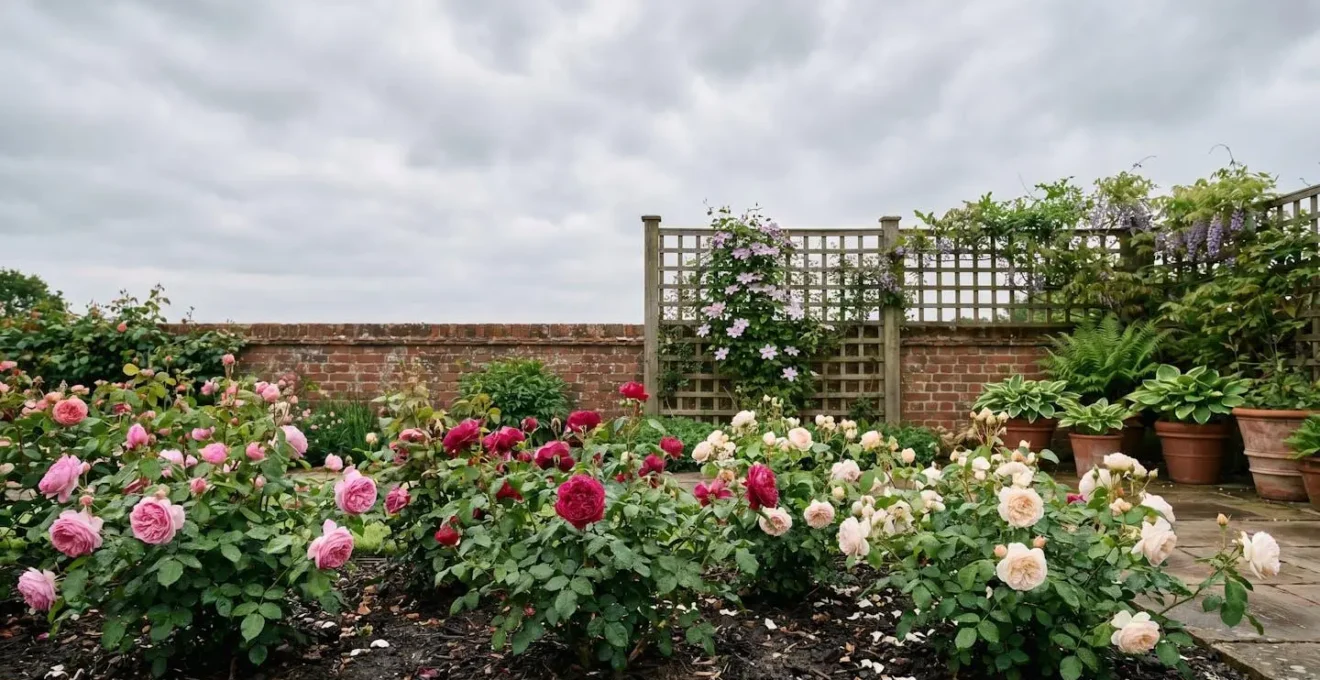
The key to a disease-free UK garden isn’t chemical intervention, but mastering environmental control to make your garden actively hostile to fungi.
- Focus on soil-level watering and strategic pruning to dramatically reduce the “canopy dry-down time” that spores need to germinate.
- Treat garden design elements like fences and plant spacing as tools for ‘environmental engineering’ to maximise critical airflow.
Recommendation: Shift your mindset from reactively ‘treating’ disease spots to proactively ‘preventing’ spore germination through meticulous garden hygiene and cultural controls.
For gardeners across the United Kingdom, the persistent damp and humidity can feel like a constant invitation for fungal diseases. The familiar, frustrating sight of black spots mottling rose leaves or a ghostly white film of powdery mildew coating foliage is an annual battle. Many guides recommend a simple routine of spraying fungicides, but this approach often feels like a temporary fix, failing to address the root cause. It also overlooks the desire of many gardeners to cultivate a healthier, more balanced ecosystem without a constant reliance on chemical treatments. This reactive cycle leaves plants weakened and gardeners disheartened.
The common advice—choose resistant varieties, spray at the first sign of trouble—is valid but incomplete. It places the gardener in a defensive posture. But what if the solution wasn’t in the spray bottle, but in the structure of the garden itself? What if you could engineer your garden’s microclimate to be fundamentally inhospitable to these fungal pathogens? The true power lies in understanding the fungal life cycle and disrupting it at every turn. This isn’t about fighting a war; it’s about changing the landscape so the battle never begins.
This guide moves beyond generic tips to provide a preventative, science-based framework rooted in the principles of plant pathology. We will dissect the environmental factors that create a ‘fungal incubator’ and provide actionable cultural controls to dismantle it. By focusing on water management, airflow dynamics, and strategic sanitation, you can significantly reduce the ‘spore load’ in your garden and create robust, resilient plants that thrive even in the dampest UK weather.
To help you navigate these preventative strategies, this article breaks down the essential cultural controls. From mastering watering techniques to understanding the profound impact of a simple garden fence, you’ll gain the knowledge to become a proactive guardian of your garden’s health.
Summary: A Pathologist’s Strategy for Fungal Disease Prevention
- Black Spot or Blight
- Watering Techniques: Why Overhead Watering Is Banned for Disease Control?
- The Spacing Mistake That Creates a ‘Fungal Incubator’ in Your Border
- Copper or Sulphur: When to Apply Organic Fungicides Effectively?
- To Compost or Burn: Handling Infected Foliage Without Spreading Spores?
- Solid Fences vs Trellis: Which Causes More Air Stagnation?
- The ‘Leave it All’ Mistake That Harbours Black Spot Spores
- Improving Canopy Air Circulation to Stop Powdery Mildew in Roses?
Black Spot or Blight
Before implementing any control strategy, it’s essential to understand the scale of the challenge. In the UK’s maritime climate, fungal pathogens are not an occasional nuisance; they are the primary cause of plant sickness. In fact, as UK horticultural surveys show, fungal pathogens are responsible for over 85% of UK garden plant diseases. Diseases like black spot (Diplocarpon rosae) and various forms of blight and mildew aren’t just cosmetic issues. They are aggressive pathogens that reduce a plant’s photosynthetic ability, leading to defoliation, loss of vigour, and increased susceptibility to other stresses.
The key to management is early identification and proportional response. A single spot is a warning, not a catastrophe. A ‘traffic light’ system is a useful mental model for gardeners. A few isolated spots (Green) require monitoring and good hygiene, but no drastic action. When spots begin to spread across a plant or to adjacent ones (Amber), it’s a clear signal to implement preventative cultural controls: remove the worst affected leaves and assess airflow. A heavy infection where large areas of foliage are compromised (Red) requires more decisive action, such as pruning back heavily infected stems to healthy, clean tissue.
Understanding this progression is crucial. The goal of a non-fungicide approach is to prevent the situation from ever reaching the ‘Red’ level. By implementing the cultural controls discussed throughout this guide, you actively manage the environment to keep disease pressure in the ‘Green’ zone, where the plant’s own immune system can often manage minor infections. This proactive stance is the foundation of disease prevention, shifting the focus from ‘curing’ a sick plant to maintaining a healthy ecosystem.
Watering Techniques: Why Overhead Watering Is Banned for Disease Control?
Water is the single most critical factor in the life cycle of most foliar fungi. Spores are omnipresent in the garden environment, but they cannot germinate and infect a plant without a period of prolonged leaf wetness. This is why overhead watering, especially in the UK’s damp climate, is the number one mistake that facilitates disease outbreaks. When you spray water across the canopy, you are essentially creating the perfect incubation conditions for black spot and mildew. Each water droplet on a leaf surface is a potential germination site for a fungal spore.
The solution is a fundamental shift in watering strategy: water the soil, not the plant. By delivering water directly to the root zone, you keep the foliage—the primary target for foliar diseases—as dry as possible. This dramatically shortens the ‘canopy dry-down time,’ giving spores no opportunity to activate. This is the most powerful non-chemical disease prevention technique available to any gardener.
As the image demonstrates, methods like soaker hoses or drip irrigation are ideal. They deliver water slowly and directly to the soil, promoting deep root growth while ensuring the leaves remain dry. If using a watering can, place the spout directly at the base of the plant. While morning watering is often recommended to allow foliage to dry during the day, the timing becomes less critical when the leaves are never wet in the first place. As the Royal Horticultural Society notes in its guidance, while evening watering is acceptable, damp leaves overnight can encourage pests and fungal diseases. By adopting a soil-focused approach, you eliminate this risk entirely.
The Spacing Mistake That Creates a ‘Fungal Incubator’ in Your Border
After water, the second most critical environmental factor for fungal disease is air circulation. When plants are packed too tightly in a border, they create a pocket of still, humid air. This stagnant microclimate is the perfect ‘fungal incubator’. It traps moisture from rain, dew, and transpiration, dramatically extending the canopy dry-down time and providing the ideal conditions for spores to germinate. Proper spacing is not a mere aesthetic choice; it is a primary tool of environmental engineering for disease prevention.
When you give each plant adequate space, you allow air to flow freely through and around its canopy. This constant air movement helps to quickly dry leaves after rainfall or morning dew, disrupting the fungal life cycle before it can begin. The principle is clearly demonstrated in commercial horticulture. Orchards and vineyards are planted with wide spacing and often with a southeast exposure to allow the morning sun and prevailing winds to dry dew from the foliage as quickly as possible, before fungal spores become active.
For the home gardener, this means resisting the temptation to over-plant for an instant ‘full’ look. Read the plant labels and respect the final spread recommendations. A good rule of thumb is to ensure that at maturity, the leaves of one plant will not be touching the leaves of its neighbour. This might look sparse initially, but as the plants grow, they will form a healthy, well-ventilated community rather than a dense, disease-prone thicket. This single decision at planting time can prevent years of struggle with mildew and black spot.
Copper or Sulphur: When to Apply Organic Fungicides Effectively?
While the primary goal is prevention through cultural controls, there are times when a certified organic fungicide can be a useful tool, particularly for prized but susceptible plants. However, their use requires a shift in mindset. Products based on copper or sulphur are not ‘cures’ that will eliminate an existing infection; they are protectants. Their entire efficacy depends on being applied *before* the fungal spores arrive and germinate.
These products work by creating a thin, inhospitable film on the leaf surface. When a fungal spore lands on this film, it is either killed or prevented from germinating. This means they must be applied preventatively to healthy foliage, often in early spring as new leaves emerge, and reapplied at regular intervals (especially after rain, which can wash the coating off) to protect new growth. As leading horticulturists explain, their application is a proactive, not reactive, measure.
Copper fungicides are protectants and must be applied before fungal spores land, not after infection occurs.
– Epic Gardening Horticulture Team, When and How to Use Copper Fungicide Guide
Applying these products requires care and precision. Because they are broad-spectrum, they can impact beneficial organisms, so applying them correctly is crucial to minimise harm and maximise effectiveness. Following a strict protocol ensures you are using them as a targeted tool, not a blunt instrument.
Your Pre-Application Safety Checklist for Organic Fungicides
- Weather Forecast Check: Before mixing any product, check the Met Office forecast. Confirm that no rain is predicted within the next 24 hours to ensure the protective film has time to dry and adhere to the foliage.
- Personal Protective Equipment (PPE) Audit: Locate and inspect your protective gear. Ensure you have appropriate gloves and a mask ready, as even organic-approved products can cause irritation.
- Beneficial Insect Timing Assessment: Plan your application for the late evening or very early morning. This avoids the peak activity hours of bees and other pollinators, significantly reducing their exposure.
- Exclusion Zone Plan: Determine how long the foliage will take to dry completely. Plan to keep pets and children out of the treated area until the spray has fully dried to prevent contact.
- Post-Application Coverage Review: After application, visually inspect the plant to confirm a fine, even coating has been achieved on all susceptible leaf surfaces (both top and bottom) without excessive run-off.
To Compost or Burn: Handling Infected Foliage Without Spreading Spores?
A crucial element of reducing disease pressure in your garden is sanitation. Fungal spores are resilient and can easily overwinter on fallen leaves and plant debris on the soil surface. This creates a primary source of inoculum for the following spring. When spring rains arrive, spores are splashed from this debris up onto the fresh, vulnerable new growth, starting the infection cycle all over again. The simple act of removing this infected material is one of the most impactful preventative measures you can take. In fact, UK horticultural research demonstrates that for diseases like black spot, removing fallen leaves in autumn prevents 60-70% of reinfection the following spring.
However, what you do with this infected material is critical. Tossing it onto a standard, cool home compost heap is a recipe for disaster. Most home compost heaps in the UK do not reach the sustained high temperatures (above 55°C) required to kill fungal spores. Instead, the compost pile becomes a reservoir of disease, which you then dutifully spread back into your garden the following year. The disposal method must ensure the spores are either destroyed or removed from your garden ecosystem entirely. This comparative analysis from the RHS provides a clear guide for UK gardeners.
| Method | Effectiveness | Suitability for UK Households | Key Considerations |
|---|---|---|---|
| Council Green Waste Bin | High (if council uses industrial hot composting) | Excellent – most convenient | Check local council processing method; industrial facilities reach spore-killing temperatures |
| General Waste Bin | High (removes from garden) | Excellent – always safe | Infected material goes to landfill; guaranteed spore removal from garden ecosystem |
| Home Hot Composting | High (if done correctly) | Moderate – requires expertise | Must maintain 55-65°C for minimum 3 days; requires correct browns/greens ratio and turning |
| Home Cold Composting | Low – NOT recommended | Poor – spreads disease | Typical UK garden heap does not reach spore-killing temperature; will reinfect garden |
| Garden Bonfire | High (complete destruction) | Poor – legal and social issues | Many UK councils restrict garden fires; smoke irritates neighbours; air quality concerns |
For the vast majority of UK gardeners, the safest and most effective options are the council green waste bin (provided your local authority uses industrial hot composting) or the general waste bin. These methods guarantee the removal of the spore load from your immediate environment. You can get more information on this from a comprehensive guide on preventing pest and disease problems.
Solid Fences vs Trellis: Which Causes More Air Stagnation?
Garden boundaries are rarely considered as factors in plant health, but they have a profound impact on the microclimate, particularly concerning air circulation. A solid 6-foot fence, ubiquitous in UK gardens, acts like a dam against wind. It creates a ‘wind shadow’—an area of still, stagnant air on its leeward side. This lack of air movement traps humidity, slows the drying of foliage after rain, and creates a perfect breeding ground for fungal diseases. Planting susceptible species like roses or phlox directly against a solid fence is setting them up for a constant battle with powdery mildew and black spot.
In contrast, a permeable boundary like a trellis, wire fence, or an open-style hedge allows air to pass through. This gentle but constant airflow is vital for whisking moisture away from leaf surfaces, drastically reducing the window of opportunity for fungal spores to germinate. The choice of boundary, therefore, is an act of environmental engineering. If you are struggling with disease in a bed next to a solid fence, the fence itself may be a primary contributing factor.
Case Study: The Wind Shadow Effect in UK New-Build Gardens
An analysis of typical UK new-build estates, often characterized by gardens enclosed by 6-foot solid featheredge fences, demonstrates this principle perfectly. These enclosed spaces create a windless, damp environment. When combined with tight planting schemes common in smaller gardens, it creates the ideal conditions for fungal spore settlement and rapid disease development. The humidity gets trapped around the foliage, and the natural drying process is severely inhibited. This stands in stark contrast to the open-field approach of orchards, which are designed specifically to maximize airflow and sun exposure to keep foliage dry.
If you have a solid boundary, you can mitigate its effects by avoiding planting right up against it. Leave a generous gap (at least 50cm) between the fence and your plants to create an air channel. Even better, consider retrofitting the fence by installing trellis panels on top to break up the solid line, or growing climbers over it to create a more texturally varied, air-permeable surface. Every action taken to disrupt stagnant air is a step toward a healthier garden.
The ‘Leave it All’ Mistake That Harbours Black Spot Spores
The ‘leave it to nature’ approach to autumn gardening, while appealing in its simplicity, can be a critical mistake when it comes to disease control. While leaving some leaf litter can benefit wildlife, allowing diseased foliage to remain on the ground over winter is the equivalent of seeding your garden for next year’s infections. This is particularly true for black spot on roses. As RHS research on the rose disease lifecycle shows, the fungus is not killed by winter frosts. It expertly overwinters on those fallen leaves and in small, often unnoticed, lesions on the young stems.
As temperatures rise in spring, these dormant infections produce a fresh crop of spores. Rain then splashes these spores from the soil-level debris up onto the newly emerging, tender foliage, and the entire cycle begins again. A meticulous autumn cleanup is therefore not just about tidiness; it is a critical sanitation practice aimed at drastically reducing the overwintering ‘spore load’. Failing to do so means you start the next growing season at a significant disadvantage, with a high concentration of the pathogen ready to attack.
A thorough autumn cleanup protocol should be a non-negotiable part of your garden routine for susceptible plants. This involves a few key steps:
- Collect and Dispose: Scrupulously collect all fallen leaves from around the base of the plants. Do not simply rake them into the border or cover them with mulch. They must be removed from the garden ecosystem via your general waste or council green bin.
- Prune Infected Stems: Inspect the stems for any black or purplish lesions. These are dormant infections that will produce spores in spring. Prune these stems out, cutting back to clean, healthy, green tissue.
- Apply Fresh Mulch: After the cleanup is complete, applying a fresh layer of mulch (such as bark chips or well-rotted compost) can act as a physical ‘splash barrier’, helping to prevent any remaining spores in the soil from reaching the new leaves.
This rigorous approach ensures that your plants start the spring with the lowest possible disease pressure, giving them a clean slate and a much greater chance of staying healthy throughout the season.
Key Takeaways
- The primary cause of fungal disease is prolonged leaf wetness; therefore, watering the soil directly and keeping foliage dry is the most effective preventative measure.
- Maximising air circulation through correct plant spacing, permeable boundaries (trellis vs. solid fences), and strategic pruning is essential to reduce humidity and speed up canopy drying.
- Rigorous garden sanitation, especially the removal and proper disposal of infected fallen leaves in autumn, is critical to reduce the overwintering spore load and prevent reinfection in spring.
Improving Canopy Air Circulation to Stop Powdery Mildew in Roses?
While spacing and boundary choices manage airflow around plants, we can also engineer airflow *within* the plant itself. This is particularly effective for tackling diseases like powdery mildew, which thrives in the dense, still, and often shaded centres of overgrown shrubs. As the Royal Horticultural Society identifies, powdery mildew is one of the most common foliar diseases of roses in the UK, often appearing as a distinctive white, dusty coating on leaves, stems, and buds during periods of high humidity. Proactive, structural pruning is your best defence.
Simply shearing the outside of a shrub is not enough. The goal is to open up the core of the plant to light and air. A highly effective technique for shrub roses and other dense shrubs is the ‘donut pruning’ method. This involves selectively removing entire stems from the centre of the plant to create a more open, vase-like or donut-shaped structure. This creates a channel for air to flow directly through the plant’s core, eliminating the stagnant, humid conditions that powdery mildew loves.
Implementing this method is straightforward and best done during winter dormancy or early spring:
- Identify the Centre: Locate the oldest, thickest, and most crowded stems growing from the centre of the shrub.
- Remove Central Growth: Using sharp, clean secateurs or loppers, prune out 2-3 of these central stems completely, cutting them right back to the base of the plant.
- Thin Crossing Branches: Look for any remaining branches that are growing inwards or crossing through the newly opened centre. Remove these as well, preserving the outward-facing framework.
- Assess the Result: Step back and look at the plant’s structure. You should see a distinct hollow or open centre that will allow light to penetrate and air to circulate freely.
This structural change permanently improves the plant’s microclimate. Any badly affected shoots showing large patches of mildew should also be cut out during routine pruning. By combining this targeted pruning with good overall garden hygiene, you create a plant that is architecturally resilient to fungal attack.
By shifting your perspective from gardener to environmental engineer, you can transform your garden from a fungal incubator into a resilient ecosystem. The principles of managing water, maximising airflow, and maintaining rigorous sanitation are not just chores; they are the pillars of a successful, preventative, and fungicide-free disease management strategy. Start today by assessing one area of your garden—a damp corner, a crowded border—and apply one of these cultural controls. This proactive approach is the most sustainable path to a truly healthy garden.