In summary:
- Systematically map your garden’s daily and seasonal sun exposure to identify high-value “warm spots.”
- Analyse shade not as a deficit, but as a distinct microclimate suitable for specific, tolerant crops.
- Actively engineer your garden’s light environment by using reflective surfaces and managing thermal mass.
- Master greenhouse ventilation to prevent heat stress, which is as critical as providing sunlight.
- Choose plant varieties specifically adapted to the quantified light levels in different zones of your garden.
The familiar frustration for any British vegetable grower is the sight of green tomatoes stubbornly clinging to the vine as September’s chill sets in. Standard advice often revolves around generic platitudes: use good compost, feed regularly, and hope for a sunny summer. While these are not incorrect, they ignore the single most critical limiting factor in the UK’s climate: the quantity and quality of solar energy reaching the plant. Achieving a bountiful harvest isn’t a matter of luck; it’s a matter of physics and strategy.
This guide moves beyond horticultural hope and into the realm of data-driven gardening. The core premise is that you must treat sunlight not as a given, but as a resource to be audited, managed, and manipulated. We will reframe the problem from simply ‘needing more sun’ to systematically engineering your garden’s microclimates to maximise photosynthetic efficiency. This involves conducting a “light audit” of your space, understanding the thermal properties of your garden’s materials, and making strategic interventions that can dramatically alter the outcome of your growing season.
By adopting an analytical mindset, you can transform your garden from a passive recipient of British weather into a highly optimised system for food production. We will explore how to map solar pathways, leverage reflected light, avoid common environmental errors, and select cultivars based on precise light-level data, not just guesswork.
This article provides a structured, analytical framework for optimising your garden’s solar potential. The following sections break down the key components of this light engineering strategy, from initial data collection to advanced microclimate management.
Summary: Mapping Solar Exposure for Maximum UK Tomato Yield
- How to Create a Sun Map of Your Garden in One Day?
- Dappled vs Deep Shade: Which Vegetables Can Survive Under Trees?
- White Walls or Mirrors: Increasing Solar Exposure in Dark Corners
- The Ventilation Error That Cooks Plants Despite Good Sun
- Winter Sun vs Summer Sun: Adjusting Pot Positions for the Season
- Mapping Your Garden: How to Identify the ‘Warm Spot’ for Early Planting
- Why Standard Grow Lights Fail During British Winters?
- How to Boost Photosynthesis in Shady North-Facing Gardens?
How to Create a Sun Map of Your Garden in One Day?
The first step in any analytical process is data collection. To engineer your garden’s light, you must first quantify it. Creating a sun map is a foundational “light audit” that replaces assumptions with empirical data. This process involves observing and recording the sun’s path across your property over a single, representative day, ideally near the spring equinox or summer solstice to understand peak conditions. The goal is to identify zones of full sun (6+ hours), partial sun (4-6 hours), and shade (less than 4 hours).
On a clear day, begin your audit in the morning. Sketch a basic layout of your garden. Every hour, from sunrise to sunset, mark on your sketch where shadows fall from trees, fences, and your house. Note the quality of the light – is it direct and intense, or is it filtered and dappled? For greater precision, technology can be employed. Smartphone light meter apps can provide a quantitative measurement of light intensity (in lux or foot-candles) in different areas. Furthermore, according to professional garden designers, specialised tracking tools can be invaluable. Some apps, for instance, allow you to visualise the sun’s path for any hour of the day and any date of the year using a slider, providing a powerful predictive model of your garden’s solar potential throughout the seasons.
The resulting map is your strategic blueprint. It reveals not just the obvious sunny spots but also the marginal zones that could be improved and the deep-shade areas that require a different planting strategy entirely. This data-driven approach is the opposite of randomly placing plants and hoping for the best. It allows for precise, deliberate placement that matches a plant’s specific photosynthetic needs to a location’s verified solar resources.
This map is not a static document; it’s the dynamic foundation upon which all subsequent yield-boosting strategies are built. It transforms you from a hopeful gardener into a strategic light manager.
Dappled vs Deep Shade: Which Vegetables Can Survive Under Trees?
A sun map often reveals significant areas of shade, particularly in gardens with mature trees or those overlooked by neighbouring structures. From an analytical perspective, these areas should not be seen as wastelands but as distinct microclimates with specific properties. The key is to differentiate between ‘dappled shade’, the moving, filtered light under a deciduous tree, and ‘deep shade’, the consistent low light found at the base of a north-facing wall or under dense evergreens.
The primary difference is not just light quantity but also temperature and soil moisture. Data on UK growing conditions reveals that shady locations are between 5 to 10°C lower than full sun locations. This temperature modulation can be beneficial, preventing heat-sensitive crops from bolting (flowering prematurely) during a summer heatwave. For instance, coriander, which quickly bolts in harsh sun, often thrives in the cooler, more humid shade cast by a row of runner beans. It’s a matter of matching the plant’s biology to the environmental data.
While tomatoes and other fruiting vegetables are non-starters in deep shade, a surprising number of edibles are adapted to lower light levels, particularly those grown for their leaves or roots. These plants have a lower light compensation point, meaning they can achieve a net photosynthetic gain with less solar energy. Strategic selection is everything. For UK gardens, several crops are proven performers in these conditions:
- Sweet cicely: Thrives in the dappled shade beneath trees like apples, offering sweet aniseed-flavoured leaves and pods.
- Swiss chard ‘Bright Yellow’: A visually striking crop whose leaves grow happily in partial shade, making it a functional addition to herbaceous borders.
- Broad beans ‘Aquadulce Claudia’: An overwintering variety that performs well in the weaker light of early spring and tolerates dappled shade.
Instead of trying to grow sun-lovers in the shade, the data-driven approach is to select crops that are evolutionarily adapted to these exact conditions, thus turning a perceived liability into a productive asset.
White Walls or Mirrors: Increasing Solar Exposure in Dark Corners
Once your sun map identifies light-deficient zones that you wish to make more productive, the next step is active light engineering. This involves physically altering the environment to redirect and amplify available sunlight. The two most effective, low-cost methods are the strategic use of reflective surfaces: white paint and mirrors. This is particularly effective in small, urban UK gardens where walls and fences define the space.
A white-painted wall or fence is the most reliable tool for light modification. A matte white surface acts as a diffuse reflector, scattering sunlight evenly and bathing the adjacent area in a brighter, more consistent light. This is far more effective than a gloss finish, which can create harsh, focused ‘hot spots’. The goal is to raise the ambient light level, boosting the total Photosynthetically Active Radiation (PAR) available to plants. A south-facing wall painted white can create a microclimate that is significantly warmer and brighter than the rest of the garden, effectively mimicking the growing conditions of a more southerly latitude. This is a classic technique used for centuries to grow tender fruits like apricots and peaches in the UK’s marginal climate.
Mirrors offer a more dramatic but complex solution. While they can be used to beam direct sunlight into a completely shaded corner, their application requires careful analysis. They must be positioned to track the sun’s path throughout the day and season, and care must be taken to avoid creating a concentrated beam that could scorch plant leaves. Outdoor-rated acrylic mirrors are safer and more durable than glass. The best application for mirrors is not to create a single patch of intense light, but to use several smaller mirrors to lift the overall ambient brightness in a confined, dark space like a narrow side return.
Ultimately, both methods transform passive garden structures into active components of your yield-boosting strategy, a core principle of analytical gardening.
The Ventilation Error That Cooks Plants Despite Good Sun
Providing ample sunlight, particularly in a greenhouse, is only half the battle. A common and catastrophic error for UK gardeners is to focus solely on maximising light while neglecting the resulting thermal gain. A sealed greenhouse, even on a moderately sunny British day, can quickly become a death trap. The very structure designed to protect plants from the cold can, without proper management, cook them from the inside out.
The physics are simple: short-wave solar radiation enters through the glass, heats the surfaces inside, and is re-radiated as long-wave infrared radiation, which cannot escape as easily. This is the greenhouse effect in miniature. The data is stark: on a sunny day with outside temperatures of 25°C, an unventilated greenhouse reaches 35-45°C within hours. For tomatoes, this is disastrous. At 35°C, tomato pollen becomes nonviable, meaning even if the plant is flowering, no fruit will set. The plant is photosynthesising furiously but its reproductive cycle has been completely halted by heat stress.
Therefore, ventilation is as crucial as sunlight. It is the primary mechanism for temperature regulation. An effective ventilation strategy ensures a constant exchange of air, preventing heat and humidity from building up to dangerous levels. The two main approaches are shading and venting, and they should be used in tandem.
Shading reduces the amount of solar radiation entering the greenhouse in the first place. Venting allows hot air, which naturally rises, to escape. The following table, based on RHS analysis, compares common methods for the UK climate.
| Method | Advantages | Disadvantages | Best UK Application |
|---|---|---|---|
| Shade Netting | Variable density (5-95%), removable, allows airflow, adjustable by season | Requires installation framework, can flap in wind | May to September, remove for spring/autumn light |
| Shade Paint (Whitewash) | Longer-lasting, more diffuse light distribution, inexpensive | Less flexible, remains until manually removed, can look messy | Mid-spring to early autumn, gradually reduce by September |
| Automatic Vent Openers | No electricity needed, wax-cylinder mechanism, prevents overheating when absent | Slower response time (wax expansion delay), lifting capacity limit (7kg typical) | Year-round essential for UK greenhouses, fits standard roof vents |
Investing in automatic vent openers is one of the single most effective, data-driven decisions a greenhouse gardener can make, providing a fail-safe mechanism that protects your plants even when you are not present.
Winter Sun vs Summer Sun: Adjusting Pot Positions for the Season
A garden’s light map is not a static document; it’s a dynamic system that changes dramatically with the seasons. The low, weak arc of the winter sun in the UK casts long shadows and illuminates different areas than the high, powerful sun of summer. A data-driven gardener does not fight this change but adapts to it, particularly when using containers, which offer the ultimate in strategic flexibility.
Container gardening allows for what professional designers call a “nimble dance” with the changing light. A spot that is in deep shade from a deciduous tree in summer might be in full sun during winter and early spring once the leaves have fallen. A south-facing wall that provides a perfect, sun-drenched home for a tomato plant in August may be the only spot that receives any direct light at all in January. The strategy, therefore, is to physically move containerised plants to follow the available solar energy. This adaptive approach creates a dynamic collaboration with the ever-changing tapestry of seasonal light. Sun-loving Mediterranean herbs might spend the summer in a central, open position, but be moved to the base of a south-facing wall in winter to benefit from the low sun and the thermal mass of the wall.
This seasonal adjustment also applies to managing moisture. As one UK Garden Design Expert notes, there is a specific microclimate crucial for overwintering certain plants:
The ‘rain shadow’ is the dry area at the base of a wall or hedge protected from prevailing south-westerly rain, crucial for overwintering plants that hate wet feet like alpines or Mediterranean herbs.
– UK Garden Design Expert, Article on UK microclimates
This demonstrates the granular level of analysis required. By moving a pot of rosemary into the rain shadow at the base of a wall for winter, you are not only maximising its access to low-angle sun but also protecting its roots from the fatal combination of cold and wet that is so common in British winters. It is a precise, calculated intervention based on an understanding of multiple environmental factors.
Treating your pots as mobile assets, deployed to the most advantageous positions based on seasonal data, is the hallmark of a truly strategic and successful container gardener.
Mapping Your Garden: How to Identify the ‘Warm Spot’ for Early Planting
Beyond direct sunlight, the key to boosting yields and extending the short UK growing season is understanding and exploiting ‘thermal mass’. Your sun map shows where light falls, but a thermal map reveals where that light energy is stored. The sunniest spot is not always the warmest. A ‘warm spot’ is an area where materials absorb solar radiation during the day and slowly release it as heat during the night, buffering against temperature drops and warming the soil earlier in spring.
Identifying these spots is a process of observation and analysis. Look for areas that combine maximum sun exposure with materials that have high thermal mass. These materials act as natural storage heaters. As explained by the Thermal Mass Gardening Principle:
The sunniest spots heat up materials like brick walls, dark slate, or tarmac paths which then act like a storage heater, raising soil temperature and warding off light frosts.
– Thermal Mass Gardening Principle, UK garden microclimate analysis
To locate your garden’s premium warm spot, conduct a simple thermal audit. On a sunny afternoon, physically touch different surfaces. A brick wall facing south will feel significantly warmer than a wooden fence in the same position. A dark-coloured paving slab will be warmer than a patch of lawn. The soil adjacent to these heat-storing materials will warm up faster in spring and stay warmer overnight, allowing for significantly earlier planting of tender seedlings like tomatoes. This can give you a crucial 2-3 week head start on the growing season.
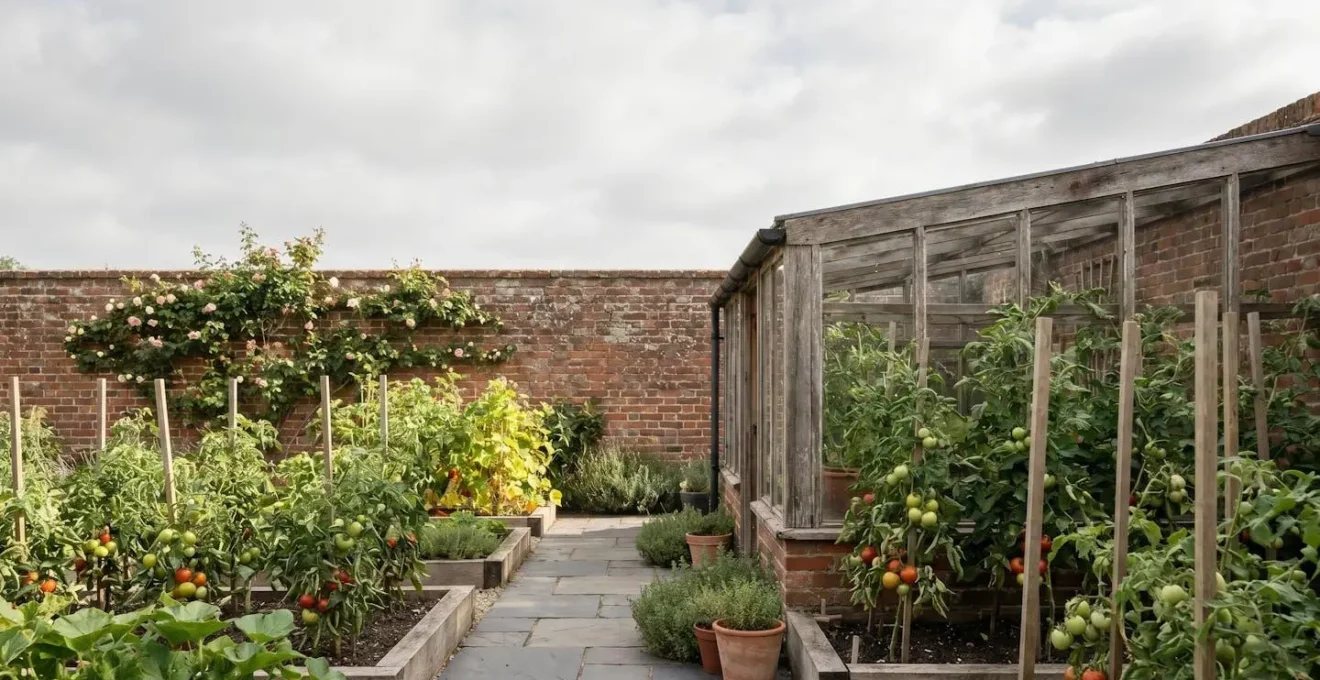
The ideal location for an early tomato crop is often in a container or raised bed placed directly against a south- or west-facing brick wall. This spot benefits not only from direct sunlight but also from the reflected light off the wall’s surface and, most importantly, the radiated heat released from the bricks throughout the evening and night. This creates a stable, nurturing microclimate that mitigates the risk of late spring frosts and accelerates early growth.
By understanding and leveraging thermal mass, you can create an island of climatic advantage, turning stored solar energy into an earlier and more abundant harvest.
Why Standard Grow Lights Fail During British Winters?
When faced with the profound lack of natural light during a British winter, many gardeners turn to artificial lighting. However, the market is flooded with cheap ‘purple lights’, often found on online marketplaces, which almost always lead to disappointment. The reason for their failure is rooted in a misunderstanding of plant physiology and the physics of light. These lights fail for two primary reasons: insufficient intensity and an incomplete spectrum.
Firstly, fruiting plants like tomatoes have an incredibly high demand for light energy. The effectiveness of a grow light is measured by its Photosynthetic Photon Flux Density (PPFD), which quantifies the amount of usable light reaching the plant. As a Daily Light Integral Analysis for UK growers points out, “Cheap Amazon ‘purple lights’ lack the intensity (PAR value) and full spectrum needed for fruiting, and are only good for starting seeds or maintaining houseplants.” They simply do not provide enough energy to power the complex process of flowering and fruit development. Keeping a tomato plant alive is different from providing it with enough energy to produce a crop.
Secondly, even with powerful, full-spectrum lights, the economics of winter tomato production in the UK are fundamentally challenging. The issue is temperature. Based on UK greenhouse temperature data, it is known that typical winter temperatures can fluctuate wildly. To keep a greenhouse at the minimum temperature required for tomatoes to thrive, significant auxiliary heating is required. This combination of high electricity costs for both intensive lighting and consistent heating makes producing summer vegetables like tomatoes during a UK winter economically unviable for the home grower. The energy input required far outweighs the value of the resulting crop.
Therefore, a strategic gardener focuses their resources not on fighting the deep winter with expensive technology, but on using that technology to get a head start in late winter and early spring, starting strong, healthy seedlings indoors under quality lights, ready for planting out into the ‘warm spots’ as soon as the natural light and temperature levels are viable.
Key Takeaways
- Doubling your tomato yield is not about luck; it’s about systematically auditing and engineering your garden’s light and thermal environment.
- A “sun map” is your foundational data blueprint, revealing high-value warm spots and distinct shade microclimates that can be used strategically.
- Ventilation is as critical as sunlight. A sealed greenhouse can cook plants and render pollen sterile, negating all other efforts.
How to Boost Photosynthesis in Shady North-Facing Gardens?
The north-facing garden represents the ultimate challenge for a UK gardener. It receives the least amount of direct sunlight and is often the coldest and dampest part of the property. While doubling a tomato yield here is highly improbable, applying an analytical approach can still lead to a respectable harvest where one might expect total failure. The key is to abandon ideal-world thinking and focus on marginal gains: maximising every scrap of available light and selecting plants bred for exactly these challenging conditions.
The impact of reduced light on tomatoes is not theoretical; it is quantifiable. Academic research on shade impact demonstrates that a 30% reduction of sunlight resulted in a yield reduction of around 25%. In a north-facing garden, the reduction in sunlight can be far greater, so managing expectations is crucial. The strategy shifts from maximising yield to achieving a viable yield. This involves two main tactics: light enhancement and genetic selection.
Light enhancement in a north-facing plot involves applying the principles of reflection with even greater urgency. Painting the boundary wall or fence a brilliant, matte white is non-negotiable. This surface becomes the garden’s primary light source for much of the day. Any container used should be light-coloured to reflect light up onto the plant’s lower leaves. Pruning is also critical; plants must be trained as single-stem cordons and lower leaves removed promptly to ensure maximum light penetration and air circulation to the developing trusses.
Most importantly, you must select cultivars that are genetically predisposed to tolerate lower light and cooler temperatures. Standard varieties will fail. Instead, focus on specific types that have been bred for or originate from high-latitude climates. These include:
- Sub-Arctic Plenty: A determinate (bush) variety known for its ability to set fruit at lower temperatures.
- Glacier: Another cold-tolerant, early-maturing variety that can produce a crop with as little as 4-5 hours of sun.
- Cherry Tomatoes: Smaller-fruited varieties like ‘Sweet Million’ or ‘Tiny Tim’ require less photosynthetic energy to ripen and can often manage with 3-4 hours of direct sun.
Action Plan: Auditing a North-Facing Garden for Viability
- Light Path Audit: Use a compass to confirm the aspect. For one full day, log the exact hours any direct sunlight hits the area, even if it’s only for 30 minutes.
- Surface Inventory: List all vertical surfaces (walls, fences). Note their colour and texture. Prioritise painting the largest, best-placed surface brilliant white.
- Microclimate Analysis: Check for ‘rain shadows’ or areas protected from wind. These are your most valuable spots. Measure soil temperature here vs an exposed area.
- Cultivar short-listing: Research and source seeds exclusively from the list of cold-tolerant, low-light varieties. Do not attempt to grow standard cultivars.
- Support System Plan: Plan for single-stem pruning. Ensure you have the necessary canes and ties to maximise airflow and light exposure to every leaf.
Success in a north-facing garden is the ultimate testament to a data-driven approach, proving that careful analysis, environmental modification, and strategic selection can coax a harvest from even the most unpromising of British plots.