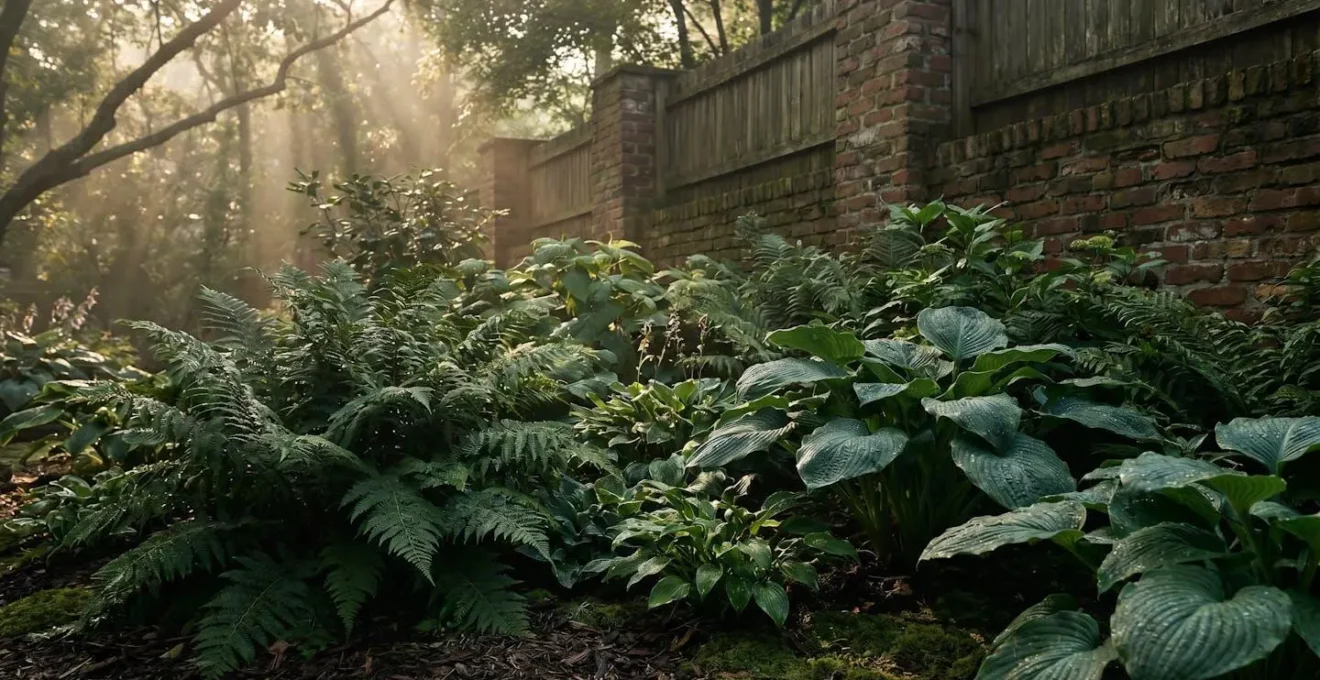
Contrary to popular belief, the key to a thriving UK shade garden isn’t fighting the lack of light, but scientifically enhancing your plants’ ability to use every available photon.
- Success in shade depends on maximising a plant’s internal ‘machinery’, focusing on chlorophyll density over simple species choice.
- Plants in low light have a slower metabolism; they require less fertiliser, and overfeeding with nitrogen is a common and critical mistake.
Recommendation: The single most effective action you can take is to create a detailed sun map of your garden to understand its true microclimates before choosing or moving any plants.
For many urban gardeners in the UK, a north-facing garden or a plot overshadowed by buildings can feel like a botanical curse. You follow the conventional wisdom, planting species labelled ‘shade-tolerant’ and hoping for the best, only to be met with spindly growth and lacklustre leaves. You might even paint a wall white or strategically place a mirror, chasing every last lumen of our notoriously shy British sun. These efforts, while well-intentioned, often treat only the symptoms of a much deeper issue: a lack of photosynthetic efficiency.
But what if we’ve been looking at the problem backwards? As a botanist specializing in cool-climate flora, I can tell you that the secret isn’t just about collecting more light, but about empowering your plants to become masters at using the limited light they receive. The most resilient shade gardens are not those that try to replicate sunny conditions, but those where the plants themselves are physiologically optimised for a low-light environment. This involves understanding the very engine of your plant’s life.
This guide will move beyond the platitudes. We will dissect the science of how plants truly see light, why the colour of a leaf is a critical performance indicator, and how the conventional approach to feeding can actually harm your plants in the shade. By learning to think like a botanist, you can turn your shady patch from a source of frustration into a lush, thriving ecosystem.
To help you navigate this scientific journey into your garden, we will explore the core principles for optimising plant health in the shade. The following summary outlines the key areas we will cover, from the quality of light to the very soil beneath your feet.
Summary: A Botanist’s Guide to Photosynthesis in Shady Gardens
- Why Standard Grow Lights Fail During British Winters?
- How to Clean Leaves to Increase Light Absorption by 15%?
- Ferns or Hostas: Which Species Photosynthesizes Better in Deep Shade?
- The Nitrogen Mistake That Burns Plants in Low-Light Conditions
- Orienting Your Greenhouse: The Exact Angle for Winter Sun Capture
- How to Create a Sun Map of Your Garden in One Day?
- Why Variegated Plants Need More Light Than Green Ones (Usually)?
- How to Map Solar Exposure to Double Your Tomato Yield in the UK?
Why Standard Grow Lights Fail During British Winters?
During the short, grey days of a British winter, many gardeners turn to artificial lighting to support their seedlings and houseplants. However, grabbing any standard household LED bulb can be a waste of energy. The reason lies in a crucial distinction: the light we see is not the same as the light plants use. We measure household lights in lumens, a measure of brightness to the human eye, which is most sensitive to green and yellow light. Plants, however, operate on Photosynthetically Active Radiation (PAR), a measure of the specific light wavelengths that fuel photosynthesis.
A plant’s photosynthetic machinery is primarily tuned to absorb light in the blue (400-465nm) and red (620-680nm) parts of the spectrum. Blue light drives vegetative leaf growth, while red light is essential for flowering and fruiting. A standard LED bulb may be very bright in lumens but produce very little energy in these critical red and blue wavelengths, offering the plant ‘junk food’ light. A proper full-spectrum grow light, by contrast, is specifically engineered to deliver high-energy peaks in these precise bands, providing a targeted and efficient energy source.
Without this correct light spectrum quality, plants under standard lights during a low-light winter will exhibit signs of stress, such as elongated, weak stems (etiolation) and pale leaves, as they struggle to produce enough energy. They are literally starving, no matter how bright the room may seem to us.
Action Plan: Witness the Power of PAR Firsthand
- Select two identical spider plants of similar size and health.
- Place Plant A under a standard household LED bulb (high lumens, limited PAR spectrum).
- Place Plant B under a full-spectrum grow light with proper red and blue wavelengths.
- Position both plants in identical temperature conditions to avoid a photoperiod-temperature mismatch.
- Photograph leaves weekly to document colour intensity and measure new growth.
- After 4-6 weeks, compare chlorophyll richness by observing leaf colour vibrancy and growth rate differences. The results will speak for themselves.
Investing in a dedicated grow light is not about making the room brighter; it’s about providing the precise nutritional-energy profile your plants need to survive and thrive when the sun cannot.
How to Clean Leaves to Increase Light Absorption by 15%?
Think of a plant’s leaves as its solar panels. In an urban UK garden, these panels are constantly being covered by a fine layer of dust, pollen, and pollutants. This seemingly insignificant film can have a major impact on a plant’s ability to create energy, especially in an already light-limited environment. When the leaf surface is obscured, less light can penetrate to the chlorophyll-containing cells beneath, directly inhibiting photosynthesis. In fact, some horticultural studies have demonstrated a reduction of up to 20% in photosynthetic efficiency due to dust accumulation.
For a plant in a north-facing garden, a 20% reduction in its already meager light budget can be the difference between surviving and thriving. Regularly cleaning the leaves of your plants is one of the simplest and most effective ways to boost their performance. This simple act of care ensures that their photosynthetic machinery can operate at maximum capacity, capturing every available photon of light.
The process is straightforward and therapeutic. Use a soft, damp microfiber cloth and gently wipe the top surface of each leaf. It’s crucial to support the leaf from underneath with your other hand to prevent tearing or bruising. Use lukewarm water and avoid chemical leaf-shine products, which can clog the leaf’s pores (stomata) and do more harm than good. For plants with many small leaves, a gentle spray with a mister can also help, but wiping is superior for broad-leaved plants like Hostas or Ficus.
By integrating this “plant spa day” into your regular gardening routine, you are directly investing in the energy-producing capacity of your green companions, ensuring they are perfectly primed to make the most of the British light.
Ferns or Hostas: Which Species Photosynthesizes Better in Deep Shade?
When faced with a deeply shaded corner, the typical response is to consult a list of “shade-loving plants,” with ferns and hostas almost always topping the list. But the question of which is “better” is a lesson in botanical strategy. The answer isn’t in the species name, but in understanding their different evolutionary adaptations for low-light survival. It’s a classic case of evaluating chlorophyll density versus surface area maximization.
Hostas, particularly the non-variegated varieties, are masters of chlorophyll density. As a case study from horticultural experts demonstrates, solid blue or deep green hosta varieties contain the most chlorophyll and are therefore the most efficient at photosynthesis in low light. The deep, rich colour is a direct visual indicator of a high concentration of light-absorbing molecules packed into the leaf. Variegated hostas, while visually striking, are significantly less efficient because the white or cream sections of the leaf contain no chlorophyll at all. In the darkest corners, a dark green ‘Devon Green’ hosta will dramatically outperform a variegated ‘White Feather’.
Ferns, on the other hand, employ a different strategy. Many species, like the native Male Fern (Dryopteris filix-mas), have evolved finely divided fronds. This intricate structure is a masterpiece of engineering, designed to maximize the light-capturing surface area while minimizing self-shading. Each small leaflet, or pinna, is positioned to catch stray photons of light filtering through the canopy above. They don’t pack in as much chlorophyll per square centimetre as a dark hosta, but they present a much larger, more intricate net to catch whatever light is available.
So, which is better? For a spot with consistent, deep shade, the high chlorophyll density of a dark green hosta offers powerful and efficient energy production. For an area with dappled, moving light, the large, intricate surface area of a fern may be more adept at capturing fleeting moments of sun. The expert gardener chooses not by name, but by strategy.
The Nitrogen Mistake That Burns Plants in Low-Light Conditions
One of the most common and damaging mistakes gardeners make with shade-grown plants is to treat them with the same feeding regimen as their sun-drenched counterparts. In a sunny spot, high photosynthesis rates mean a plant has a voracious appetite for nutrients, especially nitrogen, which fuels leaf growth. In the shade, however, the plant’s entire system operates at a slower pace—a state of metabolic down-regulation. Photosynthesis is limited by light, not nutrients, so the plant’s ‘engine’ is effectively idling.
Applying a high-nitrogen fertiliser in these conditions is like flooding the engine of a parked car with petrol. The plant simply cannot process the excess nutrients. This unused nitrogen leads to several problems: it forces weak, sappy, and leggy growth that is highly attractive to pests like aphids. More critically, the unused fertiliser salts accumulate in the soil, damaging the roots and causing “fertiliser burn”—visible as brown, crispy leaf edges. While it may seem counter-intuitive, overfeeding is far more dangerous to a shade plant than underfeeding. Properly managed, however, nutrient addition can be beneficial; scientific research has found that in low-light environments, nitrogen can result in an enhanced physiological metabolic capacity when properly balanced with other elements.
Your Checklist: Low-Light Fertilisation Protocol
- Reduce Frequency: Plants in low light have significantly reduced fertiliser needs. Feed them at half or a quarter of the rate recommended for full-sun plants.
- Choose a Balanced Formula: Look for a complete fertiliser containing Nitrogen (N), Phosphorus (P), and Potassium (K).
- Prioritise P and K: For foliage plants in shade, select a ratio where phosphorus is higher than or equal to nitrogen (e.g., 10-15-10). Phosphorus (P) is vital for energy transfer (ATP), a critical process when energy is scarce.
- Dilute, Dilute, Dilute: Always apply water-soluble fertilisers in a dilute solution to minimise the risk of root burn.
- Consider Organic Slow-Release: Sources like bone meal (for phosphorus) or liquid seaweed extract (for potassium and trace elements) provide a gentler, more sustained release of nutrients.
- Monitor for Excess: Watch for the signs of too much nitrogen: weak, leggy growth, sappy stems, and an increase in aphid populations.
By respecting the slower metabolism of your shade plants and adjusting your feeding strategy accordingly, you will foster strong, resilient growth instead of weak, vulnerable spurts.
Orienting Your Greenhouse: The Exact Angle for Winter Sun Capture
For the dedicated UK gardener, a greenhouse or a cold frame is an essential tool for season extension. Yet, in a shady garden, its effectiveness hinges on a crucial piece of science: the angle of its glazing. This is a prime example of microclimate engineering, where a small design choice can yield enormous results. The sun’s trajectory in winter is low across the sky, and a standard structure with a shallow-angled roof may have the sun’s rays glance off it rather than penetrating inside.
To maximise the precious low-angle winter sun, the glazing should be positioned as close to perpendicular to the incoming rays as possible. This is not a matter of guesswork; there is a scientific formula for this.
Case Study: The Royal Horticultural Society’s Optimal Angle Formula
Research from leading institutions like the Royal Horticultural Society provides a clear directive for maximising low winter sun in light-capturing structures. To achieve this, you should apply the rule: angle the glass at your latitude plus 15 degrees. For most UK locations, which sit at a latitude of approximately 50-55°N, this translates to an optimal glazing angle of 60-75 degrees from the horizontal. This steep angle ensures that the weak winter sun hits the glass almost head-on, maximising energy transmission into the structure. Furthermore, using twin-wall polycarbonate for glazing is particularly effective in shady spots as it diffuses light more evenly, scattering it across plant surfaces and avoiding the ‘hot spots’ that can occur with standard glass.
Positioning a cold frame with this steep angle against a south-facing wall (even if it’s only sunny for part of the day) creates a powerful solar collector. The wall acts as a ‘heat sink’, absorbing warmth during the day and slowly radiating it back into the cold frame at night, buffering your tender plants from the worst of the cold. This simple, science-based orientation can create a viable growing environment where one previously seemed impossible.
This is not just about building a structure; it’s about engineering a micro-environment precisely tuned to the challenges of the British winter.
How to Create a Sun Map of Your Garden in One Day?
The single most fundamental step in transforming a shady garden is to stop thinking of it as a single, uniform space. Your “shady” garden is actually a complex mosaic of distinct microclimates, each with a unique solar signature. Before you can choose the right plant for the right place, you must first understand this map. Creating a sun map is a simple, observational process that provides an invaluable blueprint for all future planting decisions. It is the foundational practice of microclimate engineering.
The perception of light can be deceptive. A spot that seems bright in the morning might be in deep shade by midday, while an unassuming corner might benefit from several hours of ‘borrowed light’ reflected from a neighbour’s window or a white wall. Mapping this movement of light and shadow throughout the day removes the guesswork and replaces it with hard data. This allows you to place plants with higher light needs in the brightest zones and reserve the true shade-lovers for the darkest corners, ensuring every plant is positioned for success.
Your Action Plan: The Sundial Stick Method for Sun Mapping
- Morning Preparation (8 AM): Place numbered wooden stakes or bamboo canes in 8-10 key locations you want to assess throughout your garden.
- Hourly Marking Routine: Every hour, from 9 AM to 5 PM, visit each stake and mark the exact boundary between light and shadow. Use coloured chalk on paving or coloured stones on soil.
- Use a Consistent Colour Code: For example, use yellow for full sun, orange for dappled or partial light, and blue for full shade.
- Document ‘Borrowed Light’ Zones: Pay special attention to unexpected bright spots created by light reflecting off walls, windows, or light-coloured surfaces. These are valuable assets.
- Create a Master Map: In the evening, photograph the patterns or transfer them to a simple sketch of your garden. You will now have a clear visual representation of your garden’s ‘micro-sun-zones’.
- Family Engagement: Turn it into a fun science project. Assign each family member a specific monitoring station and have them create their own colour-coded observation journal to gamify the learning experience.
With this detailed map in hand, you are no longer gardening blind. You are a strategist, armed with the data needed to place every plant in its optimal position for photosynthetic success.
Why Variegated Plants Need More Light Than Green Ones (Usually)?
A common misconception among gardeners is that the bright, variegated foliage of plants like Hosta ‘Patriot’ or Euonymus fortunei ‘Emerald ‘n’ Gold’ can be used to lighten up a dark corner. Botanically, this is the exact opposite of what you should do. Those beautiful white, cream, or yellow markings on the leaves are areas that are partially or completely lacking in chlorophyll, the green pigment that powers photosynthesis. This makes variegated plants inherently less efficient at creating energy.
Think of it this way: a solid green leaf is a complete, fully-functional solar panel. A variegated leaf is a solar panel with sections blacked out. The remaining green parts have to work much harder to produce enough energy to support the entire leaf, including the non-productive variegated sections. In a high-light environment, this isn’t a problem, as there’s plenty of energy to go around. But in the low-light conditions of a shady UK garden, this inefficiency becomes a critical liability. The plant may struggle to produce enough food to survive, leading to weak growth and a decline in health.
The most compelling evidence of this is a survival mechanism known as ‘reversion’. When a variegated plant is placed in excessively deep shade, it will often start to produce new leaves that are solid green. This is not a failure but a clever act of self-preservation. The plant detects that it is starving for light and responds by allocating all its resources to producing leaves with maximum chlorophyll density. It is the plant’s way of screaming, “I need more light!” For the darkest areas of your garden, it’s far wiser to choose plants with textural interest, like the intricate fronds of a fern, rather than relying on variegation for visual appeal.
By appreciating that variegation is a beautiful but energy-intensive feature, you can make smarter plant choices, reserving these striking specimens for the brighter spots in your garden where they can truly flourish.
Key Takeaways
- Prioritise plants based on chlorophyll density (dark green leaves) for deep shade, not just their species name.
- In low light, plants have a slower metabolism; reduce nitrogen fertiliser to prevent weak growth and root burn.
- Map your garden’s specific sun patterns before planting. ‘Shade’ is a complex mosaic, not a uniform condition.
How to Map Solar Exposure to Double Your Tomato Yield in the UK?
Tomatoes are the quintessential sun-loving crop, making their successful cultivation a particular challenge for many UK gardeners. Simply providing the textbook “6 hours of sun” is often not enough to guarantee a bountiful harvest in our cooler, cloudier climate. Achieving a truly impressive yield requires moving beyond basic requirements and applying a holistic system of microclimate engineering, using a sun map as your foundation to optimise every factor, from light to root health.
For tomatoes, it’s not just the duration of light, but the accumulation of heat that drives ripening and sugar production. A south-facing brick wall or a stone patio that receives direct sun becomes a ‘heat sink’, absorbing thermal energy during the day and radiating it back onto the plants through the cooler evening and night. This can raise the ambient temperature around the plant by several degrees, significantly accelerating fruit development. By combining the sunniest spot in your garden with a heat sink, you create a supercharged growing zone.
But the optimisation doesn’t stop at the surface. By applying the principles of microclimate management both above and below ground, you can create a total system that pushes your plants to their maximum potential. The following strategies, summarised from Royal Horticultural Society recommendations, illustrate how a multi-faceted approach can lead to dramatic improvements in yield.
The following table, based on an analysis of optimised growing strategies, breaks down how to elevate your tomato cultivation from standard practice to a high-performance system.
| Microclimate Factor | Standard Approach | Optimized Strategy for UK Conditions | Impact on Yield |
|---|---|---|---|
| Light Exposure | Any sunny spot (4-5 hours sun) | 6+ hours direct sun PLUS heat sink (south-facing brick wall or patio that radiates warmth at night) | +30-40% fruit production |
| Root System | Standard planting in garden soil | Mycorrhizal fungi inoculation at planting creates massive secondary root network | +25% nutrient/water uptake efficiency |
| Mulching | Organic bark mulch for moisture retention | Red plastic mulch reflects far-red light spectrum back to plant, triggering growth hormones | +15-20% fruit production |
| Pruning Strategy | Remove suckers only | Strategic leaf removal to ensure every truss receives direct sunlight portion of day for ripening | +10-15% earlier ripening |
Stop seeing your shady garden as a limitation and start treating it as a unique ecosystem to be understood and engineered. Begin by mapping your sun exposure this weekend and observing your plants with a new, scientific eye; you have the power to cultivate abundance, even under British skies.