Achieving garden privacy is often viewed as a horticultural task, but in reality, it’s a matter of legal compliance that can trigger expensive disputes if mishandled.
- The High Hedges Act imposes strict rules on hedge height, and non-compliance can lead to formal council action and significant fees.
- Invasive plants like running bamboo can constitute ‘private nuisance’, making you liable for thousands in damages to a neighbour’s property.
- Even ‘permitted development’ like decking can be challenged under common law if it overlooks a neighbour’s property, infringing on their “reasonable enjoyment”.
Recommendation: Approach every planting and landscaping decision not just with aesthetics in mind, but with a pre-emptive legal strategy to mitigate risk and maintain neighbourly relations.
For homeowners in semi-detached or terraced houses, the quest for garden privacy is a delicate balancing act. You desire a secluded sanctuary, but you’re acutely aware of your neighbour’s ‘Right to Light’ and the ever-present risk of a boundary dispute. The common advice is often to plant fast-growing hedges or erect tall screens, but this approach treats the issue as a simple gardening problem. It is not. From a property law perspective, every screening choice is a potential liability.
Many homeowners inadvertently create legal tripwires by focusing on the “what” to plant, rather than the “how” and “where” in compliance with UK law. They might consider pleached trees or bamboo screens, but overlook the doctrines of private nuisance, the specific clauses of the High Hedges Act, or the restrictive covenants within a Conservation Area. The result can be a ‘green screen’ that cultivates not peace, but a protracted and expensive legal battle with the people next door.
But what if the key wasn’t just about choosing the right plant, but about adopting the right legal strategy from the outset? This guide reframes garden screening as a risk mitigation exercise. We will dissect the most common screening options through the lens of UK property law. We will analyse the legal implications of hedges, the financial risk of invasive species, the boundary errors that lead to court, and the hidden liabilities in grading and decking, ensuring your privacy solution doesn’t become your next legal problem.
This article will provide a structured legal-horticultural framework to help you navigate these complexities. Follow along as we break down the critical legal considerations for every aspect of your garden screening project, from initial plant selection to long-term maintenance.
Summary: Garden Privacy Without a Neighbour Dispute: A Lawyer’s Guide to Screening & The Law
- High Hedges Act: When Does Your Privacy Screen Become Illegal?
- How to Install Pleached Trees for Privacy Above Fence Height?
- Bamboo or Laurel: Which Screen is Less Likely to invade?
- The Boundary Error: Planting Trees Too Close to Shared Fences
- How to Prune Hedges to Prevent ‘Leggy’ Bottoms?
- Do You Need Planning Permission for Decking in a Conservation Area?
- The Grading Mistake That Floods Your Neighbour’s Property
- Professional Landscape Design vs DIY: Where to Spend Your Budget?
High Hedges Act: When Does Your Privacy Screen Become Illegal?
The most common tool for creating privacy, the evergreen hedge, is also the most legally regulated. The High Hedges Act 2003 was enacted specifically to address disputes arising from hedges that block light or views. A hedge becomes legally problematic if it is comprised of two or more mostly evergreen or semi-evergreen trees or shrubs, stands over 2 metres tall, and adversely affects a neighbour’s reasonable enjoyment of their property. It is crucial to understand that this is not an automatic right for your neighbour to demand a 2-metre height; they must prove the hedge’s height is causing a demonstrable problem.
Before the council will even consider a complaint, you must provide evidence of having tried to resolve the issue amicably. If mediation fails and your neighbour proceeds with a formal complaint, the process becomes adversarial and costly. For instance, lodging a high hedge complaint with a local authority can be expensive, with fees such as the £625 charged by Dorset Council, a cost designed to deter frivolous claims but which underscores the financial seriousness of the dispute. If the council finds in your neighbour’s favour, they can issue a Remedial Notice, forcing you to cut the hedge at your own expense and setting a precedent for future maintenance.
Therefore, your first line of defence is pre-emptive compliance and meticulous record-keeping. Choosing a hedge species with a manageable growth rate is a start, but documenting your planting decisions, pruning schedule, and any communications with your neighbour is paramount. Should a dispute arise, this evidentiary trail will be invaluable. The key is to manage your hedge not just for aesthetics, but as if you are preparing a legal file for future scrutiny.
Action Plan: Assembling an Evidentiary Trail for a Hedge Dispute
- Document Correspondence: Collate all written communication with your neighbour from the last 6 months, including dated letters and emails, that demonstrate your attempts to resolve the dispute amicably.
- Photographic Evidence: Take dated photographs of the hedge from various angles, clearly showing its height, density, and the specific impact it has on your property’s light and outlook.
- Maintain a Light Loss Diary: Systematically record the times of day and seasonal variations in daylight reaching key windows and garden areas, creating a log of the hedge’s impact.
- Objective Calculation: Use the official government hedge height and light loss calculation spreadsheet to objectively assess if the hedge exceeds a reasonable height relative to its distance from your property.
- Formal Submission: If all else fails, complete your local council’s formal high hedge complaint form, submitting it with the required fee and all the supporting evidence you have meticulously gathered.
Ultimately, a proactive approach to hedge height and maintenance is not just good gardening; it is a critical legal risk mitigation strategy.
How to Install Pleached Trees for Privacy Above Fence Height?
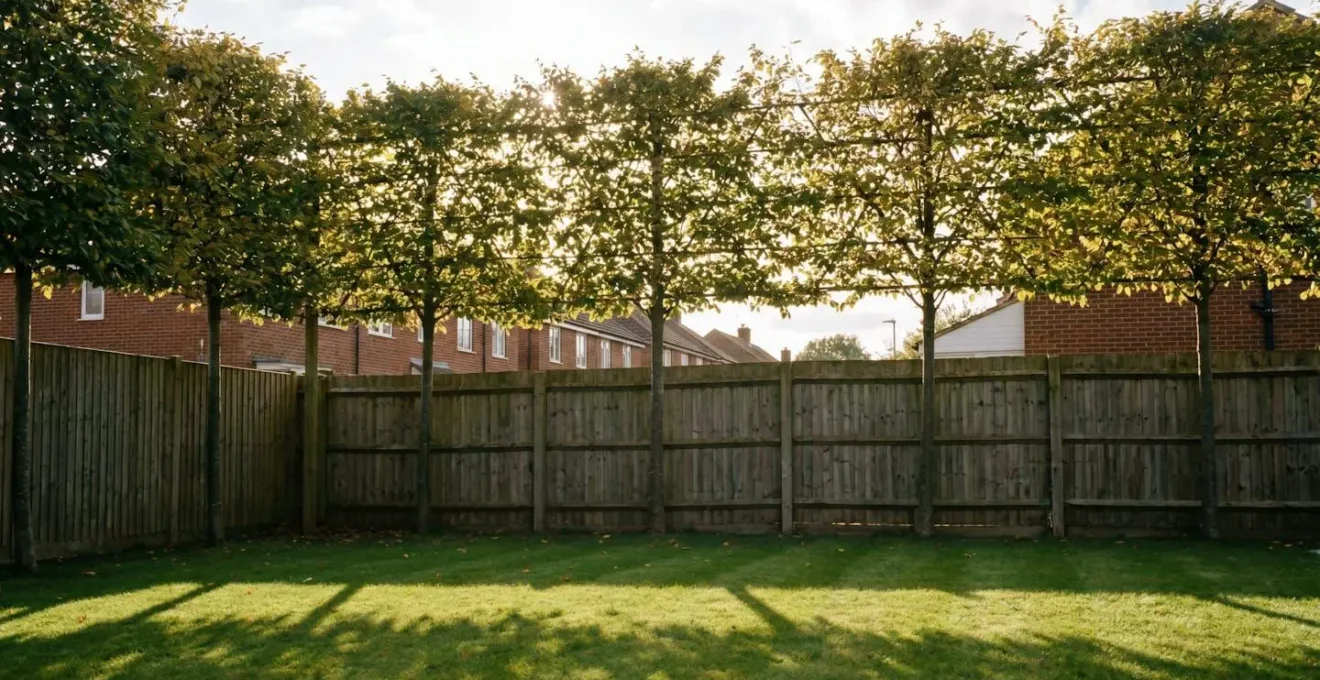
Pleached trees, often called ‘hedges on stilts’, are an elegant solution for creating privacy above a standard fence line without creating a solid, light-blocking wall at ground level. This technique involves training trees to a flat framework, creating a foliage screen on a clear stem. From a legal perspective, their main advantage is that the screen is positioned well above the 2-metre mark where the High Hedges Act typically applies, and the clear stems allow light and air to pass underneath, making a ‘loss of light’ complaint from a neighbour less likely to succeed.
However, the elegance of this solution comes at a price. The cost of pleached trees is a significant consideration, with prices determined by the maturity, species, and frame size of the tree. A homeowner can expect to invest anywhere from £150 to over £1,500 per tree, and for an effective screen, several trees will be required. This initial outlay is a key factor in project planning and budgeting. While young, freshly pleached trees offer a more budget-conscious entry point, they require more patience and horticultural skill to develop into a dense screen.
Installation is another critical phase. Proper spacing is essential to ensure the canopies eventually merge to form a continuous screen. A robust support structure of posts and wires is not optional; it is vital for holding the frames rigid against wind and guiding new growth. Failure to install this correctly can result in damaged trees and a failed screen. Given the significant investment, professional installation is often a wise decision, particularly for mature specimens, to ensure the trees establish well and the support framework is structurally sound for years to come.
The following table provides a breakdown of what to expect when sourcing pleached trees in the UK, helping you align your budget with your desired level of immediacy and impact.
| Tree Category | Frame Size | Price Range (GBP) | Availability | Best For |
|---|---|---|---|---|
| Young/Freshly Pleached | 120x150cm | £150-£300 | Year-round (potted) | Budget-conscious projects, DIY installation |
| Semi-Mature Standard | 150x180cm | £395-£650 | Oct-April (rootball), Year-round (potted) | Balanced cost vs. immediate impact |
| Mature Specimen | 180x180cm | £800-£1,500 | Limited, Oct-April | Instant screening, professional projects |
| Specialist Species (Magnolia) | Varies | £1,000+ | Made to order | Feature screening, high-end designs |
While costly, pleached trees represent a strategic investment. They offer a legally savvy method of achieving high-level privacy that is often more palatable to neighbours and planning authorities than a monolithic hedge.
Bamboo or Laurel: Which Screen is Less Likely to invade?
The choice between bamboo and laurel for a privacy screen encapsulates a classic legal dilemma: the fast, effective solution versus the safe, predictable one. Cherry Laurel (Prunus laurocerasus) is a reliable, robust evergreen that forms a dense hedge. Its growth is vigorous but its root system is generally well-behaved and unlikely to cause issues beyond its immediate planting area. It is manageable with regular pruning and poses a very low risk of encroaching on neighbouring property in a legally problematic way.
Bamboo, particularly the ‘running’ varieties (leptomorph), presents a far greater legal risk. While it offers the promise of a near-instant screen, its rhizomes can travel many metres underground, surfacing in a neighbour’s lawn, driveway, or even through their property’s foundations. This encroachment constitutes ‘private nuisance’ under UK common law. The homeowner who planted the bamboo can be held liable for the cost of removal and any damage caused, which can be substantial. In a recent UK dispute, a case of invasive bamboo damage resulted in a settlement of just under £20,000 to cover remediation costs. This highlights the severe financial consequences of choosing the wrong plant.
Not all bamboo is problematic. ‘Clumping’ varieties (pachymorph), such as those from the Fargesia genus, have a much less aggressive root system, expanding slowly from the central plant. However, even with clumping types, installing a robust, 60cm deep root barrier is a non-negotiable risk mitigation measure. Planting any bamboo without this containment is, from a legal standpoint, an act of negligence. The burden of proof will always be on you to show you took reasonable steps to contain it.
Case Study: Legal Liability for Bamboo Encroachment
A UK homeowner faced legal action after their neighbour’s running bamboo invaded their property, growing through a concrete slab and causing structural damage. The affected party commissioned a professional survey that documented the bamboo’s origin and the extent of the spread. Presented with this overwhelming evidence, the bamboo owner had little defence. The case was settled for nearly £20,000, a sum covering the complete cost of bamboo treatment and property remediation. This established a clear precedent: under UK private nuisance law, a property owner is liable for damage caused by invasive plants originating from their land, even if the plant, like bamboo, is not officially listed under the Wildlife and Countryside Act 1981.
Therefore, the legally prudent choice is clear. While Laurel may require more patience to establish a full screen, it carries a fraction of the legal and financial liability associated with bamboo. If you must use bamboo, choose a clumping variety and encase it within a fortress-like root barrier. Anything less is a gamble against your neighbour’s property and your own finances.
The Boundary Error: Planting Trees Too Close to Shared Fences
One of the most common and costly mistakes in garden screening is planting too close to a boundary line. A small sapling planted a foot from a fence may seem innocuous, but as it matures, its trunk will expand, its roots will spread, and its branches will overhang. This inevitably leads to conflict. The expanding trunk can push over and damage the fence, raising questions of ownership and repair liability. Roots can extend into a neighbour’s property, potentially causing subsidence to paths, patios, or even house foundations. Overhanging branches can block light and drop debris, which the neighbour has a common law right to cut back to the boundary line.
The legal principle is straightforward: you are responsible for the consequences of what you plant in your garden. If your tree causes damage to your neighbour’s property, you can be held liable. Resolving these issues can be incredibly expensive, with legal costs for straightforward tree boundary disputes reaching £5,000-£15,000 in UK courts. This figure doesn’t even include the cost of remedial works or the emotional toll of a protracted neighbour dispute. Mediation is a lower-cost alternative, but prevention is by far the most effective strategy.
The key to prevention is to research the mature size of any tree or shrub before planting and site it accordingly. A good rule of thumb is to plant at a distance of at least half its ultimate spread from the boundary. For large trees, this can mean planting several metres away. You must also consider access for future maintenance. Planting a vigorous hedge like Leylandii right against a fence makes it impossible to prune the back side, leading to an overgrown, unmanageable screen that quickly falls foul of the High Hedges Act.
The following table, based on expert advice from bodies like the RHS, provides a crucial guide for pre-emptive compliance. Consulting this before you dig is a critical step in risk mitigation.
| Plant Type | Mature Height | Mature Spread | Minimum Distance from Boundary | Reason |
|---|---|---|---|---|
| Cherry Laurel (Prunus laurocerasus) | 4-8m | 3-4m | 1.5-2m | Vigorous growth, dense root system, requires access for annual pruning |
| Leylandii (Cupressus × leylandii) | 20m+ | 4-6m | 3m minimum | Extremely fast growth (90cm/year), prone to High Hedges Act complaints if neglected |
| Hornbeam Hedge (Carpinus betulus) | 3-5m (managed) | 1.5-2m | 0.5-1m | Slow growth, manageable size, semi-deciduous (retains leaves in winter) |
| Clumping Bamboo (Fargesia species) | 2-4m | 1-1.5m | 1m | Compact root system, but visual courtesy to neighbours for maintenance access |
| Photinia Red Robin (pleached) | 4-5m | 2m (restricted by pleaching) | 0.3-0.5m (above fence) | Trained form above fence line, clear stem prevents boundary encroachment |
In property law, foresight is always cheaper than hindsight. Planting with respect for future growth and the boundary line is the single most effective way to ensure your privacy screen doesn’t become the root of a legal battle.
How to Prune Hedges to Prevent ‘Leggy’ Bottoms?
A hedge that is dense at the top but sparse and woody at the base—often called ‘leggy’—is not just an aesthetic failure; it’s a privacy failure. These gaps at ground level compromise the very function of the screen. This problem almost always stems from incorrect pruning techniques. The natural tendency of most hedging plants is to put on growth at the top where the light is strongest. If a hedge is pruned into a perfect rectangle or, worse, a V-shape (narrower at the bottom), the upper foliage shades out the lower sections, causing them to shed leaves and become bare over time.
The correct, legally-astute technique is to prune the hedge into a slight ‘A-shape’ or ‘batter’, so that the base is wider than the top. This seemingly minor detail is critical. It ensures that sunlight can reach the lowest parts of the hedge, encouraging dense, leafy growth from top to bottom and maintaining a solid screen. For a formal hedge, this tapered profile should be established from a young age and maintained with every trim. This requires discipline but is far less work than trying to rejuvenate a mature, leggy hedge, which can be difficult or impossible for some species, like Leylandii.
Pruning is also governed by legal timelines. The Wildlife and Countryside Act 1981 provides legal protection to nesting birds. It is a criminal offence to intentionally disturb wild birds while they are nesting. This effectively creates a closed season for major hedge trimming, typically from March to August. Carrying out heavy pruning during this period could lead to prosecution if active nests are disturbed. Therefore, your pruning schedule must be planned around this legal constraint. The main structural pruning is best done in the dormant season (late autumn/winter for deciduous hedges) or after the nesting season has clearly finished (late August for most evergreens).
A well-maintained hedge is a valuable asset. A neglected one is a liability. Adhering to both the correct physical technique and the legally required timing is essential for creating a screen that is both effective and compliant.
This disciplined approach to pruning transforms a simple maintenance chore into a strategic act, ensuring your hedge remains a dense, private, and legally sound boundary for years to come.
Do You Need Planning Permission for Decking in a Conservation Area?
Decking can be an excellent way to create a usable, private seating area, but it is a structure that can have significant legal implications, especially concerning neighbour privacy. In most of the UK, decking is considered ‘Permitted Development’, meaning it does not require a full planning application, provided it meets strict criteria. The most critical of these is that no part of the structure is more than 30cm above ground level. This seemingly small height is the legal threshold designed to prevent the creation of elevated platforms that could overlook a neighbour’s garden or windows, thereby infringing on their privacy.
However, the rules change dramatically if your property is in a Conservation Area. Local councils often use an ‘Article 4 Direction’ in these areas, which removes Permitted Development rights. This means that even a low-level deck, which would normally be exempt, could require full planning permission. The rationale is to give the local authority control over developments that could affect the character or appearance of the protected area. Before even sketching a plan, your first step must be to check your local council’s website or contact their planning department to determine if your property is subject to an Article 4 Direction.
Crucially, even if your decking falls within Permitted Development limits (i.e., under 30cm and not in a Conservation Area with an Article 4 Direction), you are not entirely free from legal challenge. If the new decking creates a platform that allows you to see into a neighbour’s home or private garden areas where you couldn’t before, they can take legal action under the common law of private nuisance for loss of privacy. UK courts have upheld claims where new structures create an intrusive level of overlooking that substantially interferes with a neighbour’s reasonable enjoyment of their property. Therefore, designing your deck with privacy screens, or positioning it to avoid creating new sightlines, is a vital part of legal risk mitigation.
In this context, a Pre-Application Enquiry with your local council, though it comes at a cost, can be a very wise investment. It provides clarity and can prevent you from building a structure that you are later forced to dismantle at your own expense.
The Grading Mistake That Floods Your Neighbour’s Property
When creating a privacy screen, particularly one involving raised beds or significant soil reshaping, the issue of water drainage becomes a critical legal consideration. A common but disastrous mistake is to alter the garden’s grading in a way that concentrates and diverts surface water onto a neighbouring property. Installing a long, raised bed for a hedge along a boundary, for example, can act as a dam, causing rainwater that once dispersed naturally to now flow in a torrent into your neighbour’s garden, potentially causing waterlogging, killing their lawn, or even threatening their foundations.
This is not merely an unfortunate side-effect; it is a clear case of private nuisance under UK law. As a property owner, you have a duty of care not to alter your land in such a way that it causes harm to your neighbour. The legal principle is well-established:
A homeowner has a duty not to cause a ‘nuisance’ to their neighbour, which includes flooding caused by altered landscaping.
– UK Common Law Principle, English Property Law – Private Nuisance
If your landscaping project is found to be the cause of your neighbour’s flooding problem, you can be held liable for the damage and be ordered by a court to undertake costly remedial works to fix the drainage issue. The key is to manage water at its source and ensure that any changes to your garden’s topography do not increase the burden on your neighbour’s land. This means incorporating proper drainage into your design from the very beginning. This could involve installing French drains at the base of raised beds to collect and redirect water, using permeable gravel boards instead of solid concrete, or designing the surface of beds with a slight slope away from the boundary.
Incorporating Sustainable Drainage Systems (SuDS) into your screening project is the most effective form of legal protection. A well-designed rain garden or soakaway not only deals with excess water on your property but also serves as powerful evidence that you have acted responsibly and taken proactive steps to prevent harm to your neighbour. This demonstrates foresight and care, which are legally and neighbourly virtues.
Ultimately, when it comes to garden grading, you must ensure that your quest for privacy does not result in a costly deluge for the person next door. Managing water responsibly is a fundamental part of being a good—and legally compliant—neighbour.
Key Takeaways
- Failure to comply with the High Hedges Act can lead to legally enforceable Remedial Notices and substantial council fees, making hedge height a critical legal issue.
- Choosing invasive plants like running bamboo without robust containment creates a significant financial liability under the law of private nuisance for any damage caused to neighbouring property.
- Even permitted structures like decking can lead to legal challenges if they create new overlooking issues that infringe on a neighbour’s right to reasonable enjoyment of their property.
Professional Landscape Design vs DIY: Where to Spend Your Budget?
Faced with the legal complexities of garden screening, the decision between a Do-It-Yourself approach and hiring a professional landscape designer becomes a strategic one. The DIY route appears to save money on design fees, but it places the entire burden of legal and horticultural compliance squarely on the homeowner. You become responsible for researching mature plant sizes, understanding local planning regulations, interpreting the High Hedges Act, and designing effective drainage. A single misstep—planting a Leylandii too close to the boundary, or failing to install a root barrier for bamboo—can lead to future costs that dwarf any initial savings.
Hiring a professional designer or landscape architect is an upfront cost, but it should be viewed as a form of legal and financial insurance. A one-off master plan consultation might cost between £500 and £1,500, but this investment buys you an expert blueprint. A good designer understands the legal pitfalls. They will specify appropriate plants for your site, produce plans with correct boundary clearances, and design structures that are compliant with planning law. They also have access to trade discounts on plants and materials, which can often partially offset their fee.
The true value of professional design lies in the avoidance of costly errors. The cost of removing a single, wrongly-sited mature tree or settling a boundary dispute can easily run into thousands of pounds. A designer’s fee is a fraction of that potential liability. As the table below illustrates, when you factor in mistake avoidance, material discounts, and the value of your own time, the “expensive” professional route can often prove to be the most cost-effective in the long run.
The following budget breakdown for a hypothetical £10,000 UK garden project demonstrates how the value of professional expertise often outweighs the initial fee through savings and risk avoidance.
| Budget Item | DIY Approach | With Professional Designer (10-15% fee) | Net Value Difference |
|---|---|---|---|
| Design/Planning | £0 (self-designed) | £1,000-£1,500 (master plan) | Professional avoids £500-£1,000 in plant/material mistakes |
| Plants & Materials | £5,000 (retail prices) | £4,250 (10-15% trade discount via designer) | £750 savings on materials |
| Labour/Installation | £0 (DIY) + hidden time cost | £3,500 (efficient professional installation) | Faster completion, warranty protection |
| Regulations/Permissions | £200 (potential mistakes/resubmissions) | £100 (designer handles correctly first time) | £100 saved, avoids legal issues |
| Contingency/Corrections | £800 (fixing errors: wrong plants, drainage issues) | £150 (minimal corrections due to planning) | £650 saved through expertise |
| Total Project Cost | £6,000 + DIY time | £10,000 (fully managed) | Designer fee often offset by discounts + avoidance of mistakes |
Ultimately, the decision rests on your appetite for risk. If you are confident in your ability to navigate the complex legal and horticultural landscape, a DIY approach can be rewarding. However, for most homeowners seeking peace of mind alongside privacy, investing in professional expertise is the most legally prudent and financially sound strategy.
Frequently Asked Questions on Natural Privacy Screening Without Blocking Your Neighbour’s Light?
What is an Article 4 Direction and how does it affect my decking plans?
An Article 4 Direction is a planning tool that removes Permitted Development rights in specific areas, commonly applied in UK Conservation Areas. This means that decking which would normally be exempt from planning permission (under 30cm high, covering less than 50% of garden) may still require formal planning consent. Check your local council’s Conservation Area map and planning portal to verify if an Article 4 Direction applies to your property.
Can my neighbour object to my decking on privacy grounds even if it doesn’t need planning permission?
Yes. Even if your decking falls within Permitted Development limits, if it creates a raised platform that enables direct overlooking into a neighbour’s home or private garden areas, your neighbour can pursue legal action based on loss of privacy under common law nuisance. UK courts have upheld claims where decking creates new sight lines that substantially interfere with reasonable enjoyment of neighbouring property.
What is a Pre-Application Enquiry and is it worth the cost?
A Pre-Application Enquiry is a formal service offered by UK local councils (typically costing £100-£300) where planning officers review your decking proposal and provide written guidance on the likelihood of approval before you submit a full application. This is particularly valuable in Conservation Areas where approval criteria are stricter. The council will identify potential issues with materials, height, overlooking, or heritage impact, allowing you to modify your design and avoid a costly refused application.