The biggest misconception about landscaping is that DIY automatically saves money. For a £10k-£20k budget, it often introduces significant financial liabilities that a professional’s fee is designed to prevent.
- Unplanned DIY projects frequently lead to costly rework, with errors in grading or scale negating any initial labour savings.
- Failing to comply with UK planning laws (e.g., for decking or driveways) can result in enforcement action, fines, and complete financial loss on the works.
Recommendation: Treat professional design fees not as a cost, but as a non-negotiable insurance policy. An upfront master plan is the most effective tool to de-risk your investment and maximise the final return in property value.
You have the budget—perhaps £10,000, maybe up to £20,000—and a vision for your dream garden. The immediate question arises: should you hire a professional landscape designer, or roll up your sleeves and go the DIY route to “save” on fees? This is often framed as a creative choice, but from a purely financial perspective, it’s a risk management decision. Many homeowners focus on the visible cost of a designer’s fee, seeing it as an expense to be avoided, without calculating the hidden—and often far greater—costs of going it alone.
The common wisdom suggests that DIY saves on labour, which can be 80% of a project’s cost. While true on the surface, this view ignores the significant financial liabilities that amateur work introduces: critical scale errors, costly rework, legal non-compliance, and the selection of materials with a high total cost of ownership. This isn’t about creativity; it’s about capital investment and return.
This article acts as your impartial budget consultant. We will move beyond the simple “pros and cons” and conduct a financial risk assessment. We will analyse how a professional master plan functions as a financial instrument to protect your capital, mitigate predictable risks, and ultimately deliver a higher return on investment when it comes to your property’s value. We will dissect the specific, costly mistakes that DIY projects are prone to and demonstrate why a professional’s fee is often the best money you’ll spend in the entire project.
To provide a clear financial framework, this analysis is broken down into key investment areas. We will examine the function of a master plan, the tangible cost of aesthetic errors, the legal liabilities tied to construction, and the long-term financial impact of material and plant choices. This structure will allow you to evaluate where your budget is best allocated for maximum security and return.
Summary: Professional Landscape Design vs DIY: Where to Spend Your Budget?
- Why a Master Plan Saves Money Even if You Build in Stages?
- The Scale Error DIYers Make That Shrinks the Garden Visually
- Do You Need Planning Permission for Decking in a Conservation Area?
- Quotes Vary by 50%: How to Spot a Cowboy Landscaper?
- Porcelain or Sandstone: Which Paving Lasts Longer in UK Weather?
- Hardscaping First or Planting First: The Most Cost-Effective Order
- Why Your New Driveway Needs to Be Permeable by Law?
- Long-Term Garden Planning: The 5-Year Roadmap to Increase Property Value
Why a Master Plan Saves Money Even if You Build in Stages?
The most significant financial mistake in landscaping is starting construction without a comprehensive master plan. Homeowners often perceive the design fee—which can range from £600 to £4,500 for a full plan—as an optional upfront cost. However, it should be viewed as the project’s foundational insurance policy. A master plan is not just a drawing; it is a detailed construction document that coordinates every element, from drainage and levels to material transitions and lighting conduits. It prevents the most common budget-killer: rework.
Consider a phased approach, a common strategy for a £10k-£20k budget. Without a master plan, the patio you build in year one may be in the wrong place for the pergola you decide to add in year three. The levels you set for a lawn may cause water to pool against the foundations of a future garden room. A detailed case study showed a homeowner who attempted DIY grading to save money, only to find water still pooled incorrectly. This required hiring professionals to re-grade the entire area, effectively paying for the labour twice. With labour constituting up to 80% of landscaping costs, this error can negate all initial DIY savings and add thousands to the final bill.
A master plan allows you to execute the project in logical, financially manageable stages, with full confidence that each phase will integrate seamlessly with the next. It ensures that the money spent in year one is a sound investment that contributes to the final vision, rather than becoming an obstacle that needs to be undone in year two. From a budget consultant’s perspective, forgoing the master plan is the single biggest financial risk you can take.
The Scale Error DIYers Make That Shrinks the Garden Visually
Beyond structural mistakes, the most common error in DIY design is a misunderstanding of scale. Professionals design with sightlines, proportions, and the “borrowed landscape” in mind. DIYers, conversely, tend to think in terms of individual objects, resulting in undersized patios, narrow pathways, and timid planting schemes. These “dinky” features not only fail to create the desired impact but also make the entire garden feel smaller and less coherent—a poor return on investment.
For example, a common mistake is creating a patio that is too small to comfortably hold a table, six chairs, and allow for circulation. While the homeowner may have “saved” money on paving, they have effectively created a useless space. As landscape design professionals point out, a £5,000 patio that’s too small is a 100% loss, as its lack of function provides zero value. A professional would have specified a functional size from the outset, ensuring the capital was well-invested.
The same principle applies to planting. Amateurs often buy one of everything, resulting in a restless, spotty look. Professionals use mass planting and repetition of a limited plant palette to create bold, cohesive drifts that guide the eye and give a sense of generosity and scale. This professional approach creates a far greater visual impact for a similar material cost.
This image demonstrates the professional concept of using bold, repetitive planting at a large scale. By using drifts of the same plant, a designer creates a powerful, unified visual that makes a space feel larger and more intentional. A DIY approach with many single, different plants would create a cluttered, visually smaller effect for the same budget.
Do You Need Planning Permission for Decking in a Conservation Area?
Navigating the UK’s planning laws is a major financial risk for the DIY enthusiast. What seems like a simple project, such as adding a deck, can become a legal and financial minefield, especially if your property is in a Conservation Area, a National Park, or is a listed building. The assumption that you don’t need permission is a costly one. In the UK, decking is considered a “permitted development” only if it meets strict criteria, primarily that it is not more than 30cm (300mm) above the ground and, along with other extensions, covers no more than 50% of the garden area.
In a Conservation Area, the rules are even tighter. If a deck is over 20 metres from the house and exceeds 10 square metres, planning permission is required. Getting this wrong has severe financial consequences. Local planning authorities can issue an enforcement notice, forcing you to dismantle the entire structure at your own cost. This means the initial investment in materials and labour is a total financial loss. You then incur additional costs for removal and disposal, and potentially for restoring the garden to its original state.
This unpermitted work also creates a significant liability when you come to sell your property, potentially derailing a sale or forcing a costly and uncertain retrospective planning application. A professional designer understands these regulations as part of their core competency. Their fee includes navigating this complex legal framework, ensuring your project is compliant from day one and protecting your investment from legal challenges.
Your UK Conservation Area Decking Permission Checklist
- Verify if your property is listed or in a Conservation Area, National Park, AONB, or World Heritage Site using local council maps.
- Measure the proposed deck height; if it exceeds 30cm (300mm) above the existing ground level at any point, permission is likely needed.
- Calculate the total ground coverage; the proposed deck plus any existing extensions or outbuildings must not exceed 50% of the total garden area.
- Confirm the deck will not be situated forward of the ‘principal elevation’ (the front wall of the house).
- If in a designated area, check if the structure is over 20m from the house and larger than 10 square metres; if so, permission is required.
Quotes Vary by 50%: How to Spot a Cowboy Landscaper?
Once you decide to hire help, you enter the minefield of vetting contractors. It’s not uncommon for quotes on a £15,000 project to vary by 50% or more. The lowest quote is rarely the best value; it is often a sign of a “cowboy” operator and a significant financial risk. A professional landscaper’s quote is a detailed financial document; a cowboy’s is a tool for deception.
The key difference lies in the detail. A cowboy provides a single-line quote like “Garden work – £8,000”. This is a red flag. It provides no legal or financial protection and opens the door to “hidden costs” being added later, such as skip hire, extra hardcore, or unspecified “sundries”. A professional quote is itemised. It breaks down site preparation, specifies material types and brands (e.g., ‘Porcelain paving, Brand X, 20mm, R11 slip rating’), and lists separate costs for labour and waste disposal. This transparency is your first line of defence.
Furthermore, a professional operator will be VAT registered, and the VAT will be clearly shown. They will insist on a formal written contract, such as a JCT (Joint Contracts Tribunal) Homeowner Contract, which protects both parties. They will also readily provide certificates for their Public Liability Insurance (look for £5M+) and Employer’s Liability Insurance. A refusal or inability to provide any of these documents is a clear signal to walk away. Engaging an uninsured contractor transfers all liability for accidents or damage directly to you, the homeowner—a potentially catastrophic financial risk.
Key Vetting Questions for UK Landscapers
- Are you a member of a recognised trade body like BALI (British Association of Landscape Industries) or the APL (Association of Professional Landscapers)?
- Can you provide current certificates for your Public Liability and Employer’s Liability insurance?
- Is your quote fully itemised, with specific material brands/types and labour costs shown separately?
- Are you VAT registered, and will the VAT be clearly broken down on the final invoice?
- Do you use a formal written contract, such as a JCT Homeowner Contract, for projects of this size?
Porcelain or Sandstone: Which Paving Lasts Longer in UK Weather?
Material selection is a critical investment decision, and a low upfront cost can often mask a high total cost of ownership (TCO). The classic UK patio debate—porcelain versus sandstone paving—is a perfect case study in financial foresight. While Indian sandstone often has a lower initial material cost per square metre, porcelain represents a far better long-term investment due to its superior performance in the damp UK climate.
Sandstone is a porous natural material with a water absorption rate of around 1.7%. In the UK, this means it readily soaks up moisture, making it a perfect breeding ground for algae and moss, especially in shaded areas. This not only looks unsightly but creates a dangerous slip hazard. Consequently, sandstone requires significant annual maintenance: pressure washing and re-sealing every 1-2 years. Over a 20-year period, this maintenance can add £2,000-£4,000 in costs and labour. Porcelain, by contrast, is a manufactured product fired at high temperatures. It is non-porous (water absorption below 0.5%), highly resistant to frost, and algae has nothing to feed on. Its maintenance cost is near-zero.
A professional designer or budget consultant will advise you to analyse the TCO. While porcelain may have a higher upfront material and installation cost (it requires specialist cutting blades and a slurry primer), its near-zero maintenance saves a significant amount over its lifespan. As UK paving professionals have calculated, saving 1-2 weekends on maintenance annually over 20 years equates to over a month of family time regained—a return on investment that goes beyond the purely financial.
| Factor | Porcelain Paving | Sandstone Paving |
|---|---|---|
| Water Absorption | Below 0.5% (non-porous) | ~1.7% (porous) |
| Algae/Moss Growth | Minimal, even in shade | Prone to growth in damp, shaded areas |
| Annual Maintenance | Occasional wash with water | Pressure washing + sealing every 1-2 years |
| 20-Year Maintenance Cost | Near-zero (£200-£400 total) | £2,000-£4,000 (sealing + cleaning) |
| Family Safety | Ideal for kids/elderly (R11 non-slip) | Requires vigilant maintenance for safety |
Hardscaping First or Planting First: The Most Cost-Effective Order
The sequence of operations in a landscaping project is not arbitrary; it is a critical factor in budget management. The non-negotiable rule of cost-effective construction is: hardscaping first, planting last. This includes all heavy-duty work: foundations, patios, walls, pathways, and irrigation or lighting conduits. Attempting to reverse this order, or to do both concurrently without strict zoning, is a fast track to financial waste.
Heavy construction work requires access for machinery, space for material storage (sand, cement, paving), and creates significant site disruption. If planting is done first, newly laid turf will be destroyed by wheelbarrows, and delicate plants will be crushed or buried under building materials. This forces you to buy the same materials twice. Documented DIY landscaping errors show this can lead to £1,800 or more in avoidable costs, accounting for lawn and plant replacement.
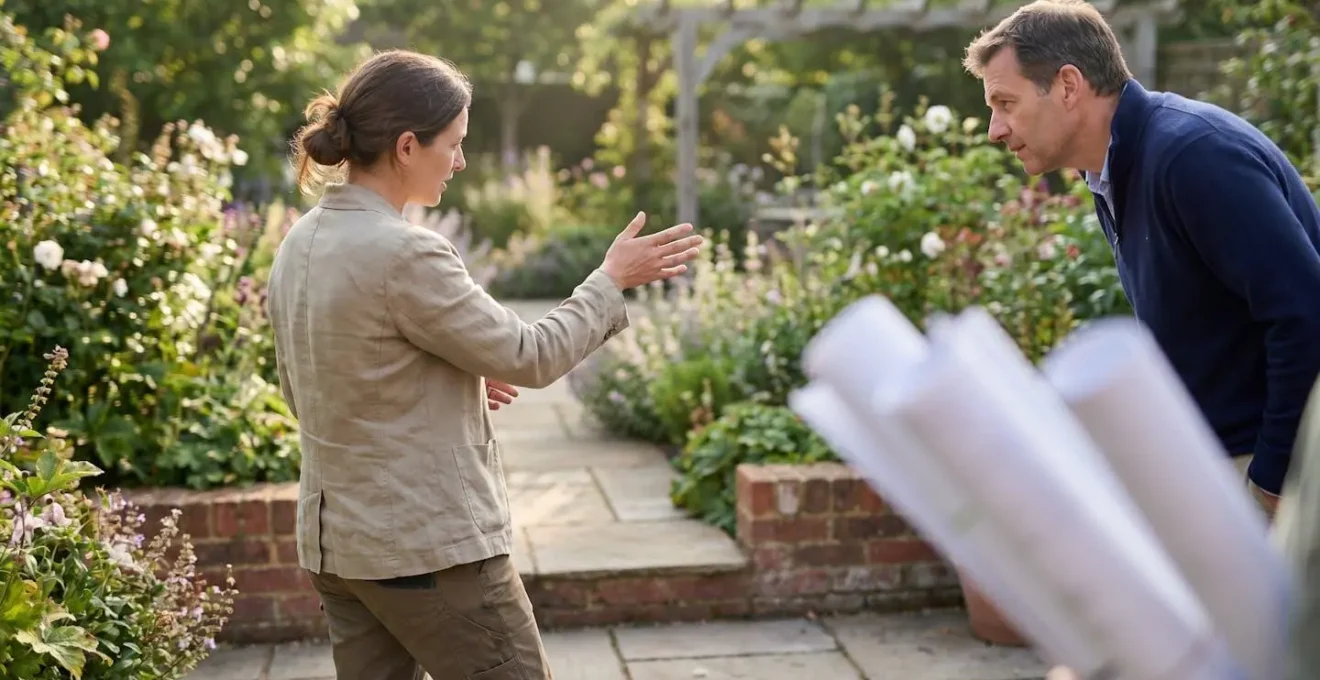
A professional project manager, as shown in the image, will establish clear zones on site. The construction area is isolated from the protected planting areas. All hardscaping elements are completed, and the site is cleaned before any topsoil is brought in or any plants are delivered. This logical sequence minimises damage, prevents contamination of soil, and ensures that you only pay for labour and materials once. A master plan is essential for this sequencing, as it dictates where underground services must be laid *before* the expensive patio is installed on top.
Why Your New Driveway Needs to Be Permeable by Law?
Another area where DIY projects create significant legal and financial liability is driveway construction. Many homeowners are unaware that since 2008 in England, government legislation has been in place to combat flooding caused by urban runoff. The Sustainable Drainage Systems (SuDS) legislation dictates that you cannot simply pave over your front garden with a traditional, impermeable surface like tarmac or standard block paving without making provision for drainage.
This law is not a minor piece of red tape. It applies to any new or replacement driveway over 5 square metres. If you install a non-compliant, impermeable driveway without planning permission (which requires a separate, costly drainage system like a soakaway), the local council can take enforcement action. This could force you to remove the entire driveway—a total loss of your initial investment—and replace it with a compliant solution.
The compliant, and therefore financially astute, options are permeable surfaces. These include resin-bound gravel, permeable block paving, or even gravel grids, which allow rainwater to soak naturally into the ground beneath. While a non-compliant tarmac drive may seem cheaper upfront, the potential additional costs of retrospective planning applications, fines, and the forced installation of a separate drainage system can easily double or triple the total project cost. A professional will specify a SuDS-compliant system from the start, eliminating this considerable financial risk.
| Scenario | Initial Cost | Potential Additional Costs | Total Cost Range |
|---|---|---|---|
| Compliant Permeable Driveway | £4,000-£8,000 | £0 | £4,000-£8,000 |
| Non-Compliant Impermeable Driveway | £3,000-£5,000 | Retrospective planning/soakaway install: £4,000-£9,000+ | £7,000-£14,000+ |
Key Takeaways
- A professional master plan is not a ‘cost’ but an ‘insurance policy’ that de-risks your entire investment by preventing expensive rework.
- Total Cost of Ownership (TCO) over 20 years, not upfront price, should guide material choices like paving to avoid thousands in future maintenance.
- Legal compliance with UK planning rules (for decks, driveways) is a major hidden cost area for DIY, with non-compliance risking total financial loss.
Long-Term Garden Planning: The 5-Year Roadmap to Increase Property Value
The ultimate goal of any significant home expenditure is to enhance both your quality of life and your property’s capital value. A well-designed and executed garden is one of the most effective ways to achieve this. Far from being just an expense, strategic landscaping is a high-return investment. According to UK property valuation data, a well-designed garden can increase a property’s value by up to 20%. On a £300,000 home, that’s a £60,000 return.
This is where a professional’s long-term vision becomes invaluable. A designer doesn’t just plan for today; they create a 5-year roadmap that evolves with your family’s needs. The open lawn for toddler years can be designed to easily accommodate a “teenager’s den” or garden office in the future, with power and data conduits planned from day one. This phased, strategic approach delivers exceptional financial returns.
Landscaping could account for up to 77% of the value added by home improvements.
– Post Office Money, UK property improvement value study
This demonstrates that money spent in the garden is not just ‘for you’; it’s one of the most powerful financial levers you can pull to increase your home’s market value. The key is that this value is unlocked by professional design, not by ad-hoc DIY projects.
5-Year Family Garden Evolution ROI Case Study UK
A family in Guildford invested £20,000 in a professionally designed cedar-clad garden office as part of their phased master plan in 2022. When they sold their property in 2024, their estate agent attributed £30,000 of the property’s increased value specifically to the garden room alone – a 50% ROI in just two years. This demonstrates how strategic, professional garden planning with family lifestyle phases can deliver exceptional financial returns alongside quality-of-life benefits.
Ultimately, viewing a professional designer’s fee as a percentage of your total budget is the wrong metric. Instead, it should be seen as a fixed cost to insure that your entire £10k-£20k investment is protected from risk, compliant with the law, and structured to deliver the maximum possible increase in your property’s value. The most prudent financial decision is to secure this expertise before a single spade breaks ground.