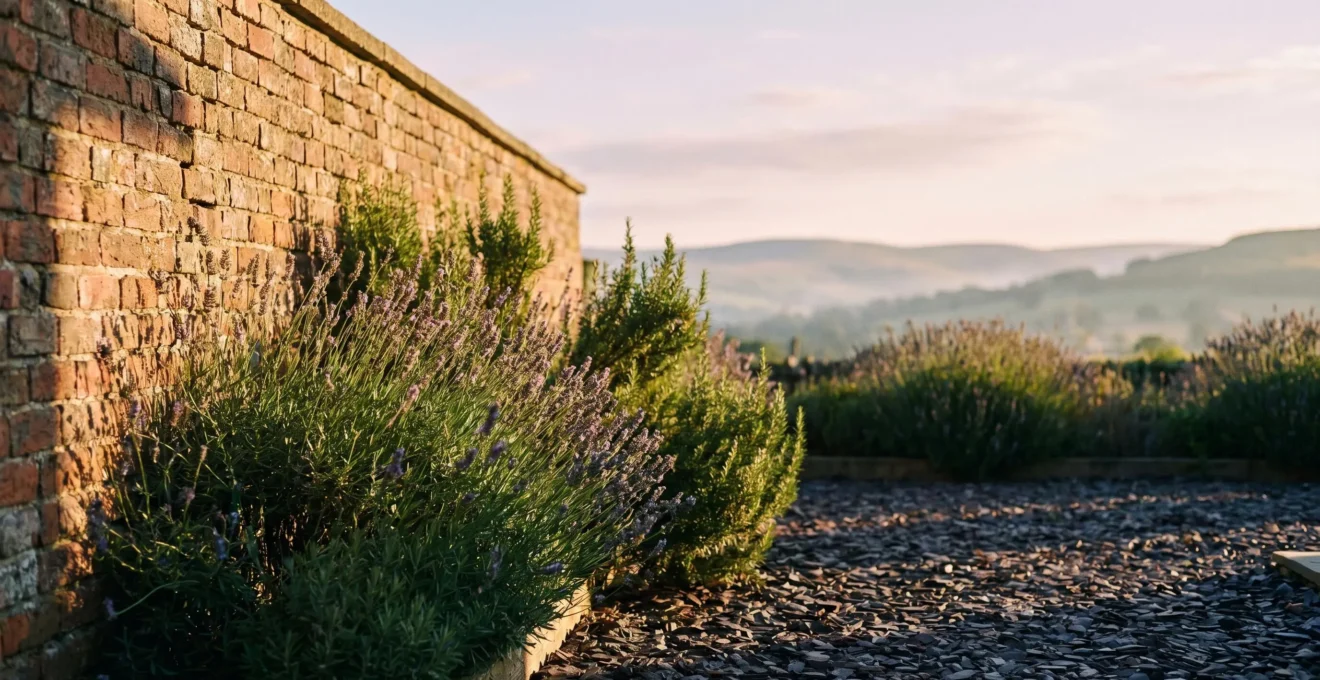
Growing Mediterranean plants in the North isn’t about fighting the climate, but intelligently designing it by manipulating the hidden physics of your garden.
- Walls and stones act as ‘heat banks’, not just warm spots, releasing stored solar energy through the night.
- Cold air flows like water; understanding its drainage paths is more critical than just providing shelter.
Recommendation: Start by identifying and enhancing one existing ‘warm spot’ using thermal mass and solar reflection before attempting to create a new one from scratch.
For the enthusiastic gardener in Yorkshire or Scotland, the dream of harvesting your own lemons or olives often feels like just that—a dream. The common wisdom tells us our climate is too cool, too damp, too unpredictable. We’re told to rely on fleece covers and dragging heavy pots indoors, constantly reacting to the weather. This approach is exhausting and treats our gardens as battlegrounds against the elements.
But what if the entire premise is wrong? What if, instead of fighting the Northern climate, we could work with it, becoming architects of our own miniature ecosystems? As a permaculture designer, I’ve learned that the key isn’t brute force, but observation and intelligent design. It’s about understanding the subtle physics of your own backyard: how heat is stored and released, how air moves, and how light can be bent to your will. This isn’t about creating a fragile, artificial environment; it’s about building robust, passive ‘heat islands’ that give sun-loving plants the edge they need to thrive, not just survive.
This guide moves beyond the platitudes. We will explore the science behind why a brick wall is more than just a wall, how windbreaks can be engineered to avoid destructive turbulence, and how the very shape of your land dictates where frost will settle. By the end, you’ll see your garden not as a flat expanse, but as a dynamic, three-dimensional system of opportunities, ready to be shaped into a haven for the Mediterranean plants you thought you could never grow.
This article will guide you through the core principles and practical techniques for engineering these powerful microclimates. The following summary provides a roadmap to transforming your Northern English garden into a productive oasis.
Summary: Engineering a Mediterranean Oasis in Your Northern Garden
- Why South-Facing Brick Walls Boost Temperature by 5°C at Night?
- How to Position Windbreaks Without Creating Damaging Turbulence?
- Slate or Gravel: Which Mulch Retains More Heat for Exotics?
- The Topography Error That Creates Frost Pockets in Your Garden
- Mapping Your Garden: How to Identify the ‘Warm Spot’ for Early Planting
- Why Biochar Lasts 100 Years in Soil Compared to Compost?
- White Walls or Mirrors: Increasing Solar Exposure in Dark Corners
- Building an Aromatic Culinary Herb Spiral: 5 Microclimates in 2 Square Metres
Why South-Facing Brick Walls Boost Temperature by 5°C at Night?
The most common piece of advice for creating a warm spot is to use a south-facing wall, but the reason it works is often misunderstood. It’s not just about the direct heat from the sun. The true magic lies in the principle of thermal mass. Think of a dense brick or stone wall not as a simple barrier, but as a ‘heat bank’. Throughout the day, it absorbs vast amounts of solar energy, slowly charging up like a battery.
When evening comes and the ambient air temperature plummets, the wall begins to discharge this stored energy, radiating warmth into its immediate surroundings. This creates a bubble of temperate climate that can be the difference between life and death for a tender plant. In fact, comprehensive research demonstrates that dense materials can keep temperatures around 5.5°C higher than the surrounding air on a summer evening. This slow, overnight release of heat protects plants from the shock of sudden temperature drops and extends their growing season.
Case Study: The 24-Hour Heat Bank
A controlled experiment, detailed by permaculture experts, measured the temperature of a south-facing brick wall during a winter’s day. At its peak in the early afternoon, the sun-bathed wall reached 40.5°C. By 8:00 pm, long after sunset, it was still significantly warmer than a shaded wall and, crucially, far warmer than the cold night air which had dropped to 5.7°C. This demonstrates the wall’s role as a thermal buffer, actively protecting plants through the coldest hours of the night.
Therefore, placing your olive or lemon tree against such a wall isn’t just about shelter; it’s about plugging it into a passive heating system. The denser the material and the darker its colour, the more effective it will be as a heat bank. This is the first and most powerful tool in your microclimate architecture toolkit.
How to Position Windbreaks Without Creating Damaging Turbulence?
Protecting plants from wind seems simple, but a poorly designed windbreak can cause more harm than good. A solid, impenetrable wall doesn’t stop the wind; it forces it up and over, creating a zone of intense, damaging turbulence on the leeward side—exactly where your precious plants are. The goal is not to stop the wind, but to filter and slow it down gently. This is the essence of airflow engineering.
An effective windbreak must have a degree of permeability, or what designers call porosity. A structure that is around 40-60% porous (think a hedge you can see glimpses of light through, or a slatted fence) is ideal. It allows a small amount of air to pass through, which breaks the vacuum that causes a turbulent downdraft. This filtered breeze is far less damaging than the swirling vortex created by a solid barrier. The wind is slowed over a much larger area, creating a valuable ‘wind shadow’ where plants can thrive.
The length and height are also critical. A short windbreak just encourages wind to whip around its ends, creating more turbulence. As a rule of thumb, the protected zone downwind extends for a distance of up to 30 times the height of the windbreak, but this is only effective if the barrier is designed correctly.
Your Action Plan: Designing a Turbulence-Free Windbreak
- Assess Porosity: Aim for a 40-60% density in your windbreak. For a hedge, this means choosing species that aren’t completely solid. For a fence, it means leaving gaps between the slats.
- Calculate Length: To minimize end-turbulence, ensure the windbreak’s uninterrupted length is at least ten times its height. A 2-metre high fence should be 20 metres long to be truly effective.
- Avoid Ground-Level Gaps: A common mistake is leaving a large gap at the bottom of a windbreak. This creates a wind tunnel, funnelling cold air at high speed directly at the base of your plants. Ensure your barrier is uniform from top to bottom.
- Filter, Don’t Block: Choose materials that break up the wind. Latticework, woven hurdles, or a mixed-species hedge are far superior to a solid brick wall or wooden fence for managing airflow.
- Observe and Adapt: Watch how snow drifts or leaves gather in your garden. These are natural indicators of wind patterns and turbulence zones. Use this information to refine your windbreak’s position and density.
By thinking like an aerodynamicist, you can turn a garden’s greatest threat into a managed resource, creating a pocket of calm essential for delicate Mediterranean blossoms and fruit.
Slate or Gravel: Which Mulch Retains More Heat for Exotics?
Mulching is a cornerstone of good gardening, but when creating a Mediterranean microclimate, the choice of material goes beyond simple weed suppression. The right inorganic mulch acts as an extension of the ‘heat bank’ principle, right at the soil level. Dark-coloured stones, like slate or gravel, absorb solar radiation during the day and release it slowly at night, warming the soil and the air immediately around the plant’s base.
This ground-level heat retention is vital for exotics that need ‘warm feet’ to thrive. It helps to moderate soil temperature fluctuations and can prevent the ground from freezing solid in a light frost. Darker materials are generally better at absorbing and retaining heat. A thick layer of dark slate chippings, for instance, can create a noticeably warmer soil environment compared to bare earth or a light-coloured organic mulch like wood chips.
While both gravel and slate offer excellent drainage—another key requirement for Mediterranean plants—they have different thermal and aesthetic properties. The choice between them depends on your specific goals, budget, and the desired look of your garden. A comparative analysis shows that while both are effective, their performance and best uses can differ.
| Property | Gravel Mulch | Slate Chips |
|---|---|---|
| Heat Reflection/Retention | Dark stones increase local micro-temperatures | Dark slate reflects less light, moderates soil temperature slightly; can raise surface temps in very hot climates |
| Material Cost | Lower initial cost | Higher cost |
| Appearance Longevity | Some colors fade or show dust | Strong color retention (blacks, blues, purples) |
| Physical Stability | Moves underfoot, can compact | Flatter pieces knit into surface, cleaner look |
| Drainage | Excellent drainage | Excellent drainage |
| Best Uses | Driveways, casual pathways, xeriscape zones with heat-tolerant plants | Decorative beds, foundation plantings, accent borders |
For gardeners in Northern England, the key takeaway is that dark-coloured, dense materials are your allies. By choosing a dark slate or gravel, you are installing a mini-patio heater for the root zone of your plants, giving them the consistent warmth they crave.
The Topography Error That Creates Frost Pockets in Your Garden
One of the most common and heartbreaking mistakes a gardener can make is to plant a prized, slightly tender specimen in the sunniest spot, only to find it decimated by frost. This often happens because of a failure to understand topographic intelligence: the way cold air moves across the landscape. Cold air is denser and heavier than warm air. On a clear, still night, it doesn’t just get colder; it flows downhill like a slow-moving, invisible river.
This ‘river’ of cold air will pool in the lowest points of your garden, creating a frost pocket. These can be large valleys or even subtle depressions just a few inches deep. A wall, a solid fence, or a thick hedge at the bottom of a slope can act like a dam, preventing the cold air from draining away and causing it to accumulate to dangerous levels. Your sunniest spot might also be your garden’s coldest spot at 5 am.
Field observations reveal that even 10-30 centimetre elevation differences substantially affect frost patterns. The solution is not always to build higher, but to facilitate drainage. By leaving a gap at the base of a downhill barrier, you can create a ‘spillway’ that allows this river of cold air to continue its journey out of your garden, rather than pooling around your plants. As the Royal Horticultural Society wisely notes, this small design choice can make a huge difference.
Making gaps in the barrier can allow the air to drain away and alleviate a frost pocket.
– Royal Horticultural Society, Understanding Microclimates in Your Garden
Before you plant, spend time observing your garden. Where does fog linger longest in the morning? Where does frost melt last? These are your frost pockets. Understanding and designing for cold air drainage is a master-level skill that separates hopeful gardeners from successful ones.
Mapping Your Garden: How to Identify the ‘Warm Spot’ for Early Planting
Your garden is not a uniform space; it is a complex mosaic of microclimates. The difference between a spot that can support a lemon tree and one that can’t might be only a few metres. The key is to stop guessing and start measuring. Becoming a microclimate architect begins with becoming a diligent cartographer of your own space. A systematic approach will reveal the hidden potential of your plot.
This process doesn’t need to be expensive or overly technical. It’s about combining simple tools with careful observation over time. By deploying a few inexpensive digital thermometers and observing patterns of sun, shade, and even snowmelt, you can build a ‘thermal map’ of your garden. This map will become your most valuable planting guide, highlighting the premium locations that deserve your most precious plants.
You might be surprised by what you find. A corner sheltered from the prevailing wind with the radiant heat from a wall and good solar exposure could be several degrees warmer than an open lawn just metres away. Identifying these ‘warm spots’ allows you to plant with confidence, giving tender species the best possible start and a greater chance of long-term success.
Your Checklist for Garden Thermal Mapping
- Establish a Baseline: On a hand-drawn map of your garden, mark key features like walls, hedges, large trees, and slopes. This will be your base layer.
- Track the Sun: Over the course of a day in different seasons (e.g., spring equinox, summer solstice), visit your garden at 9 am, 12 pm, and 3 pm. Use different coloured pencils to shade the areas that are in full sun at each time. This will reveal your sunniest zones.
- Deploy Thermometers: Place several inexpensive digital thermometers in key locations: against a south-facing wall, in an open area, in a low-lying spot, and in a windy corner. Record the temperatures at dawn and in the mid-afternoon for a week to find the warmest and coldest zones.
- Observe Natural Indicators: After a light snowfall, note which areas melt first—these are your warm spots. Observe where morning fog or frost lingers—these are your cold, damp zones.
- Synthesise Your Data: Combine all your observations onto your map. The areas with the most sun, highest average temperatures, and earliest snowmelt are your prime real estate for Mediterranean plants.
This mapping process transforms you from a passive gardener into an active site analyst. It’s a foundational permaculture practice that ensures you put the right plant in the right place, based on data, not just hope.
Why Biochar Lasts 100 Years in Soil Compared to Compost?
While we focus on the climate above ground, the world beneath our feet is just as important. A healthy soil food web is crucial, and gardeners are often told to add compost. Compost is fantastic, but it’s fundamentally a food source. It’s consumed relatively quickly by soil organisms, providing a short-term boost of nutrients and energy. Biochar, on the other hand, plays a completely different role.
Think of it this way: compost is the groceries, while biochar is the apartment building. Biochar is a form of charcoal created by burning organic matter in a low-oxygen environment (pyrolysis). This process creates an incredibly stable, porous carbon structure. Unlike compost, which decomposes within a few years, biochar’s structure remains intact in the soil for hundreds, if not thousands, of years. This is why ancient Amazonian ‘Terra Preta’ soils remain fertile to this day.
The microscopic pores and channels within biochar provide a permanent habitat for beneficial soil microbes and fungi. They act like a coral reef in the soil, offering shelter and a place for life to congregate. These pores also hold onto water and nutrients, preventing them from leaching away and making them available to plant roots when needed. For Mediterranean plants that despise waterlogged roots but need consistent moisture, this is a game-changer. By incorporating biochar into the planting hole of your olive or citrus tree, you are not just feeding it for a season; you are providing a permanent infrastructure upgrade to the soil that will support its health for its entire lifetime.
White Walls or Mirrors: Increasing Solar Exposure in Dark Corners
Once you’ve managed heat and airflow, the next frontier in microclimate design is light. In a Northern garden, every photon counts, especially in the shorter days of spring and autumn. Maximising the ‘solar budget’ of a specific spot can be achieved through clever solar architecture, using reflective surfaces to bounce light into otherwise shady corners.
The immediate thought for many is to use mirrors, but this is often a mistake. Mirrors create a specular, focused reflection that can act like a magnifying glass, creating intense hot spots that scorch leaves. They are also fragile and can be a hazard. A far better and safer solution is to use a surface painted with a high-quality, matte white paint. This creates a diffuse reflection, scattering the light gently and evenly over a wider area, raising ambient light levels without the risk of burning.
The effectiveness of a surface at reflecting light is measured by its albedo. A freshly white-painted wall can have an albedo of 80-90%, meaning it reflects 80-90% of the light that hits it. A dark brick wall, by contrast, might only have an albedo of 20-30% because it is absorbing that energy as heat (which, as we’ve seen, is another useful function). By strategically painting a wall or even placing a large, movable white panel, you can effectively ‘import’ sunlight into a north-facing corner or the shaded side of a raised bed. This can be enough to enable sun-loving herbs to thrive where they otherwise wouldn’t, or to help ripen the last of the fruit on a trained tree.
This is an advanced technique, but it’s a perfect example of the permaculture mindset: identifying a limiting factor (low light) and turning it into an opportunity for creative design.
Key Takeaways
- Effective microclimate creation is a proactive design process, not a reactive battle against weather.
- Mastering the flow of invisible forces—thermal energy and cold air—is more impactful than just physical protection.
- Every element, from a wall’s material to the colour of your mulch, is a tool for climate engineering.
Building an Aromatic Culinary Herb Spiral: 5 Microclimates in 2 Square Metres
Perhaps the most elegant and complete expression of microclimate design is the herb spiral. This classic permaculture structure is a masterpiece of efficiency, creating multiple, distinct climate zones in a footprint of just a couple of square metres. It’s a living model of all the principles we’ve discussed: thermal mass, topography, drainage, and solar aspect, all working together in a beautiful, productive system.
An herb spiral is essentially a small, spiralling raised bed, typically built from stones or bricks. Its vertical structure immediately creates different microclimates. The very top of the spiral is the highest, driest, and sunniest spot—perfect for sun-worshipping Mediterranean herbs like rosemary, thyme, or oregano. The soil here drains quickly, and the stones provide thermal mass, mimicking the rocky hillsides of their native habitat. As you move down the spiral, the conditions change.
The south-facing slopes are hot and sunny, while the north-facing side is cooler, shadier, and retains more moisture. The very bottom of the spiral, often ending in a small pond or boggy area, is the wettest and coolest spot, ideal for water-loving plants like mint or watercress. In between, you have a gradient of conditions. Herbs like parsley and coriander, which appreciate some sun but can bolt in intense heat, can be planted on the eastern slopes to catch the morning sun but avoid the scorching afternoon heat. By stacking functions in this way, you can create the perfect conditions for a wide variety of plants in an incredibly compact space, demonstrating that you don’t need a large garden to be a sophisticated climate architect.
By moving beyond generic advice and embracing the role of a climate architect, you can unlock the hidden potential within your Northern English garden. It begins with observation and is realised through intelligent, physics-based design. Start small by enhancing one warm spot, and you’ll soon have the confidence to cultivate the Mediterranean oasis you’ve always dreamed of. Evaluate your garden’s unique potential today to begin this rewarding journey.