In summary:
- Your garden border is a living canvas; use the ‘Thriller, Filler, Spiller’ method not just for pots, but to paint a story with layers of contrast.
- Go beyond color. True visual drama comes from pairing contrasting textures (spiky vs. round) and forms (velvet vs. glossy).
- Avoid the ‘polka dot’ look by planting in groups or ‘drifts’ to create rhythm and guide the eye, rather than scattering single plants.
- Plan for sequential blooms and use strong foliage plants to ensure your border has interest all year, not just for a few weeks.
Does your garden border feel a little… flat? You’ve chosen beautiful plants, but somehow they all blend into a sea of green, lacking the ‘wow’ factor you see in magazines. It’s a common frustration for beginner designers. You might have heard advice about planting in drifts or using color, but these tips often miss the fundamental artistic principle that brings a garden to life: dynamic contrast. This isn’t just about putting a few different plants together; it’s about orchestrating a visual narrative.
Many gardeners are familiar with the ‘Thriller, Filler, Spiller’ technique for container gardens, a simple formula for creating balanced pots. But what if we elevated this rule from a mere formula to a strategic framework for entire borders? The secret to a breathtaking border lies in treating it as a living canvas. Instead of just placing plants, we will be painting with them, using their inherent qualities to create a sensory dialogue that unfolds throughout the seasons.
This guide will move beyond the basics. We’ll explore the ‘why’ behind the rules, transforming you from a plant-placer into a garden artist. You’ll learn to see your plants not just as specimens, but as performers in a carefully choreographed display. We will delve into the science of color, the language of texture, the rhythm of repetition, and the magic of light to build borders that are not just beautiful, but are brimming with life and personality—gardens that tell a story for you and your family to enjoy.
This article provides a structured approach to mastering contrast in your garden. Explore the sections below to understand each layer of this powerful design philosophy and learn how to apply it step-by-step.
Summary: A Guide to Creating High-Contrast Garden Borders
- Complementary Colours: Why Purple and Yellow Pop More Than Red and Pink?
- Spiky vs Round: Creating Contrast Without Colour?
- The ‘Polka Dot’ Mistake: Why Too Much Contrast Looks Messy?
- Black Grasses and Silver Foliage: The Ultimate Modern Contrast?
- Synchronization: How to Ensure Your Contrast Plants Bloom Together?
- Velvet vs Glossy: Pairing Leaf Textures in Herbaceous Borders
- White or Gold: Which Variegation Stands Out Best in Twilight?
- Using Vibrant Variegated Foliage to Light Up North-Facing Gardens
Complementary Colours: Why Purple and Yellow Pop More Than Red and Pink?
The most immediate tool for creating contrast is color, but not all combinations are created equal. The reason purple and yellow create such a vibrant, electric pop is rooted in color theory. They sit directly opposite each other on the color wheel, making them complementary colors. When placed side-by-side, they intensify one another, making the yellow appear brighter and the purple seem richer. In contrast, colors that are next to each other on the wheel, like red and pink (which is a tint of red), are analogous. They create a harmonious, gentle blend, but they lack the high-energy visual tension that makes a design exciting.
As a garden design teacher, I encourage my students to think of this as a conversation between plants. Analogous colors are a quiet, agreeing murmur, while complementary colors are an exciting, animated debate. For a beginner, mastering this single concept is the fastest way to inject life into a dull border. You are not just planting flowers; you are creating a visual vibration that captures and holds the eye. This principle is not just academic; it can be a wonderful and engaging teaching tool for children in the garden.
Case Study: Learning Color Theory Through Garden Art
An educator discovered that garden art projects were a powerful way to teach color theory. By having students first create a color wheel with primary paints, they could then identify complementary pairs like yellow and purple. They applied this knowledge directly by designing garden patterns with plants of those colors. This hands-on project successfully combined art, science, and fine motor skills, demonstrating how a design principle can become an unforgettable learning experience for children.
To make this experience even more enriching for families, you can choose plants that are not only beautiful but also edible and safe for children. Here are a few child-safe options for a purple and yellow themed border, as suggested by resources like gardening guides for edible flowers:
- Purple Violas: These have a mild, grassy flavor and are perfect for decorating salads or cakes.
- Yellow Calendula: Its golden petals are edible, sometimes called ‘poor man’s saffron’, and are ideal for sensory gardens.
- Purple Pansies: With a subtle flavor, their cheerful faces are versatile for both savory and sweet dishes.
- Yellow Nasturtiums: The entire plant is edible with a peppery flavor, and it’s a great source of vitamin C.
Spiky vs Round: Creating Contrast Without Colour?
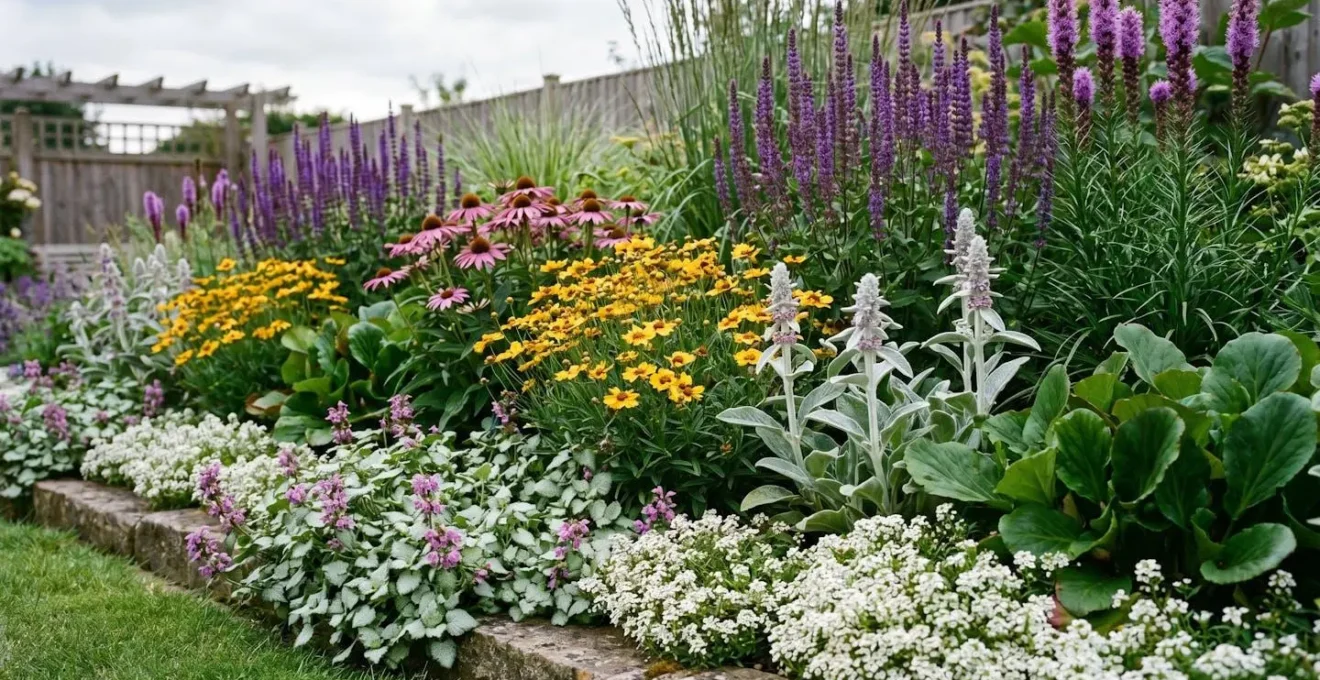
While color provides instant impact, a truly sophisticated border relies on contrast in form and texture. This is the element that provides interest even when nothing is in bloom. Think of it as the underlying architecture of your design. The most effective way to achieve this is by pairing opposite shapes: the soft, mounding forms of plants like Geraniums or Alchemilla mollis against the sharp, vertical spires of Salvia, Liatris, or ornamental grasses. This juxtaposition of spiky versus round creates a dynamic rhythm that leads the eye through the border.
This textural play is especially powerful in creating sensory gardens for children, who experience the world through touch. A border that invites tactile exploration becomes a living playground. The contrast between a soft, fuzzy leaf and a smooth, rounded seed head offers a rich sensory dialogue that a color-only design can never achieve.
As you can see in the image, the interplay between different surfaces is captivating. The soft, strokeable texture of the Lamb’s Ear in the foreground invites touch, while the more structured, bristly seed heads behind it provide a different tactile note. When creating such a space, safety is paramount. According to guidelines for creating sensory gardens, it is essential to build a safe and engaging environment.
Here are key points for creating a safe “touch-and-feel” border for children:
- Choose Non-Toxic Plants: Ensure all plants are non-toxic, non-allergenic, and free of pesticides.
- Provide Texture Variety: Include a mix of soft flowers, fuzzy leaves (like Lamb’s Ear), rough bark, and prickly-but-safe seed pods.
- Avoid Dangerous Spikes: Keep thorny plants like roses at the back of beds, out of reach, and avoid anything with dangerously sharp foliage.
- Make Plants Accessible: Position plants near walkways so children can gently brush against them as they pass.
- Select Hardy Varieties: Choose plants that can withstand frequent handling and exploration.
The ‘Polka Dot’ Mistake: Why Too Much Contrast Looks Messy?
As beginners gain confidence with contrast, a new problem often emerges: the ‘polka dot’ garden. This happens when a gardener buys one of everything they like and scatters them randomly throughout the border. While each plant might be beautiful, the overall effect is chaotic and messy. Instead of a cohesive design, you get a jumble of competing elements with no place for the eye to rest. There is contrast, yes, but there is no story.
The solution lies in two key design principles: repetition and massing. Instead of planting one of each, you should plant in groups of three, five, or seven. These ‘plant families’ create a much stronger visual statement. By repeating these groups, or ‘drifts,’ of color and texture throughout the border, you create a visual rhythm. This repetition acts like a recurring chorus in a song, unifying the composition and guiding the viewer’s eye through the garden in a logical, pleasing way. As one expert puts it:
A ‘polka dot’ garden has no story, it’s just a collection of words. A well-designed garden uses repetition and rhythm to create a narrative.
– Garden Design Principle, Illinois Extension – Complementary Colors in Landscape
Applying the ‘Thriller, Filler, Spiller’ concept helps structure these groups. The ‘Thriller’ is your bold vertical accent, the ‘Filler’ provides the mounding mass, and the ‘Spiller’ softens the edges. By grouping these combinations and repeating them, you create cohesive ‘chapters’ in your garden story. Here’s how to create these ‘plant families’ for better visual clarity:
- Plant in Odd-Numbered Groups: Plant in groups of 3, 5, or 7 to create natural-looking masses that stick together.
- Use Repetition for Rhythm: Repeat these drifts of color or texture to guide the eye and create a sense of harmony.
- Create Focused Zones: Designate specific areas of interest rather than scattering everything randomly. This is less overwhelming, especially for children.
- Blend Thoughtfully: Use the Thriller, Filler, Spiller technique within your groups to ensure a balanced blend of heights, textures, and forms.
Black Grasses and Silver Foliage: The Ultimate Modern Contrast?
For a truly sophisticated and modern take on contrast, look beyond flowers to the power of foliage. One of the most dramatic and elegant combinations is the pairing of deep, almost-black foliage with shimmering silver leaves. This duo creates an incredible high-contrast statement that feels both contemporary and timeless. The black foliage, like that of Black Mondo Grass (Ophiopogon planiscapus ‘Nigrescens’), acts as a ‘visual void,’ absorbing light and adding profound depth. The silver foliage, from plants like Artemisia ‘Silver Mound’ or Lamb’s Ear (Stachys byzantina), does the opposite, reflecting light and glowing, especially in the soft light of dawn and dusk.
This combination is perfect for creating a “Moon & Stars Garden”—a magical theme that can capture a child’s imagination. The black grasses become the deep night sky, and the silver plants are the twinkling stars and moonbeams. For busy families, a major benefit is that foliage-first combinations often require significantly less deadheading than flower-heavy borders, offering high impact with lower maintenance.
The ethereal quality of this pairing is most potent during twilight, as shown in the image. When the bright colors of the day fade, the silver foliage seems to gather the remaining light, creating a luminous, otherworldly glow against the deep shadows of the black leaves. This creates a mysterious and enchanting atmosphere, turning the garden into a stage for evening storytelling or watching for fireflies. It’s a design choice that appeals to a sophisticated adult aesthetic while simultaneously creating a space of wonder and magic for children.
Synchronization: How to Ensure Your Contrast Plants Bloom Together?
You’ve mastered color theory and chosen contrasting forms. You plant a stunning purple Salvia next to a brilliant yellow Coreopsis. But in spring, the Salvia blooms alone, and by the time the Coreopsis flowers in summer, the Salvia is finished. This is the final, crucial piece of the puzzle: bloom-time synchronization. For your color contrasts to work, the plants must be performing on stage at the same time. The most beautiful pairing in theory is useless if their bloom times don’t overlap in reality.
As garden design experts emphasize, a plant that blooms purple in May will not benefit from a complementary yellow daisy that flowers in August. Getting bloom time, color, and size just right is the formula for picture-perfect results. This requires a bit of research, but it’s what separates a good garden from a great one. You need to become a choreographer, ensuring your “dancers” are on stage together for the main performance. Check plant tags and online resources for bloom periods (e.g., “Early Summer,” “Mid-Summer to Fall”) and match them up.
An alternative to perfect synchronization is to plan for a “sequential show.” Design a spring contrast (like purple crocuses and yellow daffodils) that fades as a summer contrast (like purple coneflowers and yellow yarrow) takes over. The key is to have a “backbone” of contrasting foliage plants that provide structure and interest while the floral performers come and go. This ensures the border never has an “off” season.
Your Action Plan for Year-Round Contrast
- Chart Your Seasons: Create a simple chart or “Family Planting Calendar” with columns for Spring, Summer, and Fall. Use pictures or drawings of plants to map out when each will perform.
- Select a Spring Act: Choose an early-season complementary pair, such as purple crocuses with yellow daffodils, to kick off the show.
- Plan a Summer Headliner: Design a mid-season pairing that will take center stage, like purple Echinacea (coneflower) with yellow Coreopsis.
- Establish a Foliage Backbone: Use ever-present foliage plants with contrasting textures or colors (like silver Artemisia or black Mondo Grass) to provide a consistent structural base.
- Design for Overlap: Don’t aim for perfect starts and stops. Plan for overlapping bloom times, where one combination begins to fade as the next one starts to build, creating a seamless transition.
Velvet vs Glossy: Pairing Leaf Textures in Herbaceous Borders
Diving deeper into the world of texture, we find another powerful contrast: the opposition between velvety and glossy leaves. This is a subtle but deeply satisfying pairing that engages the sense of touch as much as sight. A velvety leaf, like that of Lamb’s Ear (Stachys byzantina), has a soft, fuzzy surface that diffuses light, giving it a matte, silvery appearance. A glossy leaf, like that of Bergenia or European Wild Ginger (Asarum europaeum), has a smooth, waxy coating that reflects light, creating a shiny, wet look.
Placing these two types of foliage next to each other creates a wonderful sensory dialogue. The matte texture absorbs light, making the glossy texture next to it appear even shinier and more vibrant. This combination is particularly effective in creating a “petting zoo for plants,” an irresistible feature in a family garden that encourages gentle interaction and close observation. Children are naturally drawn to these different tactile sensations.
Case Study: The Science of Touch in a Sensory Garden
As explained by Penn State Extension’s sensory garden guide, this tactile contrast also offers a science lesson. The tiny hairs on fuzzy leaves (trichomes) help the plant conserve water, like a camel’s fur. The waxy coating on glossy leaves helps repel rain, acting like a tiny raincoat. This turns a simple design choice into a teachable moment about plant adaptations. The guide also notes how these textures react differently to weather: velvety leaves hold magical-looking water droplets after rain, while glossy leaves look even shinier, encouraging observation in all conditions.
To create this tactile experience, you can use a variety of safe and durable plants. Here are some excellent choices for a velvet-and-glossy contrast border:
- Velvet: Lamb’s Ear (Stachys byzantina) is the classic choice for its incredibly soft, strokeable leaves.
- Glossy: Bergenia offers large, leathery, and shiny leaves that provide year-round interest.
- Velvet: Yarrow (Achillea) has soft, fern-like foliage that provides a different kind of fuzzy texture.
- Glossy: Sedum varieties have smooth, rubbery succulent leaves that are fun and safe for little hands to touch.
- Activity: Encourage children to make leaf rubbings with paper and crayons to capture and compare the different tactile qualities as a piece of art.
Key takeaways
- Effective contrast is about more than color; it’s a ‘sensory dialogue’ between form (spiky vs. round) and texture (velvet vs. glossy).
- Create a visual narrative by planting in odd-numbered groups and repeating these ‘drifts’ to avoid a chaotic ‘polka dot’ effect and establish rhythm.
- Use the ‘Thriller, Filler, Spiller’ concept as a framework to layer your border, ensuring a mix of heights and forms that tell a cohesive story.
White or Gold: Which Variegation Stands Out Best in Twilight?
Variegated plants, with their splashes of white, cream, or gold, are invaluable for brightening up garden borders. But their effect changes dramatically with the light. In the full sun of midday, both white and gold variegation can sometimes look washed out or even scorched. Their true magic is revealed in the low, angled light of morning and evening. This is when you must decide: which one glows best? The answer depends on the quality of light.
In the cool, blue-toned light of deep twilight and dusk, white variegation truly shines. Plants like the white-edged Hosta ‘Patriot’ or Brunnera ‘Jack Frost’ seem to absorb the last vestiges of daylight and emit their own silvery luminescence. They become the ‘moonbeams’ of the garden, creating ghost-like shapes that stand out dramatically against the deepening shadows. They are the clear winners for a classic “moon garden” designed for evening viewing.
On the other hand, in the warm, golden-hour light just before sunset, gold variegation comes alive. The yellow tones in plants like Japanese Forest Grass (Hakonechloa macra ‘Aureola’) catch the warm rays and appear to be lit from within, like embers or hidden treasure. They don’t glow with the same ethereal quality as white, but they smolder with a rich, warm energy. So, the choice isn’t about which is ‘better,’ but about when you want the performance to peak. White is for the cool of the night; gold is for the warmth of the sunset.
This creates a fantastic opportunity for a family activity:
- Conduct a ‘Flashlight Test’: Go out at dusk with your children and flashlights. Shine the light on different variegated plants to see which ones ‘sparkle’ or ‘glow’ the most. This turns plant selection into a fun discovery game.
- Create Storytelling Themes: Use white-variegated plants as ‘ghosts’ or ‘moonbeams’ in a spooky story garden, and position gold-variegated plants as ‘dragon’s gold’ or ‘hidden treasure’ in an adventure theme.
- Add Night-Fragrance: Enhance the twilight experience by pairing these glowing plants with night-scented flowers like Nicotiana or Moonflower for a full sensory journey.
Using Vibrant Variegated Foliage to Light Up North-Facing Gardens
A north-facing garden, with its limited direct sunlight, is often seen as a challenge. But as a designer, I see it as an opportunity. This is the perfect stage for the subtle beauty of variegated foliage to take the spotlight. In the harsh glare of full sun, intricate leaf patterns can be hard to appreciate. In the soft, diffuse light of a shady border, however, every splash of white, cream, and gold becomes a critical tool for illumination. These plants act like tiny mirrors, bouncing and amplifying the available light to prevent the space from feeling gloomy.
This kind of space is often ideal for families. As sensory garden research indicates, shaded areas provide calm play spaces away from the hot sun, and cool colors like blue, purple, and white can encourage a sense of tranquility. A well-designed shade garden can become a ‘secret enchanted forest,’ a cool, quiet retreat for imaginative play and peaceful observation. The lower light levels mean that a child’s focus is naturally drawn to the details right in front of them—the intricate veining on a Hosta leaf or the silver frosting on a Brunnera.
The key is choosing the right performers for this low-light stage. Here are some shade-loving variegated plants that can turn a dark corner into a ‘secret enchanted forest’:
- Hakonechloa ‘Aureola’: This Golden Japanese Forest Grass cascades like a waterfall of light, illuminating the ground with its yellow-striped foliage.
- Brunnera ‘Jack Frost’: Its heart-shaped, silver-frosted leaves appear to glow in the dim light, complemented by sprays of bright blue forget-me-not-like flowers in spring.
- Hosta varieties: The undisputed kings of shade, Hostas offer an incredible range of white, cream, and gold variegated cultivars to paint with.
- Lamium maculatum (Spotted Dead-nettle): A wonderful groundcover with silver-splashed leaves and vivid purple or pink blossoms, providing both foliage and flower contrast.
Turn the design process into a game. Create a “Shade Plant Treasure Hunt” where children help find the perfect spot for each of these light-bringing ‘treasures’ in their ‘dark forest’. This transforms a challenging garden area into a space of creativity and wonder.
By viewing your border not as a chore but as a canvas, and by using the principles of contrast in color, form, and texture, you can transform any flat space into a dynamic, living work of art. The next logical step is to take out a pencil and paper, sketch your border, and start choreographing your own visual narrative, one plant at a time.