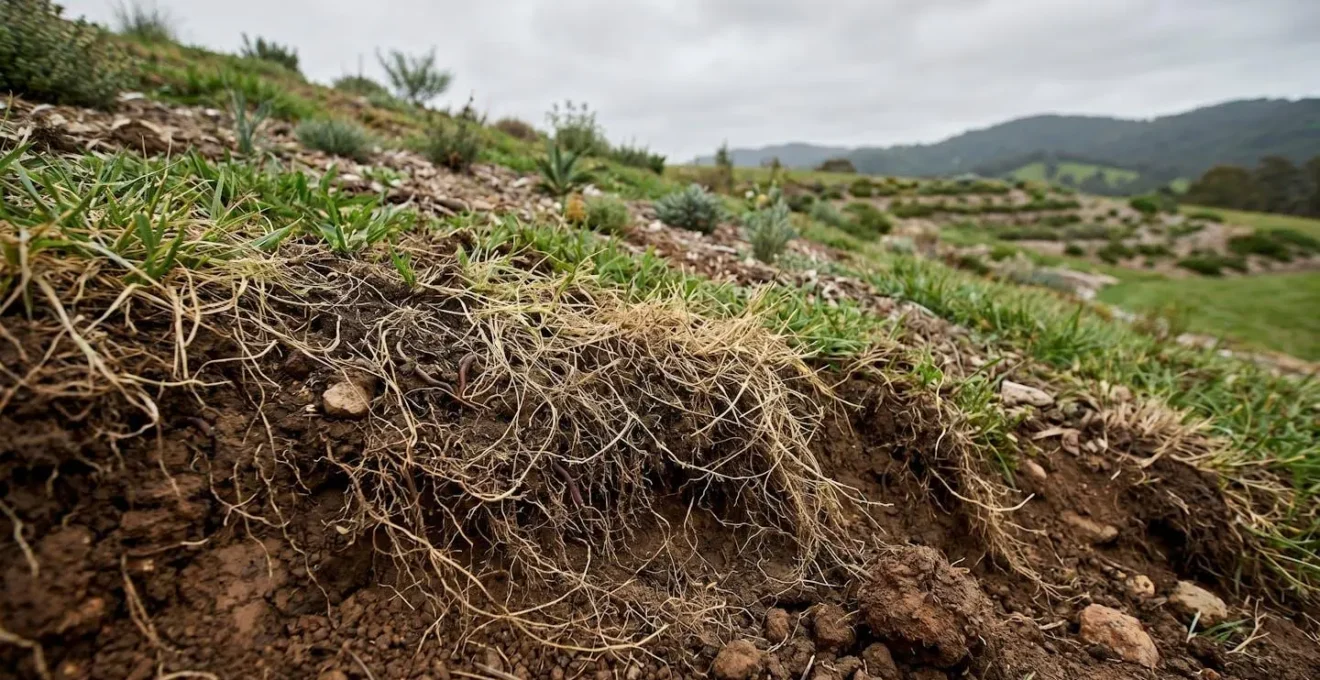
The stability of a sloped garden is not a matter of luck, but of soil engineering, where fibrous root systems act as a living geotextile to reinforce the soil matrix.
- Fibrous roots, especially when combined with mycorrhizal fungi, create a web that physically binds soil particles, dramatically increasing aggregate stability and shear strength.
- Effective soil stabilization requires a systems-based approach: selecting plants for their root architecture, using specialized watering techniques to encourage deep growth, and amending soil to enhance its structural permanence.
Recommendation: Shift your focus from merely planting on a slope to actively engineering a reinforced, living soil structure using the right plants and techniques.
For any UK gardener tending a property with a slope, especially on the nation’s ubiquitous heavy clay, the battle against soil erosion is a familiar one. After a downpour, you see rivulets of muddy water carving paths, stealing precious topsoil and undermining the very stability of your landscape. The common advice is to “plant something,” often with a vague reference to roots holding the soil. While true, this advice often misses the crucial point: not all root systems are created equal, and preventing erosion is less a horticultural task and more a feat of geotechnical engineering.
The conventional approach focuses on surface-level fixes: terracing, retaining walls, or simply hoping for the best with generic ground cover. But these solutions can be costly, intrusive, and often fail to address the underlying mechanics of soil failure. The real key lies in understanding and leveraging the immense structural power of a specific type of root system—the fibrous network—and treating it as a high-performance, self-regenerating geotextile. This article moves beyond platitudes to explain the mechanical principles at play, providing an engineer’s perspective on how to turn a vulnerable slope into a robust, stable, and living structure.
We will deconstruct the science behind how these root systems function, explore practical methods for encouraging their development, and identify the specific plants and soil amendments that serve as the best tools for this engineering project. By the end, you will see your garden slope not as a problem to be contained, but as an opportunity to build a resilient, integrated ecosystem from the ground up.
Summary: A Soil Scientist’s Guide to Slope Stabilization with Fibrous Roots
- Fibrous vs Taproots: Which Absorbs Surface Fertiliser Faster?
- How to Water New Turf to Encourage Deep Fibrous Rooting?
- The Pot-Bound Trap: When Fibrous Roots Strangle Your Container Plants
- 3 Native Grasses With Roots That Drink Excess Groundwater
- When to Divide Fibrous-Rooted Perennials to Rejuvenate Growth?
- Compaction or Grading: Why is Water Pooling in the Middle?
- Why Biochar Lasts 100 Years in Soil Compared to Compost?
- Correcting Land Grading to Stop Lawn Waterlogging in Winter
Fibrous vs Taproots: Which Absorbs Surface Fertiliser Faster?
To understand soil stabilisation, one must first appreciate the fundamental architectural differences in root systems. A taproot, like that of a carrot or dandelion, is an energy storage organ designed to punch deep into the soil profile, seeking out deep water tables. In contrast, a fibrous root system, typical of grasses, is a dense, shallow, and widespread network of thin roots and rootlets. While both are effective for the plant’s survival, their impact on the surrounding soil matrix is profoundly different.
In the context of surface-applied fertilisers, fibrous roots are vastly more efficient. Their massive surface area, concentrated in the upper soil layers (top 15-30 cm), acts like a sponge, intercepting nutrients before they can leach away. However, their true engineering value lies in their ability to create soil aggregate stability. Each individual root and the even finer mycorrhizal fungal hyphae associated with them exude sticky substances (glomalin) that glue tiny clay, silt, and sand particles together into larger, more stable clumps called aggregates. A soil with good aggregate structure resists being broken apart by the impact of raindrops and flowing water.
As research on soil structure highlights, this network does more than just absorb. It actively builds.
Fibrous roots and AM fungal hyphae can be viewed as a sticky-string bag that contributes to the entanglement and enmeshment of soil particles to form macroaggregates.
– Research from ResearchGate study, Mycorrhizal Fungi Influence Soil Structure
This “sticky-string bag” is the essence of erosion control. It’s not merely the presence of roots, but the creation of a biomechanically interlocked and chemically bonded soil matrix that has inherent shear strength. A taproot anchors a plant; a fibrous root system anchors an entire landscape.
How to Water New Turf to Encourage Deep Fibrous Rooting?
Establishing a new lawn or planting on a clay slope presents a specific hydraulic challenge: water’s tendency to run off the surface rather than infiltrate. Conventional watering—long, single sessions—exacerbates this on slopes, leading to surface erosion and shallow root systems that offer minimal structural reinforcement. The goal is to train roots to grow deep, creating the vertical pins that lock soil layers together. This requires a specific, counter-intuitive watering method known as the “Cycle and Soak” approach.
The principle is simple: apply water only as fast as the soil can absorb it. For heavy clay, the infiltration rate is very low. By splitting the total watering time into several shorter cycles with a “soak” period in between, you allow gravity to pull the water down into the soil profile instead of across its surface. This encourages roots to follow the moisture downward, creating a deeper, more resilient and more effective stabilising network.
This visual of water beading on the surface is precisely what the Cycle and Soak method aims to manage. A soaker hose, pegged to the slope’s contour, is an excellent tool for this, as it applies water slowly and directly to the soil. The key is to run the irrigation just until the first sign of runoff appears, then stop and wait. This pause is the most critical part of the process, as it’s when the deep infiltration happens, creating the conditions for strong root architecture.
Your Action Plan: The Cycle and Soak Watering Method for Slopes
- Initial Run: For moderate slopes, split your normal watering time into two cycles. Run the irrigation only until water just begins to run off the surface, then stop it immediately.
- Soak Time: Allow the water 30 minutes to 3 hours to soak into the soil. Use longer breaks for steeper slopes or more compacted clay soils.
- Second Cycle: Resume watering for the second half of your cycle. The pre-moistened soil will now accept water more readily and at a greater depth.
- Depth Check: The goal is to moisten the soil to a depth of 3-6 inches (7.5-15 cm). Use a soil probe or a long screwdriver to check the penetration depth a few hours after watering.
- Extreme Slopes: For very steep inclines, it may be necessary to split the watering into three or even four shorter cycles to prevent any surface runoff and maximise infiltration.
The Pot-Bound Trap: When Fibrous Roots Strangle Your Container Plants
The effectiveness of a fibrous root system is entirely dependent on its architecture. When a plant is grown in a container for too long, its roots hit the plastic walls and begin to circle, creating a dense, tangled, and impenetrable mass. This “pot-bound” or “root-bound” condition is the perfect negative example of what we want to achieve on a slope. It creates a shallow, non-penetrating root system that sits atop the soil rather than integrating with it. Planting a pot-bound perennial or shrub on a slope without correcting the root ball is a common and critical mistake.
A circling root system has virtually zero geotechnical reinforcement value. It fails to penetrate the deeper, more stable soil layers and does not create the vertical and horizontal web needed to lock soil aggregates together. Instead, it forms a slippery interface between the root ball and the surrounding soil, a plane along which water can travel and initiate a small-scale landslide. This is why it’s crucial to tease out or even slice the circling roots of a pot-bound plant before planting to encourage them to grow out into the native soil.
Case Study: The Drastic Impact of Shallow Rooting on Slope Stability
The danger of shallow rooting isn’t just theoretical. A 2017 flume experiment provided a stark demonstration. When fibrous-rooted plants were allowed to establish deep, integrated root systems in sandy soil, they were highly effective. However, when the plants developed shallow, circling systems analogous to a pot-bound state, their ability to stabilize the soil was catastrophically compromised. The study found that properly established fibrous roots could achieve an 80% reduction in soil erosion. In contrast, the shallow-rooted specimens showed erosion rates almost identical to those of completely bare soil, especially when the roots failed to penetrate below the top 10cm layer. This highlights that it is the *structure* of the root system, not just its presence, that prevents erosion.
This demonstrates that a plant intended to stabilise a slope can, if improperly prepared, do more harm than good. It creates a false sense of security while offering no real structural benefit, a critical lesson for any geotechnical gardener.
3 Native Grasses With Roots That Drink Excess Groundwater
Choosing the right “engineering materials” is paramount. For stabilising UK clay slopes and managing excess water, native grasses are often the superior choice. They are adapted to the climate and soil conditions, and many possess the extensive, deep fibrous root systems required for effective soil reinforcement and water management. Their roots can penetrate dense clay, creating channels that improve hydraulic conductivity—the rate at which water moves through soil. This reduces surface runoff and helps prevent the soil from becoming waterlogged, a key factor in slope failure.
The goal is to select plants that are not just tolerant of wet conditions, but actively thrive by “drinking” excess groundwater and transpiring it through their leaves. These plants act as living water pumps. Here are three excellent native or naturalised choices for UK gardens:
- Tufted Hair Grass (Deschampsia cespitosa): This is a cornerstone plant for damp clay. It forms dense tussocks and has a remarkably deep and fibrous root system that is brilliant at binding soil. It’s tolerant of both winter wet and summer dry periods, making it highly resilient. Its roots create a dense mat that is incredibly effective at preventing surface scour.
- Purple Moor Grass (Molinia caerulea): Known for its beautiful airy flower heads, Molinia’s real work happens below ground. It forms deep, clumping root systems that are excellent for stabilising banks. The subspecies arundinacea is particularly robust. They are brilliant at absorbing large amounts of water in winter and are very low maintenance.
- Sedges (Carex species): While not technically grasses, sedges are grass-like plants that are champions of wet soil. Many native Carex species, like Pendulous Sedge (Carex pendula), have incredibly dense, fibrous root masses that are unparalleled for holding saturated soil on steep banks. They are often used in professional bioengineering projects for this very reason.
By incorporating these species, you are not just planting a garden; you are installing a biological drainage and reinforcement system. They form a multi-layered root matrix that works on the surface and deep within the soil profile to manage water and lock soil in place.
When to Divide Fibrous-Rooted Perennials to Rejuvenate Growth?
The living geotextile of a fibrous root system is not a static structure. It is a dynamic ecosystem that requires periodic maintenance to remain vigorous and effective. For many clumping, fibrous-rooted perennials like Hostas, Daylilies, or ornamental grasses, division is a necessary process every three to five years. Over time, the centre of the clump can become old, woody, and less productive, with root growth concentrated on the periphery. This reduces the plant’s overall vigour and, critically for our purposes, the effectiveness of its root system as a soil stabiliser.
Dividing the plant—lifting it, splitting the root ball into several smaller pieces, and replanting them—rejuvenates its growth. This process stimulates the production of new, active roots that will colonise the surrounding soil more aggressively, enhancing the integrity of the soil matrix. The ideal time for division depends on the plant, but a general rule is to divide autumn-flowering plants in spring and spring-flowering plants in early autumn. This gives the new divisions time to establish their root systems before the stresses of winter cold or summer heat.
One might worry that this disturbance temporarily compromises the slope’s stability. While this is a valid concern, the underlying biological network is more resilient than it appears. The associated network of arbuscular mycorrhizal fungi (AMF) plays a crucial role here. This reinforcement is remarkably durable, with research showing up to 5 months of soil stabilization from AMF hyphae observed after host plant death or removal. This fungal scaffolding provides a persistent structural benefit, bridging the gap while the newly divided plants re-establish their own root systems. Therefore, a phased approach to division, never disturbing more than a small area at a time, ensures continuous protection.
Compaction or Grading: Why is Water Pooling in the Middle?
A common symptom of drainage problems on a slope is not erosion at the bottom, but water pooling in the middle. This often indicates a localised issue with either soil compaction or improper grading. Compaction, often from foot traffic or machinery during construction, squeezes out the pore spaces in the soil, creating an impermeable layer (hardpan) that water cannot penetrate. Alternatively, a subtle dip or a “belly” in the grade of the slope can collect water, creating a boggy, unstable patch.
The traditional engineering response is to re-grade the entire slope to ensure a uniform fall, a costly and disruptive process. However, a soil-centric approach offers a more elegant, plant-based solution. Rather than fighting the hydrology, one can work with it by transforming the problem area into a functional landscape feature. This is the principle behind a rain garden or a small bioretention swale.
Case Study: The Rain Garden as an Alternative to Re-Grading
A landscape project in Arlington, Virginia, provides a perfect model. Faced with water pooling on slopes, the designers opted against expensive grading. Instead, they created intentional rain gardens in the low spots. They used moisture-loving native plants like sedges (Carex) and tufted hair grass (Deschampsia cespitosa) that thrive in wet conditions. These plants’ dense, fibrous root systems not only absorbed the excess water but also created channels to improve infiltration over time, effectively fixing the drainage problem. As highlighted in a report on the project, this approach transformed a drainage issue into a wildlife habitat and an educational feature, demonstrating a sophisticated, ecological engineering solution.
For a home gardener, this means identifying pooling areas not as failures, but as opportunities. Amending the soil in that specific spot with copious organic matter and planting it with water-loving, fibrous-rooted species like those mentioned previously (Carex, Deschampsia) can solve the problem permanently and beautifully, without the need for heavy machinery.
Why Biochar Lasts 100 Years in Soil Compared to Compost?
To maximise the engineering potential of a fibrous root system, one must optimise the medium it grows in. While compost is an excellent soil amendment, its organic matter is actively broken down by soil microbes, typically lasting only a few seasons. For long-term structural improvement, especially in heavy clay, biochar offers a near-permanent solution. Biochar is a form of charcoal produced by heating organic material in a low-oxygen environment (pyrolysis). This process creates a highly porous, stable carbon structure that resists microbial decomposition for centuries.
The key to biochar’s effectiveness is its microscopic, honeycomb-like structure. These countless tiny pores serve multiple functions. They physically lighten dense clay soil, improving aeration and drainage. More importantly, they provide a protected habitat for beneficial microbes, particularly the arbuscular mycorrhizal fungi (AMF) that form symbiotic relationships with fibrous roots. This fungal network is the superglue of the soil world.
AM fungi hyphae grow into the soil matrix to create the skeletal structure that holds primary soil particles together to form soil aggregates.
– Research published in PMC, The Potential Role of Arbuscular Mycorrhizal Fungi in the Restoration of Degraded Lands
By providing a permanent refuge for these fungi, biochar ensures this “skeletal structure” is constantly maintained and expanded. The effect is dramatic; as shown in a study where more than 70% of plant roots were colonized by AM fungi, leading to a measurable improvement in soil aggregate stability. Adding biochar to a slope is like installing permanent, microscopic scaffolding throughout the soil, which the fibrous roots and fungi then colonise to create an exceptionally strong, stable, and long-lasting reinforced earth structure.
Key Takeaways
- Soil erosion on slopes is a geotechnical problem that can be solved with biological engineering, using fibrous roots as a living reinforcement system.
- The effectiveness of erosion control depends not just on planting, but on the specific architecture of the root system and its integration with the soil matrix.
- Advanced techniques, such as cycle-soak watering and the use of soil amendments like biochar, can dramatically enhance the structural integrity of a sloped garden.
Correcting Land Grading to Stop Lawn Waterlogging in Winter
Bringing all these principles together, we can now re-frame the problem of correcting poor land grading and winter waterlogging. Instead of viewing it as a task for bulldozers and extensive earthworks, we can approach it as a phased, biological engineering project. The ultimate goal is to create a landscape with a high infiltration rate, good internal drainage, and a robust soil structure that can withstand the hydraulic pressures of a wet UK winter.
The first step is a diagnosis. Is the waterlogging due to widespread compaction and poor structure, or is it a specific grading issue? Using a soil auger or simply digging a few test pits can reveal the presence of a hardpan layer or the depth of the topsoil. This diagnosis will inform the strategy. If the issue is deep compaction, mechanical aeration combined with a biochar and compost top-dressing can begin to open up the soil structure.
The long-term solution, however, lies in establishing a permanent, multi-layered root matrix. This involves a phased planting strategy. Begin by establishing pioneer plants, like the native grasses discussed earlier, to create an initial stabilising network. As they establish, their roots will begin to break up compacted layers and improve water infiltration. In subsequent seasons, you can inter-plant deeper-rooted perennials and small shrubs, whose different root architectures will complement the grasses, creating reinforcement at various depths. This mimics the process of natural succession and builds a resilient, self-maintaining system that actively manages water and reinforces soil year-round.
By applying these geotechnical principles, you can systematically transform a problematic, waterlogged slope into a stable, functional, and thriving part of your garden ecosystem. Assess your slope not as a liability, but as an engineering opportunity to cultivate a stable, living landscape.