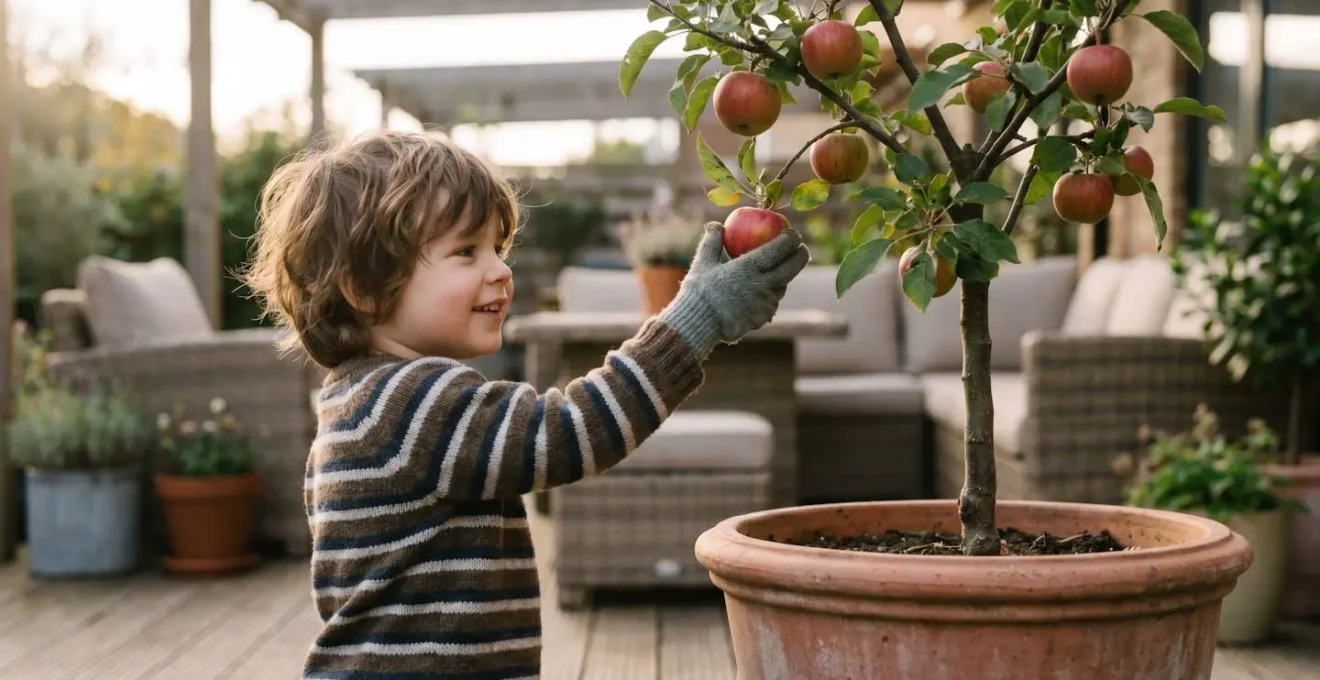
Choosing a dwarf fruit tree isn’t about its label, but about understanding its hidden “operating system”—the rootstock.
- The rootstock dictates not just the tree’s ultimate size, but its essential requirements for soil, water, and physical support.
- Ignoring these ‘system requirements’ is the primary cause of failure, leading to stunted growth, disease, or a tree that literally falls over.
Recommendation: Before you even consider the fruit variety, match the rootstock’s genetic blueprint to your garden’s specific conditions.
The dream is simple and potent: stepping into your garden to pick a crisp, sun-warmed apple from your very own tree. You head to the nursery, filled with this vision, only to be met by a wall of cryptic labels. M27, M9, MM106—it feels less like gardening and more like deciphering code. You came for a tree, and now you’re faced with an alphabet soup of options that all promise some form of “dwarf” or “semi-dwarf” tree, but what does it all really mean?
The common advice is to simply “pick a dwarf tree for a small garden.” This is the most prevalent platitude in horticulture, and while not incorrect, it is dangerously incomplete. It’s like advising someone to “buy a small car for city driving” without mentioning the difference between one that runs on diesel, needs premium fuel, or has the turning radius of a bus. The size is just one specification among many, and focusing on it alone often leads to disappointment.
The secret lies in shifting your perspective. Stop thinking of the rootstock as just a size controller. Instead, understand it as the tree’s hidden operating system. This genetic blueprint, quietly working below the soil, dictates everything: the tree’s anchorage, its tolerance to wet or dry soils, its need for life-long support, and even its susceptibility to pests and diseases. The variety of apple you choose—the ‘scion’—is the software, providing the delicious fruit. But if you run that software on incompatible hardware, the entire system will crash.
This guide is designed to make you a systems administrator for your garden. We will decode these cryptic labels, not just by what size they produce, but by what they demand from you and your garden. We will explore the critical ‘system requirements’ for popular rootstocks, show you how to avoid the most common ‘hardware failures’ like planting errors and sucker growth, and ultimately empower you to go beyond the simple question of “M9 or MM106?” to ask the right question: “Which operating system is compatible with my garden’s environment?”
To navigate this complex but crucial topic, this article is structured to build your expertise from the ground up. The following sections will guide you through understanding rootstock codes, matching them to your soil, avoiding critical planting mistakes, and planning a productive, healthy patio orchard.
Summary: M9, MM106, M27? Decoding Fruit Tree Rootstocks for the Perfect Garden Fit
- What Does M27 Mean? Understanding Extremely Dwarf Rootstocks
- Which Rootstock Handles Wet Clay Soil Without Rotting?
- The Planting Depth Error That Cancels Out the Rootstock Effect
- Sucker or Scion: How to Identify and Remove Rootstock Growth?
- Why M9 Rootstocks Need Permanent Staking for Life?
- Family Trees or Pairs: How to Ensure Pollination with Only One Pot?
- Patio Clematis vs Climbers: Which Cultivar Actually Flowers at Eye Level?
- Planning a Dwarf Fruit Tree Orchard on a Patio: Yield vs Space?
What Does M27 Mean? Understanding Extremely Dwarf Rootstocks
When you see a code like ‘M27’ on a fruit tree label, you’re looking at the name of the tree’s engine. The ‘M’ stands for Malling, as in the East Malling Research Station in the UK, a pioneer in rootstock development. The number signifies a specific genetic line with a predictable set of traits. M27 is the most dwarfing apple rootstock in common use, creating what is often called a “miniature” or “step-over” tree. This isn’t just a slightly smaller tree; it’s a completely different kind of plant designed for tiny spaces and container growing.
An M27 rootstock will produce a tree that remains incredibly compact, typically staying around 4 to 6 feet tall at maturity. Its primary purpose is to induce precocity—meaning it forces the scion variety to focus its energy on fruiting much earlier in its life, often producing apples within the first one or two years after planting. This is a stark contrast to older, more vigorous rootstocks that might take five to seven years to bear fruit. However, this focus on fruit comes at the cost of vegetative growth and structural integrity.
The trade-off for this miniature size and early fruiting is yield. You can’t expect a large harvest from such a small plant. Reputable nurseries suggest a mature M27 tree will produce a modest but respectable 4-5kg of apples per tree annually. Further research shows that trees on M27 rootstock will produce about 10-15 pounds of fruit per year, which is perfect for a small family’s fresh eating needs but not for large-scale preserving. It’s a rootstock for the gardener who values novelty, space-efficiency, and the joy of an early harvest over sheer volume.
Choosing M27 means you are prioritizing the smallest possible form factor. It is the perfect ‘operating system’ for a software of ‘quick results in a pot’, but it’s entirely unsuited for a program demanding ‘low-maintenance and high volume’.
Which Rootstock Handles Wet Clay Soil Without Rotting?
Here we arrive at one of the most critical ‘system requirements’ of your tree’s operating system: soil compatibility. You can give a tree the perfect amount of sun and water, but if its roots are sitting in soil that they are genetically intolerant to, the system will fail. The most common and devastating failure is root rot, particularly in heavy, wet clay soils that are common in new housing developments and many regions with poor drainage.
For most apple rootstocks derived from Malus pumila, “wet feet” are a death sentence. When clay soil becomes waterlogged, it expels oxygen, creating an anaerobic environment where beneficial microorganisms die off and pathogenic fungi, like Phytophthora, thrive. These fungi attack the tree’s root system, causing it to rot away. The tree can no longer absorb water or nutrients, leading to yellowing leaves, stunted growth, and eventual death. In fact, apple tree growing guides warn that constant waterlogging can kill or stunt up to 50% of trees in unsuitable soil.
So, which rootstock can handle these challenging conditions? While no apple tree truly *loves* swampy ground, some have been specifically bred for much higher tolerance. The standout performer in this category is MM.111. This rootstock is a workhorse, known for its resilience and adaptability. It creates a larger tree—a semi-dwarf, roughly 80-90% of a standard tree’s size—but its vigor is precisely what helps it power through difficult conditions. Its robust root system is far more resistant to root rot and collar rot than its more dwarfing cousins like M9 or MM106.
Case Study: The Success of MM.111 in Heavy Soils
Nurseries and horticultural extensions have long recognized the strengths of MM.111 for challenging sites. For example, West Virginia University Extension specifically recommends it for the wet, heavy soils common in the region. They note its high tolerance to both collar and root rot (Phytophthora), making it one of the most forgiving choices for home gardeners. This makes MM.111 the go-to ‘operating system’ when the ‘hardware’ of the garden is compacted, wet clay where more sensitive rootstocks like M9 would quickly fail.
If your garden turns into a puddle after a heavy rain, choosing a sensitive dwarf rootstock is a recipe for failure. Opting for a tolerant, albeit larger, rootstock like MM.111 is the only sustainable choice. You can always prune a vigorous tree to keep it smaller, but you can never make a dead tree grow.
The Planting Depth Error That Cancels Out the Rootstock Effect
You have done your research. You’ve matched a rootstock to your soil type and space. You’ve chosen the perfect apple variety. You then proceed to make the single most common and catastrophic error in planting a grafted tree: you plant it too deep. This one mistake completely negates all your careful planning and effectively cancels out the dwarfing effect of the rootstock you paid for.
Every grafted tree has a ‘graft union’, a knobby, swollen area on the lower trunk where the scion (the fruit variety) was joined to the rootstock. This union is the critical dividing line between the tree’s two genetic components. The rootstock’s job is to control size and provide soil adaptation from below the union. The scion’s job is to produce the desired fruit from above the union. If you bury the graft union below the soil line, you are essentially inviting the scion to bypass its operating system. The scion, now in contact with the moist soil, will grow its own roots—a process called ‘scion rooting’. These roots are from the original, full-sized apple variety, not the dwarfing rootstock. Your carefully selected “dwarf” tree will then revert to its standard genetic size, growing into a 25-foot giant and defeating the entire purpose of using a dwarfing rootstock.
To avoid this, you must be able to identify the graft union and ensure it remains well above the soil level for the entire life of the tree. Think of it as the tree’s knee; it should never be buried. It is the most critical landmark on your tree.
As you can see, the change in bark texture and the distinct bulge are clear indicators of the graft union. This point must remain exposed to the air. In fact, experts recommend a significant margin of safety. As the soil settles, your tree will sink slightly. A leading horticultural authority provides this clear instruction:
Keep the graft union at least 6 inches above the soil level. Six inches above the soil allows for the 2 inches or so of sinking that is commonly seen as soil settles after planting.
– Michigan State University Extension, Quick Reminders for Planting Apple Trees
No matter how perfect your rootstock choice is, planting it with the graft union below the soil is like performing a factory reset and installing the wrong operating system. Your tree will abandon its dwarfing instructions and revert to its wild, vigorous nature.
Sucker or Scion: How to Identify and Remove Rootstock Growth?
Once your tree is planted correctly, the battle for genetic dominance begins. The rootstock, the tree’s original ‘operating system’, is a living entity with its own survival instinct. Its primary drive is to grow its own top and produce its own (usually small and inedible) fruit. It will constantly try to bypass or overthrow the grafted scion that has been imposed upon it. This attempt at rebellion manifests as ‘suckers’.
Suckers are vigorous, fast-growing shoots that emerge from the base of the tree, below the graft union. They can sprout directly from the trunk of the rootstock or even erupt from the root system several inches away from the tree. These are not branches of your chosen apple variety; they are clones of the rootstock. If left to grow, they will steal water, nutrients, and energy from the desirable scion wood, weakening your tree and reducing your fruit harvest. In extreme cases, a vigorous sucker can eventually grow larger than the scion and take over the tree completely, reverting your ‘Honeycrisp’ into a thorny crabapple bush.
Therefore, identifying and removing suckers is not just cosmetic tidying; it is an essential act of maintenance to preserve the integrity of your grafted tree. It’s a constant vigilance, especially in the first few years. You must be able to distinguish between a low-hanging branch of the scion and a rebellious shoot from the rootstock. The rule is simple: any growth originating from below the graft union is a sucker and must be removed. Often, you can even see a difference in the leaves; sucker leaves might be a different size, shape, or color compared to the leaves of the scion.
Your Action Plan: Sucker Identification and Removal
- Locate the Landmark: Find the graft union—the swollen, bumpy area on the trunk a few inches above the soil line. This is your line in the sand.
- Identify the Rebel: Examine any shoot or branch that is growing from below this union or emerging from the ground nearby. This is a sucker.
- Inspect the Foliage: As a secondary check, compare the leaves on the suspect shoot to the leaves on the main tree. Sucker leaves often look distinctly different.
- Perform the Removal: Do not just snip the sucker at ground level. This encourages it to regrow with more vigor. Instead, dig down slightly to expose its point of origin on the root or trunk and tear or cut it off completely flush. This causes more damage to the latent buds and discourages regrowth.
- Maintain Vigilance: Check for suckers regularly throughout the growing season, especially on young trees. A quick removal now saves a major problem later.
Think of removing suckers as routine software maintenance, patching a vulnerability that allows the old operating system to try and reinstall itself. It’s a simple but necessary task to ensure the program you want—delicious fruit—continues to run as intended.
Why M9 Rootstocks Need Permanent Staking for Life?
Another critical ‘system requirement’ that is often overlooked is the need for physical support. Gardeners often assume that once a tree is established, it can support itself. While this is true for vigorous, deep-rooting trees (like those on MM.111 rootstock), it is a fatal assumption for many of the most popular dwarfing rootstocks, particularly the world-renowned M9.
The M9 rootstock was a revolutionary development. It produces a small, highly productive, and precocious tree. However, the genetic traits that make it so good at dwarfing also make it structurally weak. M9 roots are brittle and poorly anchored. They simply do not have the structural integrity to hold the tree upright under the combined weight of a full crop of fruit and the force of a strong wind. An M9 tree without support is not a question of *if* it will fall over, but *when*. The technical term for this is ‘windthrow’, and it’s a heartbreaking end for an otherwise healthy and productive tree.
This is not a temporary requirement. An M9-based tree needs a permanent, robust staking system for its entire life. This could be a single, thick post driven deep into the ground, a trellis system, or a sturdy tripod structure. The support system is not just a training aid; it is a permanent prosthetic, an essential piece of hardware that compensates for the rootstock’s inherent genetic weakness. This need for permanent infrastructure is a major consideration when planning your garden. A “free-standing” M9 tree is a myth; it’s a system that requires an external support structure to function.
This reality must factor into your decision. While M9 offers the promise of a small, manageable tree, it comes with the non-negotiable requirement of installing a permanent support structure. If you are unwilling or unable to provide this, then M9 is the wrong ‘operating system’ for you, regardless of its appealing size. In the nursery, we see this failure often: a gardener buys an M9 for its small size, neglects to install a proper stake, and two years later, a summer storm lays their prized tree flat on the ground, its brittle roots snapped.
Choosing M9 is not just choosing a tree; it’s choosing to install and maintain a piece of garden hardware. If the thought of a permanent post or trellis in your garden is unappealing, you must choose a more self-supporting rootstock like M26 or MM106, even if it means accommodating a slightly larger tree.
Family Trees or Pairs: How to Ensure Pollination with Only One Pot?
For the container gardener or someone with a very small balcony, even a single tree on an M27 rootstock can be a spatial commitment. This brings up the next critical system issue: pollination. Most apple varieties are not self-fertile. They require pollen from a different, compatible apple variety to set fruit. The traditional solution is to plant two different trees. But what if you only have space for one pot?
This is where horticultural ingenuity provides a clever solution: the “family tree.” This isn’t a sentimental name; it’s a technical one. A family tree is a single rootstock onto which several different varieties of apple (or pear, or plum) have been grafted. You might have a single trunk with one branch growing ‘Gala’, another growing ‘Fuji’, and a third growing ‘Granny Smith’.
The primary advantage of this system is self-contained pollination. The different varieties grafted onto the same tree canopy will cross-pollinate each other, ensuring a fruit crop without the need for a second tree. It is the ultimate space-saving solution for the solo-container gardener, providing both pollination and a variety of fruit from a single plant. However, this complex ‘operating system’ comes with its own unique maintenance requirements.
Case Study: The Challenge of the Multi-Grafted Tree
Leading nurseries like Dave Wilson Nursery have perfected the art of the multi-grafted “family tree,” solving the pollination problem for single-tree growers. However, their data and grower feedback reveal a critical challenge: varietal dominance. Different apple varieties have different growth rates. A vigorous variety like ‘Fuji’ can easily outgrow and shade a less vigorous variety like ‘Gala’ on the same tree. If left unchecked, the strongest variety will dominate, effectively turning the family tree back into a single-variety tree over time. The key to success, therefore, is diligent, selective pruning. The gardener must intentionally cut back the stronger-growing branches each year to maintain a balance of power among the grafted varieties, ensuring each one has enough light and resources to thrive.
A family tree is not a “plant-it-and-forget-it” solution. It is a high-performance system that requires a knowledgeable user to act as a referee, ensuring all the different software programs get a chance to run. For the dedicated hobbyist, it’s a fascinating challenge; for the casual gardener, a pair of simple trees might be a less demanding option.
Patio Clematis vs Climbers: Which Cultivar Actually Flowers at Eye Level?
The principle of decoding a plant’s genetic blueprint isn’t limited to fruit trees. It’s a universal concept in gardening, and misunderstanding it often leads to frustration. Consider the world of climbing plants, and the popular ‘patio clematis’. The label suggests a plant perfectly suited for a pot on the patio, covered in blooms at a height you can enjoy. But is that always the reality?
The term ‘patio clematis’ is often a marketing category rather than a strict botanical one. It generally refers to cultivars that are more compact and free-flowering than their wilder cousins. However, “compact” is a relative term. Many clematis are genetically programmed to climb towards the sun. Their nature is to produce a lot of green vine growth first and then flower profusely at the top, where the light is best. This can result in a pot with a tangle of bare stems at the bottom and a glorious burst of flowers 8 feet in the air, well above eye level. The gardener is left staring at woody stems, while the birds get the best view of the blooms.
The solution, just as with fruit trees, is to look beyond the general label and understand the specific genetics of the cultivar. True eye-level flowering comes from cultivars that are programmed to set buds all along the stem, from the base to the top. Varieties like those in the Boulevard® or Garland® series have been specifically bred for this trait. They treat every leaf node as a potential flowering point, resulting in a column of color rather than a tuft at the top. This is the difference between a plant’s hardware (its genetic code) and the marketing software (the ‘patio’ label). When the two are aligned, the result is spectacular. When they are not, the result is a pot full of disappointment.
Whether it’s an apple tree that grows too large or a clematis that flowers out of sight, the problem is the same: a mismatch between the plant’s ‘operating system’ and the gardener’s expectations. Learning to read the fine print and understand the genetics is the key to creating the garden you envision.
Key Takeaways
- Rootstock is a tree’s ‘operating system’, dictating needs for soil, support, and water—not just its final size.
- The most common failures—root rot, windthrow, and reverting to full size—are caused by a mismatch between the rootstock’s needs and the garden’s conditions or planting errors.
- Correct planting depth, with the graft union always above the soil, is the single most critical factor for success with any grafted tree.
Planning a Dwarf Fruit Tree Orchard on a Patio: Yield vs Space?
Now that you understand the critical role of the rootstock ‘operating system’, you can begin to plan your own patio orchard. This is where you move from theory to practice, balancing your horticultural ambitions with the physical constraints of your space. The key variables are your desired yield, the number of varieties you want, and the time you are willing to commit to maintenance. The rootstock you choose is the lever that controls these outcomes.
Do you dream of baking a few apple pies each autumn? A single, more vigorous semi-dwarf tree like one on an M26 rootstock in a large 20-gallon pot might be the most efficient solution, producing a large crop from one plant. Or perhaps your goal is the ‘lunchbox orchard’—having a handful of fresh apples ready for the kids each day in September. In that case, two different varieties on a classic dwarf M9 rootstock in 15-gallon pots would provide the necessary pollination and a steady supply.
For the truly dedicated hobbyist, the M27 rootstock opens up the possibility of a “collection.” Because they are so small, you can fit three, four, or even five M27 trees in the space a single M26 would occupy. This allows you to grow a wide range of apple varieties, from early to late season, creating a miniature orchard that provides a succession of different flavors. This, however, is a high-intensity system. The small pots require more frequent watering and feeding, and managing five small trees is a more significant time commitment than managing one larger one. Data from specialist nurseries can help illustrate these trade-offs between different patio orchard strategies.
| Family Orchard Goal | Rootstock | Container Size | Number of Trees | Annual Yield | Maintenance Level |
|---|---|---|---|---|---|
| The Apple Pie Orchard | M26 (semi-dwarf) | 20-gallon pot | 1 tree | 40-80 pounds | Low – Fun project |
| The Lunchbox Orchard | M9 (dwarf) | 15-gallon pots | 2 trees | 20-30 pounds each | Medium – Active hobby |
| The Jam-Maker’s Corner | M27 (very dwarf) | 10-gallon pots | 3 trees | 10-15 pounds each | High – Part-time commitment |
| The Variety Collection | M27 (very dwarf) | 10-gallon pots | 5+ trees (1.5m spacing) | 10-15 pounds each | Very High – Serious hobby |
By understanding the ‘operating system’ you are choosing, you can now go to the nursery with confidence. You are no longer a confused consumer, but an informed architect of your own personal, productive, and delicious green space.