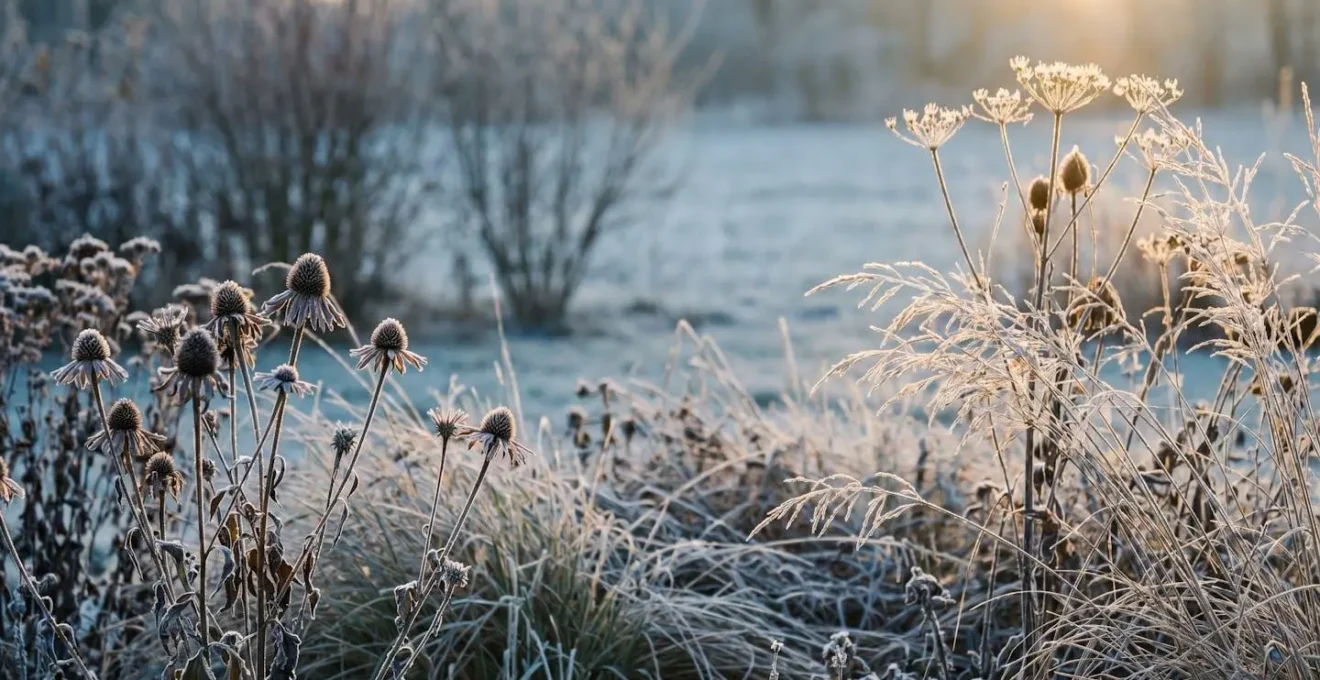
Contrary to the ‘leave it all’ mantra, protecting overwintering insects isn’t about abandoning your garden; it’s about strategically curating specific habitats like hollow stems and dry leaf litter.
- Most beneficial insects, like lacewings and native bees, rely on the “mess” of dead plant material—not commercial bug hotels—to survive the winter.
- However, a blanket approach can backfire, as diseased leaves (like those with black spot) should be removed to prevent reinfection next year.
Recommendation: The most impactful action is patience. Delay your main garden cleanup in spring until temperatures are consistently above 50°F (10°C) for a week to allow insects to emerge safely.
As the vibrant hues of summer fade, a familiar urge takes hold of the conscientious gardener: the desire to tidy. We see the browning stems, the falling leaves, and our instinct is to cut, rake, and neaten everything into submission before winter arrives. This annual ritual feels productive, a way of putting the garden “to bed.” It’s a vision of cleanliness reinforced for generations. We’re told to clear debris to prevent pests and diseases, and there is certainly some truth to that.
But what if this deep-seated need for order is inadvertently silencing the hum of next year’s garden? We are beginning to understand the value of leaving seed heads for birds, but the life happening below the flower heads is a world we are just starting to appreciate. The truth is, that “mess” of dormant perennials and leaf litter is not an ending; it is a bustling metropolis, a vital nursery for the thousands of beneficial insects that are the backbone of a healthy ecosystem. These are the tiny allies who will pollinate our crops and prey on pests for free, but only if we provide them with a place to shelter.
This guide moves beyond the simplistic “leave the leaves” advice. We will explore the science behind this structural scaffolding, showing that a truly wildlife-friendly garden isn’t about neglect, but about strategic curation. It’s about learning to see the architectural beauty in a frost-kissed grass and understanding the life-giving properties of a hollow stem. We will delve into which structures provide the most benefit, which “rules” can be bent, and which mistakes to avoid, transforming your autumn garden from a list of chores into a conscious act of conservation.
To navigate this crucial topic, this article breaks down the essential elements of winter garden stewardship. From identifying high-calorie food sources for birds to understanding the signals for a safe spring cleanup, you’ll gain the knowledge to curate a garden that is both beautiful and bursting with life.
Summary: The Gardener’s Dilemma: Why ‘Tidying Up’ for Winter Harms Your Garden’s Hidden Allies
- Which Seed Heads Provide the Most Calories for Winter Birds?
- How to Use Dead Foliage to Insulate Tender Crowns Naturally?
- Frost on Grasses: Designing for the ‘Golden Hour’ in Winter
- The ‘Leave it All’ Mistake That Harbours Black Spot Spores
- When to Cut Back: The Temperature Signal for Safe Cleanup
- Log Piles or Bug Hotels: Which Actually Works for Lacewings?
- Why Herbaceous Stems Collapse and How It Feeds the Soil?
- How to Attract Beneficial Insects to Eat 90% of Your Aphids?
Which Seed Heads Provide the Most Calories for Winter Birds?
While we focus on insects, we cannot ignore their avian counterparts who also rely on the winter garden. Leaving seed heads is common advice, but not all seeds are created equal. For a small bird trying to survive a freezing night, a single seed’s energy content can mean the difference between life and death. The key is fat. Research into avian energetics shows that seeds with 35-50% fat content are critical for survival, providing the dense calories needed to maintain body temperature.
So, which plants are the best providers? Sunflowers (Helianthus) are the undisputed champions, their large seeds packed with oil. However, a diverse offering is best. Think of your garden as a winter buffet. Plants in the Aster family, like Black-eyed Susans (Rudbeckia) and Coneflowers (Echinacea), are particularly valuable. Their composite flower structure means they offer hundreds of tiny, oil-rich seeds in a single head, creating efficient, high-calorie feeding stations.
These plants don’t just offer food; they provide it in a sturdy, accessible package. Their strong, upright stems act as natural perches, holding the seeds high above the snow and allowing birds like goldfinches, siskins, and chickadees to cling and feed throughout the coldest months. By selecting plants known for their high-fat seeds and robust structure, you create powerful calorie banks that are far more effective than any store-bought feeder.
Case Study: The Echinacea Magnet
Purple coneflower (Echinacea) seed heads are a documented magnet for goldfinches and other small birds in winter. The tightly packed seeds are exceptionally rich in oils and fats, providing the high-calorie nutrition essential for surviving cold nights. The cone’s robust shape and sturdy stem allow it to stand firm against snow and wind, making it an easy and reliable landing pad for birds to land, perch, and feast when other food sources are buried or scarce.
This simple act of leaving the right seed heads transforms your garden from a barren space into a life-sustaining oasis, filling it with the movement and song of birds all winter long.
How to Use Dead Foliage to Insulate Tender Crowns Naturally?
Nature has its own perfect insulation: a fluffy, airy blanket of leaves and collapsed plant matter. Before you reach for the rake, understand that this layer is a critical thermal blanket for the tender crowns of your perennial plants. The crown, where the roots and stem meet, is the plant’s life-support system, containing the buds for next year’s growth. Exposing it to harsh, freeze-thaw cycles can cause severe damage or death.
The best insulating leaves are large and sturdy, like those from oak or maple trees. Unlike smaller leaves that can mat down and become a soggy, airless mess, these larger leaves trap pockets of air. This trapped air is the secret to insulation, buffering the soil from extreme temperature swings. It keeps the ground from freezing too deeply and, more importantly, prevents premature thawing during a mid-winter warm spell, which can trick plants into breaking dormancy too early, only to be killed by the next frost.
This natural mulch also provides a vital habitat. Countless beneficial insects, from queen bumblebees to predatory beetles, shelter in this layer. The fallen foliage becomes a self-regulating ecosystem, protecting both your plants and their tiny guardians. So, instead of raking leaves away, think of yourself as an ecological bed-maker, gently tucking your perennials in for the winter under a protective, life-giving duvet.
The image above perfectly illustrates how the structure of oak leaves creates air pockets, forming a protective layer over a dormant plant crown. This is nature’s own high-performance insulation at work, a system that costs nothing and supports an entire ecosystem. By allowing this process, you are working with nature, not against it.
This simple shift in perspective—from seeing leaves as “mess” to “mulch”—is fundamental to creating a resilient, low-maintenance, and wildlife-rich garden.
Frost on Grasses: Designing for the ‘Golden Hour’ in Winter
A wildlife-friendly garden should also be a garden that brings you, the gardener, joy throughout the seasons. And there is a unique, ephemeral beauty to the winter garden that a “tidy” approach completely erases. One of the most spectacular displays is the effect of frost on the structural scaffolding of ornamental grasses and perennial stems left standing through winter.
Grasses like Miscanthus, Panicum (Switch Grass), and Pennisetum (Fountain Grass) retain their form long after their color has faded. Their fine-textured blades and fluffy seed heads are designed to catch the light. On a frosty morning, each individual blade and seed becomes outlined in a crystalline layer of ice. When the low winter sun hits them during the ‘golden hour’ just after sunrise, the entire plant seems to explode with light, a breathtaking spectacle of silver and gold.
This is not an accident of nature; it’s a design opportunity. When you select and place perennial grasses, you are not just choosing a plant for its summer form, but also for its winter silhouette. Think of them as living sculptures. By leaving them standing, you are designing for the fourth season. You create a garden with depth, texture, and interest long after the flowers have faded. This visual reward is a powerful antidote to the grey bleakness that can define winter, reminding us that the garden is never truly dormant, but merely sleeping and sparkling.
The same principle applies to the sturdy, dark stems of plants like Sedum ‘Autumn Joy’, Phlomis russeliana (Turkish Sage), or the skeletal umbels of fennel. They create strong vertical lines and dark, graphic shapes against the pale backdrop of winter, catching snow and frost in patterns that no human hand could design. Letting go of the shears is an invitation to witness this quiet, daily magic.
It transforms the act of leaving stems from a passive omission into an active choice for year-round beauty and ecological function.
The ‘Leave it All’ Mistake That Harbours Black Spot Spores
Our passionate advocacy for leaving plant matter must be tempered with horticultural wisdom. The “leave it all” approach, while well-intentioned, is a simplification that can lead to problems. The most significant of these is the overwintering of plant diseases. This is where strategic curation, not blind preservation, becomes essential.
The classic example is black spot on roses or powdery mildew on phlox and bee balm. The fungal spores that cause these diseases don’t simply vanish in winter; they survive on fallen leaves and infected stems. If you allow this diseased material to remain at the base of the plant, you are essentially creating a perfect incubator for next year’s infection. When spring rains arrive, the spores are splashed back up onto the new, tender foliage, and the cycle begins anew.
In these specific cases, cleanliness is the right course of action. You must remove and dispose of (do not compost) all affected leaves and stems. This is not a contradiction; it is a clarification. Our goal is to support a healthy ecosystem, and a plant perpetually weakened by disease is not healthy. The same logic applies to other specific problems, like iris borer eggs which overwinter in old iris leaves.
This nuanced approach requires you to be an observer in your garden, to know your plants and their common ailments. It moves you from a passive role to that of an active, knowledgeable manager of your garden’s health. As the experts at SeeWhatGrows.org point out, this discernment is key:
Do rake all leaves from fruit trees, as they contain properties than can harm overwintering insects. Non-fruit tree leaves are fine.
– SeeWhatGrows.org contributors, How to Protect Beneficial Bugs Your Winter Garden
By learning to distinguish between beneficial “mess” and detrimental debris, you elevate your gardening practice and create a truly resilient and healthy environment.
When to Cut Back: The Temperature Signal for Safe Cleanup
Perhaps the single most harmful act of “tidying up” occurs not in the autumn, but during the first warm spell of late winter or early spring. Eager to get a head start, gardeners rush out to cut back all the old growth. In doing so, they are unwittingly destroying the very life they sought to protect. Those hollow stems and piles of leaves are still occupied hotel rooms.
The inhabitants—tiny native bees, lacewing larvae, butterfly chrysalises—don’t follow a calendar; they follow temperature cues. They need a sustained period of warmth to complete their development and emerge safely. Cutting everything back prematurely is like demolishing the apartment building while the residents are still asleep inside. So, when is it safe?
The scientific consensus points to a clear thermal signal. According to Oregon State University Extension research, you should wait to clean up your garden until temperatures consistently reach 50°F or higher. This isn’t just a one-day fluke; it needs to be a consistent trend. As the Forest Preserve District of Will County clarifies, this means a sustained period of warmth.
Others suggest waiting until the daytime temperature reaches at least 50 degrees for seven consecutive days.
– Forest Preserve District of Will County, Protect overwintering insects by resisting urge to start garden cleanup now
This “Seven-Day Rule” at 50°F (10°C) is your most reliable guide. It ensures that the vast majority of overwintering insects have had a chance to wake up and vacate their winter quarters. Patience is the ultimate act of kindness for a wildlife gardener.
The image of this solitary bee emerging from its hollow-stem nest is a powerful reminder of what’s at stake. This is the hidden life we are protecting. By waiting for the right temperature, you allow this magical moment of emergence to happen across your entire garden.
Resist the urge to be tidy, and you will be rewarded with a garden buzzing with the activity of beneficial pollinators and predators.
Log Piles or Bug Hotels: Which Actually Works for Lacewings?
In the rush to “do something” for insects, the market has been flooded with decorative “bug hotels.” These neat little boxes with bamboo tubes and drilled holes look appealing and make us feel good. However, for many of our most valuable beneficial insects, particularly lacewings, they are ecological traps or, at best, completely ignored. To understand why, we need to look at how these insects actually live.
Common green lacewings, voracious aphid-eaters, overwinter as adults, not as larvae in tubes. As the Wildlife Gardening Forum notes, they seek sheltered, dry places like sheds, houses, or, most naturally, deep piles of dry leaves and loose bark. They need nooks and crannies to crawl into, not perfectly round tubes. The popular tube-style bug hotels are designed primarily for a small subset of solitary bees, like mason bees. For lacewings, ladybugs, and predatory ground beetles, a simple, “messy” log pile or a deep layer of leaf litter is far superior.
A log pile creates a complex, multi-layered habitat. It offers dry, sheltered cavities under the bark and in the gaps between logs. As the wood slowly decays, it provides food for other organisms, which in turn feed predators. It is a self-sustaining community hub, whereas a bug hotel is more like a sterile, single-purpose barracks. The following table, based on information from the University of Minnesota Extension, clarifies the difference.
| Feature | Log Piles / Leaf Litter | Bug Hotels (Tube-style) |
|---|---|---|
| Lacewing Overwintering | ✓ Highly effective – lacewings overwinter as adults in sheltered, dry places | ✗ Poor – lacewings don’t nest in tubes like solitary bees |
| Target Insects | Generalist habitat: lacewings, ladybugs, ground beetles, spiders | Specialist habitat: primarily tube-nesting solitary bees and mason bees |
| Maintenance | Low – natural decomposition, minimal intervention needed | Medium – tubes can become moldy or filled with debris, may need cleaning |
| Natural Habitat Mimicry | Excellent – replicates natural woodland floor conditions | Moderate – provides artificial nesting cavities not found in nature for most species |
| Kid-Friendliness | Moderate – less visible insect activity, observation requires patience | High – visible bee activity at tube entrances, easier for children to observe |
So, save your money. Find a shady corner of your garden, start a small pile of logs, branches, and leaves, and let nature do the rest. You’ll be creating a far more effective and authentic sanctuary for a wider range of your garden’s hidden allies.
Why Herbaceous Stems Collapse and How It Feeds the Soil?
We’ve discussed the value of standing stems as perches, food sources, and nesting sites. But what about the inevitable end of their structural life? When heavy snows or winter rains finally cause herbaceous stems to bend and collapse, it’s not a sign of failure. It is the beginning of the final, crucial chapter in their lifecycle: feeding the soil.
This collapsed layer of stems and leaves is what ecologists call “duff.” It forms a protective mat over the soil surface, further reducing moisture loss and buffering against temperature extremes. More importantly, it becomes a slow-release feast for the soil food web. Earthworms, millipedes, woodlice, and a universe of microscopic fungi and bacteria begin the work of decomposition. They break down the complex organic matter of the stems, unlocking the nutrients—carbon, nitrogen, phosphorus—that the plant accumulated during its life.
This process is the very definition of a closed-loop system. The nutrients are not lost or carted away in a yard waste bag; they are returned directly to the soil, right where the plant’s roots can access them for the next season’s growth. This is nature’s composting and fertilizing service, and it’s perfectly efficient. By leaving the stems to collapse and decay in place, you are actively building topsoil, improving its structure, increasing its water-holding capacity, and nourishing the very plants that will grow there next year.
This cycle of growth, decay, and rebirth is the foundation of a sustainable garden and, indeed, all life on Earth. As native plant gardener Jerad Bryant eloquently puts it, it’s all connected:
Insects feed birds, birds feed larger animals, and they feed even larger animals! The more biomass accumulates, the more organic matter exists for decaying organisms. They then feed plants with their decay, returning the nutrients where they came from.
– Jerad Bryant, Native Plant Gardener, 19 Perennial Seed Heads That Feed Garden Birds in Winter
When you see a collapsed stem, don’t see decay. See renewal. See the quiet, powerful process of your garden feeding itself.
Key Takeaways
- Strategic Mess: Effective wildlife gardening isn’t about letting everything go; it’s about curating specific habitats like hollow stems and log piles while removing diseased material.
- The 50°F (10°C) Rule: The most critical action is to delay spring cleanup until temperatures are consistently above 50°F for a week, allowing overwintering insects to emerge safely.
- Function over Form: Natural, “messy” habitats like leaf litter and log piles are vastly more effective for a wide range of beneficial insects (like lacewings and ladybugs) than most commercial bug hotels.
How to Attract Beneficial Insects to Eat 90% of Your Aphids?
The ultimate goal of all this effort is to build a self-regulating ecosystem—a garden where nature’s own checks and balances keep pest populations under control. The promise of attracting enough beneficial insects to handle up to 90% of your aphids isn’t a fantasy; it’s the reality of a mature, diverse habitat. It doesn’t happen overnight, but by providing food, shelter, and water, you lay the groundwork for an army of allies to establish itself.
The first step is providing the winter shelter we’ve discussed throughout this article. A ladybug that successfully overwinters in your leaf litter is a ladybug that will lay eggs in your garden in spring, producing larvae that can consume up to 50 aphids a day. But shelter is only half the equation. In the growing season, these insects need food, specifically nectar and pollen. Many beneficial insects, including parasitic wasps and hoverflies, have a dual diet: their larvae are carnivorous predators, but the adults are plant-powered, feeding on the tiny flowers of plants in the carrot family (dill, fennel, cilantro) and aster family (yarrow, cosmos).
By planting a succession of these small-flowered plants, you provide a constant food source for the adult predators, keeping them in your garden and ready to lay eggs when pests appear. This combination of year-round shelter and in-season food is the key. While establishing this balance takes time, even a new habitat can see significant results. University of Missouri Extension research shows a reduction of 20 to 40 percent in pest populations from beneficial insects is a realistic baseline. As your garden’s biodiversity increases, so will this number.
Action Plan: Auditing Your Garden’s Beneficial Insect Habitat
- Points of Contact: Make a list of all potential overwintering sites in your garden. Include perennial beds, areas with leaf litter, log piles, rock walls, and patches of evergreen bunch grasses.
- Collecte: Inventory the existing plant structures. Do you have hollow stems from coneflowers or Joe Pye weed? Pithy stems from raspberries or elderberry? Do you have sturdy seed heads from Rudbeckia or grasses?
- Cohérence: Compare your inventory to the needs of key beneficials. Are your leaf litter piles dry and fluffy (good for lacewings) or wet and matted? Are stems being left at various heights to accommodate different bee species?
- Mémorabilité/émotion: Step back and look at the winter garden’s aesthetics. Can a “messy” log pile be framed by evergreen ferns to look intentional? Can you group winter-interest plants together for a more powerful visual impact?
- Plan d’intégration: Based on the gaps in your audit, plan for next season. Do you need to plant more perennials with hollow stems? Designate a specific, out-of-the-way corner for a permanent leaf and log pile?
Embrace this new role as a habitat curator. Stop fighting your garden and start collaborating with it. By providing these simple, fundamental requirements, you transform your patch of land from a constant battleground into a thriving, balanced, and beautiful sanctuary, one strategic stem at a time.