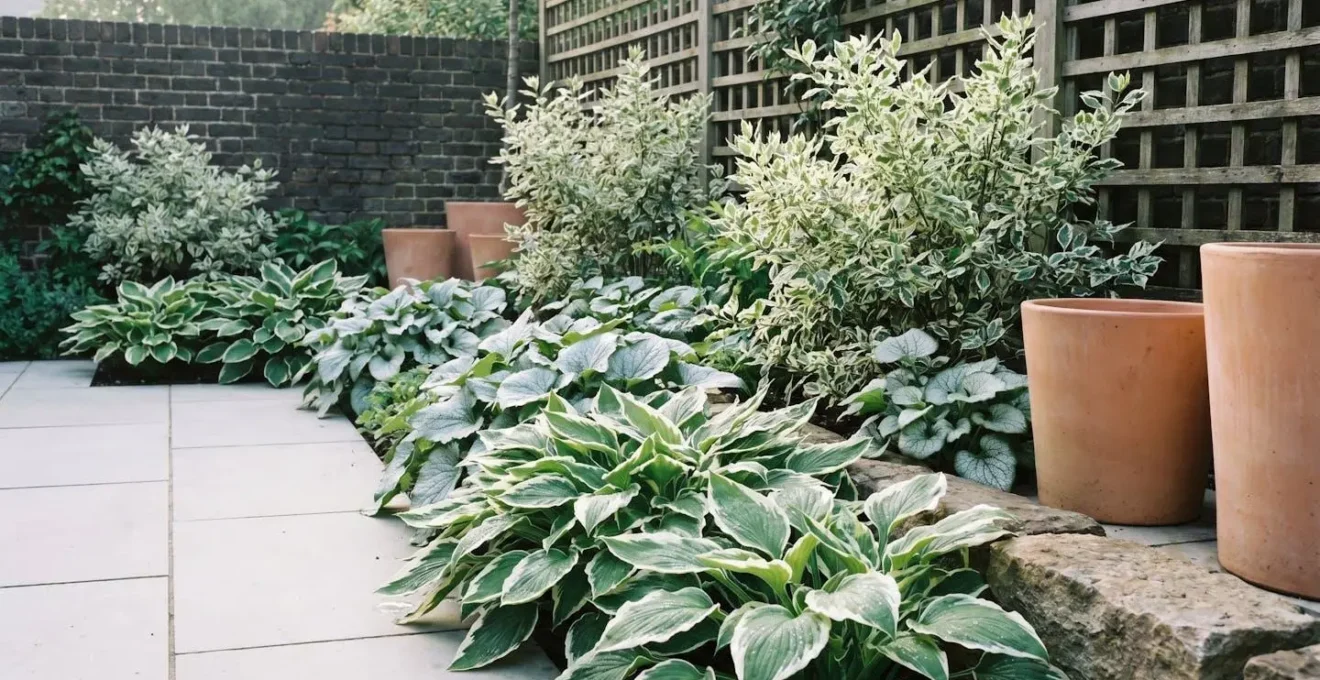
The key to a luminous shade garden isn’t just choosing variegated plants, but understanding the biological and optical rules they play by.
- White and silver variegation are physically more visible in low light (the Purkinje effect), making them superior to yellow or gold for twilight viewing.
- Variegation is a plant’s energy deficit; high-nitrogen fertilizer and low light will cause it to revert to more efficient all-green growth.
Recommendation: Select plants for their light-reflective qualities and low-maintenance needs (like ferns over hostas for pest resistance), and feed them minimally to preserve their colour.
Every gardener knows the challenge: that dim, north-facing corner where vibrant flowers give up and even the lawn seems to retreat. The common advice is to “brighten it up” with variegated plants, turning to a splash of cream, white, or gold to simulate sunlight that isn’t there. We buy hostas, euonymus, and dogwoods, hoping their patterned leaves will solve the problem of perpetual twilight. Yet, often the results are disappointing. The variegation fades, the white edges scorch, or the plant simply fails to thrive.
The issue is that we often treat variegated foliage as mere decoration, a simple splash of paint on a green canvas. But what if the solution lies not just in adding colour, but in strategically managing light itself? What if the leaves of a plant could act like tiny, biological mirrors, capturing and reflecting every last photon in a dimly lit space? The truth is, they can—but only if we understand the science behind their beauty.
This article moves beyond the simple “plant this” advice. We will explore the biological trade-offs that variegation represents, understanding why these plants have different needs. We’ll delve into the optical physics that makes certain colours glow at dusk while others vanish. Finally, we will provide a framework for selecting and combining these plants not just for their appearance, but for their performance as light-amplifying tools, transforming your shadiest spots into a dynamic and luminous landscape.
This detailed guide will walk you through the science and strategy of using variegated foliage. By understanding the principles, you can make informed choices that lead to a thriving, radiant shade garden.
Summary: A Strategic Guide to Variegated Foliage in Shade Gardens
- Why Variegated Plants Need More Light Than Green Ones (Usually)?
- White or Gold: Which Variegation Stands Out Best in Twilight?
- The Sunburn Risk: Why White Variegation Burns in Midday Sun?
- Euonymus vs Dogwood: Which Variegated Shrub Keeps Its Pattern Best?
- Nitrogen Levels: Can High Feeding Reduce Variegation Intensity?
- Ferns or Hostas: Which Species Photosynthesizes Better in Deep Shade?
- Black Grasses and Silver Foliage: The Ultimate Modern Contrast?
- Creating High Visual Contrast: The ‘Thriller, Filler, Spiller’ Rule for Borders
Why Variegated Plants Need More Light Than Green Ones (Usually)?
The fundamental misunderstanding about variegated plants is thinking of them as simply green plants with white or yellow paint. The reality is a biological trade-off. The non-green sections of a leaf—the white, cream, or yellow parts—lack chlorophyll, the engine of photosynthesis. This means the plant has a significantly reduced area for converting sunlight into energy. As a result, variegated plants generally require brighter, indirect light compared to their all-green counterparts to compensate for this reduced photosynthetic capacity.
Think of it as a factory running on fewer solar panels. To generate the same amount of power, it needs more intense or longer exposure to the sun. As Mike Rimland, a plant expert at Costa Farms, explains, “They have less chlorophyll so they need higher indirect sunlight and longer periods of the same light. The green areas of the leaves need to compensate for the non-green areas.” This compensation is a high-energy act for the plant. If light becomes too low, the plant’s survival instincts kick in. It will begin producing more all-green leaves, a process called reversion, to maximize energy production and abandon the costly aesthetic of variegation.
If you notice your plant’s vibrant patterns fading or new growth coming in solid green, it’s a clear signal that the energy budget is not balancing. The first step is to assess its location and move it to a spot with brighter, filtered light. You should also immediately cease any high-nitrogen feeding, as nitrogen encourages fast, leafy growth, which the plant will default to making all-green. Finally, you must be ruthless: trace any all-green shoots back to their origin and prune them out completely. This prevents the more vigorous, photosynthetically efficient green growth from consuming the entire plant and erasing the variegation you cherish.
Ultimately, keeping variegation vibrant is about finding the sweet spot: enough light to power the green parts without scorching the delicate, non-pigmented areas.
White or Gold: Which Variegation Stands Out Best in Twilight?
When designing for a north-facing garden, we’re not just planting for the middle of the day; we’re designing for the low light of morning and, more importantly, the enchanting period of twilight. Here, not all variegation is created equal. The choice between white or silver and yellow or gold foliage is a decision rooted in the physics of human vision. This phenomenon, known as the Purkinje effect, explains why some colours pop at dusk while others fade to a muddy grey.
This scientific principle, first described in 1825, notes that as light intensity decreases, the human eye’s peak sensitivity shifts towards the blue end of the spectrum. As Jan Evangelista Purkinje noted, in low light, the human eye is more sensitive to blue-green and silver hues, making them appear almost luminous, while yellow and gold tones lose their vibrancy. This is why a silvery Brunnera or a white-edged Hosta seems to glow in a “moon garden,” while a golden-leafed shrub next to it can disappear.
This optical illusion is a powerful tool for the shade gardener. The illustration below captures how the metallic sheen of silver foliage can catch the last rays of light, creating a magical, luminous quality.
As you can see, the cool, silvery tones stand in stark contrast to the deepening shadows. Garden designers leverage this by creating “cocktail-hour gardens” using plants with silver or white foliage that become the main event after sunset. According to Garden Design magazine, trees with variegated foliage like the dappled willow are especially suited for theatrical up-lighting, as the white leaves are already more visible at night, creating romantic and inviting spaces for evening gatherings.
For a north-facing garden that you want to enjoy in the evening, prioritizing plants with white or silver variegation is not just an aesthetic choice—it’s a strategic one based on the very physics of how we see the world.
The Sunburn Risk: Why White Variegation Burns in Midday Sun?
While bright, indirect light is crucial for variegated plants, direct sun is often their greatest enemy. The very same white or cream sections that make a plant so beautiful in the shade are also its greatest vulnerability. These areas lack the protective pigment of chlorophyll, making them exceptionally susceptible to sunburn, also known as leaf scorch. They are essentially a plant’s equivalent of pale skin without sunscreen.
Sunburn occurs when a leaf absorbs more light energy than it can process through photosynthesis, causing the cells to overheat and die. This often results in crispy, brown patches or a bleached, translucent appearance on the most exposed parts of the leaf. According to the Foliage Factory Plant Care Guide, “Pale or white variegated areas often have reduced chlorophyll and lower light-processing capacity, so they can scorch faster.” This risk is magnified on hot days; many houseplants can suffer sunscald when exposed to temperatures above 85°F (29°C) combined with intense light.
A north-facing garden is generally safe, but even there, reflective light from a wall or a few hours of intense morning or late afternoon sun in summer can be enough to cause damage. If you notice scorch marks, the immediate action is to move the plant to a more protected spot to prevent further cell damage. Ensure the soil is well-watered—but avoid wetting the leaves in the sun—to help the plant cool itself through transpiration. For plants in the ground, creating temporary shade with a chair or shade cloth on the hottest days can be a lifesaver. Applying a thick layer of mulch will also help keep the roots cool and conserve vital moisture.
Ultimately, protecting variegated plants is about understanding their inherent vulnerability and providing the filtered, dappled light of their native understory environments, not the harsh exposure of an open field.
Euonymus vs Dogwood: Which Variegated Shrub Keeps Its Pattern Best?
When selecting structural shrubs for a shady spot, variegated Euonymus and Dogwood (Cornus) are two of the most popular choices. Both offer bright foliage that can lift a dark corner, but their performance, maintenance, and year-round appeal differ significantly. Choosing between them requires looking beyond the summer foliage and considering winter interest, maintenance effort, and even family safety.
The primary difference lies in their foliage type: most variegated Euonymus are evergreen, holding their patterned leaves through winter, while variegated Dogwoods are deciduous, losing their leaves in autumn. This might seem like a clear win for Euonymus, but the Dogwood has a secret weapon. The following table breaks down the key characteristics, drawing on insights from horticultural bodies like the Royal Horticultural Society.
This comparative data, synthesized from resources like analysis provided by the Royal Horticultural Society, highlights the different roles these plants can play in a garden.
| Characteristic | Variegated Euonymus | Variegated Dogwood (Cornus) |
|---|---|---|
| Foliage Type | Evergreen – provides winter structure | Deciduous – loses leaves in winter |
| Winter Interest | Year-round variegated foliage | Vibrant red or yellow stems that light up bleak winter landscapes |
| Toxicity (Family Safety) | All parts toxic if ingested – major concern for young children and pets | Generally non-toxic to humans and pets |
| Reversion Tendency | Moderate – produces green shoots that must be pruned | Moderate – but easier to manage as hard annual pruning is standard practice for stem color |
| Maintenance Effort | Requires vigilant monitoring and selective pruning of reverted growth | More forgiving for busy families – annual hard pruning removes reverted stems naturally |
| Best For | Formal evergreen structure where constant monitoring is possible | Family gardens needing low-maintenance, safe, and dynamic seasonal interest |
As the table shows, the choice is not straightforward. Euonymus provides constant structure but requires vigilance for both toxic parts and reverted green shoots. Dogwood, while bare in winter, offers a spectacular show of colourful stems and its annual hard pruning regime automatically takes care of most reversion issues, making it a more forgiving choice for busy families or low-maintenance gardens.
Therefore, the “best” shrub depends entirely on your priorities: evergreen structure with higher supervision, or dynamic seasonal interest with lower maintenance and greater peace of mind.
Nitrogen Levels: Can High Feeding Reduce Variegation Intensity?
One of the most counter-intuitive aspects of caring for variegated plants is fertilization. A gardener’s instinct when a plant looks weak is to feed it, but with variegated species, this can be the very thing that destroys their unique patterning. The culprit is typically an excess of nitrogen, the primary nutrient responsible for promoting lush, green, leafy growth.
When a variegated plant, already operating at a photosynthetic deficit, is given a boost of high-nitrogen fertilizer, it’s like telling a struggling company it has a sudden windfall to spend on its most profitable division. The plant will invariably invest that energy in what works best: producing chlorophyll. This triggers the reversion process, where the plant produces all-green leaves to maximize its energy-making potential. As explained by Biology Insights, the combined effect of low light and high nitrogen “pushes the plant to prioritize efficient growth over aesthetic patterning.” The plant isn’t being difficult; it’s simply following a logical survival strategy.
This is why experienced horticulturists often recommend a “tough love” approach to feeding variegated plants, especially those in shady conditions. A single application of compost or a balanced, slow-release organic fertilizer in the spring is usually more than sufficient.
Case Study: Slow-Release Organic Feeding for Variegated Plant Health
Horticultural experts at Plant Delights Nursery observe that variegated plants are often less hardy than their all-green relatives and more prone to tissue damage. To maintain the integrity of their patterned leaves, they advise against using high-nitrogen synthetic fertilizers. These can encourage fast, weak growth that is overwhelmingly green. Instead, they recommend a single spring application of compost or a slow-release organic fertilizer. This provides foolproof, gentle nutrition throughout the season without triggering the plant’s survival instinct to revert to its stronger, all-green predecessors.
By avoiding the temptation to over-feed, you are respecting the plant’s delicate energy balance and encouraging it to maintain its beautiful, but costly, variegation.
Ferns or Hostas: Which Species Photosynthesizes Better in Deep Shade?
In the world of shade gardening, ferns and hostas are the undisputed royalty. Hostas offer bold, architectural mounds of foliage that can create a lush, “dinosaur jungle” feel, perfect for filling space and acting as a living mulch. Ferns, with their delicate, arching fronds, bring texture, movement, and a timeless woodland aesthetic. While both are shade-loving champions, their suitability for a low-maintenance, family-friendly garden can differ dramatically due to a very practical, and often overlooked, factor: pests.
From a purely photosynthetic standpoint, both are highly adapted to low-light conditions. However, practical experience from shade garden experts reveals a crucial difference. Despite their beauty, hostas are notorious magnets for slugs and snails, which can turn their magnificent leaves into a tattered, hole-ridden mess overnight. This can be a source of immense frustration and disappointment, especially in a family garden. In contrast, most ferns exhibit a natural resistance to these common pests, making them an invaluable choice for a beautiful, hassle-free shade garden.
Beyond pest resistance, the true art of using these plants lies in combining their contrasting forms. The image below demonstrates this powerful design principle: the vertical, feathery architecture of ferns rising above the horizontal, smooth carpet of hostas.
This juxtaposition creates a visually dynamic, three-dimensional landscape. The hosta provides the solid, colourful base—the “filler”—while the fern provides the elegant vertical accent—the “thriller.” This textural interplay is far more sophisticated and engaging than simply planting a monoculture of one or the other. It transforms a simple planting bed into a composed work of art.
For a garden that needs to be both beautiful and resilient, especially where children play and chemical pest control is undesirable, the reliable and graceful fern often proves to be the more strategic long-term choice.
Black Grasses and Silver Foliage: The Ultimate Modern Contrast?
For a truly dramatic and modern look in a shade garden, few pairings can compete with the high-contrast combination of black and silver foliage. Plants like the dark, strappy leaves of Black Mondo Grass (Ophiopogon planiscapus ‘Nigrescens’) paired with the shimmering silver of a variegated Lamium or Brunnera create an electrifying visual tension. This is the colour-blocking of the plant world, sophisticated and bold. However, executing this pairing successfully requires more than just placing the two plants next to each other; it demands an understanding of their very different personalities.
The primary challenge in these high-contrast pairings is managing their vastly different growth rates. This common design pitfall is often described by landscape designers as a “tortoise and hare” scenario. The dark-leafed accent plant is almost always the slow, steady tortoise, while the silvery groundcover is the fast, aggressive hare.
Case Study: Managing Growth Rate Disparities in Black-Silver Pairings
Landscape designers frequently report that combining slow-growing Black Mondo Grass with a fast-spreading silver groundcover like variegated Lamium can lead to long-term failure. The Lamium (the ‘hare’) can quickly overwhelm the Ophiopogon (the ‘tortoise’), which may take years to establish a solid clump. By the time the black grass is ready to make a visual impact, it’s often smothered. Successful designs anticipate this disparity. One strategy is to install a buried metal or plastic edging to contain the aggressive spreader. An even better approach is to plant the Black Mondo Grass in dense clusters or drifts from the start, rather than as single specimens, to create immediate visual weight and give it a fighting chance to hold its own while it matures.
This foresight is what separates a planting that looks good for one season from a design that matures beautifully over many years. It is a strategic move to balance the power dynamic between the plants from day one, ensuring the intended contrast is maintained rather than lost to the dominance of the more vigorous partner.
By planning for these growth rate disparities, you can create a stunning black-and-silver tapestry that remains balanced and beautiful for years to come.
Key Takeaways
- For twilight and dawn visibility, prioritize silver and white variegation, which appears more luminous in low light due to the Purkinje effect.
- Variegation is a plant’s energy deficit; preserve it by using slow-release fertilizers and avoiding high-nitrogen feeds that encourage reversion to all-green growth.
- Create sophisticated designs by contrasting textures and forms (e.g., bold hostas with feathery ferns), not just colours, for a richer, three-dimensional effect.
Creating High Visual Contrast: The ‘Thriller, Filler, Spiller’ Rule for Borders
We’ve explored the science of light and the biology of plant choice, but bringing a shade garden to life requires putting these elements together with a clear design principle. The most effective and easy-to-remember framework for creating visually stunning compositions, whether in a large border or a simple patio container, is the ‘Thriller, Filler, Spiller’ rule. This classic design trio ensures your planting has height, volume, and graceful movement, creating a professional-looking result every time.
The concept is simple:
- The Thriller: This is the star of the show, a plant that provides a strong vertical focal point. In a shade garden, this could be an upright, variegated Pieris or a colourful Heuchera with dramatic flower spikes.
- The Filler: These are the mid-height, mounding plants that surround the thriller, filling out the space and creating a sense of lushness. Bold, variegated hostas or clumps of Japanese Forest Grass are perfect fillers.
- The Spiller: These are the trailing plants placed at the edge to soften the borders and cascade over the side, connecting the planting to its surroundings. Variegated ivy, Vinca minor, or Creeping Jenny work beautifully.
This method forces you to think beyond colour and consider form and texture, leading to a much richer, more engaging design. It’s a foolproof recipe for success and a fantastic weekend project for the whole family.
Your Weekend Project Plan: Container ‘Thriller, Filler, Spiller’ for Shady Patios
- Choose Your Container: Select a large pot (minimum 16-18 inches diameter) with drainage holes for a shady patio or north-facing entrance.
- Plant the Thriller: Add a small variegated Pieris or an upright Heuchera ‘Caramel’ in the centre or back to provide height and draw the eye upward.
- Add the Filler: Plant 2-3 colourful Heucheras or a bold variegated hosta around the thriller to fill the middle space and create mass.
- Install the Spiller: Tuck variegated ivy or Vinca minor ‘Argenteovariegata’ around the edges to soften the container rim and create cascading movement.
- Design Tip: Ensure contrast beyond just colour—pair the bold, smooth texture of hosta leaves with the fine, airy quality of ferns for true three-dimensional interest.
By applying this simple rule, you can move from just planting things in the shade to actively designing a layered, dynamic, and luminous garden that is beautiful from every angle.