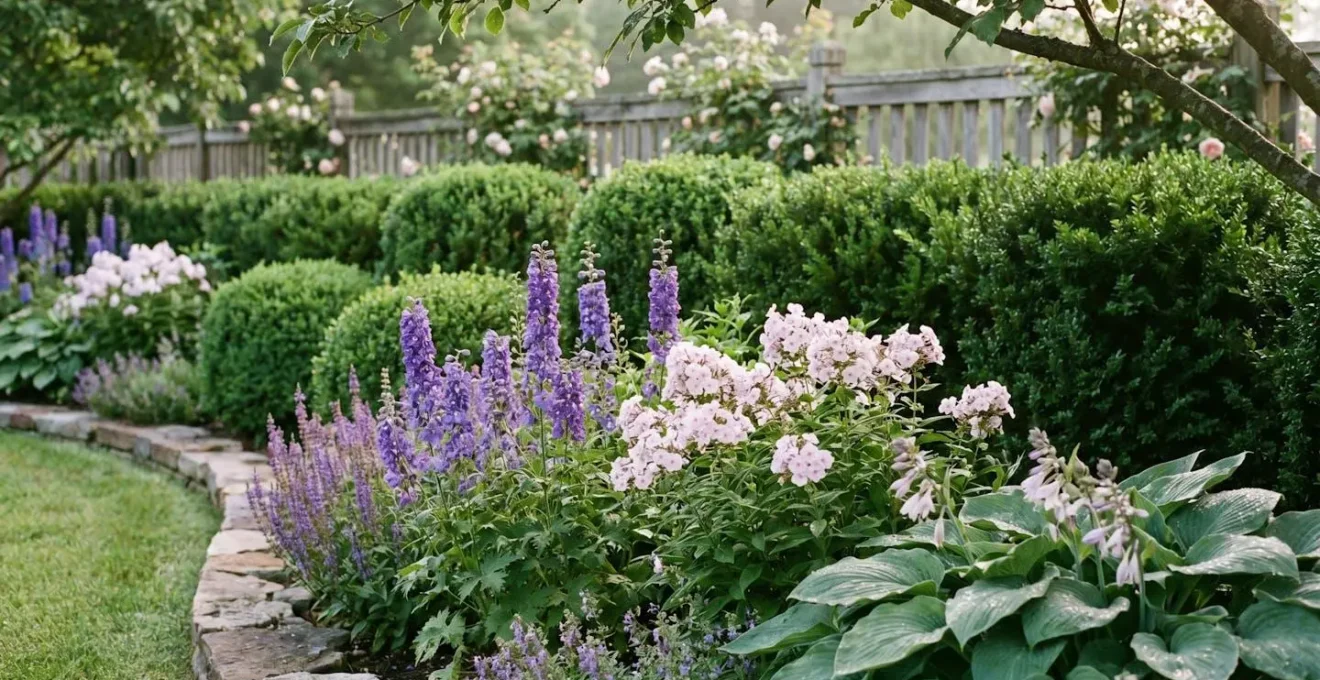
The best value for a small garden comes not from choosing between plants, but by treating your border as a dynamic ecosystem instead of a static display.
- Herbaceous perennials can provide year-round structure and interest if you master their lifecycle, from growth to decay.
- Techniques like “chop and drop” and the “Chelsea chop” turn maintenance into a benefit, feeding the soil and extending blooms.
Recommendation: Shift your mindset from “which plant to buy” to “how can I design a self-sustaining system” to create a garden that is both beautiful and budget-aware.
As the owner of a new build home, you’re faced with a familiar challenge: a small, often concrete-heavy garden that’s a complete blank canvas. The default advice is often a rigid choice between shrubs for “structure” and herbaceous perennials for “colour.” This leads many to create static, predictable borders with woody skeletons underplanted with seasonal flowers that disappear in winter, leaving bare earth. You’re told to prize year-round interest, but you’re left with a garden that feels disjointed for half the year.
But what if this fundamental choice is a false one? What if the real secret to a stunning, high-value small garden isn’t about pitting shrubs against perennials, but about rethinking the very purpose of your border? The most pragmatic and cost-effective approach is to stop designing a static display and start cultivating a dynamic, living ecosystem. The true value of herbaceous plants is unlocked when you work *with* their entire lifecycle, from vigorous spring growth to their winter collapse.
This article will guide you through the professional designer’s mindset. We will deconstruct the techniques that transform seemingly “messy” herbaceous borders into sophisticated, low-maintenance, and visually compelling spaces all year round. We will explore how to manage collapse, create invisible supports, use texture as architecture, and sequence flowering to prove that a well-designed herbaceous border offers unparalleled value for modern, small-space living.
To help you navigate these advanced but highly effective concepts, we have broken down the key principles and techniques used by professional designers. This guide will walk you through each step, from managing decay to orchestrating blooms.
Contents: A Designer’s Guide to High-Value Herbaceous Borders
- Why Herbaceous Stems Collapse and How It Feeds the Soil?
- How to Stake Delphiniums Without Ruining the Natural Look?
- Velvet vs Glossy: Pairing Leaf Textures in Herbaceous Borders
- The Spacing Mistake That Causes Mildew in Herbaceous Borders
- Sequencing Your Planting: How to Hide Dying Foliage With New Growth
- Why Trailing Plants Make Small Concrete Spaces Feel Larger?
- Patio Clematis vs Climbers: Which Cultivar Actually Flowers at Eye Level?
- Softscape Vegetation to Soften Harsh Concrete Lines in Modern Builds
Why Herbaceous Stems Collapse and How It Feeds the Soil?
The annual collapse of herbaceous perennials in autumn isn’t a sign of failure; it’s the engine of a healthy garden ecosystem. In a traditional, tidy-focused approach, this stage is seen as a mess to be cleared. We spend hours cutting back, bagging up, and removing this valuable organic matter, only to buy and import compost back into the garden later. A pragmatic designer sees this process differently: the collapsing stems are free mulch and soil conditioner, delivering nutrients exactly where the plant needs them for next year’s growth.
This natural cycle of growth, collapse, and decay mimics a forest floor. As the stems and leaves break down, they create a protective layer over the soil, suppressing weeds, retaining moisture, and feeding the vast network of soil microbes and mycorrhizal fungi. This is the foundation of a resilient, low-input garden. The “chop and drop” method is a way to formalise this natural process, saving time and money while boosting biodiversity.
Case Study: Large-Scale “Chop and Drop” at RHS Bridgewater
At RHS Bridgewater, horticulturists have adopted the chop and drop technique across their extensive herbaceous borders. Instead of painstakingly clearing material, they use a ride-on mower with the deck set high (15cm) to cut everything down, leaving all the material where it falls. This has proven to be a significant time-saver. Critically, it also creates a more biodiverse habitat; the short, hollow upright stems provide valuable shelter for overwintering insects. The team notes that new spring growth quickly emerges through the decomposing “tapestry,” which provides more visual interest during the transition period than bare soil.
By leaving the stems in place over winter, you’re not just feeding the soil; you’re creating essential habitats. The hollow stems become homes for beneficial insects, and the decomposing layer provides cover for ground-dwelling creatures. This approach turns a seasonal “chore” into a powerful tool for building a self-sustaining garden ecosystem.
How to Stake Delphiniums Without Ruining the Natural Look?
Nothing disrupts the soft, natural feel of a herbaceous border more than a clunky metal grid or a series of green plastic canes and string. While tall, show-stopping perennials like Delphiniums, Hollyhocks, and some Asters require support to prevent them from snapping in wind and rain, the solution shouldn’t be more visually intrusive than the problem. The goal of good staking is for the support to be completely invisible by the time the plant is in its full glory.
The key is to provide a supportive framework early in the season that the plant can grow up and through. The “pea-staking” method, using twiggy branches (often called brushwood), is a classic and highly effective technique favoured by designers for its natural appearance and low cost. By inserting a network of branching twigs around a perennial clump when it’s just a few inches tall, you create a three-dimensional scaffold that the stems will colonise. As the foliage develops, it completely hides the brushwood, giving the impression the plant is effortlessly holding itself up.
This is a perfect task for early spring, using prunings from shrubs like hazel, birch, or dogwood. The key steps are:
- Collect twiggy branches that are stiff but not brittle. A three-dimensional, branching structure is ideal.
- When the perennial is less than 6 inches tall, push the stems of the branches into the ground around the plant, angling them slightly inward.
- Ensure the tops of the stakes are about 6 inches shorter than the plant’s final mature height. This is crucial for them to become invisible.
- Simply allow the plant to grow up through the network of twigs. Its own leaves will soon obscure the entire structure.
This technique embodies the principle of “managed wildness”—an intentional, carefully executed intervention that results in a completely natural and effortless look. It respects the plant’s form while providing the hidden strength it needs to perform at its best.
Velvet vs Glossy: Pairing Leaf Textures in Herbaceous Borders
A common mistake in small garden design is focusing solely on flowers. While blooms provide fleeting moments of excitement, they are an unreliable source of year-round structure. For a border to have presence and look good even when not in flower, the design must be built on a foundation of foliage, form, and texture. This is the real secret to four-season interest, and it costs nothing extra—it’s about smarter plant selection.
Think of your border in terms of textural contrast. By pairing plants with different leaf surfaces and shapes, you create a visual tapestry that is interesting in its own right. A classic and effective contrast is pairing glossy, reflective leaves with matte, velvety ones. The large, waxy leaves of a Bergenia (Elephant’s Ears) next to the soft, felted foliage of Stachys byzantina (Lamb’s Ear) creates a dynamic that catches the light in different ways. Similarly, the fine, feathery foliage of a fennel or ornamental grass cuts through the bold leaves of a rodgersia, creating movement and depth.
This principle of “textural architecture” is what gives a professionally designed border its substance. As garden designer Steve Edney points out, it’s about looking beyond the flower.
When creating a perennial border, partner plants that have something to offer at a similar time of year. That may be foliage or flower colour, structure or seedheads.
– Steve Edney, The Middle-Sized Garden
In a small garden, where every plant must work hard, choosing perennials for their textural contribution is paramount. Before buying a plant for its flower, ask what its leaves offer. Are they big, small, shiny, matte, silver, or purple? Building a collection of contrasting foliage is the most budget-aware way to create a border that looks intentionally designed and compelling from March through to February.
The Spacing Mistake That Causes Mildew in Herbaceous Borders
Powdery mildew—that unsightly white coating on the leaves of Phlox, Asters, and Monarda—is often treated as an unavoidable disease. Gardeners rush to buy fungicides or try home remedies, but this is a reactive approach. For a pragmatic designer, powdery mildew is not primarily a disease problem; it’s a design and airflow problem. The number one cause is planting too densely, creating the stagnant, humid conditions in which the fungus thrives.
When you buy small plants from a garden centre, it’s tempting to place them close together for an instant “full” look. This is a critical error that creates future work and unhealthy plants. You must space plants based on their mature size, not their current one. This requires patience and a bit of faith, but it’s the single most effective way to prevent fungal issues. Good spacing allows air to circulate freely between plants, drying the leaves quickly after rain or morning dew and preventing fungal spores from gaining a foothold. Spacing guidelines for preventing powdery mildew all centre on this principle of creating an environment hostile to the fungus.
Think of your border not as a collection of individual plants, but as an architectural system for managing airflow. This “Airflow Architecture” is a core tenet of preventative garden health. By leaving deliberate gaps, you are designing a healthier, more resilient border that requires fewer interventions.
Your Action Plan: Auditing Your Border for Airflow
- Calculate Final Size: When planting, always check the label for the plant’s final spread. Use this measurement, not the pot size, to determine spacing. As a rule, leave a gap equal to half the final spread between each plant.
- Audit Existing Clumps: For established borders, identify plants that are touching. Are these the ones that consistently get mildew? Plan to divide or move one of them in the autumn or spring.
- Practice Subtractive Pruning: You can improve airflow within a dense perennial clump by selectively removing a few stems from the centre at the base. This “thinning” is invisible but dramatically improves circulation.
- Monitor Sunlight: Ensure your border receives at least six hours of direct sun. Mildew thrives in shade and dampness. If a new building or tree has created more shade, consider moving susceptible plants to a sunnier spot.
- Choose Resistant Cultivars: When adding new plants, actively look for varieties specifically bred for mildew resistance. This information is often on the plant tag and represents a smart, one-time investment in future garden health.
Sequencing Your Planting: How to Hide Dying Foliage With New Growth
One of the biggest challenges for new gardeners is managing the “ugly” phase of herbaceous perennials. Early spring bulbs like daffodils and tulips look wonderful, but their dying foliage must be left in place for weeks to feed the bulb for next year. Similarly, the foliage of oriental poppies (Papaver orientale) collapses into a messy heap right after their spectacular but brief flowering. The temptation is to cut it all back, but this weakens the plant. The designer’s solution is not to fight this process, but to choreograph it through sequential planting and timely intervention.
The first strategy is to plant in layers. Place later-emerging, bushy perennials like Geraniums or Alchemilla mollis (Lady’s Mantle) in front of your spring bulbs. As the bulb foliage begins to yellow and flop, the perennial’s fresh new growth will surge up and completely hide it. The dying leaves are still there, doing their job for the bulb, but they are visually edited out of the scene. This same trick works for poppies; a late-starting ornamental grass planted nearby will unfurl its leaves just in time to mask the poppy’s decline.
The second, more advanced technique is the “Chelsea Chop.” This is a pruning method for clump-forming perennials like Sedum, Phlox, and Helenium, performed in late May (around the time of the UK’s Chelsea Flower Show). By cutting back the stems by a third to a half, you achieve several things: the plant becomes shorter, stockier, and less likely to need staking. Most importantly, it delays flowering. Research shows the Chelsea chop can delay perennial flowering by 4 to 6 weeks. By chopping some clumps but not others, or even chopping the front half of a single clump, you can stagger the bloom time, extending the season of interest and creating waves of colour rather than one big bang.
Why Trailing Plants Make Small Concrete Spaces Feel Larger?
In a small garden, especially a new build patio or balcony dominated by hard surfaces, every design choice must work to create an illusion of more space. One of the most effective and budget-friendly visual tricks is the strategic use of trailing plants. Our eyes perceive space based on lines and angles. A typical patio is a box defined by a hard, 90-degree angle where the horizontal floor meets the vertical wall or fence. This creates a strong, confining visual boundary.
Trailing plants work their magic by disrupting this hard line. A plant like Dichondra ‘Silver Falls’, trailing Lobelia, or trailing ivy, when allowed to spill over the edge of a pot or raised bed, blurs the sharp transition between the horizontal and the vertical. The cascading foliage creates a soft, organic line that draws the eye downwards and outwards, fooling the brain into perceiving a less defined, and therefore larger, space. This is a fundamental principle of environmental perception in garden design.
The vertical line of a trailing plant blurs the hard, 90-degree angle between a horizontal floor and vertical wall, fooling the eye into seeing a softer, more integrated, and thus larger space.
– Garden Design Psychology Principle, GardenDesign.com
This effect is amplified when used in vertical planting. A “living wall” or even a simple trellis with climbers and trailing elements breaks up a large, flat, and imposing brick wall, turning it into a green feature that adds depth rather than confinement. For the owner of a small, concrete-heavy space, investing in a few good trailing plants for pots and containers offers an unmatched return on investment in terms of perceived space and softening the harsh architectural lines of the build.
Patio Clematis vs Climbers: Which Cultivar Actually Flowers at Eye Level?
Clematis are a fantastic choice for adding vertical interest to a small garden, but choosing the wrong type can lead to disappointment. The classic mistake is planting a vigorous, large-flowering hybrid like ‘Nelly Moser’ or ‘The President’ in a pot against a 6-foot fence, only to find that all the flowers appear at the very top, well out of sight, while the bottom half is a tangle of bare stems. To get flowers where you can actually enjoy them—at eye level—you need to understand the different types and choose a “patio” cultivar.
Clematis are broadly divided into three pruning groups, but for a small space, it’s more useful to think of them by their habit: vigorous climbers vs. compact patio types. The vigorous climbers are genetically programmed to race towards the sun; they will always flower most profusely at the top of their growth. In contrast, patio or “boulevard” clematis have been specifically bred for a more compact habit. They are less aggressive growers and, crucially, they are selected for their ability to produce flowers all the way up the stem, not just at the top.
Cultivars like ‘Abilene’, ‘Bijou’, or ‘Fleuri’ are perfect examples. They rarely exceed 4-5 feet in height and are ideal for growing in containers with a small obelisk. They will happily cover the support with blooms from top to bottom. When shopping, look for collections explicitly labelled as “Patio,” “Boulevard,” or “Container” Clematis. This ensures you are getting a plant whose entire purpose is to provide a dense, eye-level floral display, making it a far better value and more satisfying choice for a small pot or a low fence than its more towering cousins.
Key Takeaways
- The true value in a small garden comes from designing a dynamic ‘ecosystem,’ not a static ‘display.’
- Mastering the lifecycle of herbaceous perennials—from staking to the “chop and drop”—turns maintenance into a benefit.
- Foliage texture and clever spacing for airflow are more critical for year-round structure and plant health than flower choice alone.
Softscape Vegetation to Soften Harsh Concrete Lines in Modern Builds
The ultimate goal in a modern, new build garden is to create a harmonious balance between the “hardscape” (concrete, brick, paving) and the “softscape” (the plants). Too often, the planting is treated as a decorative afterthought, resulting in a space that feels sterile and dominated by harsh architectural lines. A truly successful design uses softscape vegetation to actively challenge, blur, and reclaim the hardscape, creating a garden that feels integrated and alive.
This is where the principles we’ve discussed come together. Using trailing plants to spill over the hard edge of a raised bed, allowing self-seeding perennials like Erigeron karvinskianus (Mexican fleabane) to colonise the cracks in paving, and planting bold ornamental grasses whose soft plumes move in the wind against a stark brick wall—all these techniques work to soften and humanise the space. It’s about letting the plants create a “living patina” over the rigid structure of the build.
The “Living Patina” Approach
Master Gardener Mary Jane Duford advocates for a naturalistic approach where the goal is an evolving, rather than static, design. By using ornamental grasses and self-seeding perennials, you create a garden that actively colonizes and softens hard lines over time. This requires a shift in mindset: the border is not “finished” upon planting. The real beauty emerges as plant drifts fill in and interact with the architecture over seasons. While this approach requires some management—she recommends planning to divide perennials roughly every 3 years to prevent them from becoming overgrown—it creates a far more dynamic and interesting garden than a rigidly controlled display.
Adopting this ecosystem-based approach, where you manage lifecycles, choreograph succession, and use texture and form as your primary tools, is the most pragmatic and rewarding way to tackle a small, modern garden. It results in a space that is not only more beautiful and resilient but also more deeply connected to the natural processes that govern it. You move from being a garden labourer, endlessly tidying and correcting, to a garden conductor, orchestrating a beautiful, self-sustaining performance.
Begin today by looking at your garden not as a space to be filled, but as a system to be designed. Assess one area and, instead of asking “what flower can I plant?”, ask “how can I improve the airflow, add textural contrast, and plan for its elegant decay?” This change in perspective is the first step toward creating a truly high-value, designer-quality garden.