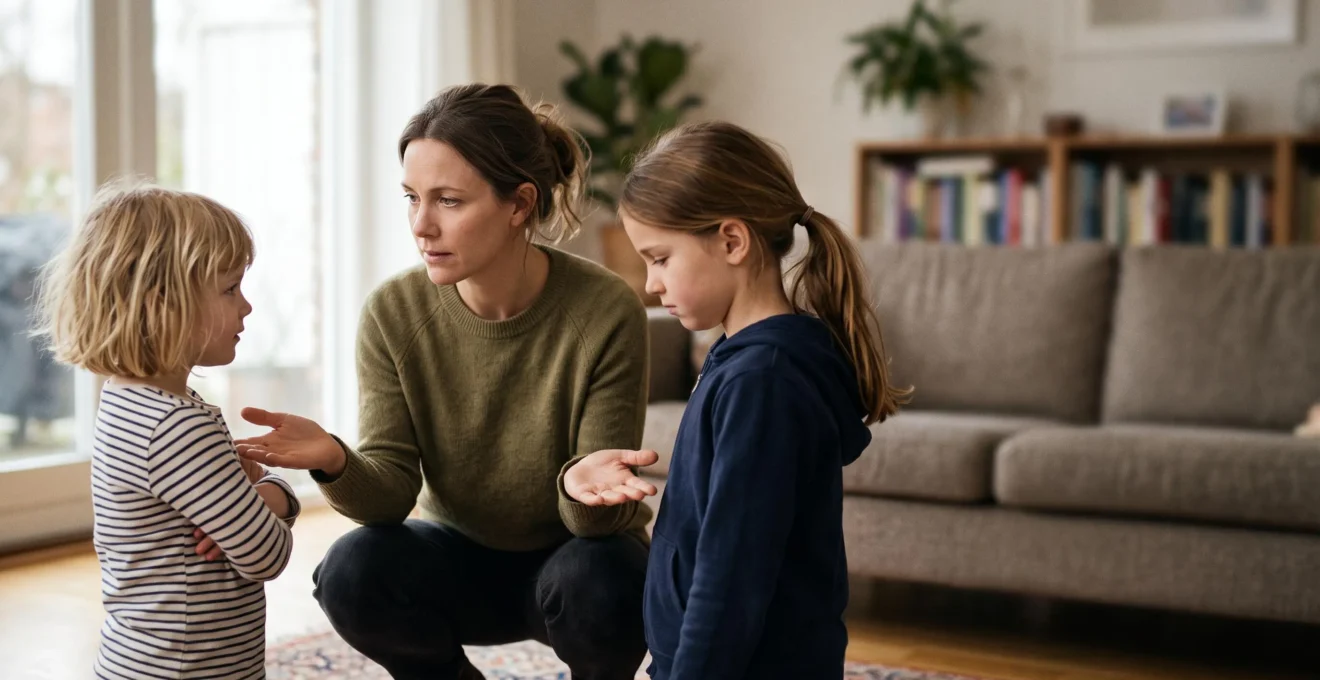
The constant cycle of sibling fights often traps parents in the role of a judge, a position that breeds resentment and fails to teach crucial life skills. The real solution isn’t to determine who is right or wrong, but to act as a neutral facilitator. This approach transforms conflict from a household problem into a valuable learning lab for emotional regulation, negotiation, and empathy.
The shriek from the other room is a sound every parent knows. It’s the universal signal that a toy has been snatched, a line has been crossed, and you are, once again, being summoned to act as judge and jury. For parents who feel like permanent referees, the exhaustion is real, as is the gnawing fear of being unfair. The common advice is to investigate, identify the aggressor, and enforce a consequence, often a forced apology. We are told to teach them to share, separate them, and hope for the best.
But what if this entire judicial approach is flawed? What if, by trying to solve the problem for them, we are robbing our children of the chance to develop one of the most critical skills for a successful life: conflict resolution? The constant arguments over who had it first or who started it are not just noise to be silenced. They are raw, unrefined opportunities for social and emotional learning. This guide reframes the parent’s role entirely. Instead of stepping in as a judge, you will learn to step back as a neutral facilitator.
This perspective shifts the goal from finding a culprit to building a skill. It’s about moving away from imposing solutions and toward empowering your children to find their own. We will explore practical, proven techniques that help you describe conflicts without judgment, validate feelings without condoning harmful behavior, and create an environment where children feel safe enough to negotiate, make mistakes, and ultimately, grow together.
This article provides a complete roadmap for transforming your role from a stressed-out referee to a calm, effective mediator. The following sections break down the core principles and actionable strategies to bring peace and skill-building into your home.
Summary: A Complete Guide to Mediating Sibling Conflict Without Playing the Judge
- How to Use “Sportscasting” to Describe Conflicts Without Judging?
- The Forced Apology Mistake: Why It Breeds Resentment?
- Why Is Sibling Conflict Actually Good for Social Skills?
- How to Set Up a “Peace Corner” for Negotiation?
- When to Step In: Identifying the Line Between Bickering and Bullying
- How to Use the “Name It to Tame It” Technique Effectively?
- How to Validate Feelings Without Agreeing with the Behavior?
- How to Create Psychological Safety at Home for Anxious Kids?
How to Use “Sportscasting” to Describe Conflicts Without Judging?
The first step in shifting from judge to facilitator is to change how you talk about the conflict. “Sportscasting,” a term coined by early childhood educator Magda Gerber, is a powerful technique that involves narrating children’s actions and interactions in a neutral, objective way, much like a sports commentator. Instead of saying, “Stop fighting over that truck!” you describe what you see: “I see two children who both want to play with the same red truck.” This simple change removes accusation and judgment from the equation.
The goal is to provide a calm, factual account that helps children understand the situation from a clearer perspective. As educator Janet Lansbury notes, the idea is to say only what we know for sure, rather than making assumptions about intent. By simply stating the facts (“You’re holding the doll, and your sister is reaching for it”), you give children the space to process what is happening and recognize their own feelings and the other person’s actions without the added layer of parental anger or disappointment. This technique is surprisingly effective at de-escalating tension, as it models a calm response to a heated situation and shows children that you are there to help, not to punish.
Your Action Plan: Age-Adapted Sportscasting Cues
- For Infants/Young Toddlers: Use pure action descriptions. Focus on simple, observable facts like, “You’re holding the red ball,” or “You’re crawling towards the toy.” The goal is language exposure and neutral observation.
- For Toddlers/Preschoolers: Introduce neutral emotional language. Try phrases such as, “You look happy playing with the blocks,” or “It seems like you’re frustrated because the tower fell down.”
- For All Ages: Avoid handing them a resolution. The purpose is not to solve the problem for them but to help them see different perspectives and encourage them to find a shared solution on their own.
- Maintain Neutrality: Your tone is as important as your words. Speak calmly and without bias. Your objective voice creates the psychological safety needed for them to work through the issue.
- Observe and Narrate: Before intervening, take a second to just watch. What are their bodies doing? What are their facial expressions? Narrate these objective facts to build their self-awareness.
The Forced Apology Mistake: Why It Breeds Resentment?
One of the most common parental instincts is to demand an apology to “make things right.” We believe it teaches remorse and accountability. However, coercing a child to say “I’m sorry” often has the opposite effect. It teaches them that a specific sequence of words can get them out of trouble, regardless of their genuine feelings. This hollow ritual bypasses true empathy and can foster deep-seated resentment, both in the child forced to apologize and the one receiving the insincere words.
Research from the University of Michigan confirms this backfire effect. The study found that children may dislike the apologizer even more after an insincere, forced apology than before the conflict began. The “teachable moment” is lost because the focus shifts from understanding the other’s feelings to parental compliance. A far more effective approach is to encourage action-based amends. This means guiding children to *do* something to repair the situation. This could be helping to rebuild a fallen block tower, getting an ice pack for a bump, or simply giving the other person some space. These actions are concrete, meaningful, and connect directly to the consequence of their behavior, fostering genuine empathy and a sense of responsibility rather than compliance.
Why Is Sibling Conflict Actually Good for Social Skills?
While the constant noise and bickering can be draining, it’s crucial for parents to reframe their perspective: sibling conflict is not a failure of parenting, but a vital training ground. The home is a relatively safe “social lab” where children can practice some of life’s most complex and necessary skills. Every argument over a toy, a turn, or personal space is a real-time lesson in negotiation, compromise, emotional regulation, and seeing another person’s point of view. These are skills that are difficult to teach in the abstract but are learned powerfully through direct experience.
When left to navigate these disputes (with a facilitator’s guidance, not a judge’s verdict), children learn to articulate their needs, listen to another’s perspective, and experiment with solutions. They might try bartering (“You can have it in five minutes”), collaborating, or simply learning to manage the frustration of not getting their way. This process is often messy and imperfect, but it is deeply educational. Research consistently shows that these early interactions are fundamental for future relationships.
Indeed, a study published in the Journal of Family Psychology highlighted that sibling interactions are particularly important for developing the social skills needed for relationships outside the family. Peers and colleagues in the real world won’t have a parent to step in and solve disputes. By allowing our children to practice these skills in the low-stakes environment of the family, we are giving them a significant advantage for building healthy friendships, romantic partnerships, and professional collaborations later in life. It’s a shift from viewing conflict as a problem to be eliminated to an opportunity to be guided.
How to Set Up a “Peace Corner” for Negotiation?
A “Peace Corner” or “Negotiation Nook” is a designated physical space in the home where children can go to resolve their conflicts. This is not a punitive “time-out” spot, but rather a voluntary, neutral territory designed to facilitate calm conversation. The purpose of this space is to shift the energy of a conflict from a heated battleground to a structured negotiation. Having a dedicated area signals that resolving disagreements is a valued and normal part of family life, with its own special place and tools.
To create this space, choose a comfortable and relatively quiet corner of your home. Equip it with items that promote calmness and communication. Key elements could include:
- Comfortable Seating: Two small cushions or beanbags facing each other to encourage face-to-face interaction.
- A “Talking Stick”: An object (it could be a decorated stick, a smooth stone, or a specific stuffed animal) that designates whose turn it is to speak. Only the person holding the object can talk, which teaches turn-taking and active listening.
- A Timer: A sand timer or a simple kitchen timer can be used to ensure each child gets an equal amount of time to express their feelings without interruption.
- Calming Tools: A small basket with sensory items like a stress ball, a soft blanket, or a fidget toy can help children self-regulate when emotions run high.
The rules of the Peace Corner should be simple and co-created with your children: you go there to solve a problem together, you use the talking stick, and you stay until you’ve agreed on a solution. As a parent, your role is to introduce the space and its tools, and then act as a facilitator only when needed, reminding them of the rules rather than dictating the outcome.
When to Step In: Identifying the Line Between Bickering and Bullying
While letting children navigate their own conflicts is valuable, it’s not a license for a “Lord of the Flies” environment. The parent’s role as a facilitator includes being a vigilant guardian of safety—both physical and emotional. It is absolutely critical to know when to step in. The key is to distinguish between normal, balanced bickering and genuine bullying. Bickering is a two-way street; there’s a back-and-forth, and the power dynamic is relatively equal. Both children are active participants, even if the conflict is loud and frustrating.
Bullying, however, is one-sided. It’s characterized by a persistent power imbalance. One child consistently targets the other, who is unable to defend themselves. Red flags for bullying include: a significant age or size difference being exploited, one child being consistently fearful of the other, verbal attacks that are cruel and targeted at a vulnerability, social exclusion, or any physical aggression. If you see a pattern where one child is always the “winner” and the other is always the victim, it is no longer a productive conflict; it’s harassment, and you must intervene immediately and firmly.
Research confirms that parental intervention styles are crucial in this area. How parents mediate can either empower children or, as some studies suggest, inadvertently play a role in developing dysfunctional relationships if they fail to address these power imbalances. The question is not simply “at what age should I stop intervening?” but rather “what is the nature of this specific conflict?” A 10-year-old and an 8-year-old arguing over the remote is bickering. A 10-year-old repeatedly mocking an 8-year-old’s lisp is bullying. Your primary job is to ensure emotional and physical safety. When that is threatened, your facilitator hat comes off, and your protector hat goes on.
How to Use the “Name It to Tame It” Technique Effectively?
During a conflict, children are often overwhelmed by powerful emotions they can’t articulate. This emotional flooding, driven by the brain’s alarm center (the amygdala), makes rational thought and negotiation impossible. “Name It to Tame It,” a concept popularized by Dr. Daniel Siegel, is a simple yet profound technique for helping a child regain control. By giving a name to the intense feeling, you engage the logical part of their brain, which helps to calm the emotional storm.
When big, right-brain emotions are raging out of control, help your child tell the story about what’s upsetting them. In doing so, he’ll use his left brain to make sense of his experience and feel more in control.
– Dr. Daniel Siegel
The execution is simple. You calmly observe and offer a guess about their emotional state: “You seem really frustrated right now,” or “I can see how disappointed you are that your tower was knocked down.” It’s not about being 100% accurate; it’s about making the effort to understand and giving them the language to do so themselves. This act of naming the emotion signals to the child that their feelings are seen, valid, and manageable. As a facilitator, this is one of your most powerful tools. Before children can solve a problem, they must first move from a state of pure reaction to one of awareness. Neuroscience studies have even shown that this simple act of labeling emotions reduces amygdala activation, literally calming the brain down and allowing the prefrontal cortex—the center for problem-solving—to come back online.
How to Validate Feelings Without Agreeing with the Behavior?
One of the biggest hurdles for parents acting as facilitators is the fear that acknowledging a child’s feelings is the same as condoning their negative behavior. This is a crucial distinction. You can—and should—validate the emotion without ever validating the harmful action. This is the cornerstone of building emotional intelligence and maintaining firm boundaries. When a child hits their sibling, for example, the wrong approach is to dismiss the feeling (“There’s no reason to be so angry!”). The right approach is to separate the two.
Validation sounds like: “Wow, you were so angry when your brother took your toy. I understand why you felt that way.” This statement does not say that hitting was okay. It simply says, “I see your anger, and it makes sense.” This is deeply connecting for a child and helps them feel understood. Immediately after validating the feeling, you set the boundary on the behavior: “But we don’t hit. Hitting hurts.” This two-step process is a powerful combination of empathy and clear limits. You are communicating: “All your feelings are okay, but not all your behaviors are okay.”
This approach allows a child to accept their own emotions without shame, which is the first step toward learning to manage them. When you skip validation and go straight to punishment for the behavior, the child’s brain stays focused on the perceived injustice (“You don’t understand! He took my toy!”). They don’t learn how to handle their anger differently next time; they only learn that being angry gets them in trouble. By validating first, you defuse that defensive posture, open them up to hearing the limit you’re about to set, and pave the way for a conversation about what they could do differently next time they feel that big emotion.
Key Takeaways
- The parent’s role is a neutral facilitator, not a judge, to empower children.
- Conflict is a necessary “social lab” for developing negotiation and empathy skills.
- Techniques like “Sportscasting” and “Name It to Tame It” build emotional literacy and de-escalate fights.
How to Create Psychological Safety at Home for Anxious Kids?
All the techniques we’ve discussed—sportscasting, avoiding forced apologies, validating feelings, and setting clear boundaries—are not just individual strategies. They are the building blocks of a much larger and more critical foundation: psychological safety. A home is psychologically safe when children feel they can express their full range of emotions, make mistakes, and engage in conflict without the fear of losing their parents’ love or being shamed. For all children, but especially those prone to anxiety, this sense of safety is paramount for healthy development.
When a parent acts as a judge, they inadvertently create an environment of fear. Children become anxious about being “wrong,” getting in trouble, or disappointing their parents. They learn to hide their mistakes or blame others to avoid punishment. Conversely, when a parent acts as a steady, non-judgmental facilitator, they communicate a powerful message: “This home is a safe place for you to learn and grow, even when it’s messy. My love for you is not conditional on your perfect behavior.” This security allows children to be vulnerable, admit when they’re wrong, and truly engage in the hard work of resolving conflict.
Creating this environment is an ongoing commitment. It means consistently responding to conflicts with calm curiosity rather than anger. It means celebrating the effort of negotiation, even when the outcome isn’t perfect. And it means modeling this behavior yourself, showing that it’s okay to feel frustrated or angry, and then demonstrating healthy ways to manage those feelings. For an anxious child, knowing that conflict doesn’t threaten their connection to you allows them to un-clench and participate in a solution, rather than retreating into fear or escalating the fight out of defensiveness.
By shifting your role from referee to facilitator, you give your children an incredible gift: the confidence and the competence to navigate their relationships with empathy and resilience, a skill that will serve them long after the arguments over toys have been forgotten.