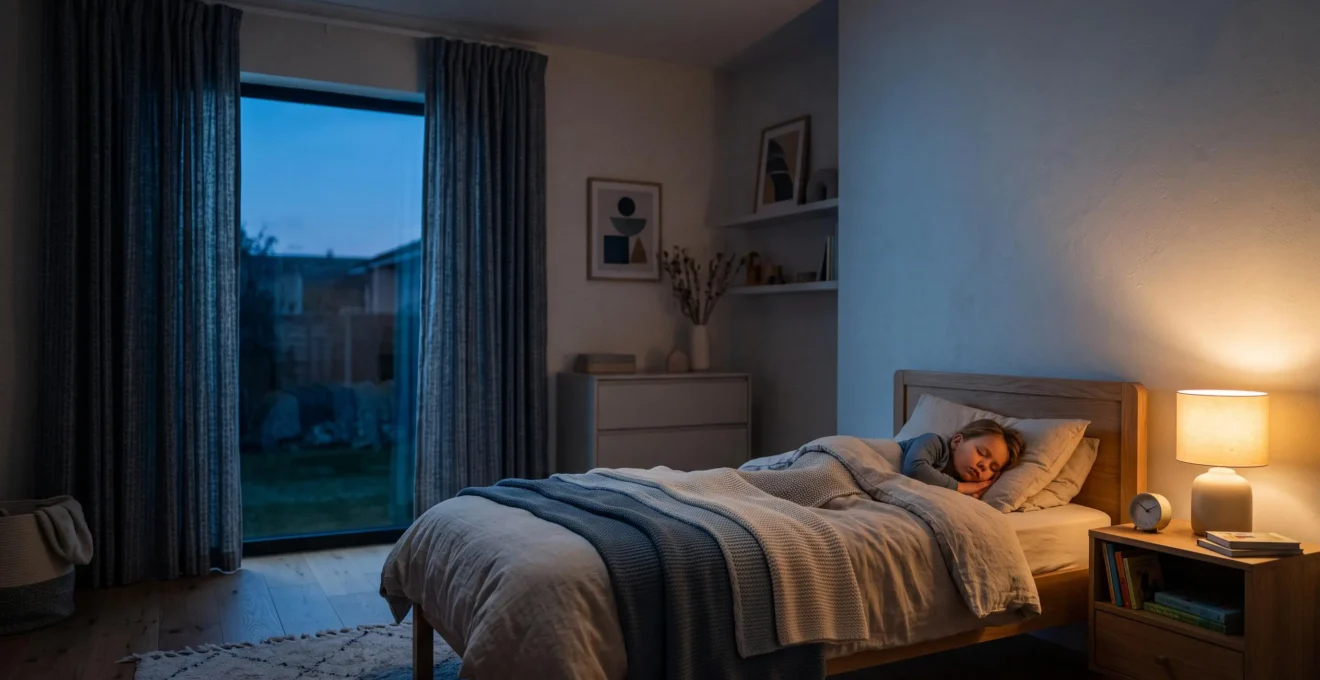
The secret to ending your child’s sleep struggles isn’t stricter rules; it’s architecting an environment that aligns with their fundamental biology.
- Sleep isn’t just behavioral; it’s hormonal. Light, temperature, and timing directly control your child’s melatonin and growth hormone production.
- Weekend lie-ins create “social jetlag,” actively disrupting the internal body clock you work to set all week.
Recommendation: Shift your focus from “sleep training” to “sleep environment design.” Prioritize managing light exposure and maintaining a consistent rhythm above all else.
If you’re an exhausted parent, the phrase “sleep hygiene” probably brings to mind a familiar, and often frustrating, checklist: a warm bath, a quiet story, a consistent bedtime. You’ve followed the rules, but your child still wakes up, battles bedtime, or rises at dawn. This cycle can leave you feeling defeated, wondering what you’re doing wrong. The common advice focuses heavily on behavioral compliance, treating sleep as a skill your child must be trained to master.
But what if the conventional approach is missing the point? The most profound improvements in a child’s sleep don’t come from enforcing routines, but from understanding and engineering their biological environment. This is about shifting your perspective from being a rule-enforcer to becoming a sleep architect. It’s less about what your child *does* and more about what their body and brain *experience* through light, temperature, and rhythm.
The key lies in aligning their surroundings with their innate biological cues, particularly their circadian rhythm and the hormones that govern sleep and growth. This guide will move beyond the platitudes to explore the science of your child’s sleep environment. We will deconstruct the powerful roles of light, timing, and regulation, providing you with the tools to create a setting that doesn’t just encourage sleep, but biologically demands it, leading to the deep, restorative rest your entire family needs.
To help you navigate these advanced concepts, this article is structured to build your expertise from the ground up. The following summary outlines the key environmental pillars we will construct together.
Summary: Sleep Hygiene for Kids: Creating the Perfect Biological Environment?
- Why Does Deep Sleep Directly Impact Your Child’s Height?
- How to Set Up a Bedroom for Sleep Success: Light and Temp?
- The Consistency Mistake: Why Weekend Lie-Ins Ruin Weekday Sleep?
- Sleep Hygiene or Sleep Training: Which Focuses on Long-Term Habits?
- How to Use Amber Bulbs to Protect Melatonin in the Evening?
- How to Use Morning Light to Shift Wake-Up Times Earlier?
- When to Apply Co-Regulation: The Critical Bedtime Window
- How to Reset a Child’s Circadian Rhythm After the School Holidays?
Why Does Deep Sleep Directly Impact Your Child’s Height?
While parents often associate good sleep with better moods and cognitive function, one of its most critical roles is physical growth. The connection isn’t just a correlation; it’s a direct biological process. The majority of a child’s daily Growth Hormone (GH) is secreted during the deepest phases of sleep, known as slow-wave sleep. When sleep is fragmented or a child fails to reach these deep stages, this crucial hormonal pulse is blunted, directly impacting their growth potential.
Insufficient or poor-quality sleep, therefore, poses a tangible risk to a child’s physical development. The link is so strong that a recent clinical study on children with sleep disorders found significantly higher rates of short stature (10.1%) and growth hormone deficiency (2.1%) compared to control groups. This isn’t just about missing a few centimetres; it’s about the body’s fundamental repair and development processes being compromised.
As one comprehensive review on the topic explains, this nightly peak in GH is essential not only for linear growth (height) but also for muscle development, tissue repair, and immune function. Viewing sleep through this biological lens reframes its importance. It’s not a luxury or a simple break; it is the primary window for the body’s most intensive construction and repair work. Ensuring your child gets consolidated, deep sleep is a direct investment in their long-term physical health and stature.
How to Set Up a Bedroom for Sleep Success: Light and Temp?
The two most powerful environmental levers for controlling sleep are light and temperature. These aren’t just comfort settings; they are direct signals to your child’s brain, telling it when to produce sleep-inducing melatonin and when to be alert. The goal is to create a “sensory blackout” that minimizes all alerting inputs. The first step is absolute darkness. A child’s brain is highly sensitive to light, and even small amounts from streetlights, hallways, or electronics can disrupt melatonin production.
This means investing in 100% blackout curtains that leave no gaps. Use black electrical tape to cover the tiny LED lights on baby monitors, air purifiers, and smoke detectors. The room should be so dark that you cannot see your hand in front of your face. This total darkness signals to the pineal gland that it is time for the deep, uninterrupted sleep needed for growth and recovery.
The second pillar is temperature. The body’s core temperature naturally needs to drop to initiate and maintain sleep. A room that is too warm can interfere with this process, leading to restlessness and night wakings. The ideal temperature for sleep is surprisingly cool, typically between 18-20°C (65-68°F). Dress your child in breathable layers (like cotton or bamboo) rather than using heavy blankets, allowing their body to regulate its temperature more effectively. A cool, dark room is the biological foundation for successful sleep.
Your Action Plan: Auditing the Sleep Environment
- Light Pollution Audit: After your child is in bed, stand in their room for 5 minutes with the door closed and lights off. Identify and list every single source of light, no matter how small (e.g., under the door, monitor LEDs, clock display).
- Blackout Implementation: For each light source identified, apply a solution. Install full-coverage blackout curtains or blinds. Use electrical tape on all electronic lights. Place a draft stopper under the door.
- Temperature Check: Place a thermometer in the room and monitor the temperature for one night. Is it consistently within the 18-20°C (65-68°F) range? Adjust the thermostat or use a fan to maintain a cool, stable temperature.
- Soundscape Assessment: Listen for disruptive noises (e.g., pipes, traffic, household sounds). Consider a white noise machine to create a consistent, masking sound floor that muffles sudden interruptions.
- Bedding & Pajama Review: Check the materials of your child’s sleepwear and bedding. Are they breathable natural fibers (cotton, bamboo, wool) or heat-trapping synthetics (polyester, fleece)? Replace synthetics to prevent overheating.
The Consistency Mistake: Why Weekend Lie-Ins Ruin Weekday Sleep?
One of the most common and damaging mistakes well-intentioned parents make is allowing different sleep schedules on weekends. The seemingly harmless “lie-in” on a Saturday morning actively sabotages the body’s internal clock, a phenomenon scientists call “social jetlag.” Your child’s circadian rhythm thrives on predictability. When you shift their wake-up time, even by an hour or two, you are essentially putting their body through the same disorientation as flying across a time zone.
This isn’t a minor disruption. A large-scale survey of nearly 20,000 students found the mean social jetlag was a staggering 1 hour and 53 minutes. Come Sunday night, their body isn’t ready for an earlier bedtime, leading to difficulty falling asleep. On Monday morning, they are forced to wake up for school while their internal clock is still in “weekend mode,” resulting in grogginess, irritability, and a dysregulated start to the week.
You might assume this is a problem for teenagers, but research shows it starts much earlier. A recent study revealed that children as young as four already exhibit substantial social jetlag, sometimes even more than their own parents. The weekend schedule shift begins to unravel circadian alignment from a very early age. To truly create a robust sleep rhythm, the wake-up time must be treated as a non-negotiable anchor, within 30 minutes every single day, including weekends and holidays. This consistency is far more powerful than a rigid bedtime.
Sleep Hygiene or Sleep Training: Which Focuses on Long-Term Habits?
The public discourse around children’s sleep is dominated by “sleep training”—methods that focus on teaching a child to fall asleep independently, often through behavioral conditioning. While these methods can be effective for some families, they frame the issue as a problem of compliance. They operate on the assumption that the child must learn a rule. True, sustainable sleep hygiene, however, takes a different approach. It focuses on creating an environment that fosters biological regulation, not just behavioral conformity.
This is a crucial distinction. Sleep training is often about managing a child’s protests in the short term. Environmental sleep hygiene is about designing a system that makes sleep the natural, inevitable outcome in the long term. It addresses the root causes—hormonal imbalances and circadian misalignments—rather than just the symptom of night waking. It asks, “What in this child’s environment is preventing their body from doing what it’s designed to do?” instead of, “How can I make this child stay in their bed?”
This philosophy prioritizes creating a nervous system that feels safe and ready for sleep. It’s about ensuring the biological signals for sleep (darkness, coolness, low cortisol) are so strong and consistent that the body has no choice but to surrender to rest. As the experts at Little Live Wires eloquently put it in their guide on emotional regulation and sleep:
Design for regulation, not compliance.
– Little Live Wires, Emotional Regulation and Sleep: A Nervous System Guide
This single sentence captures the essence of a biological approach. By focusing on the environmental and emotional inputs that regulate a child’s nervous system, you build a resilient foundation for a lifetime of healthy sleep habits, moving beyond the endless cycle of training and retraining.
How to Use Amber Bulbs to Protect Melatonin in the Evening?
Light is the most powerful signal controlling the circadian rhythm, and not all light is created equal. The blue and green wavelengths, abundant in standard LED bulbs, overhead lights, and all screens, are particularly effective at suppressing the production of melatonin—the hormone that signals “nighttime” to the brain. For a child, whose eyes and brain are still developing, this effect is dramatically amplified. In fact, research comparing children and adults found that a given amount of evening light exposure suppressed melatonin twice as much in children.
This means that the “dimly lit” hour before bed might still be flooding your child’s brain with a powerful “wake up” signal, delaying sleep onset and leading to bedtime battles. The solution is to strategically manage the color of your light in the 60-90 minutes before bedtime. This is where amber or red light bulbs become an essential tool. These bulbs are specifically designed to filter out the disruptive blue and green spectrum, emitting only warm, non-stimulating light.
The science backing this is clear. A controlled study directly compared the effects of cool, blue-enriched LED light with warmer tones on children at night. The results showed significantly greater melatonin suppression under the cooler light. By swapping out the bulbs in bedside lamps and overhead fixtures in the bedroom and bathroom for true amber-toned ones, you create a “circadian-safe” bubble for the evening routine. This simple environmental change allows melatonin to rise naturally, preparing the brain for an easy transition to sleep without a fight.
How to Use Morning Light to Shift Wake-Up Times Earlier?
Just as evening light can delay sleep, morning light is the powerful “on” switch for the circadian rhythm. Getting bright light exposure within the first 30-60 minutes of waking is the single most effective way to anchor the entire 24-hour body clock. This morning light signal does two critical things: it shuts down any lingering melatonin production to promote immediate alertness, and it starts a countdown timer that helps regulate the timing of melatonin release that evening, which builds sleep pressure for bedtime.
This connection is not just theoretical. A study that used wearable sensors to track children’s daily light exposure found a direct link: earlier bright light exposure in the day was linked to shorter delays in falling asleep at night for the 247 children tracked. For parents struggling with children who wake too late (a common issue with older kids and teens) or who take a long time to fall asleep, a deliberate morning light routine is a game-changer.
This doesn’t have to be complicated. The goal is to get 10-15 minutes of direct, unfiltered sunlight as soon as possible after waking. This could mean eating breakfast by a large, sunny window (with the window open, as glass filters some crucial wavelengths), a short walk around the block, or simply playing on a porch or balcony. On dark or cloudy winter mornings, a “light therapy” lamp (10,000 lux) placed on the breakfast table can serve the same purpose. By making bright morning light a non-negotiable part of the routine, you are setting the master clock that governs the entire sleep-wake cycle.
When to Apply Co-Regulation: The Critical Bedtime Window
While the physical environment is foundational, sleep is also deeply emotional. A child cannot enter a state of rest if their nervous system is in a state of fight, flight, or freeze. This is where co-regulation—the process of a caregiver lending their calm nervous system to a child to help them manage big emotions—becomes a critical component of sleep hygiene. The “critical bedtime window” is the 30-45 minutes before sleep, a time when a child’s “sleep pressure” is high but their cognitive control is low, making them more susceptible to anxiety or overstimulation.
During this window, a child who is feeling disconnected, anxious about separation, or over-tired can easily become dysregulated. Their protests or “stalling” tactics are not acts of defiance but a cry for connection and help calming their internal state. Responding with frustration or rigid enforcement of rules only adds fuel to their stress fire, increasing cortisol and actively working against sleep. The correct response is to proactively offer calming, connecting presence.
This can look like a slow, rhythmic back rub, humming a low-toned song, deep pressure hugs, or simply sitting quietly beside them and taking slow, audible breaths. You are not “giving in”; you are providing the external regulation their developing brain cannot yet provide for itself. While regulation disorders are complex, a German clinical study on parent-child regulation highlights how common these challenges are, with about 3.4% of infants showing signs of multiple regulation difficulties. Co-regulation is the antidote, creating the felt sense of safety that is a biological prerequisite for sleep.
Key Takeaways
- Your child’s sleep is primarily driven by biological cues (light, temperature), not behavioral rules.
- Consistency in wake-up time, even on weekends, is more critical than a rigid bedtime for stabilizing the circadian rhythm.
- The color of light matters: use amber/red light in the evening to protect melatonin and bright, natural light in the morning to anchor alertness.
How to Reset a Child’s Circadian Rhythm After the School Holidays?
The end of school holidays often brings a dreaded sleep challenge: the child’s internal clock has drifted later, making the return to early school mornings a painful battle. Resetting their circadian rhythm requires a strategic, multi-pronged approach using the very principles we’ve discussed. It’s not about a single quick fix but a concerted effort to realign their biology with the new schedule. The key is to act decisively and consistently in the 3-5 days leading up to the return to school.
The most powerful tool for this reset is a strict light schedule. Begin shifting the wake-up time 15-30 minutes earlier each day. Crucially, upon waking, expose your child to bright morning light immediately for at least 15-20 minutes. This powerful signal will help advance their body clock. In the evening, be hyper-vigilant about light hygiene. Implement a strict “sensory blackout” 90 minutes before the desired bedtime, using only dim, amber lighting and absolutely no screens. This combination of a strong morning “on” signal and a clear evening “off” signal will help their rhythm shift faster.
However, it’s important to have realistic expectations. A study examining the use of bright light to advance adolescent circadian rhythms found that a blanket approach isn’t always a silver bullet, suggesting that protocols must be carefully designed. Maintain all other sleep hygiene pillars: keep the room cool, offer a protein-rich snack before bed to stabilize blood sugar, and use co-regulation to manage any anxiety about the return to school. By layering these environmental and emotional strategies, you can guide their body clock back on track gently but effectively.
Begin today by auditing and redesigning your child’s sleep environment. By focusing on these biological principles, you can move beyond nightly struggles and architect a space that fosters the deep, restorative rest they need to thrive.