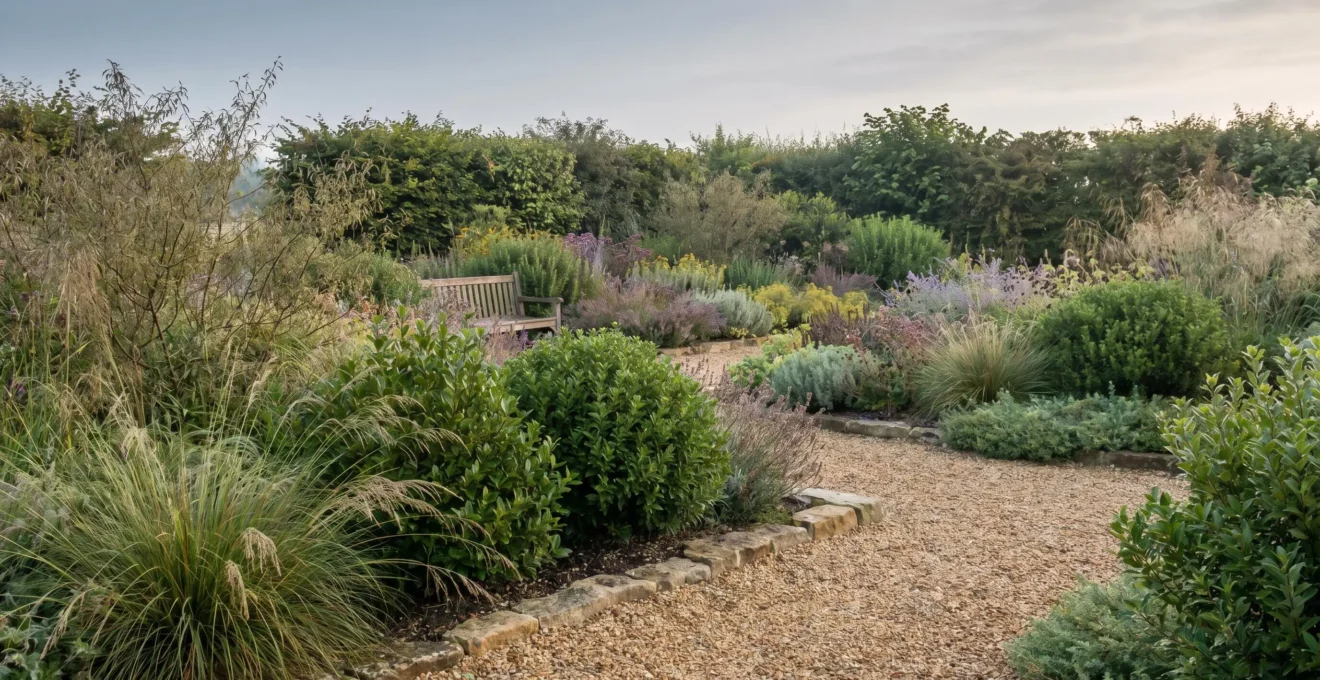
The key to a truly drought-proof garden isn’t just choosing the right plants; it’s designing a permanent ‘living backbone’ of native species that functions as a self-regulating ecosystem.
- Native hedges and shrubs build a structural framework that improves soil, supports biodiversity, and drastically cuts long-term water needs.
- Fast-growing, non-native plants often create an “ecological debt,” depleting soil and water resources while offering little value to local wildlife.
Recommendation: Shift your focus from individual plant survival to designing a cohesive garden system that is water-wise by design, starting with its structural softscape.
For environmentally conscious homeowners, particularly in the water-stressed South East of England, the recurring threat of a hosepipe ban turns garden maintenance into a source of anxiety. The common response is a reactive scramble for “drought-tolerant” plants, turning gardens into a patchwork of hardy survivors. We’re told to mulch heavily and water deeply, but these are merely coping mechanisms for a garden not fundamentally designed to thrive in our changing climate. This approach overlooks the most powerful tool at our disposal: strategic, long-term design.
What if the solution wasn’t found in last-minute fixes, but in establishing a permanent, structural framework for your garden? The true path to a resilient, low-water landscape is to think like a sustainable architect. It involves creating a ‘living backbone’—a carefully selected softscape of native hedges, shrubs, and perennial layers that works as a cohesive ecosystem. This framework doesn’t just survive drought; it actively manages water, improves soil health, and creates a thriving habitat.
This article moves beyond the platitudes of water-wise gardening. We will deconstruct the principles of designing this sustainable softscape backbone. We’ll explore why native species are structurally superior, how to work with challenging soils, and how to apply systems-level thinking like permaculture to create a garden that is not only beautiful and resilient but also a net positive for your local environment.
This guide provides a complete blueprint for rethinking your garden’s structure. Below is a summary of the core principles we will cover, from selecting foundational plants to integrating advanced ecological concepts for a truly sustainable suburban landscape.
Summary: Building a Resilient, Water-Wise Garden Framework
- Why Native Hedges Outperform Conifers in Drought Conditions?
- How to Establish a ‘Dry Garden’ Backbone in Chalky Soil?
- Evergreen or Deciduous: Which Supports More Biodiversity Year-Round?
- The ‘Fast-Growing’ Shrubs That Will Destroy Your Garden’s Ecosystem
- Calculating the Carbon Footprint of Your Garden Hedges
- Are Drip Systems Legal During a Hosepipe Ban?
- Nettle and Dock: Can You Incorporate Them Without It Looking Messy?
- Applying Permaculture Principles to a Standard Suburban Garden?
Why Native Hedges Outperform Conifers in Drought Conditions?
The conventional choice for a quick privacy screen, the conifer hedge, is often a poor investment in a water-wise garden. While seemingly robust, these monocultures function as ‘biodiversity dead zones’ and lack the deep ecological resilience of native hedgerows. The superiority of native species lies in their complex, underground partnerships. In fact, specific research has demonstrated that over 70% of plant species associate with arbuscular mycorrhizal (AM) fungi. This symbiotic network dramatically extends a plant’s root system, allowing it to access water and nutrients far beyond its physical reach, a critical advantage during drought.
Conifers, especially in dense, single-species plantings like leylandii, fail to foster this rich subterranean life. They create a sterile environment, both below and above ground. A meta-analysis of Japanese conifer plantations confirmed this, finding that species richness in cypress family plantations was significantly lower than in natural forests. A mixed native hedge, by contrast, acts as a living ecosystem. It includes species like Hawthorn, Blackthorn, and Holly, which have evolved for millennia in the UK climate. Their varied root structures, leaf-fall cycles, and flowering times create a dynamic habitat that supports a web of insects, birds, and small mammals, forming a resilient ‘ecological scaffolding’ that conifers simply cannot replicate.
By choosing a mixed native hedge as your garden’s backbone, you are investing in a system that builds its own resilience. It actively improves the soil, fosters beneficial microbial life, and provides food and shelter for wildlife, all while requiring significantly less water once established. It’s a shift from a high-maintenance screen to a low-input, high-value ecological asset.
How to Establish a ‘Dry Garden’ Backbone in Chalky Soil?
Gardening on the chalky soils common across the South East presents a unique challenge: superb drainage that becomes a liability during dry spells, as water and nutrients quickly leach away. The secret to establishing a ‘dry garden’ backbone here is not to fight the soil’s nature, but to embrace it with the right techniques and plant choices. The goal is to create a system that slows moisture loss and builds fertility over time, transforming free-draining soil into a reservoir for your plants.
A core technique is the use of a gravel or stone mulch, a method perfectly suited to alkaline-loving plants. Unlike organic mulches that can retain too much moisture around the crowns of Mediterranean species and decompose quickly, a 2-3 inch layer of gravel acts as a barrier. It suppresses weeds, prevents the top layer of soil from baking in the sun, and dramatically reduces evaporation. This creates a more stable root environment where plants can thrive. As the Royal Horticultural Society advises for these conditions:
The key to gardening in these often drought-prone and nutrient poor soils is to select from the wide range of colourful plants that thrive in dry summers, need sharp drainage and moderate to low fertility.
– Royal Horticultural Society, RHS Advice on Chalky Soils
This approach is visualized below, showing how angular gravel creates a protective layer over the chalky substrate, allowing architectural, drought-loving plants to establish themselves successfully.
When establishing your backbone, incorporate plants adapted to these conditions. Think of silvery-leaved species like Lavender, Santolina, and architectural Euphorbias. Their foliage is a natural adaptation to reflect sunlight and reduce water loss. By combining the right plants with the right mulching technique, you create a garden that is water-wise by design, turning the challenge of chalky soil into an aesthetic and ecological advantage.
Evergreen or Deciduous: Which Supports More Biodiversity Year-Round?
The question of whether an evergreen or deciduous backbone is ‘better’ presents a false choice. A truly resilient and biodiverse softscape relies on the strategic integration of both. Each type provides essential, but different, ecological services throughout the year. A garden composed solely of evergreens offers consistent screening but can be a monotonous habitat, while a purely deciduous garden leaves wildlife exposed during the critical winter months.
Evergreens, like Holly (Ilex aquifolium) or Yew (Taxus baccata), provide the permanent structural framework. They are the essential winter shelters, offering crucial protection from harsh weather for nesting birds and overwintering insects like ladybirds and lacewings. This year-round cover is the ‘scaffolding’ upon which the rest of the garden’s ecosystem is built. However, the real magic happens when you weave deciduous species into this evergreen matrix. Deciduous plants like Hawthorn (Crataegus monogyna) and Dog Rose (Rosa canina) offer a dynamic sequence of resources: spring blossoms for early pollinators, a dense summer canopy for shade and nesting, and autumn fruits and berries that fuel migratory birds and small mammals.
This layered approach creates a habitat rich in structural variety, which is paramount for wildlife. In fact, a comprehensive UK biodiversity study revealed that 60% of priority species depend on the tree layer and 56% on the shrub layer of hedges. By combining plant heights and forms—from low-growing groundcover to tall shrubs—you create a multitude of microclimates and niches. This combination of evergreen shelter and deciduous resources ensures your garden’s ‘living backbone’ is a functioning, supportive ecosystem 365 days a year.
The ‘Fast-Growing’ Shrubs That Will Destroy Your Garden’s Ecosystem
In the quest for a quick garden fix, the allure of a ‘fast-growing’ shrub is powerful. Marketers promise instant privacy and lush greenery, but this quick reward often comes at a steep, hidden cost. Many of these aggressive growers, particularly non-native species, establish an ‘ecological debt’ in your garden. Instead of contributing to a healthy ecosystem, they actively degrade it by outcompeting native flora, depleting soil resources, and offering little to no value for local wildlife.
Invasive species like Rhododendron ponticum or Buddleja davidii (in certain contexts) spread rapidly, creating dense, light-blocking canopies and aggressive root systems that choke out more delicate native plants. This underground battle is where the real damage occurs. The root systems of these invaders monopolize water and nutrients, effectively starving their neighbours and creating a sterile monoculture. The illustration below captures this hidden drama, showing how the dominant, fibrous roots of an invasive shrub can displace and inhibit the growth of beneficial native species, leading to soil depletion and a loss of biodiversity.
These plants may look green, but they are often ecological deserts. Their leaves may be unpalatable to local insects, breaking a crucial link in the food web. A caterpillar that cannot feed on a non-native leaf is one less meal for a nesting blue tit. The result is a garden that is superficially lush but functionally broken. The short-term gain of rapid growth is traded for the long-term loss of resilience, biodiversity, and soil health. Building a sustainable softscape backbone requires patience and a commitment to choosing species that give back more than they take, slowly weaving a rich, interconnected web of life rather than rolling out a sterile green carpet.
Calculating the Carbon Footprint of Your Garden Hedges
As responsible gardeners, our thinking must expand beyond just water usage to encompass the total environmental impact of our choices—a concept we can call the ‘Carbon & Water Ledger’. Every element of a garden, especially its structural backbone, has a footprint. This includes the ‘plant miles’ from nursery to garden, the emissions from maintenance, and the water required over its lifetime. For instance, according to water conservation research, landscape irrigation can account for as much as 50% of total household water use. A hedge that requires constant watering and trimming with gas-powered tools is a significant environmental liability.
Conversely, a well-designed native hedge is a powerful carbon sink. Its dense foliage absorbs CO2 from the atmosphere, and its deep root system helps sequester carbon in the soil. The key is to make conscious choices that minimize the debits and maximize the credits on your garden’s ledger. This means sourcing plants from local nurseries to reduce transport emissions, favouring manual or electric tools over fossil-fuel-powered ones, and, most importantly, choosing species that won’t require a lifetime of intensive irrigation and trimming.
Thinking about your hedge in these terms transforms it from a simple boundary marker into a dynamic part of your personal climate action plan. An audit of your hedge’s carbon footprint can reveal surprising areas for improvement. It’s about shifting the balance from high-input, high-emission maintenance to low-input, high-sequestration growth.
Your Action Plan: Hedge Carbon Assessment Framework
- Calculate Embodied Carbon: Track the production and transport carbon footprint by sourcing locally-grown native species from regional nurseries within 50 miles to minimize ‘plant miles’.
- Assess Operational Carbon: Quantify maintenance emissions by switching from gas-powered hedge trimmers to manual shears or electric tools, and eliminate synthetic fertilizers in favor of compost.
- Measure Sequestration Potential: Allow hedges to grow fuller with less frequent trimming (e.g., once or twice yearly) to maximize leaf surface area and carbon storage capacity.
- Factor in Lifecycle Water Usage: Choose native hedge species that become self-sufficient after establishment, avoiding non-natives that demand increasing irrigation as they mature.
- Optimize Trimming for Ecology: Reduce trimming frequency to allow for flowering and fruiting, which increases both carbon sequestration and ecological value while decreasing tool-related emissions.
Are Drip Systems Legal During a Hosepipe Ban?
During a hosepipe ban (officially a Temporary Use Ban), the rules can feel confusing. While using a hose for watering the garden is typically prohibited, the regulations often make specific exceptions for more efficient methods. Drip or trickle irrigation systems are frequently permitted, albeit sometimes with restrictions on timing (e.g., only overnight). The reason is simple: they are fundamentally different from wasteful sprinklers or hand-held hoses. These systems are water-wise by design, delivering water directly to the plant’s root zone with minimal loss to evaporation or runoff.
Water companies recognise this efficiency. The goal of a ban is to curb water waste, not to kill established gardens. Therefore, systems that demonstrate responsible water use are often allowed. However, it is crucial to check the specific rules set by your local water supplier (e.g., Thames Water, Southern Water) when a ban is enacted, as details can vary. The following table, based on data from sources like the University of Nebraska’s guide on sustainable landscapes, compares the efficiency and typical legal status of common irrigation methods during drought conditions.
| Irrigation Method | Water Efficiency Rating | Installation Cost | Maintenance Requirements | Drought Suitability | Typical Legal Status During Bans |
|---|---|---|---|---|---|
| Drip Irrigation System | 85-95% efficient (direct root zone delivery) | Moderate to High ($200-800 for average garden) | Regular checking for leaks and clogs | Excellent – minimal evaporation loss | Usually permitted with restrictions on timing |
| Soaker Hose | 70-90% efficient (some surface evaporation) | Low ($50-150 for average garden) | Seasonal inspection and storage | Very Good – porous delivery reduces waste | Generally permitted in most ban scenarios |
| Olla Pot (Buried Clay) | 90-95% efficient (underground seepage) | Low to Moderate ($30-200 depending on coverage) | Minimal – periodic refilling | Excellent – zero evaporation, ancient technique | Almost always permitted (hand-filled container) |
| Hand Watering with Hose | 40-60% efficient (high evaporation and runoff) | Very Low ($20-50) | None | Poor – labor intensive, uneven coverage | Usually prohibited during hosepipe bans |
| Sprinkler System | 40-75% efficient (significant evaporation) | Moderate ($100-400) | Seasonal adjustments and winterization | Poor – high water waste in hot conditions | First to be banned during water restrictions |
Ultimately, a garden with a well-designed softscape backbone should rarely need supplemental watering after its first few years. Drip irrigation is a valuable tool for establishment, but the long-term goal is to create a system that thrives on natural rainfall alone.
Nettle and Dock: Can You Incorporate Them Without It Looking Messy?
The very mention of nettles (Urtica dioica) and docks (Rumex obtusifolius) can make a tidy gardener shudder. We’ve been conditioned to see them as enemies to be eradicated. Yet, from an ecological perspective, these native ‘weeds’ are powerhouse plants. Nettles are a primary food source for the caterpillars of beautiful butterflies like the Red Admiral and Peacock. Docks, with their deep taproots, are excellent at drawing up nutrients from the subsoil. The challenge isn’t their existence, but their integration. The key is a concept of ‘managed wildness’—applying design principles to frame and contain these plants, transforming them from chaotic invaders into intentional, valuable features.
Instead of letting them run rampant, you can create deliberate ‘wildlife zones’. One effective technique is using physical borders. A crisp Corten steel or simple metal edge creates a geometric frame, turning a patch of nettles into a living sculpture. This visual cue tells the observer, “This is here on purpose.” Another method is ‘gravel framing’, where a wide border of gravel mulch surrounds the patch, creating a clean, defined edge that also acts as a physical barrier to prevent spreading.
You can also soften their appearance through companion planting. Weaving ornamental grasses or ferns around a stand of broad-leaved dock creates a beautiful textural contrast that integrates it into a more conventional planting scheme. By giving these plants a designated place and a clear boundary, you harness their immense ecological benefits without sacrificing garden aesthetics. It’s about shifting perception from ‘messy’ to ‘purposefully wild’.
Key Takeaways
- A garden’s drought resilience comes from its structural design (the ‘living backbone’), not just individual plant choices.
- Native, mixed-species hedges are ecologically and structurally superior to non-native monocultures like conifers.
- Designing for your specific conditions, like chalky soil, and viewing the garden as a complete system (permaculture) are essential for long-term sustainability.
Applying Permaculture Principles to a Standard Suburban Garden?
Permaculture can sound like an intimidating, large-scale concept reserved for rural homesteads, but its core principles are perfectly applicable—and incredibly powerful—in a standard suburban garden. At its heart, permaculture is about smart design. It’s about observing how natural ecosystems work and applying those patterns to create a garden that is productive, self-regulating, and resilient. It’s the ultimate expression of creating a garden that is water-wise by design.
One of the most accessible principles is ‘zoning’. This involves placing garden elements based on how frequently you need to access them. Zone 1, right by the back door, is for daily-use items like culinary herbs and salad greens. Zone 2, a little further out, might house your main vegetable beds. Zone 3, at the property margins, could be for your ‘backbone’ elements like fruit trees and berry hedges that only need seasonal attention. This simple layout saves time and energy, making the garden more efficient to manage.
Another key principle is ‘stacking functions’, where every element serves multiple purposes. A native hedge isn’t just a boundary (function 1); it’s a wildlife habitat (function 2), a windbreak (function 3), and a source of berries (function 4). A rain garden disguised as an attractive flower bed captures stormwater (function 1) while providing a habitat for moisture-loving plants and pollinators (function 2). As the University of Nebraska Extension notes in their guide on the topic:
Sustainable landscaping practices not only conserve water but also reduce maintenance, promote biodiversity, and create resilient ecosystems.
– University of Nebraska Extension, Water Conservation & Sustainable Landscapes Guide
By applying these principles, you transform a collection of individual plants into an intelligent, interconnected system. You begin to work with nature, not against it, creating a suburban garden that is less of a chore and more of a thriving, productive ecosystem.
By adopting this architectural approach, you can design a garden that not only survives but thrives in a changing climate. The next logical step is to begin observing your own space and planning the foundational elements of your own resilient, living softscape backbone.