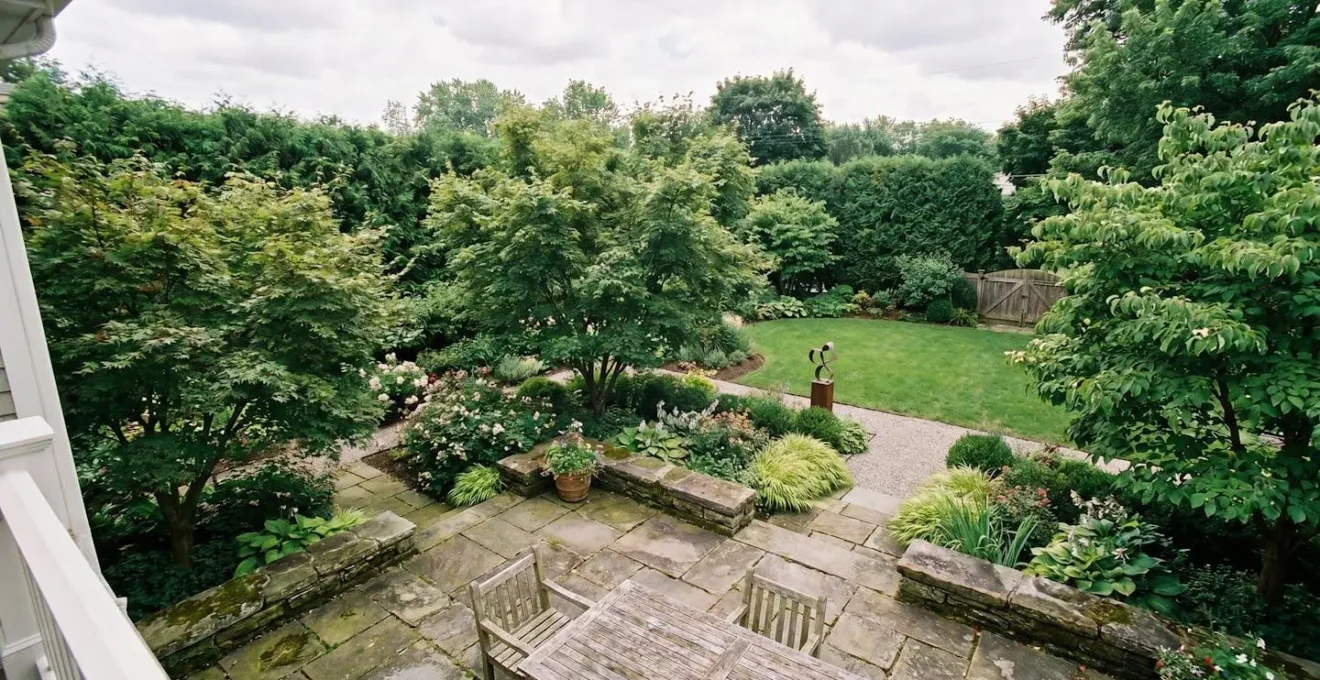
The biggest mistake homeowners make is treating their garden as a decoration; the biggest gains come from managing it as a long-term financial asset.
- Prioritising hardscaping and infrastructure *before* planting can prevent the loss of 30-50% of your vegetation investment.
- Slow-growing, resilient plants offer a higher long-term “Maturity ROI” by drastically reducing annual maintenance costs over a decade.
Recommendation: Develop a professional master plan before spending a single pound. This document is the single most important investment, saving thousands by preventing redundant work, even if you build in stages.
For homeowners looking to maximise their property’s value, the focus often lands on kitchens and bathrooms. The garden, meanwhile, is frequently viewed as a recurring expense or a candidate for a quick, cosmetic fix before a sale. Common advice centres on a pre-sale “curb appeal” blitz: a splash of colourful annuals, a freshly mown lawn, and perhaps a new patio set. This approach treats the garden as a static decoration, a cost to be managed rather than an asset to be grown.
But what if the most significant financial returns weren’t in what you add, but in the catastrophic future costs you strategically avoid? What if the true value lies not in a weekend makeover, but in a deliberate, five-year plan that treats your outdoor space as a maturing financial asset? This is the core of long-term garden strategy. It’s a shift in mindset from short-term aesthetics to long-term capital appreciation, where decisions about soil, structure, and species are guided by a financial roadmap.
This guide moves beyond simple gardening tips. We will deconstruct the garden into a series of strategic investment decisions. We will analyse the correct, most cost-effective order of operations, evaluate plants based on their 10-year maintenance liability, design spaces with a built-in lifecycle, and determine where professional investment yields the highest return. This is your roadmap to transforming a plot of land from a liability into a high-performing asset that grows in value every single year.
To navigate this strategic approach, we have broken down the key financial and planning considerations. This framework will guide you through the critical decisions that ensure every pound invested in your garden contributes directly to your property’s long-term value.
Summary: A Strategic Investor’s Guide to Landscape Value
- Why Planting Trees Too Close to the House Costs £5,000 later?
- Hardscaping First or Planting First: The Most Cost-Effective Order
- Fast vs Slow Growers: Which Saves More Maintenance Time Over 10 Years?
- Designing a Garden That Evolves From Play Area to Entertaining Space
- When to Start Major Earthworks to Avoid Ruining Summer Use?
- Why a Master Plan Saves Money Even if You Build in Stages?
- High Hedges Act: When Does Your Privacy Screen Become Illegal?
- Professional Landscape Design vs DIY: Where to Spend Your Budget?
Why Planting Trees Too Close to the House Costs £5,000 later?
One of the most common and costly mistakes in landscape planning is misjudging the future. A small, charming sapling planted for a touch of greenery can become a significant financial liability within a decade. The primary danger lies in root systems, which relentlessly seek water and can invade and destroy foundational structures, plumbing, and pathways. This isn’t a minor inconvenience; it’s a structural threat that can lead to devastating repair bills.
The financial implications are severe. A single tree root intrusion can compromise the integrity of a home’s foundation, leading to cracks, subsidence, and water damage. According to foundation repair specialists, the cost to remedy this type of damage can range anywhere from $2,000 to $10,000, and often more. This figure doesn’t even include the cost of removing the offending tree or repairing the landscape afterwards. It’s a classic example of a short-term aesthetic choice creating a long-term, high-cost problem—the exact opposite of strategic asset management.
The solution is proactive spatial planning. Before a single tree is purchased, its mature size must be considered. As a general rule, a tree should be planted at a distance from the foundation equal to its expected mature height. This requires research into the specific species. For practical planning, follow these guidelines:
- Small trees (maturing under 25 feet): Plant at least 10-15 feet away from the house.
- Medium trees (25-40 feet): Maintain a 15-20 feet distance.
- Large trees (over 40 feet): Keep them a minimum of 20-30 feet from any structure.
This simple due diligence transforms tree planting from a gamble into a calculated investment. By respecting the future growth of your living assets, you ensure they add aesthetic and monetary value without threatening the very structure they are meant to enhance.
Hardscaping First or Planting First: The Most Cost-Effective Order
When developing a garden from scratch or undertaking a major renovation, the sequence of operations is not a matter of preference—it’s a critical factor in budget control. The question of whether to install hardscaping (patios, paths, walls) or planting first has a clear, financially sound answer: hardscaping and all major construction must be completed before a single plant goes into the ground. Reversing this order is a direct path to budget overruns and wasted resources.
The logic is brutally practical. Installing patios, retaining walls, and underground utilities requires heavy machinery, extensive excavation, and significant foot traffic. This process is inherently destructive to the surrounding environment. If delicate plants, new turf, or irrigation systems are already in place, they will inevitably be damaged or destroyed. In fact, landscaping professionals warn that this sequencing error can lead to a 30-50% increase in plant replacement costs, effectively forcing you to pay for the same assets twice.
Imagine heavy equipment needing access to the rear of the property after a pristine new lawn and perennial beds have been installed. The only options are to risk destroying thousands of pounds of new landscaping or to incur massive labour costs by moving all remaining materials by hand. This visualises why the construction phase must have unrestricted access.
As the image illustrates, creating a solid, well-drained base for hardscaping is an industrial process. The optimal order of operations is designed to contain this disruption and build the garden from the ground up, moving from large-scale disruption to fine detail. A professional workflow always follows this sequence:
- Major earthworks, grading, and underground utilities.
- Structural elements like retaining walls.
- All hardscaping, including patios and walkways.
- Irrigation and drainage systems.
- Final soil preparation and, lastly, planting.
By adhering to this sequence, you treat the project like a professional construction site, ensuring that each phase builds upon the last without causing expensive, redundant work. It is the cornerstone of efficient capital deployment in landscape development.
Fast vs Slow Growers: Which Saves More Maintenance Time Over 10 Years?
In our pursuit of instant gratification, the appeal of fast-growing plants is undeniable. They promise rapid screening, quick establishment, and an immediate “finished” look. From a strategic financial perspective, however, this rapid growth often represents a long-term liability, not an asset. The true measure of a plant’s value is not its initial growth rate, but its total cost of ownership over a decade, and this is where slow growers provide a superior return on investment.
Fast-growing species are often characterised by weak wood, invasive root systems, and a constant need for pruning, watering, and feeding to maintain their health and appearance. Their rapid metabolism makes them less resilient. A study comparing slow-growing perennials to fast-growing invasive species found that the slow-growing species possess traits that make them far more resilient to environmental stressors like drought and nutrient-poor soil. Fast growers, despite their initial vigour, are more vulnerable and require more resources to thrive under challenging conditions, making them a high-maintenance investment.
This principle has been leveraged to create commercial products with a clear financial benefit. For instance, a specific patented zoysiagrass cultivar was developed specifically for its slow growth rate. The patent documentation highlights the direct economic advantage:
Since the newly developed ‘TMX’ advantageously has a very slow growing rate in terms of plant height as compared with conventional cultivars, mowing is required not more than once a year to maintain fair condition and the amount of fertilizer can be in reduced to almost less than half.
– USPTO Plant Patent Documentation, Zoysiagrass plant ‘TMX’ patent filing
This demonstrates the core concept of “Maturity ROI”: the return comes from reduced operational expenditure. A hedge that needs trimming once a year instead of four times saves significant labour costs. A lawn that requires less mowing, fertilising, and watering directly lowers your annual budget. Choosing slow-growing, site-appropriate plants is a deliberate strategy to minimise future maintenance liabilities.
While the initial impact may be less dramatic, a garden built on a foundation of resilient, slow-growing plants will mature into a stable, low-maintenance, and therefore more valuable asset over the long term. It’s the difference between buying a high-maintenance sports car and a reliable, low-cost utility vehicle; both get you there, but one costs far less to keep on the road.
Designing a Garden That Evolves From Play Area to Entertaining Space
A property’s value is enhanced by its ability to meet the needs of its occupants. For homeowners with a 5-to-10-year plan, those needs will inevitably change. A garden designed for toddlers will be obsolete by the time they are teenagers. A truly strategic garden plan anticipates this “asset lifecycle” and builds in the flexibility to evolve, ensuring the space remains a valuable asset at every stage of family life without requiring costly, complete overhauls.
The key is to separate the underlying, permanent infrastructure from the temporary, age-specific features. A common scenario is the transition from a children’s play area to an adult entertaining space. A strategic approach plans for this from day one. Instead of simply placing a swing set on the lawn, you design a dedicated zone with a robust, multi-purpose base. For example, the foundation for a toddler’s sandbox can be built to the exact dimensions of a future fire pit seating area. When the time comes, the sand is removed, and pavers are installed on the already-prepared base—a simple, low-cost conversion instead of a major new construction project.
This “modular base” concept is a prime example of future-proofing. It allows the garden’s function to change while preserving the initial investment in excavation, grading, and foundation work. This lifecycle adaptation can be planned in phases:
- Years 1-5 (Toddler Zone): A designated area with soft surfacing like rubber mulch over a prepared, level base. The key is visibility from the house and safety.
- Years 6-12 (Active Play): The same base is repurposed for larger climbing structures. The “soft fall” area might be expanded, but the core location remains.
- Years 13+ (Entertainment Zone): The play equipment is removed, and the base is converted into a patio, fire pit area, or foundation for an outdoor kitchen.
This approach treats the garden not as a static picture, but as a flexible platform. The initial investment in a well-built, strategically located base pays dividends for years to come, allowing for seamless and cost-effective transformations that keep the garden relevant and valuable.
By planning for the entire lifecycle of your family’s use of the garden, you are embedding value into the very structure of the landscape. It becomes an asset that adapts and grows with you, always contributing to your quality of life and, ultimately, your property’s sale price.
When to Start Major Earthworks to Avoid Ruining Summer Use?
Timing is a critical, and often overlooked, strategic element in landscape project management. For major earthworks—the most disruptive phase of any garden renovation—the decision of when to start involves a trade-off between contractor availability, weather conditions, and the impact on your family’s enjoyment of the property. Starting a project at the wrong time of year can extend timelines, increase costs, and completely eliminate the use of your garden during its peak season.
The most common desire is to have a new garden ready *for* summer, which leads many to plan for a spring start. However, spring is also the busiest season for contractors, meaning demand is high, and timelines can easily stretch. A two-week project can quickly become a four-week one due to weather delays and scheduling conflicts, pushing construction well into June and July. This completely negates the goal of enjoying the space during the best months.
A strategic analysis reveals that the optimal time for major structural work is often the fall. Kicking off a project in September or October means the primary disruption occurs after the peak summer season has passed. While there is a risk of weather delays from fall rains, the ground is still workable, and it is an ideal time for planting new trees and shrubs, allowing their root systems to establish over the winter. This approach “sacrifices” the fall to “gain” a fully completed and usable garden for the following spring and summer.
Each season presents a different set of financial and lifestyle trade-offs. The following analysis breaks down the strategic considerations for timing major earthworks, as informed by landscaping professionals:
| Season | Advantages | Disadvantages | Best For |
|---|---|---|---|
| Spring | Ideal growing weather for plant establishment; soil workable after thaw | High contractor demand extends timelines 2-3 weeks; race against summer deadline | Projects requiring immediate planting after construction |
| Summer | Dry ground conditions; stable soil for excavation | Maximum disruption to family garden enjoyment; intensive watering required for new plants | Hardscape-only projects; families with alternative outdoor space |
| Fall | Less impact on summer use; excellent for tree and shrub planting; moderate contractor availability | Risk of early freezes; muddy conditions from fall rains; shorter working days | Long-term structural projects; tree planting programs |
| Winter | Lowest contractor rates; dedicated project focus | Weather delays common; limited to hardscape in mild climates; no planting possible | Planning phase; hardscape in temperate regions |
By consciously choosing your start date based on these strategic factors rather than simply “when you can get to it,” you take control of the project’s impact on both your wallet and your quality of life. This is the mark of a savvy property investor.
Why a Master Plan Saves Money Even if You Build in Stages?
The single most valuable asset in any long-term garden project is not a plant or a paver; it is the master plan. For homeowners planning to develop their garden in phases over several years, the temptation is to tackle projects piecemeal without an overarching design. This is a critical financial error. A comprehensive master plan, created upfront, is an investment that pays for itself many times over by eliminating redundant work, preventing costly mistakes, and ensuring every pound spent contributes to a cohesive and valuable final product.
Without a master plan, sequencing becomes a matter of improvisation, which inevitably leads to disaster. The cost of redundant work can be astronomical.
Case Study: The Cost of Poor Sequencing
A landscape planner documented a project where a homeowner, lacking a master plan, installed a beautiful £10,000 stone patio and walkway. The next phase involved planting several large, 500-pound trees in the back garden. The problem? The new walkway completely blocked access for the heavy machinery needed to move the trees. The homeowner was faced with a terrible choice: risk driving the machinery over and destroying the brand-new stonework, or pay for countless hours of manual labour to move the soil and root balls by wheelbarrow. A master plan, which would have taken a professional an hour to sequence correctly, could have saved thousands of pounds by simply scheduling the tree installation before the path was built.
A master plan’s value lies in this “structural forethought.” It allows you to install underground infrastructure for future phases during the disruption of current ones. This proactive approach saves an immense amount of money and effort down the line. Below is a checklist of future-proofing actions that a good master plan enables.
Your Master Plan Future-Proofing Audit
- Install empty conduits under paths during Year 1 construction for future garden lighting and irrigation lines.
- Rough in drainage pipes before permanent paved drives or walkways are completed.
- Mark and document locations of future features (like a fountain or pond) even if not installing them for years.
- Create a “nursery bed” in an out-of-the-way corner to grow small, inexpensive plants that can be transplanted to their final positions in later years once they mature.
- Coordinate with your home builder on new constructions to install all underground utilities before any hardscape is finalised.
Investing a few hundred or even a few thousand pounds in a professional master plan at the very beginning is the highest-leverage financial decision you can make. It transforms your project from a series of disjointed, expensive gambles into a coordinated, efficient, and value-creating long-term investment.
High Hedges Act: When Does Your Privacy Screen Become Illegal?
One of the most common goals in garden planning is creating privacy. Hedges and trees are the go-to living screens, but they can also become a source of intense neighbourhood disputes and legal trouble if not planned with foresight. While you may be focused on aesthetics, your neighbours are concerned about their access to light, and your municipality is concerned with safety and property lines. Ignoring these external factors can turn your dream privacy screen into a costly legal liability.
In the United Kingdom, for example, this issue is so prevalent that it is governed by the High Hedges Act, part of the Anti-social Behaviour Act 2003. This legislation gives councils the power to intervene and force a hedge to be cut down if it is over two metres high and adversely affecting a neighbour’s enjoyment of their property. This serves as a powerful cautionary tale: your ownership rights end at your property line, and what you plant can have legally actionable consequences for others.
Every country, state, and city has its own version of the “High Hedges Act,” whether it’s a formal law, a municipal code, a zoning ordinance, or an HOA bylaw. The onus is on the homeowner to discover and comply with these rules *before* planting. A beautiful, 15-foot-tall screening hedge is no longer an asset if you are legally compelled to pay for its removal. To avoid this, a pre-planting legal compliance checklist is not optional; it is essential due diligence.
- Get a Property Survey: Before anything else, know your exact property lines. Do not rely on fences or assumptions.
- Check Local Codes: Research your city and county’s rules on plant and fence setbacks, as well as maximum height restrictions.
- Review HOA Covenants: If applicable, these documents often contain highly specific and restrictive rules about landscaping.
- Call Before You Dig: Use your local utility-marking service (like 811 in the US) to locate all underground lines before any digging.
- Research Root Systems: Avoid planting species with known invasive roots, such as bamboo or certain poplars, near property lines or shared utilities.
Ultimately, the smartest move is often to discuss your plans with your neighbours beforehand. A simple conversation can prevent years of conflict. A written agreement, while informal, can provide an extra layer of security. This proactive communication, combined with thorough legal and practical research, is the hallmark of a strategic homeowner who understands that a good garden fosters good relationships, both of which increase value.
Key takeaways
- A master plan is the single most critical investment, saving thousands by preventing redundant work and costly errors in phased projects.
- The sequence of construction is non-negotiable: hard infrastructure must always be installed before softscaping to protect your investment in plants and soil.
- The highest long-term ROI comes from selecting resilient, slow-growing plants that minimise annual maintenance costs and are better adapted to environmental stress.
Professional Landscape Design vs DIY: Where to Spend Your Budget?
In the quest to add value, homeowners often face a critical decision: where to allocate a limited budget. Should they invest in professional design and installation, or attempt to save money through DIY? As a property valuation expert, the answer is clear: it’s not an “all or nothing” choice. The strategic approach is to allocate professional budget to high-risk, high-leverage areas and apply your own “sweat equity” to low-risk, high-visibility tasks. This hybrid model provides the best return on investment.
Landscaping is one of the few home improvements that can offer a return greater than its cost. In fact, a strategic landscaping project can have a significant payoff, with some reports suggesting a potential return on investment of over 100%. To achieve this, however, the investment must be smart. The biggest financial risks are not in planting flowers, but in structural failures. A poorly built retaining wall that collapses or a patio that subsides due to improper grading can cost more to fix than the initial installation.
Therefore, your professional budget should be laser-focused on the elements where mistakes are catastrophic and expertise is non-negotiable. This includes:
- The Master Plan: As established, this is the #1 priority. A designer’s expertise in space, flow, and long-term growth is invaluable.
- Grading and Drainage: Water is the biggest enemy of a house’s foundation. Professional engineering ensures water moves away from your home, a critical, invisible asset.
- Major Hardscaping: Retaining walls over 3 feet, complex patios, and gas or major electrical lines are not DIY projects. Professional installation ensures safety and structural integrity.
- Large Tree Installation: The placement and successful transplantation of mature, high-value trees require specialised equipment and knowledge.
Conversely, significant savings can be realised by tackling tasks that are labour-intensive but low-risk. These include planting smaller shrubs and perennials (once the plan is set), spreading mulch, seasonal maintenance, and adding decorative elements. This division of labour maximises your budget’s impact.
Your first and most important professional expenditure should always be on the plan itself. A few hours of consultation with a qualified landscape designer or architect can provide a strategic roadmap that you can then implement yourself over several years, ensuring that every DIY project you undertake is a step toward a cohesive, valuable, and professionally-vetted vision.