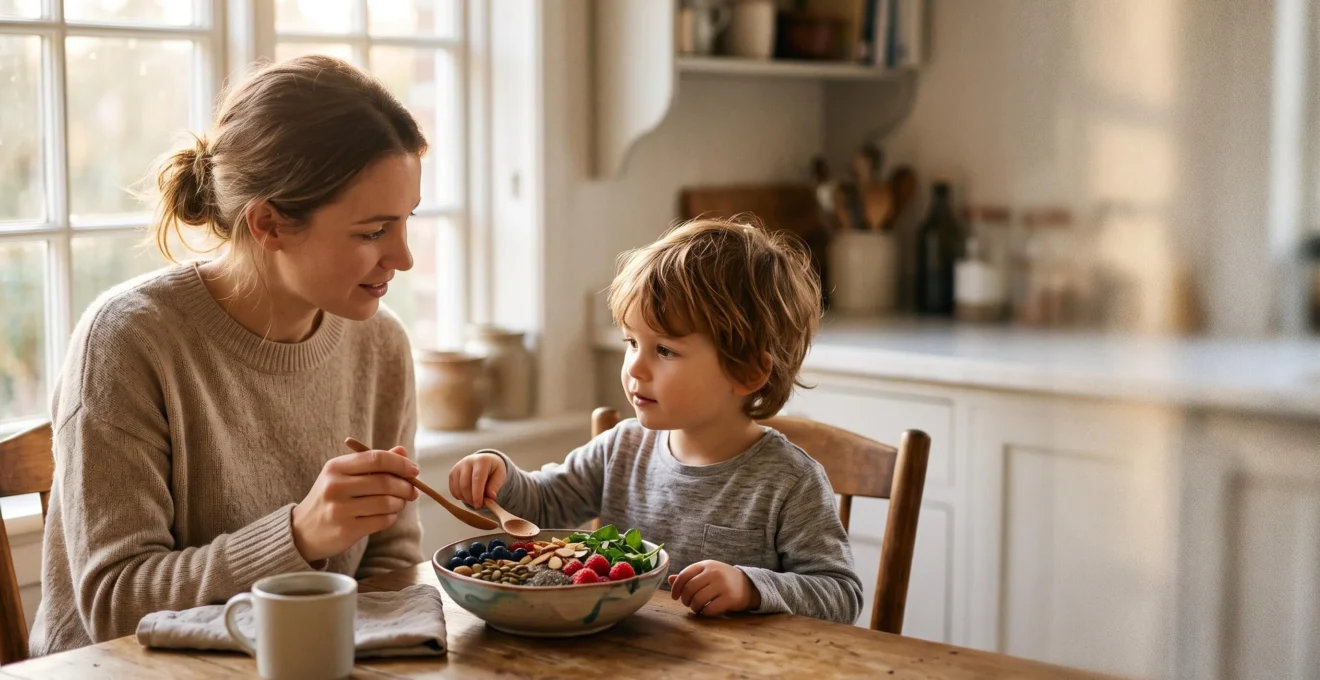
True childhood wellness is not about reacting to illness, but proactively building a resilient internal environment where your child can thrive.
- A child’s mood and focus are directly influenced by their gut health via the “gut-brain superhighway”.
- Whole foods provide complex nutrient synergy that isolated multivitamins cannot replicate, making them foundational for immunity.
- A family-wide mindset shift from simply “avoiding sickness” to “cultivating well-being” is the most powerful preventive tool.
Recommendation: Start by focusing on one small, consistent daily habit, like a “digital sunset,” to begin building your family’s unique wellness routine.
As a parent, you want nothing more than to see your child healthy, happy, and full of life. When sniffles, sleepless nights, or unexplained mood shifts appear, the instinct is to find a quick fix. We’re often told to reach for a multivitamin, enforce a stricter bedtime, or simply wait for the latest bug to pass. This reactive approach, focused on managing symptoms as they arise, can feel like a constant battle against an invisible tide of childhood ailments.
But what if the key wasn’t in fighting off individual illnesses, but in building a fortress of health from the inside out? What if, instead of just treating sickness, we could cultivate a state of vibrant, resilient well-being? This is the core principle of a holistic, preventive approach. It requires a shift in perspective: from viewing health as the mere absence of disease to seeing it as a dynamic, thriving ecosystem within your child. This ecosystem is powered by interconnected systems, from the gut to the brain, and is profoundly shaped by daily rhythms and family mindsets.
This guide moves beyond the surface-level advice. We won’t just tell you *what* to do; we will explore the biological ‘why’ behind each strategy. We will unpack the profound connection between your child’s gut and their mental state, reframe the debate between whole foods and supplements, and provide actionable steps to build a family culture of proactive wellness. It’s time to move from a defensive posture to one of empowered, intentional cultivation of your child’s health.
To help you navigate this journey, we have structured this guide to address the most critical pillars of holistic childhood health. You can explore the topics most relevant to you or read through to build a complete picture of this preventive philosophy.
Summary: A Preventive Path to Child Wellness
- Why Does Gut Health Influence Your Child’s Mood and Focus?
- How to Build a 5-Step Daily Wellness Routine for Families?
- Multivitamins or Whole Foods: Which absorption is Better for Immunity?
- Wellness or Absence of Disease: Changing Your Family’s Mindset
- When to Start Winter Proofing Your Child’s Immune System?
- When to Expect Rolling, Crawling, and Walking: A Realistic Timeline
- How to Set Up a Bedroom for Sleep Success: Light and Temp?
- Sleep Hygiene for Kids: Creating the Perfect Biological Environment?
Why Does Gut Health Influence Your Child’s Mood and Focus?
The idea that the stomach can affect the mind is no longer folk wisdom; it’s established science. The connection is a physical and chemical communication network often called the gut-brain axis. Think of it as a superhighway, with the vagus nerve acting as the main road carrying a constant stream of information in both directions. Surprisingly, a huge portion of this traffic is one-way: from the gut to the brain. In fact, research on the gut-brain axis shows that around 80% of signals flow upward, meaning your child’s gut is constantly “talking” to their brain, influencing everything from emotions to cognitive function.
This communication is heavily mediated by the gut microbiome—the trillions of bacteria living in your child’s digestive tract. A healthy, diverse microbiome helps produce neurotransmitters like serotonin and dopamine, which are crucial for regulating mood, happiness, and motivation. When the gut environment is out of balance (a state known as dysbiosis), this production can be disrupted. This may manifest not just as digestive upset, but also as irritability, poor concentration, or anxiety. Suddenly, that “inexplicable” tantrum or inability to focus on homework might have a biological root in the gut.
The link is not just theoretical; it’s observable. Interventions aimed at improving gut health have shown measurable effects on children’s behaviour, providing powerful evidence of this connection in action.
Case Study: The Impact of Probiotics on Children’s Behaviour
A study involving 135 children with gastrointestinal issues investigated the effects of targeted probiotic (psychobiotic) therapy. The researchers documented a statistically significant improvement in concentration and a reduction in hyperactivity and aggression among the participants. This illustrates a direct, measurable link between a gut-focused intervention and observable changes in childhood behaviour, confirming that nurturing the gut is a valid strategy for supporting mental and emotional balance.
How to Build a 5-Step Daily Wellness Routine for Families?
A routine provides a sense of safety and predictability that is essential for a child’s nervous system. However, a truly holistic routine is more than just a schedule; it’s a collection of daily rituals that actively build your family’s “biological environment” for wellness. Instead of a rigid, military-style timetable, think of it as creating gentle, consistent anchors throughout the day that support health without adding stress. One of the most impactful and often overlooked areas is the transition to sleep.
In our digitally saturated world, the evening hours are often filled with screens. The blue light emitted from tablets, phones, and televisions is a powerful disruptor of our natural sleep-wake cycle. Specific chronobiology research confirms that blue-wavelength light (400-500nm) actively suppresses melatonin, the hormone that signals to the body it’s time to sleep. For a child’s developing brain, this can delay sleep onset, reduce sleep quality, and lead to next-day fatigue and irritability.
Rather than simply banning screens, a more effective approach is to create a positive family ritual around powering down. I call this the “Digital Sunset.” It’s a shared, consistent practice that replaces screen time with connection and calm, teaching children to value and protect their sleep. It reframes the act of putting devices away from a restriction into a positive, proactive step toward feeling good. This simple routine becomes a powerful anchor for the entire family’s well-being.
Your Action Plan: The Digital Sunset Routine
- Set a Consistent Time: Choose one time each evening, ideally 90 minutes before bed, when all family devices are brought to a central charging station away from bedrooms.
- Model the Behaviour: The power of this ritual comes from you, the parent, participating. Power down your own screen at the same time to show it’s a family value, not just a rule for kids.
- Introduce a Screen-Free Anchor: Replace the newly freed-up time with a calming, connection-focused activity. This could be reading a book together, listening to a quiet story podcast, or doing a simple puzzle.
- Talk About the ‘Why’: Openly discuss with your child how protecting sleep helps them have more energy for play, feel happier, and focus better at school the next day. This builds their own internal motivation.
Multivitamins or Whole Foods: Which absorption is Better for Immunity?
The supplement aisle can be overwhelming, with countless brightly coloured bottles promising to “boost” your child’s immunity. While multivitamins have a place, particularly in correcting a diagnosed deficiency, the belief that they are a first-line defence for immunity is a common misconception. The true foundation of a resilient immune system lies in the complex, synergistic power of whole foods. A vitamin C tablet is not the same as an orange; the orange contains fibre, bioflavonoids, enzymes, and a host of other micronutrients that work together in ways scientists are still discovering. This is the concept of nutrient synergy.
Think of it like an orchestra. A supplement is a single instrument playing a solo. A whole food is the entire orchestra playing a symphony. The combined effect is far richer and more complex. Nutrients from whole foods are generally more bioavailable, meaning the body can recognise, absorb, and use them more efficiently than their isolated, synthetic counterparts. The fibre in an apple slows sugar absorption, while the healthy fats in an avocado help the body absorb fat-soluble vitamins A, D, E, and K.
This doesn’t mean supplements are useless. For specific, targeted needs—like vitamin D during the dark British winter months—they can be an essential ally. The key is to see them as just that: an ally, not a replacement for a diet rich in a colourful variety of fruits, vegetables, proteins, and healthy fats. The goal should be to build the “orchestra” first with whole foods, and only bring in a “soloist” supplement when a specific instrument is proven to be missing.
Case Study: The Nuanced Role of Vitamin D Supplements in the UK
A 12-week randomised controlled trial with UK children aged 4-11 provided crucial insight. Vitamin D3 supplementation was successful in preventing deficiency during the winter. However, it showed no additional effect on immune function or cognition in children who were not already deficient. This result, from a rigorous UK-based study, supports the naturopathic view of supplements as a tool for correcting an actual deficiency, not as a blanket immune booster for every child. It highlights the importance of a food-first approach.
Wellness or Absence of Disease: Changing Your Family’s Mindset
One of the most profound shifts you can make for your family’s long-term health has nothing to do with diet or supplements; it’s a change in mindset. Most of us are raised to think of health in a reactive way: you are “healthy” if you are not currently “sick.” This binary view puts us on the defensive. We wait for a problem—a fever, a cough, a stomach ache—and then we react, seeking a cure to return to our baseline of “not sick.” This is the “absence of disease” model.
A holistic, preventive approach invites a more empowering perspective: the active pursuit of wellness. In this model, health isn’t a neutral state; it’s a vibrant, dynamic quality of life. It’s about having abundant energy, stable moods, deep sleep, and a natural resilience to stressors. The goal isn’t just to avoid getting ill, but to build a biological environment so robust that your child can thrive, adapt, and bounce back quickly when they do inevitably encounter challenges.
This mindset shift changes your daily choices. Instead of asking, “What can I do to stop this cold?” you start asking, “What can we do today to build our resilience?” The answer might be a walk in the park after school to regulate the nervous system, adding an extra portion of colourful vegetables to dinner to feed the gut microbiome, or prioritising the “Digital Sunset” ritual to protect sleep. These small, proactive choices compound over time, strengthening the foundations of health.
Adopting this mindset as a family also changes the way you talk about health. It moves the conversation from a place of fear (“Don’t do that, you’ll get sick!”) to one of empowerment (“Let’s eat these carrots to give our bodies superhero fuel!”). This positive framing helps children develop an internal motivation for healthy habits, seeing them not as chores or restrictions, but as tools for feeling their best.
When to Start Winter Proofing Your Child’s Immune System?
As autumn leaves begin to fall, many parents go into “winter proofing” mode, stocking up on remedies and supplements in anticipation of the cold and flu season. While this instinct is understandable, a truly effective strategy for immune resilience doesn’t begin in September. It’s a year-round commitment. The idea of “winter proofing” is a perfect example of the reactive, “absence of disease” mindset. The proactive “wellness” mindset, by contrast, understands that the preparations for winter happen in the spring and summer.
A resilient immune system is built over time, not in a last-minute rush. It relies on consistent, foundational pillars: a diverse gut microbiome, adequate sleep, managed stress levels, and, crucially, sufficient nutrient stores. Vitamin D is a prime example. It is synthesised in the skin through sun exposure, and levels naturally peak in late summer. This vitamin plays a vital role in immune function, and heading into winter with robust stores is a key determinant of resilience. Research consistently shows a link between low vitamin D levels and increased susceptibility to respiratory infections.
For instance, one randomised trial of over 300 children found a 58% lower likelihood of contracting influenza A with winter vitamin D supplementation, highlighting its protective role. However, the goal is not to start supplementing frantically in October. The goal is to ensure sufficiency all year long, through sensible sun exposure in the summer and appropriate supplementation during the darker months, as recommended by public health bodies like the NHS.
Study: Year-Round Vitamin D Sufficiency is Key
A cross-sectional study of 215 preschool-age children found that those with recurrent respiratory infections had significantly lower vitamin D levels than children who had only one infection in the past year. Children receiving adequate vitamin D year-round were roughly half as likely to experience these infections. This reinforces that consistent, year-round sufficiency, not just a seasonal panic, is what underlies a truly resilient immune system ready for winter’s challenges.
When to Expect Rolling, Crawling, and Walking: A Realistic Timeline
For new parents, developmental milestones can be a source of both excitement and anxiety. Well-meaning advice and comparison charts can create pressure, leading to worry if a child isn’t rolling, crawling, or walking by a specific date. It’s crucial to remember that these timelines are based on averages. Every child is on their own unique developmental journey, and a wide range of “normal” exists. A holistic perspective encourages us to focus less on the ‘when’ and more on creating an optimal environment that *supports* this natural unfolding.
Motor development is not just a muscular process; it’s a complex interplay of the nervous system, sensory input, and cognitive drive. The same “biological environment” that supports robust immunity and stable moods also fuels this physical progression. Good nutrition provides the building blocks for strong muscles and bones. Quality sleep is when the brain consolidates learning and growth hormone is released. A low-stress environment allows the nervous system to feel safe enough to explore and take risks, like that first wobbly step.
Instead of anxiously tracking dates, focus on providing opportunities. Ample “tummy time” strengthens the neck, back, and core muscles essential for rolling and crawling. A safe, baby-proofed floor space encourages exploration. Your calm, encouraging presence gives your child the confidence to try, fail, and try again. As a general guide, you might see:
- Rolling Over: Typically between 4 and 7 months.
- Crawling: Often between 7 and 10 months, but some children skip it entirely, which is also normal.
- Walking: Usually begins somewhere between 9 and 18 months.
Notice the wide windows for each milestone. Your role isn’t to push your child to meet a deadline, but to nurture the healthy, resilient body and mind that will allow them to meet these milestones in their own perfect time. If you have genuine concerns about a significant delay, always consult your GP or health visitor, but try to release the pressure of the calendar.
How to Set Up a Bedroom for Sleep Success: Light and Temp?
A child’s bedroom should be a sanctuary for sleep—a space that signals to their body and brain that it’s time for rest and restoration. Creating this sanctuary involves managing two critical environmental cues: light and temperature. Our bodies have an internal clock, or circadian rhythm, that is powerfully influenced by these external factors. Getting them right is a cornerstone of good sleep hygiene and a simple, effective way to build your child’s biological environment for wellness.
Light is the most powerful signal for our brains. Bright light, particularly in the blue spectrum, says “Wake up! It’s daytime!” Darkness signals the production of melatonin, the sleep hormone. This is why even a small amount of light from a hallway, a streetlamp, or a device can interfere with sleep. A review of studies confirms that evening blue light exposure creates measurable circadian disruption. The goal is to make your child’s room as dark as possible. Blackout blinds or curtains are one of the best investments you can make for sleep quality. If a night light is necessary, choose one with a dim, warm, red, or amber tone, as these wavelengths are least disruptive to melatonin.
Temperature is the second key factor. To initiate sleep, our core body temperature needs to drop slightly. A bedroom that is too warm can interfere with this natural process, leading to restlessness and night-waking. While every child is different, the general consensus is that a cool room is better for sleep. The ideal range is typically between 18-20°C (65-68°F). Rather than overheating the room, it’s better to maintain a cool ambient temperature and use appropriate bedding and sleepwear to keep your child comfortable. A well-ventilated, dark, and cool room creates the perfect biological cave for deep, restorative sleep.
To Remember
- True wellness is proactive, focusing on building a resilient “biological environment” for your child.
- A child’s gut health has a direct and measurable impact on their mood, focus, and behaviour via the gut-brain axis.
- Consistent daily rituals, like a “Digital Sunset,” are more powerful for long-term health than reactive, quick fixes.
Sleep Hygiene for Kids: Creating the Perfect Biological Environment?
We’ve established that a dark, cool room sets the stage for sleep. But creating the perfect biological environment for rest goes beyond the physical setup. It encompasses a wider set of practices and routines known as sleep hygiene. This is about building a consistent, predictable rhythm that cues your child’s entire system for sleep. It’s a holistic approach that values routine and behaviour just as much as blackout blinds.
The transition from a busy day to a restful night should be a gentle slope, not a cliff edge. A consistent bedtime routine—a warm bath, changing into pyjamas, brushing teeth, and a quiet story—is a powerful signal to the brain that sleep is approaching. This sequence of calming activities helps lower cortisol (the stress hormone) and allows melatonin to rise naturally. The key is consistency. The same steps in the same order each night create a deeply ingrained biological and psychological cue for sleep.
However, life is not always perfect. Travel, illness, or special occasions can disrupt even the best routines. This is where a resilient approach to sleep hygiene becomes vital. Instead of abandoning the routine altogether, the goal is to hold onto small “anchor rituals” that provide a sense of familiarity and safety, even in a new environment. This teaches children that sleep is a priority no matter where they are. This holistic view is backed by experts who find that focusing on broader habits is more effective than fixating on a single element, like filtering blue light.
Expert Consensus: Routine Matters More Than Single Fixes
A multidisciplinary expert panel convened by the National Sleep Foundation reviewed extensive evidence on screen media and sleep. Their findings, published in the Sleep Health Journal, concluded that interventions like filtering blue light alone produced only minimal improvements. They emphasised that broader habits, such as consistent timing and overall routine, have a much greater impact on sleep health, supporting a holistic rather than a single-fix approach to children’s sleep hygiene.
Action Plan: Building a Resilient Sleep Routine
- Anchor the Wake-Up: Keep a consistent wake-up time each morning, even if bedtime shifted during travel or sickness. This is the most powerful anchor for the circadian rhythm.
- Preserve a Micro-Ritual: No matter the location or situation, preserve one small anchor from your home routine—like a specific bedtime story or a familiar lullaby.
- Set Non-Negotiable Boundaries: Maintain your family’s core principles, such as the “Digital Sunset,” even when away from home. Model this behaviour yourself.
- Communicate the ‘Why’: Talk with your child about why sleep is still important for feeling good, even when routines are temporarily disrupted by fun holidays or feeling unwell.