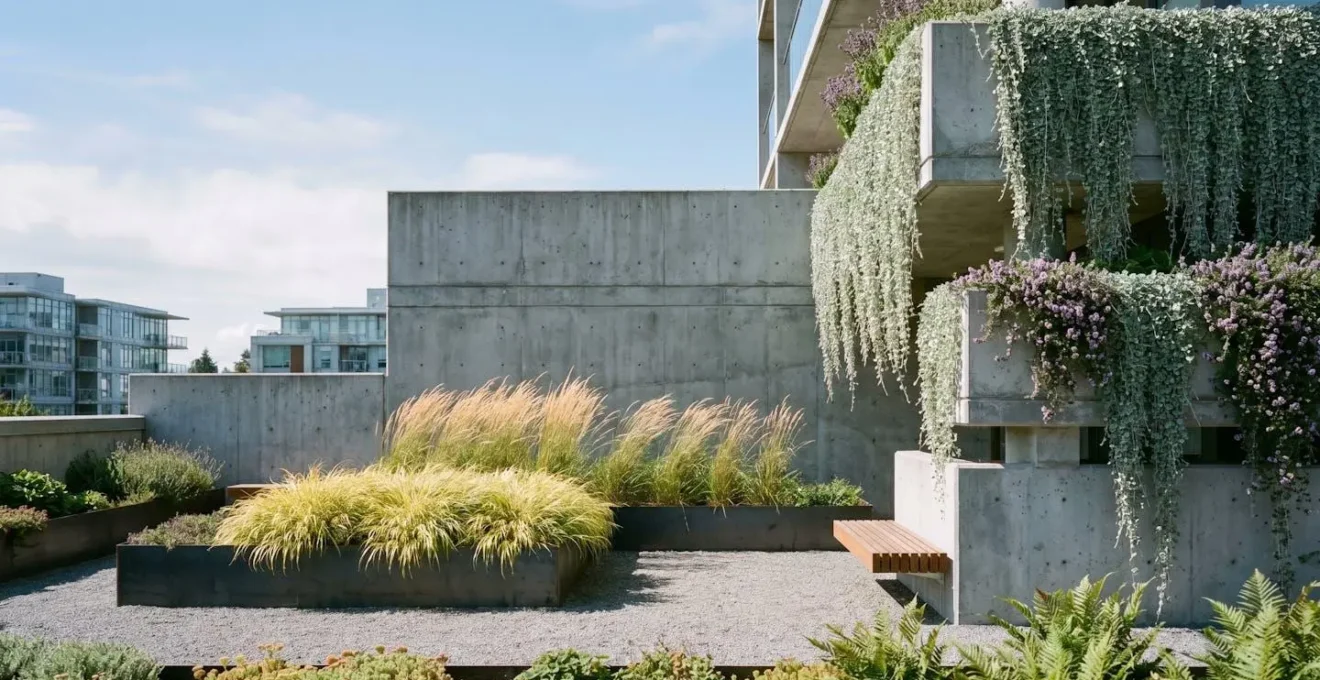
The secret to successfully greening modern architecture is treating plants as a deliberate design layer, not just decoration, to create a dynamic dialogue with the built form.
- Choose self-clinging climbers that respect pristine rendered walls and vertical systems that preserve precious floor space.
- Incorporate grasses for movement and slender, upright (fastigiate) plants to add height and privacy without consuming width.
- Understand that pruning is about revealing a plant’s structure, not just reducing its size, to maintain a clean, architectural aesthetic.
Recommendation: Begin by selecting one key area, such as a patio wall or entrance, and invest in a single, well-chosen mature specimen to witness the immediate transformative effect of strategic softscaping.
The appeal of a modern new-build is undeniable: clean lines, expansive glass, and the raw, textural honesty of concrete or smooth render. There’s a purity to this minimalism. Yet, after the dust settles, a nagging feeling can emerge. The space can feel stark, acoustically harsh, and visually cold. The human touch, the sense of a home that is lived-in and alive, can seem just out of reach. The default solution is often a scattered collection of pots, a token gesture of green against the grey.
This approach, however, often misses the point and raises valid concerns, especially for the proud owner of a flawless new extension. Will that climber damage my expensive render? Will bulky planters clutter my carefully designed patio? The fear of marring the pristine surfaces or disrupting the minimalist aesthetic is real. We’re often told to simply “add plants,” but this advice fails to address the unique challenges and opportunities of modern architecture.
But what if the solution wasn’t to cover up the concrete, but to enter into a dialogue with it? The true art of softscaping a modern build lies in using vegetation not as camouflage, but as a complementary architectural element. It’s about a strategic layering of texture, movement, and life that enhances the structure’s form rather than obscuring it. This is not about creating a messy, traditional cottage garden; it is about controlled wildness and functional softness.
This guide will walk you through a designer’s methodology for achieving this balance. We will explore how to select plants that respect your walls, use vertical space intelligently, and master the techniques that turn vegetation into a living, breathing extension of your home’s architecture, creating a space that is both stylishly modern and deeply human.
To navigate this design-led approach, we’ve structured this article to address the key decisions you’ll face. The following summary outlines how you can strategically transform your space from stark to soulful.
Summary: A Designer’s Guide to Softening Modern Architecture
- Why Trailing Plants Make Small Concrete Spaces Feel Larger?
- Climbers That Won’t Damage Your Expensive Rendered Walls
- Grasses vs Bamboo: Adding Movement to Static Modern Courtyards
- The Pruning Error That Turns Architectural Plants into Messy Bushes
- Pot Size Matters: When to Buy Mature Specimens for Instant Softening?
- Vertical Gardening: How to Green Walls Without Losing Floor Space?
- Patio Clematis vs Climbers: Which Cultivar Actually Flowers at Eye Level?
- Improving Spatial Flow in Narrow Terraced House Gardens
Why Trailing Plants Make Small Concrete Spaces Feel Larger?
In the contained world of a concrete courtyard or balcony, our perception of space is governed by hard edges. Walls, floors, and railings create a distinct, finite box. Trailing plants are a powerful design tool because they deliberately blur these boundaries. By spilling over the edges of pots, raised beds, and containers, they break up the rigid geometry of the space, creating soft, organic lines that the eye follows downwards, creating an illusion of depth and continuity.
This isn’t just a visual trick; it’s a psychological one. The act of scattering greenery at different heights and allowing it to cascade creates a more complex, three-dimensional environment. A 2026 Cambridge University study on indoor plants found that this type of multi-level arrangement enhances our connection to nature through spatial interaction, which in turn fosters a sense of wellbeing and makes a space feel larger and more intricate. When a trailing plant drapes down a wall, it connects the horizontal plane of the planter with the vertical plane of the wall, effectively weaving the two together.
The key is to think in layers. A tall planter with a trailing plant like Dichondra ‘Silver Falls’ creates a high starting point, while a low bowl with cascading ivy fills the lower visual field. This layering creates a sense of a lush, immersive environment, tricking the brain into perceiving the space as more expansive than its physical dimensions would suggest. You’re no longer in a simple concrete box, but a mini-ecosystem, which inherently feels more generous and less confined. The goal is to achieve a high percentage of green view, which research has linked directly to psychological comfort.
This effect is most potent when the foliage itself offers textural contrast to the smooth concrete, turning a simple wall into a backdrop for a living, moving sculpture.
Climbers That Won’t Damage Your Expensive Rendered Walls
The single greatest fear for new-build owners is wall damage. The vision of ivy tendrils burrowing into fresh render, cracking concrete, or leaving permanent marks is enough to veto any thoughts of a green wall. However, this fear is largely based on a misunderstanding of how different climbers work. It is crucial to distinguish between plants that attach themselves and those that need support.
Plants like traditional English Ivy (Hedera helix) can indeed be problematic on compromised or soft brickwork over many decades. But for modern, sound render, the narrative changes. As a `Gardens Illustrated` expert panel concluded, when it comes to structurally sound surfaces, there is little to no risk.
there is no evidence to suggest that ivy poses a threat to sound masonry
– Gardens Illustrated Expert Panel, Climbing Plants and Wall Damage Assessment
The safest and most elegant solutions for modern builds are self-clinging climbers that use adhesive pads, not invasive roots, to attach. Species like Boston Ivy (Parthenocissus tricuspidata) and Virginia Creeper (Parthenocissus quinquefolia) are ideal. They don’t penetrate the wall; they adhere to its surface with tiny, suction-cup-like structures.
As this macro photograph shows, these adhesive pads form a physical, surface-level bond. When the plant is removed, these pads may leave a slight residue but will not cause structural damage to a high-quality, properly applied render. The other category includes twining climbers (like Jasmine or Clematis) and rambling roses. These plants have no attachment mechanism of their own and are perfect for modern walls because they require a support structure—such as a trellis or a system of tensioned wires—installed a few inches away from the wall. This creates an air gap, promoting healthy air circulation and ensuring the plant never even touches the render, giving you complete peace of mind.
Ultimately, by selecting the correct type of climber, you are not risking your wall; you are adding a protective, beautiful, and living “second skin” to your home.
Grasses vs Bamboo: Adding Movement to Static Modern Courtyards
Modern courtyards, with their emphasis on stone paving and concrete walls, can feel beautifully minimalist but also static and silent. The introduction of plants that respond to the slightest breeze is one of the most effective ways to inject life, sound, and movement. The two primary candidates for this role are ornamental grasses and bamboo, each offering a different kind of “controlled wildness.”
Ornamental grasses are the masters of subtle, sensory experience. The gentle rustle of a Miscanthus or the soft, swaying plumes of a Pennisetum add an auditory layer to the garden that counters the silence of stone. Their fine texture provides a perfect foil to the hard, smooth surfaces of modern materials. They are generally low-maintenance, and clumping varieties pose no threat of uncontrolled spreading. For family gardens, their soft, tactile nature is a significant bonus.
Bamboo, on the other hand, offers a more dramatic, architectural presence. Its linear, vertical canes echo modern lines, while the rustle of its leaves in the wind is more pronounced, creating a soothing white noise. However, the word “bamboo” rightly triggers caution. It is essential to differentiate between clumping bamboo (like Fargesia species), which grows in a tight, manageable clump, and running bamboo (like Phyllostachys), which sends out aggressive underground rhizomes. If you opt for a running variety for its height or screening potential, a containment strategy is non-negotiable. This involves installing a robust rhizome barrier; most landscape designers recommend that these barriers be at least 60cm deep to be effective.
For most modern, family-oriented spaces, the choice leans towards clumping bamboo or a curated selection of ornamental grasses. They provide the desired movement and softness without the high-stakes maintenance of running bamboo. Many varieties are perfectly safe and engaging for children.
- Fountain Grass (Pennisetum setaceum): Soft, furry flowerheads provide a tactile sensory experience and are resilient to occasional play.
- Japanese Forest Grass (Hakonechloa macra): A low, mounding grass with a gentle rustling sound, perfect for edges where children might be playing.
- Feather Reed Grass (Calamagrostis x acutiflora ‘Karl Foerster’): Its tall, strictly upright form adds height and a crisp whisper without taking up width, keeping pathways clear.
- Clumping Bamboo (Fargesia species): A non-invasive ‘plant-and-forget’ option that requires no rhizome barriers, making it safe for play areas while providing excellent screening.
Ultimately, both grasses and well-behaved bamboo serve to choreograph the wind, making an invisible force visible and turning a static courtyard into a dynamic, responsive environment.
The Pruning Error That Turns Architectural Plants into Messy Bushes
In a modern garden, plants are often chosen for their strong, sculptural form—a spherical boxwood, a columnar yew, or a cloud-like Pittosporum. This “architectural” quality is a deliberate design choice. The most common mistake that ruins this effect is improper pruning. Many gardeners, faced with an overgrown shrub, resort to shearing the entire outer surface into a tight shape. While this may seem neat initially, it is a fatal error that leads to a dense, messy, and ultimately unhealthy plant.
This “heading back” method of cutting all branches to the same length forces a flush of dense growth right at the surface. This creates a thick outer “crust” of foliage that blocks light and air from reaching the plant’s interior. The inner branches become bare and weak, and the plant loses its structural definition, turning from a piece of living sculpture into a featureless green blob. The key to maintaining architectural form is not shearing, but selective thinning and structural pruning.
This technique involves reaching inside the plant and removing entire branches right back to their point of origin. This creates negative space within the plant’s structure. As the professionals at Surrounds Landscaping note, this is not just about aesthetics; it’s about the plant’s health and vitality.
opens up the middle of the plant to admit more sunlight—which keeps the interior branches healthy and encourages new growth
– Surrounds Landscaping Professional Team, The Art of Pruning in Landscape Maintenance
By thinning the interior, you reveal the plant’s elegant branching structure and maintain its intended form. This method takes more time and thought than indiscriminate shearing, but the result is a plant that remains healthy, airy, and true to its architectural purpose. A well-pruned architectural plant should have a sense of lightness, allowing glimpses of the structure and landscape behind it.
Case Study: The Art of Cloud Pruning
An advanced form of structural pruning, known as “cloud pruning” or Niwaki, offers a way to transform even overgrown shrubs into stunning features. The technique involves thinning dense foliage to reveal the main branches and then shaping pads of foliage at the ends into soft, rounded, cloud-like forms. By emphasizing the negative space between these “clouds,” the plant gains a sense of lightness and airiness. When applied to neglected architectural shrubs like Boxwood or Pittosporum, this method can salvage them, creating enchanting, fort-like structures that are perfect for sparking children’s imaginative play while maintaining a sophisticated, modern aesthetic.
The goal is to work with the plant’s natural form, enhancing its structure rather than imposing an artificial shape upon it. This respects the plant as a living element and preserves the clean aesthetic of the modern garden.
Pot Size Matters: When to Buy Mature Specimens for Instant Softening?
One of the most significant decisions when softscaping a modern space is whether to invest in large, mature specimen plants or to start with smaller, younger ones and wait for them to grow. In the context of a new build, where the goal is often to immediately counteract the starkness of concrete and glass, the allure of an “instant garden” is strong. This is where pot size and plant maturity become critical strategic considerations, not just horticultural details.
Buying a mature specimen—a multi-stemmed silver birch, a large tree fern, or a fully-grown olive tree—offers immediate and dramatic visual impact. It instantly provides the height, scale, and texture needed to balance a tall wall or a large window. This is the fastest way to achieve the desired softening effect. However, this comes at a significant financial cost and requires careful logistical planning for transport and planting. The pots required are necessarily large and heavy to provide stability and adequate root volume, which is a crucial safety factor in a family garden.
Conversely, starting with smaller plants is budget-friendly and offers the joy and educational value of watching something grow over time, a particularly rewarding experience for families with children. However, it requires patience, as it can take years for small plants to achieve the scale needed to make a real impact against a modern architectural backdrop. This approach also involves more frequent maintenance in the form of re-potting as the plants outgrow their containers. The following matrix, based on insights from professional softscape landscaping design, breaks down the decision-making factors.
| Factor | Mature Specimens | Small/Starter Plants |
|---|---|---|
| Initial Cost | High investment (3-5x price of small plants) | Budget-friendly, accessible for families |
| Immediate Visual Impact | Instant softening of harsh concrete lines; immediate privacy and shade | Minimal impact; requires patience for visual transformation |
| Toddler Safety (Pot Stability) | Requires heavy, low-profile planters (Corten steel cubes recommended) to prevent tipping | Lighter pots acceptable; easier to reposition away from high-traffic zones |
| Maintenance Burden | Correctly-sized pots reduce watering frequency and eliminate re-potting for years | Requires annual or biannual re-potting; more frequent watering |
| Emotional/Family Value | Purchased beauty without growth memories | Long-term family project measuring time and creating memories as plants grow alongside children |
| Best Use Case | Urgent softening needs; establishing instant privacy in family seating areas | Educational tool for children; budget-conscious phased garden development |
A hybrid approach is often the most effective strategy: invest in one or two key mature specimens for focal points and fill in the surrounding areas with smaller, more affordable plants that will mature over time.
Vertical Gardening: How to Green Walls Without Losing Floor Space?
In modern homes, especially in urban settings, outdoor space is a luxury. Every square foot of a patio or courtyard is precious. The desire to add greenery often conflicts with the need to preserve open space for seating, dining, or children’s play. Vertical gardening offers the perfect solution, transforming stark, empty walls into lush, living surfaces without sacrificing a single inch of valuable floor area.
A vertical garden is more than just a climber; it’s a dedicated system designed to support a multitude of plants on a vertical plane. These systems range from simple felt pockets to sophisticated modular trays with integrated irrigation. They allow you to create a dense tapestry of foliage and flowers, providing a powerful visual statement that completely changes the character of a space. A bare concrete wall becomes a vibrant ecosystem, which can also improve air quality and provide acoustic buffering.
For family homes, vertical gardens offer a unique opportunity for engagement and education. By planting edible varieties like alpine strawberries, cherry tomatoes, and various herbs at an accessible height, you can create a “snack wall” for children. This fosters a connection to food and nature in a fun, hands-on way. The key to a successful and long-lasting vertical garden, however, lies in careful planning, especially concerning water management to prevent damage to the wall behind it.
Action Plan: Preventing Water Damage on Vertical Garden Walls
- Choose the Right System: For felt pocket systems, ensure a waterproof backing membrane is installed between the felt and the wall. For modular tray systems, select those with built-in drainage channels and collection reservoirs.
- Protect the Wall Surface: Before installation, apply a high-quality waterproof sealant to the concrete or rendered wall. It’s also best practice to leave a 2-3 inch air gap between the system’s frame and the wall to allow for ventilation.
- Control Irrigation: Overwatering is the biggest risk. Install an automated drip irrigation system with a timer and, if possible, soil moisture sensors to deliver precise amounts of water only when needed.
- Ensure Proper Drainage: Ensure the system has a clear path for excess water to escape, ideally channelled into a planter or drain at the base. Do not let water run directly down the wall surface.
- Conduct Regular Checks: Monthly, check that drainage outlets are clear of debris. Annually, inspect a section of the wall surface behind the system to monitor for any signs of moisture accumulation or discoloration.
This approach effectively multiplies your usable garden space, layering a productive and beautiful garden onto a surface that was previously just a boundary.
Patio Clematis vs Climbers: Which Cultivar Actually Flowers at Eye Level?
One of the most common frustrations with climbing plants is that they often reserve their floral display for the very top of the plant, well above eye level. You nurture a clematis all year, only for it to produce a glorious crown of flowers 10 feet in the air, leaving you with a view of bare, woody stems. This is particularly true for vigorous climbers planted in a confined space. To achieve flowers where you can see and appreciate them—at seated eye level on a patio, or at a child’s height—requires selecting the right type of plant.
This is where the distinction between traditional climbing clematis and modern “patio” or “boulevard” cultivars becomes crucial. Traditional, vigorous climbers (like Clematis montana) are genetically programmed for rampant growth, aiming to reach the top of a tree or structure before flowering. Patio clematis, however, have been specifically bred for a compact growth habit. They produce flowers all along their stems, from the base to the top, ensuring a profuse display within a much more contained height of 3-6 feet. This makes them ideal for pots and small trellises, where they will reliably flower at eye level.
Choosing the correct cultivar is also a functional decision. Beyond aesthetics, a dense covering of foliage provides tangible benefits to your home. Research has shown that climbers act as a thermal shield. A study from Oxford University for English Heritage found that climbers buffer buildings from temperature extremes and pollution, effectively helping to preserve the building fabric. So, choosing a plant that provides good coverage is also a practical investment.
For a truly spectacular and family-friendly display, a tiered planting strategy is most effective, using different types of clematis to cover different visual zones.
- Low Level (60-90cm) for Children: Use compact patio cultivars like Clematis ‘Bijou’ that concentrate their flowers at a 2-3 foot height, perfect for planting along low walls or at the edge of raised beds.
- Mid-Height (100-140cm) for Seated Adults: Select Group 3 clematis (which are hard-pruned annually) as they flower prolifically at 3-4.5 feet, ideal for viewing from patio chairs.
- Upper Level (180cm+) for Standing Views: Train larger, late-flowering cultivars like ‘Jackmanii’ on upper trellis sections to create privacy screening and draw the eye upwards.
- Bee-Friendly Selection: Near family seating, prioritize single, open-flowered varieties which attract gentle bees, over double-flowered types which can be more attractive to wasps.
By layering these different types, you can orchestrate a continuous wall of colour that can be appreciated from every vantage point, by every member of the family.
Key Takeaways
- The goal is not to hide modern architecture but to create an “architectural dialogue” with plants that complement its form.
- Prioritise plant selection based on function and safety: self-clinging climbers that don’t damage render, clumping grasses for movement, and vertical systems to save floor space.
- Embrace structural pruning to maintain the sculptural quality of architectural plants, and choose pot sizes strategically for either instant impact or a long-term family project.
Improving Spatial Flow in Narrow Terraced House Gardens
The narrow, rectangular garden of a terraced house presents a unique design challenge. Often bookended by the house and a back fence, these spaces can feel like corridors, with a tendency to draw the eye directly to the end, encouraging you to rush through rather than linger. Improving the “spatial flow” in these gardens is about interrupting this linear rush and creating a sense of journey and discovery, making the garden feel wider and more engaging than its dimensions suggest.
The key is to move away from linear planting along the edges and instead use plants to create vertical punctuation and to partially obscure the view. This is where fastigiate, or columnar, plants become invaluable. These are plants that have a naturally slender, upright growth habit. By placing them strategically, you can create “soft walls” or vertical accents that force a slight deviation in a path or screen the view of what lies beyond. This creates intrigue and divides the long, narrow space into a series of smaller, more intimate “rooms.”
This strategy of creating height without consuming precious width is the secret to making a narrow garden feel more generous. A tall, slender plant draws the eye upward, away from the constricting horizontal plane. If you can see the entire garden in a single glance, it will always feel small. By using columnar plants to create layers and conceal the final boundary, you create a sense of mystery and a reason to explore the full length of the garden. A carefully placed fastigiate hornbeam or a row of ‘Sky Pencil’ hollies can transform a simple passage into a destination.
Here are some excellent fastigiate plant choices for maximizing space in narrow gardens:
- Sky Pencil Holly (Ilex crenata ‘Sky Pencil’): An extremely slender, evergreen column that provides year-round structure and privacy without taking up space.
- Columnar Juniper: A drought-tolerant option with a strong vertical habit, perfect for adding height and a touch of formality.
- Fastigiate Hornbeam (Carpinus betulus ‘Fastigiata’): A deciduous tree that holds its form well, with dense branching that creates excellent screening in summer and a beautiful structure in winter.
- Strategic Placement: Position these tall, slender plants slightly overlapping, so they break the direct line of sight from the house to the back fence, creating a more dynamic journey.
By interrupting the linear view and adding vertical interest, you can transform a simple corridor into a sophisticated and immersive garden experience, proving that great design is not about the amount of space you have, but how you choose to shape it.