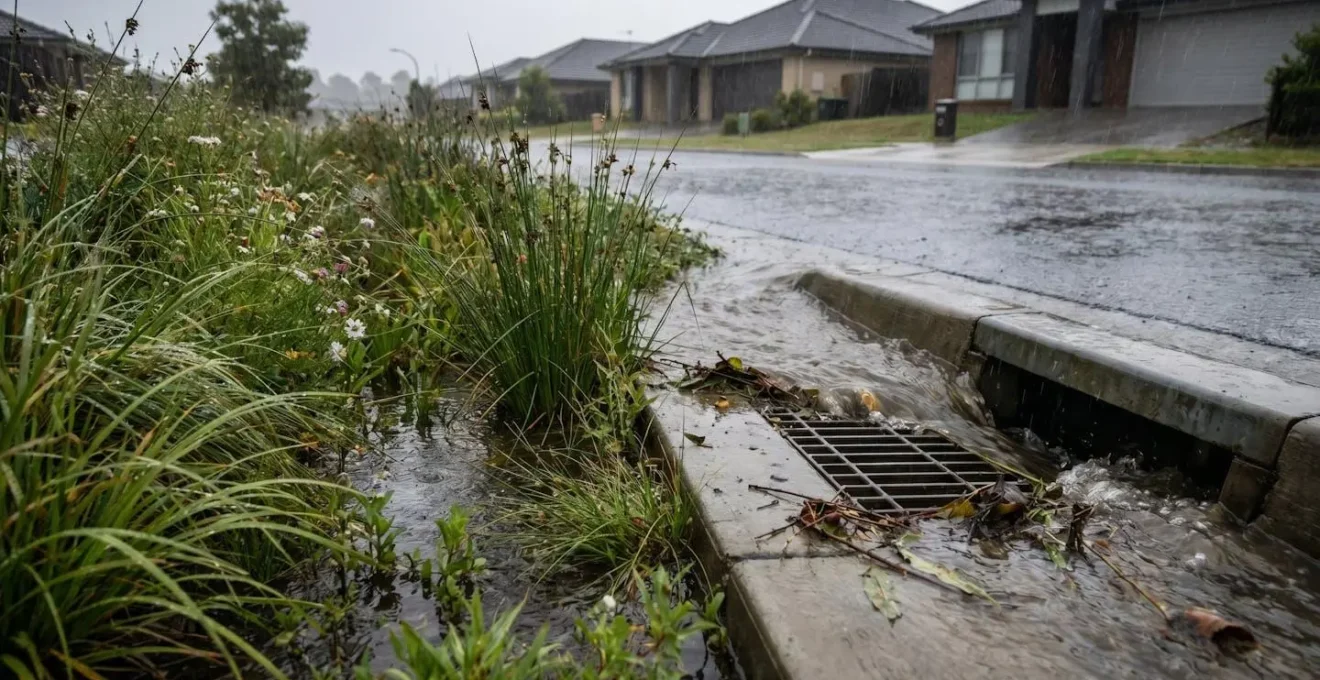
Properly engineered bioswales consistently outperform traditional drains by treating stormwater as a resource to be managed, not a waste product to be removed.
- Success depends on treating bioswales as living infrastructure, requiring precise engineering for filtration, flow rate, and sediment load.
- Long-term failure is almost always due to sediment clogging, a predictable issue that must be addressed with design features like forebays.
Recommendation: Shift focus from a simple “green vs. grey” comparison to a systems-thinking approach that prioritizes hydraulic performance and scheduled maintenance for long-term resilience.
For managers of large estates and community gardens, intensifying rainfall poses a critical challenge. Traditional concrete drains and piped infrastructure, designed for rapid water removal, are increasingly overwhelmed. This approach channels pollutants directly into waterways, causes downstream erosion, and contributes to localized flooding. While the concept of using bioswales—vegetated channels designed to slow and filter water—is gaining traction, a superficial understanding often leads to underperformance and failure. The common narrative praises them as a “greener” alternative, but this overlooks the critical engineering principles that make them effective.
The truth is, a high-performance bioswale is not simply a ditch with plants; it is a piece of living infrastructure. Its success hinges on a sophisticated interplay of soil science, hydrology, and biology. It’s designed not just to convey water, but to decontaminate it, reduce its velocity, and promote groundwater recharge. According to the U.S. Environmental Protection Agency, stormwater runoff accounts for up to 70% of the pollution in our rivers and lakes, transforming every impervious surface into a source of contamination. Traditional drains exacerbate this problem; bioswales are engineered to solve it at the source.
This article moves beyond the basic comparison. We will dissect the operational mechanics of high-performance bioswales, treating them as the engineered systems they are. We will explore how they filter pollutants, the common mistakes that lead to costly failures, and the specific design components required to ensure they function effectively for decades, turning a drainage problem into a valuable ecological asset.
This guide provides a systematic overview of the critical components and considerations for designing, building, and maintaining bioswales that can reliably handle heavy rainfall. Explore the detailed sections below to understand the science behind superior stormwater management.
Summary: Bioswales vs Traditional Drains: Which Handles Heavy Rainfall Better?
- How Bioswales Filter Oil and Pollutants From Driveway Runoff?
- Mowing or Weeding: How to Maintain a Functioning Bioswale?
- How to Use Check Dams to Slow Water Speed on Slopes?
- The Silt Mistake That Blocks Bioswales After Two Years
- Turning Drainage into Habitat: Attracting Amphibians to Swales
- How Big Should Your Rain Garden Be to Handle Roof Runoff?
- 3 Native Grasses With Roots That Drink Excess Groundwater
- How to Build Rain Gardens to Handle British Storm Surges?
How Bioswales Filter Oil and Pollutants From Driveway Runoff?
A bioswale’s primary advantage over a traditional drain is its ability to actively treat water quality, not just manage water quantity. When runoff from a driveway, parking lot, or road enters a bioswale, it undergoes multiple decontamination processes. This is not passive filtration; it is a complex sequence of physical, chemical, and biological actions. The engineered soil media and dense vegetation work in concert to capture and break down a wide range of common urban pollutants.
The first mechanism is physical filtration and sedimentation. As the water’s velocity is slowed by the vegetation and the channel’s contours, heavier particles like sand, grit, and other suspended solids drop out of the water column. Research demonstrates that well-designed bioswales are exceptionally effective at this, achieving up to 90% removal of total suspended solids. These trapped sediments often carry other pollutants, such as heavy metals and phosphorus, attached to their surfaces.
Next, chemical and biological processes take over. Hydrocarbons like oil and grease are captured in the mulch layer, where they are broken down over time by soil microorganisms in a process called bioremediation. Even with relatively short contact times, the effects are significant. For example, studies show a minimum 49% removal of oil and grease with a water residence time of just over four minutes. Meanwhile, the roots of the selected plants and the soil media itself can adsorb dissolved pollutants, including heavy metals like zinc and copper, effectively locking them out of the water system.
This multi-stage treatment process is what fundamentally separates a bioswale from a concrete channel, which provides zero water quality improvement. The bioswale is an active ecosystem engineered to decontaminate runoff before it can pollute groundwater or downstream waterways.
Mowing or Weeding: How to Maintain a Functioning Bioswale?
A common misconception is that bioswales are “natural” systems that require no maintenance. This is a critical error that leads to system failure. A bioswale is an engineered asset, and like any piece of infrastructure, it requires a scheduled, targeted maintenance plan. This plan, however, looks very different from traditional landscape care. The goal isn’t just aesthetics (mowing and weeding), but ensuring its long-term hydraulic performance.
Effective maintenance focuses on four key areas: water flow, sediment control, vegetation health, and trash removal. Regular inspections, especially after major storms, are essential to identify blockages, signs of erosion, or areas of standing water. While some weeding of invasive species is necessary to protect the desired native plant community, excessive mowing or manicuring can be detrimental. The dense, tall vegetation is a functional component that slows water and aids filtration; it should not be treated like a conventional lawn.
From a budget perspective, this proactive approach is highly efficient. A lifecycle cost analysis reveals that maintenance practices typically account for only 5-10% of a bioswale’s total lifecycle cost, far less than the cost of failure and remediation. This planned expenditure ensures the system continues to provide its full range of benefits, from flood control to pollutant removal.
Case Study: Bioswale Cost Savings Over Traditional Infrastructure
For property managers evaluating long-term costs, the economic advantages are clear. Small property bioswales are often 5% cheaper over their total lifecycle compared to conventional stormwater management techniques like underground piping systems. Furthermore, they can save over $8,000 in initial construction costs when installed with a new structure, demonstrating significant upfront and long-term economic advantages for both residential and commercial applications.
How to Use Check Dams to Slow Water Speed on Slopes?
On sloped terrain, the primary challenge for a bioswale is managing water velocity. If stormwater flows too quickly, it can cause erosion within the channel, prevent effective infiltration, and bypass the filtration media, rendering the system ineffective. The solution is to install a series of check dams—small, semi-permeable barriers placed perpendicular to the direction of flow.
A check dam works by creating a small, temporary pool of water behind it. This pooling action achieves two critical objectives. First, it dramatically reduces the water’s kinetic energy, slowing its velocity and transforming erosive, turbulent flow into gentle, laminar flow. Second, this increased “residence time” allows more water to infiltrate into the soil and gives suspended sediments a chance to settle out. A series of check dams creates a stepped profile within the swale, effectively dissipating the slope’s energy in a controlled manner.
These structures can be made from various materials, including rock, untreated wood, or even densely packed earth, depending on the expected flow rates and site aesthetics. The key is that they are not impermeable walls. They are designed to allow water to flow slowly over the top and through the material once the small pool is filled. This prevents water from being diverted out of the swale. For large-scale or high-velocity applications, professional engineering is essential to determine the precise height, spacing, and material specifications.
As the illustration demonstrates, the check dam interrupts the linear flow, creating a wider, deeper, and slower-moving pool behind it. This is the core principle of energy dissipation in an open channel, a fundamental technique for managing runoff on any property with significant grade changes.
Action Plan: Key Points for Check Dam Installation
- Spacing: Install multiple check dams along a channel, ensuring the base (toe) of the upstream dam is at the same elevation as the top (crest) of the downstream dam to create a continuous series of pools.
- Height: Keep check dams relatively low, typically less than 3 feet tall, to prevent them from becoming hazardous barriers and to manage overtopping safely during extreme events.
- Energy Dissipation: Protect the area immediately downstream of each dam from scour by installing erosion control measures, such as large aggregate (riprap) or turf reinforcement mats, for a distance of 1-2 meters.
- Material Selection: Choose appropriate materials based on site conditions. Options include rock, earth, untreated wood, or concrete, with the choice dictated by flow velocity, soil type, and project lifespan.
The Silt Mistake That Blocks Bioswales After Two Years
The single most common cause of long-term bioswale failure is not plant death or improper mowing; it is sediment clogging. Every time it rains, runoff carries a load of silt, sand, and organic debris. Over time, this material accumulates in the bioswale, gradually reducing the pore space in the soil media. When this happens, the swale’s infiltration rate plummets. The system becomes less effective at absorbing water, leading to more bypass flow, prolonged standing water, and eventual failure to meet its hydraulic performance goals.
This is not a hypothetical risk; it is a certainty. The mistake is not that sediment accumulates, but that its accumulation is not planned for in the design. Many property owners are shocked when their two-year-old bioswale starts to hold water for days or floods during moderate storms. This is almost always due to the original design lacking a dedicated component for managing the predictable inflow of sediment.
As experts from the San Francisco Public Utilities Commission state, this is an expected part of the system’s life. The key is proactive management.
Sediment accumulation in BMPs is normal and expected. Steps must be taken to remove sediment accumulation on an annual basis to keep the BMP functioning properly.
– San Francisco Public Utilities Commission, Urban Watershed Management Program – Bioretention/Swale Maintenance Guidelines
The most robust engineering solution to this problem is the inclusion of a sediment forebay at the inlet of the bioswale. This is a small, dedicated basin designed specifically to capture the majority of coarse sediment before it can enter and clog the main filtration area.
Design Solution: The Sediment Forebay
A sediment forebay acts as a pretreatment cell. It is an accessible, easily maintained area designed to temporarily store and settle coarse sediment and debris. Formed by barriers like earthen berms or stone weirs, the forebay is typically sized to handle 10% to 25% of the Water Quality Volume. By trapping the bulk of the sediment load in this sacrificial area, the main filtration bed of the bioswale is protected from premature clogging, critically extending its functional lifespan and drastically reducing long-term maintenance costs.
Turning Drainage into Habitat: Attracting Amphibians to Swales
While the primary function of a bioswale is engineered stormwater management, a significant co-benefit is the creation of ecological habitat. Unlike a sterile concrete drain, a well-designed bioswale is a living system that can support a diverse array of plants, insects, birds, and even amphibians. This transforms a piece of utility infrastructure into a valuable ecological asset for a property or community.
The key to creating this habitat is the use of native vegetation and designing for varied hydrologic zones. By including plants that thrive in wet conditions at the bottom of the swale, moist-soil plants along the slopes, and drought-tolerant species at the top, you create a complex, multi-layered plant community. This structure provides food and shelter for beneficial insects, including pollinators, which in turn attract birds. The dense vegetation also provides cover for small animals moving through the landscape.
A common concern is that bioswales might attract mosquitoes. However, a properly functioning system is designed to drain completely within 24 to 48 hours—a period too short for mosquito larvae to complete their life cycle. A bioswale that holds water for longer is a sign of a design or maintenance flaw (likely sediment clogging), not a feature of the system itself. When functioning correctly, they can actually support predators of mosquito larvae, such as dragonflies and, in some cases, amphibians like frogs and salamanders. By creating small, shallow pooling areas with rocks or logs for cover, you can provide the necessary conditions for these species, turning a drainage channel into a vibrant wetland corridor.
This approach moves beyond simple drainage to embrace a philosophy of ecological landscape integration. The swale becomes more than just a tool; it becomes a feature that enhances biodiversity, offers educational opportunities, and improves the aesthetic and ecological value of the property.
How Big Should Your Rain Garden Be to Handle Roof Runoff?
Proper sizing is arguably the most critical factor in the success of a bioswale or its cousin, the rain garden. While the terms are often used interchangeably, a rain garden is typically a depression designed to temporarily pond water, emphasizing infiltration in one spot, whereas a bioswale is a linear channel designed to both convey and treat water. For the purpose of sizing, the core principle is the same: the system must be large enough to handle the volume of water from a typical storm event for its specific drainage area.
A common professional rule of thumb is that the surface area of the bioswale or rain garden should be at least 1% of the impervious area it drains. For example, if you are managing runoff from a 5,000-square-foot parking lot, your bioswale should have a surface area of at least 50 square feet. This is a starting point, and more precise calculations will factor in soil type, slope, and local rainfall intensity. Poorly draining clay soils may require a larger footprint or an underdrain, while sandy soils can accommodate a smaller one.
It’s crucial to calculate the drainage area accurately. For a roof, this is simply its footprint. For a driveway or patio, it’s the total square footage of the impervious surface. Miscalculating this area is a frequent error that leads to undersized systems that are quickly overwhelmed, causing flooding and erosion—the very problems they were meant to solve.
Case Study: Practical Sizing for a Residential Roof
To make this tangible, consider a rain garden designed to handle runoff from a 1,000-square-foot roof. Based on engineering best practices for typical soil conditions, a recommended design might be approximately 20 feet long, 3 feet wide, and 1 foot deep. This total volume not only accommodates the water itself but also includes the necessary space for the functional layers: a ponding area at the surface, a mulch layer for filtration, and several inches of amended, high-infiltration soil, demonstrating the practical application of sizing principles.
3 Native Grasses With Roots That Drink Excess Groundwater
The vegetation in a bioswale is not decorative; it is a high-performance functional component. While the title suggests specific species, the professional approach is to select plants based on their functional traits, which are dictated by the engineered soil media they will inhabit. The soil itself is a carefully designed mixture—often a blend of sand, compost, and topsoil—built to achieve a specific infiltration rate. To function correctly, engineered soil media for bioswales typically achieve infiltration rates from 1.3 to 5.1 inches per hour. Plant selection must be compatible with this rapid drainage.
Instead of focusing on just three species, a landscape infrastructure specialist selects plants from functional groups that ensure the system’s resilience and performance. The “grasses” in the title represent a category of plants with fibrous root systems that are excellent for stabilizing soil and maintaining its porous structure. The three critical types to include are:
- Deep-Rooted Prairie Grasses (e.g., Switchgrass, Big Bluestem): These are the workhorses of the system. Their dense, fibrous roots can penetrate deep into the soil profile, creating and maintaining channels for water infiltration long after the surface has dried. They are incredibly drought-tolerant once established, making them perfect for the upper slopes of a bioswale.
- Wetland Sedges and Rushes (e.g., Fox Sedge, Soft Rush): These plants are adapted to the wettest part of the bioswale—the bottom of the channel. They can tolerate periods of both inundation and relative dryness. Their dense growth habit is excellent for slowing water flow, trapping sediment, and providing robust filtration right at the point of entry.
- Adaptable Bunch Grasses (e.g., Little Bluestem, Prairie Dropseed): These species are ideal for the transitional slopes of the swale. They form distinct clumps or “bunches” that allow water to flow around them while their root systems hold the soil. They are highly adaptable and provide critical structural diversity to the plant community, creating niches for other beneficial plants and wildlife.
The strategy is to create a polyculture of functional types. By selecting appropriate native species from these three groups, you build a resilient, self-sustaining plant community that actively enhances the bioswale’s hydraulic performance, stabilizes its structure, and contributes to its overall ecological value.
Key Takeaways
- A bioswale is an engineered system; its success depends on treating it as infrastructure, not just a garden feature.
- Sediment management is the most critical factor for long-term performance. A design without a sediment forebay is a design for failure.
- Proper sizing based on the drainage area is non-negotiable. An undersized system will be overwhelmed and fail.
How to Build Rain Gardens to Handle British Storm Surges?
Adapting stormwater infrastructure to handle the increasing intensity of rainfall, such as the storm surges experienced in the UK, requires a shift from centralized, large-scale solutions to a distributed network of smaller, resilient features. Rain gardens and bioswales are perfectly suited for this approach, but their design must be adapted to account for high-volume, high-intensity “cloudburst” events. The core principles remain the same, but the specifications are pushed to their limits.
First, sizing and volume capacity become even more critical. While a 1% surface area rule is a good baseline, designs for storm surge-prone areas must incorporate a larger “freeboard” (the distance from the maximum water level to the top of the swale) and a well-defined, non-erosive overflow path. The system must be designed to handle its target storm event gracefully and, crucially, fail safely when that capacity is exceeded, directing excess water to a secondary safe location rather than a building’s foundation.
Second, the infiltration rate of the soil media must be maximized, and the inclusion of an underdrain system should be considered standard practice, not an optional extra. An underdrain—a perforated pipe at the bottom of the soil media—ensures that the system can dewater itself quickly after a deluge, restoring its capacity to absorb the next wave of rainfall. For the dense clay soils common in many parts of the UK, an underdrain is often the only way to achieve the required hydraulic performance.
This strategy of using distributed green infrastructure at a massive scale is not just theoretical; it has been proven to be effective in some of the world’s most dense urban environments.
Case Study: New York City’s Large-Scale Bioswale Implementation
The New York City Department of Environmental Protection has built more than 11,000 curbside bioswales (referred to as rain gardens) throughout the city. This massive program was specifically designed to manage storm water and improve the water quality of city waterways. It stands as one of the world’s largest municipal green infrastructure programs, demonstrating conclusively how a distributed network of thousands of small bioswales can create a highly resilient and effective stormwater system at a city-wide scale.
Ultimately, the decision to implement a bioswale system is a commitment to a more intelligent, resilient, and sustainable form of landscape management. For property managers ready to move beyond the limitations of traditional drainage, the next step is a detailed site assessment. A professional evaluation of your property’s topography, soil conditions, and drainage patterns is essential to developing an effective, site-specific bioswale design.