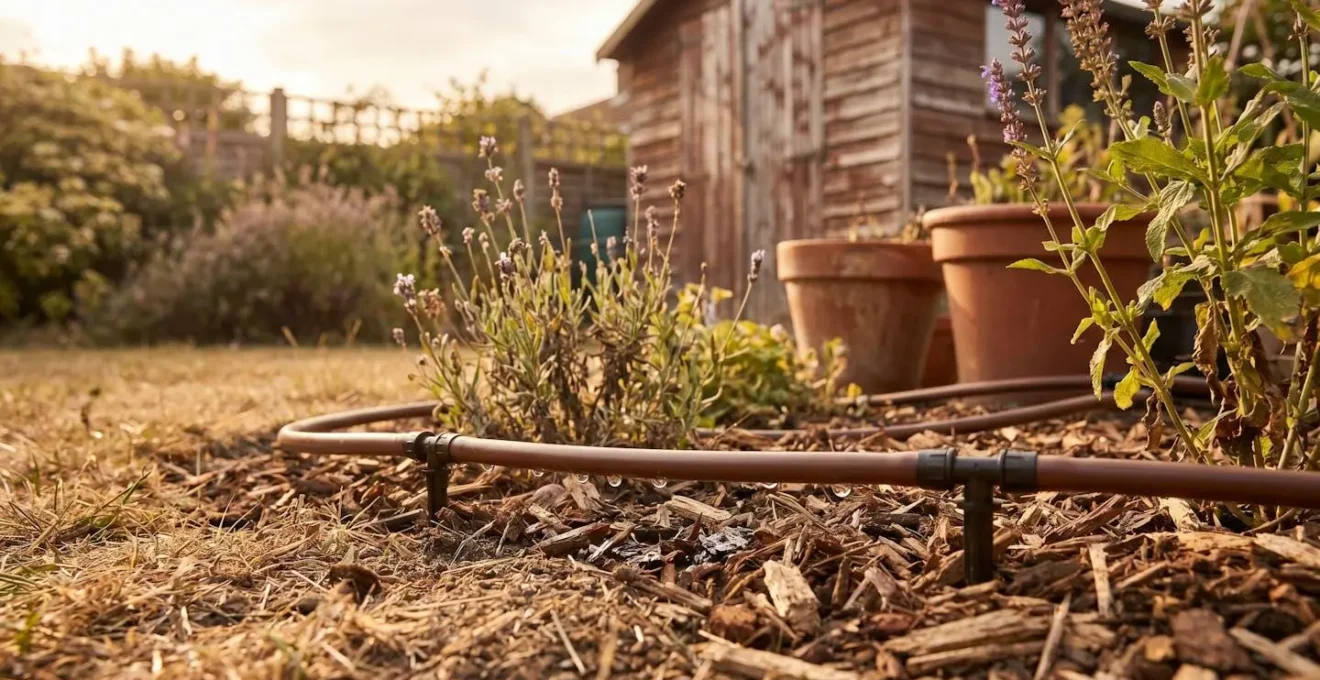
Drip irrigation isn’t just a loophole to get around a hosepipe ban; it’s a fundamentally superior strategy for creating a drought-resilient garden that thrives with less water.
- Legal compliance requires specific hardware: an automatic timer and a pressure-reducing valve are non-negotiable.
- True efficiency comes from training deep roots with infrequent, longer watering sessions, not daily sprinkles.
Recommendation: Shift your mindset from ‘how can I water?’ to ‘how can I make every drop count?’ by testing your soil and matching your system to its specific needs.
For gardeners in the UK, particularly in the water-stressed South East, the words “hosepipe ban” or “Temporary Use Ban” (TUB) can sound like a death sentence for carefully nurtured plants. The immediate reaction is often a frantic search for loopholes, a reluctant acceptance of wilting borders, or the daily chore of hauling watering cans. We’re told that drip irrigation is the answer, often presented as a simple, compliant alternative. But this view misses the bigger picture.
The real power of drip irrigation isn’t just that it’s often exempt from restrictions. Its true value lies in a strategic shift in thinking. It’s about moving away from wasteful, superficial watering and embracing a more precise, scientific approach that builds long-term water resilience into the very fabric of your garden. It’s about understanding the hydrodynamics of your specific plot, from the pressure in the pipes to the texture of your soil.
But what if the key to surviving a hosepipe ban wasn’t just about following the rules, but about using them as a catalyst to become a smarter, more efficient gardener? This guide moves beyond the basics of compliance. We will explore the science of when to water, how to select the right equipment for your soil type, and how to avoid the common mistakes that lead to weak, dependent plants. This is your roadmap to transforming your garden into a thriving, water-wise ecosystem that doesn’t just survive a ban, but flourishes through it.
To navigate this transition from reactive watering to proactive strategy, this guide breaks down the essential components. We’ll cover the legal requirements, optimal timing, hardware selection, and crucial soil testing methods that form the foundation of an effective drip irrigation system.
Summary: How to Beat UK Hosepipe Bans With Strategic Drip Irrigation
- Are Drip Systems Legal During a Hosepipe Ban?
- Night or Morning: The Best Time to Run Drip Systems for Efficiency?
- Soaker Hose or Drippers: Which Wastes Less Water in Borders?
- The Drip Mistake That Creates Weak, Surface-Level Roots
- How to Ensure the Last Pot Gets as Much Water as the First?
- How to Establish a ‘Dry Garden’ Backbone in Chalky Soil?
- The Bucket Test: How Fast Should Water Drain for Lavender?
- How to Test for Well-Drained Soil Before Planting Expensive Herbs?
Are Drip Systems Legal During a Hosepipe Ban?
The short answer is yes, but with critical conditions. Simply attaching a leaky hose to a tap does not qualify. UK water companies permit the use of “drip or trickle irrigation” during a Temporary Use Ban (TUB) because it is recognised as a highly efficient method. In fact, drip systems can be over 70% more efficient than a standard hosepipe, as water is delivered directly to the plant’s root zone with minimal loss to evaporation or runoff. However, this exemption is not automatic; it is contingent on your system being “properly fitted”.
“Properly fitted” is the key phrase. For all major UK water suppliers like Thames, Southern, and South East Water, this universally means your system must include two non-negotiable components: an automatic timer and a pressure-reducing valve (PRV). The timer provides the essential “automatic shut-off” function, preventing accidental all-day watering. The PRV is a crucial safety device that regulates pressure, protecting the small-bore pipes and joints of a drip system from being blown apart by mains pressure, which would cause a flood and defeat the entire purpose of water conservation. Furthermore, the emitters themselves must only drip or trickle; systems that spray, jet, or mist are not exempt.
To ensure your system is compliant, it’s vital to check the specific rules of your local water provider, as they can have minor variations. The following table summarises the general requirements across major UK companies.
| Water Company | Timer Required | Pressure Reducing Valve Required | Emitter Type Allowed | 2025-2026 Ban Status |
|---|---|---|---|---|
| Thames Water | Yes – automatic shut-off | Yes – PRV mandatory | Drip/trickle only (no spray/mist) | Lifted Feb 2026 |
| Southern Water | Yes – automatic shut-off | Yes – PRV mandatory | Drip onto or below soil surface | Lifted Feb 2026 |
| South East Water | Yes – automatic shut-off | Yes – PRV mandatory | Drip/trickle only | Lifted Feb 2026, high risk summer 2026 |
| Yorkshire Water | Yes – automatic shut-off | Yes – PRV mandatory | Drip/trickle only | Lifted Feb 2026 |
| All UK Companies (General) | Universal requirement | Universal requirement | No spray, sprinkle, jet or mist | Subject to Temporary Use Ban (TUB) conditions |
Your Ban-Proofing Checklist
- Install a timing device (water timer or tap timer) to control duration and provide automatic shut-off.
- Fit a pressure-reducing valve (PRV) to protect against pressure spikes that could cause joints to pop off.
- Ensure emitters drip onto or underneath the soil surface – no sprays, jets, or mists.
- Position drippers to deliver water directly to plant root zones without surface runoff.
- Check your specific water company’s current Temporary Use Ban (TUB) notice for any local additions.
Night or Morning: The Best Time to Run Drip Systems for Efficiency?
The age-old gardening debate of when to water takes on new importance when every drop counts. The optimal time to run your drip system is in the early morning, around dawn. This timing creates the perfect balance of conditions for maximum water efficiency and plant health. Watering in the cool, still air of the morning minimises water loss to evaporation from both the soil surface and wind, ensuring that almost all the water delivered by your drippers reaches the root zone. This simple scheduling choice can significantly increase the effectiveness of your system.
This early morning routine allows the foliage to dry out naturally as the sun rises, which is a key factor in preventing the development of fungal diseases like mildew and black spot, which thrive in damp, cool conditions. Watering late at night, while also low in evaporation, can leave foliage and the soil surface wet for an extended period, creating an open invitation for these pathogens. Watering in the heat of the day is the least efficient option, as a significant portion of the water can evaporate before it even penetrates the soil.
For gardeners looking to take efficiency to the next level, technology offers a powerful solution. Modern smart irrigation controllers, such as those from Orbit B-hyve or Rachio, connect to local weather forecasts. They can automatically adjust the watering schedule, pausing the system if rain is predicted or increasing duration during a heatwave. Some UK homeowners have reported water bill reductions of 30-50% by pairing a smart controller with their drip system, turning a good practice into a truly optimised, data-driven strategy.
Soaker Hose or Drippers: Which Wastes Less Water in Borders?
When planning a system for garden borders, the choice between soaker hose and individual drippers is a crucial one. Both are far more efficient than a sprinkler, but they function differently, making one a better choice depending on your soil and planting style. For targeted delivery to individual, spaced-out plants like roses, shrubs, or tomatoes, individual drippers are unmatched in their precision. They deliver a specific volume of water exactly where it’s needed, at the base of the plant. This precision is why specialist firms state that drip irrigation can achieve an efficiency rating of 95-100%.
A soaker hose, which is porous along its entire length, weeps water into the soil, creating a continuous strip of moisture. This makes it ideal for dense plantings in a line, such as a hedge, a row of lettuces, or a densely packed herbaceous border where individual drippers would be impractical to install for every single plant. The key is to match the tool to the task.
However, the most strategic approach, particularly in UK gardens with their varied soil types, is often a hybrid system. Consider the different conditions in your garden. For instance, in heavy clay soil, common in the Midlands, water is absorbed slowly. A soaker hose can lead to surface runoff if the application rate is too high. Here, slow-flow (2-4 litres per hour) point-source drippers are superior, giving the soil time to absorb the moisture. Conversely, in a free-draining sandy or chalky soil, a soaker hose is excellent for creating a wide, moist zone for shallow-rooted crops without the water simply plunging deep out of reach. A truly efficient system might use drippers for thirsty individual plants like runner beans and sections of soaker hose for salad beds, all calibrated to the specific soil in that part of the garden.
The Drip Mistake That Creates Weak, Surface-Level Roots
One of the most common and counter-intuitive mistakes gardeners make when switching to drip irrigation is watering too often for too short a time. Running a system for 5-10 minutes every day seems attentive, but it creates a major problem: shallow, lazy roots. When water is only ever available in the top few inches of soil, plants have no incentive to send their roots down deep in search of moisture. This results in a weak, surface-level root system that is highly vulnerable to drought. The moment a heatwave hits or you turn the system off, these plants will stress and wilt immediately because they have not been encouraged to become self-reliant.
The solution is to use your drip system to train your plants’ roots. This involves a strategy of deep, infrequent watering. By delivering a larger volume of water less often, you force the water to penetrate deeper into the soil profile. As the top layer of soil dries out over the following days, the plant’s roots are forced to grow downwards to follow the receding moisture. This process creates a deep, extensive, and resilient root system that can access moisture from a much larger volume of soil, making plants dramatically more drought-tolerant and less dependent on daily watering.
A structured approach can help establish this deep root system, especially for new plantings. Consider a ‘root training programme’ over the first few weeks of establishing your plants on a drip system, adjusting as you go based on weather and plant-specific needs. The goal is to gradually increase the duration of watering while extending the interval between sessions.
- Week 1 (Establishment): Run the system for 15 minutes daily in the early morning to help new plants settle in without being waterlogged.
- Week 2 (Transition): Reduce frequency to every other day but increase the duration to 25-30 minutes. This begins to encourage deeper root growth.
- Week 3 (Deep Root Training): Move to longer 40-45 minute sessions every 3 days. This forces roots to search for moisture between cycles, building resilience.
- Ongoing Maintenance (Week 4+): Maintain the Week 3 schedule throughout the summer, pausing the system during rainy periods and only adding extra cycles during extreme heatwaves.
How to Ensure the Last Pot Gets as Much Water as the First?
For gardeners with multiple pots on a patio, a common and frustrating problem with basic drip systems is uneven water distribution. Due to friction and pressure loss along the length of the supply pipe, the first few pots get a good soaking while the last pot in the line receives a pathetic dribble. This is especially true for gravity-fed systems running from a water butt, where initial pressure is already low. The result is a mix of over-watered and under-watered plants, completely undermining the system’s purpose. The solution lies in better system design and smarter components.
The single most effective piece of hardware to solve this is the pressure-compensating (PC) dripper. Unlike a standard, simple dripper whose flow rate varies with pressure, a PC dripper contains a small diaphragm that automatically adjusts to maintain a constant flow rate across a wide range of pressures. This means that whether the dripper is first in line or the twentieth, it will deliver the same amount of water (e.g., 2 litres per hour), guaranteeing even watering for all your containers.
Combining PC drippers with a smart layout provides a robust solution. Instead of a single long line, design your system as a looped circuit. By running the supply pipe out to the last pot and then back to the start, you create two pathways for water to reach every dripper. This design trick dramatically equalises the pressure across the entire system. For water butt systems, adding a small, low-wattage pump can provide the consistent 1-2 bar pressure needed for PC drippers to function optimally, while still using far less water than a mains-powered hose.
How to Establish a ‘Dry Garden’ Backbone in Chalky Soil?
Establishing a garden on the thin, alkaline, and free-draining chalk soils common across much of Southern and Eastern England presents a unique challenge that is perfectly solved by drip irrigation. While it seems paradoxical to install an irrigation system for a ‘dry garden’, the first year is critical. As the Royal Horticultural Society advises, “Even drought-tolerant plants need consistent drip irrigation for their first year to establish deep roots.” A drip system allows you to provide this crucial, targeted moisture to new plants without wasting water on the surrounding, fast-draining soil, a common issue as chalky soils cover up to 40% of the land in some parts of England.
The strategy is to build a ‘backbone’ of plants that, once established, will thrive in these conditions with minimal future watering. The key is selecting cultivars known to perform well on alkaline soils. Your drip system is the tool to get them through their first summer, encouraging the deep root growth they need to become self-sufficient. Focus on Mediterranean species and those adapted to similar conditions.
A successful chalk garden plant palette could include structural shrubs and vibrant perennials. Here are five top performers for UK chalk gardens:
- Lavandula angustifolia ‘Hidcote’: A classic English lavender with deep purple, fragrant flowers that adores free-draining alkaline conditions.
- Nepeta ‘Six Hills Giant’: This robust catmint produces a cloud of violet-blue flowers all summer and is exceptionally tolerant of dry, chalky ground.
- Eryngium planum ‘Blue Glitter’: Sea holly offers striking architectural form with its silvery-blue, spiky flower heads that shimmer in the sun.
- Cistus corbariensis: The white rock rose is a Mediterranean evergreen that covers itself in papery white flowers and is highly drought-tolerant once its roots are down.
- Salvia nemorosa ‘Caradonna’: With its upright, dark purple stems and violet-blue spikes, this salvia thrives in dry grasslands and is a magnet for bees.
The Bucket Test: How Fast Should Water Drain for Lavender?
Before you plant expensive, drought-tolerant herbs like Lavender or Rosemary, it’s crucial to know if your soil provides the one thing they cannot live without: excellent drainage. Planting them in heavy, waterlogged soil is a guaranteed failure. A simple, low-tech diagnostic tool called the ‘Bucket Test’ can give you a clear, quantitative answer about your soil’s drainage capacity. To perform the test, dig a hole roughly 30cm (12 inches) deep and wide, fill it with a bucket of water, and time how long it takes for all the water to disappear.
For Mediterranean herbs that demand sharp drainage, the results are unambiguous. If the water drains away in under 10 minutes, your soil has the fast, free-draining properties that Lavender, Rosemary, and Thyme adore. If the water is still standing in the hole after an hour, your soil is heavy clay, and you will need to take significant action, such as creating a raised bed filled with a grittier compost mix, to give these plants any chance of survival.
Interestingly, not all herbs want the same conditions. Moisture-loving herbs like Mint and Parsley prefer soil that holds water for longer. For them, a drainage time of 15-30 minutes is actually ideal. This test allows you to ‘map’ your garden, identifying zones of fast and slow drainage and placing your plants accordingly. This is the essence of strategic gardening: working with your existing conditions rather than fighting against them.
This comparative chart gives a clear guide to the ideal drainage times for popular UK-grown herbs and the corrective actions to take if your soil is not a perfect match.
| Herb Type | Ideal Drainage Time | Soil Texture Preference | Action if Too Fast (<5 mins) | Action if Too Slow (>30 mins) |
|---|---|---|---|---|
| Lavender | Under 10 minutes | Free-draining, alkaline | Add compost to retain moisture | Plant in raised bed with gritty mix |
| Rosemary | Under 10 minutes | Free-draining, alkaline | Add compost to retain moisture | Plant in raised bed with gritty mix |
| Thyme | Under 10 minutes | Free-draining, alkaline | Add compost to retain moisture | Plant in raised bed with gritty mix |
| Mint | 15-30 minutes | Moisture-retentive | Perfect drainage for mint | Acceptable – mint prefers moisture |
| Parsley | 15-30 minutes | Moisture-retentive | Perfect drainage for parsley | Acceptable – parsley prefers moisture |
Key Takeaways
- True water efficiency is achieved by training deep roots with infrequent, prolonged watering, not daily sprinkling.
- System compliance during a hosepipe ban is not optional; an automatic timer and pressure reducer are mandatory.
- The best hardware choice (drippers vs. soaker hose) depends entirely on your specific soil type and planting density.
How to Test for Well-Drained Soil Before Planting Expensive Herbs?
Understanding your soil is the most fundamental skill in water-wise gardening. A few simple tests, conducted before you even think about planting, can save you a great deal of money, time, and heartache. Beyond the ‘Bucket Test’ for drainage speed, a more complete soil protocol will give you a holistic view of your garden’s foundation. These tests can easily be turned into an educational and engaging activity for the whole family, creating a ‘Soil Detective Kit’ with a trowel, a jar, and a notepad.
The ‘Ribbon Test’ helps you determine soil texture. Take a small handful of moist soil and try to squeeze it into a ribbon between your thumb and forefinger. If it forms a long, smooth, pliable ribbon, you have heavy clay, which holds moisture but has poor drainage. If it crumbles and refuses to form a ribbon at all, you have sandy or silty soil with excellent drainage but poor water retention. A perfect loam will form a short, weak ribbon. Another simple clue is the ‘Worm Weather Watch’: healthy populations of earthworms visible after rain are a great sign of well-structured soil with good organic matter.
For chalk-loving plants, confirming alkalinity is also key. A simple pH testing kit from a garden centre will give you a reading, with anything above pH 7.0 being alkaline. An old-school method is to drop a little vinegar on a soil sample; if it fizzes, it confirms the presence of free calcium carbonate, a hallmark of chalky soil. Once you have this data, you can make informed decisions. As one UK garden expert notes, even in well-suited soil, “Summer drought stress is the biggest killer of plants on chalk… A 5cm bark or compost mulch in spring conserves moisture through summer.”
Now that you are equipped with the knowledge to diagnose your soil’s unique character, the next logical step is to perform these tests in your own garden. Begin this weekend by conducting a bucket test in the area you plan to plant next.